
The Plain Writing Act of 2010 (Act) is intended to make it easy for the public to understand government documents. The SEC, like other federal agencies, must write documents in plain writing, defined under the Act as writing that is "clear, concise, well-organized, and follows other best practices appropriate to the subject or field or audience." Starting in October 2011, the Act requires us to write new and substantially revised documents in plain language using the Federal Plain Language Guidelines.As a disclosure agency, the SEC is committed to communicating with investors in easily understandable language. In 1998, the SEC published a guide, A Plain English Handbook: How to Create Clear SEC Disclosure Documents, showing securities lawyers and companies ways to reduce legalese. (Summary by the SEC)Reader Note: The examples in Chapter 7 - Designing the Document convey visual information. Please refer to the e-text to see these examples.
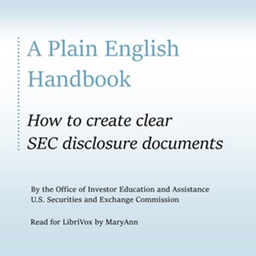
A Plain English Handbook: How to create clear SEC disclosure documents by The Securities and Exchan
Claim This Podcastby Mentor New York
Podcast Overview
The Plain Writing Act of 2010 (Act) is intended to make it easy for the public to understand government documents. The SEC, like other federal agencies, must write documents in plain writing, defined under the Act as writing that is "clear, concise, well-organized, and follows other best practices appropriate to the subject or field or audience." Starting in October 2011, the Act requires us to write new and substantially revised documents in plain language using the Federal Plain Language Guidelines.As a disclosure agency, the SEC is committed to communicating with investors in easily understandable language. In 1998, the SEC published a guide, A Plain English Handbook: How to Create Clear SEC Disclosure Documents, showing securities lawyers and companies ways to reduce legalese. (Summary by the SEC)Reader Note: The examples in Chapter 7 - Designing the Document convey visual information. Please refer to the e-text to see these examples.
Language
🇺🇲
Publishing Since
7/15/2023
1 verified contact email on file for A Plain English Handbook: How to create clear SEC disclosure documents by The Securities and Exchan
Pitch yourself as a guest, propose sponsorships, or reach out directly to the host.
Recent Episodes
July 15, 2023
Chapters 8-12
July 15, 2023
Chapter 7
July 15, 2023
Chapter 6
5 total episodes available
Deep-dive analytics for A Plain English Handbook: How to create clear SEC disclosure documents by The Securities and Exchan
Frequently asked questions
Have a different question and can't find the answer you're looking for? Reach out to our support team by sending us an email and we'll get back to you as soon as we can.
- What is A Plain English Handbook: How to create clear SEC disclosure documents by The Securities and Exchan?
- How often does this podcast release new episodes?
This podcast updates daily.
- Where can I listen to this podcast?
This podcast is available on 4 platforms including Apple Podcasts, Spotify, and more. You can also use the RSS feed directly.
- Does this podcast accept guests?
Information about guest appearances is not available.
Legal Disclaimer
Pod Engine is not affiliated with, endorsed by, or officially connected with any of the podcasts displayed on this platform. We operate independently as a podcast discovery and analytics service.
All podcast artwork, thumbnails, and content displayed on this page are the property of their respective owners and are protected by applicable copyright laws. This includes, but is not limited to, podcast cover art, episode artwork, show descriptions, episode titles, transcripts, audio snippets, and any other content originating from the podcast creators or their licensors.
We display this content under fair use principles and/or implied license for the purpose of podcast discovery, information, and commentary. We make no claim of ownership over any podcast content, artwork, or related materials shown on this platform. All trademarks, service marks, and trade names are the property of their respective owners.
While we strive to ensure all content usage is properly authorized, if you are a rights holder and believe your content is being used inappropriately or without proper authorization, please contact us immediately at hey@podengine.ai for prompt review and appropriate action, which may include content removal or proper attribution.
By accessing and using this platform, you acknowledge and agree to respect all applicable copyright laws and intellectual property rights of content owners. Any unauthorized reproduction, distribution, or commercial use of the content displayed on this platform is strictly prohibited.