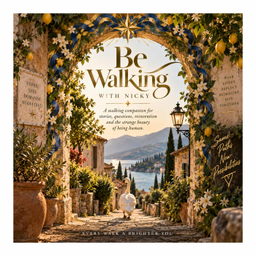
Be Walking with Nicky
A podcast for the lone walker who just wants to hear the voice of a friend or something calming to listen to in a world of busy thoughts about being human when the instruction manual never arrived
- 15
- Episodes
- Monthly
- Cadence
- 2026
- First episode
About Be Walking with Nicky
Be Walking with Nicky Most podcasts give answers. This one follows questions. Questions about belonging, identity, friendship, community, loneliness, home, change, and what it means to be human in a world that often asks us to flatten ourselves to fit in. Recorded through walks, reflections, stories, and conversations, Be Walking with Nicky is for thoughtful outsiders, curious minds, and anyone still figuring things out. Because none of us arrive fully formed. We're all walking somewhere. The interesting part is what we notice along the way. Come for the walk. Stay for the thought. ▶ Start walking spirandiombrevtre.substack.com (https://spirandiombrevtre.substack.com?utm_medium=podcast)
- Publisher
- A podcast for the lone walker who just wants to hear the voice of a friend or something calming to listen to in a world of busy thoughts about being human when the instruction manual never arrived
- Category
- science · society & culture
- Language
- en
- Explicit
- No
- First episode
- 20 Sept 2026
- Latest episode
- 31 Oct 2026
Latest episodes
15 episodes in the feed.
31 Oct 2026
The problem became Ours
Ten people came to a session with different expectations. By the end, they had eight possible solutions they could all use. What changed? In this episode of Be Walking with Nicky, I reflect on a session I facilitated using an exercise called the anti-guide. Instead of asking people how to achieve confidence at work, I invited them to consider how they might undermine it. The discussion took an unexpected turn. People began recognising their own experiences in one another's stories. The problem-solving became shared, and the group left feeling more empowered than they had at the beginning. The experience left me thinking about organisational culture, the way we talk about problems at work, and what becomes possible when people have the opportunity to think together. I also explore something smaller, but no less interesting: how often we apologise when a simple thank you might better acknowledge the situation. “Sorry this took so long” and “Thank you for your patience” recognise the same delay, but they place the emphasis in different places. Gratitude is not a substitute for accountability, and not every workplace problem can be solved through a change in perspective. But what might happen if we made more room for shared thinking and recognised what people contribute? I haven't arrived at a neat conclusion. The experience left me with questions, and I'm still sitting with them. A question for you When have you seen a group achieve something together that would have been difficult to achieve alone? I'd love to hear your experience in the comments. If you see things differently, welcome. Be Walking with Nicky is a podcast about belonging, walking and reflection, and figuring life out. Real moments, bigger questions, useful ideas, and a little humour along the way. Subscribe for more conversations about people, relationships, work and the human experience. You are stronger today only because you are different. Walk good. #BeWalkingWithNicky #OrganisationalCulture #Teamwork This is a public episode. If you'd like to discuss this with other subscribers or get access to bonus episodes, visit spirandiombrevtre.substack.com/subscribe (https://spirandiombrevtre.substack.com/subscribe?utm_medium=podcast&utm_campaign=CTA_2)
27 Oct 2026
Season 2 Episode 1: The stranger story:What Happens When You Feel Like an Outsider
The Stranger Story Not writing. There is more writing now than there has ever been. Words are everywhere. People are writing about writing, about becoming writers, about building audiences, about finding an audience for the writing they have written about. Sometimes I open one of these places and feel that I have entered a hall of mirrors. Everyone is looking at everyone else. How to build an audience. How to grow a newsletter. How to become consistent. How to become disciplined. How to turn your ideas into content. And somewhere in the middle of all this machinery, I sometimes wonder where the life has gone. I don't mean that as a criticism. I do some of it myself. I think about episodes. I think about titles. I think about sound. I think about publishing. There is a whole machinery surrounding the making of a thing now. But occasionally I want to forget the machinery. I want somebody to tell me what happened. Tell me about the year you learned to sail. Tell me about the business that failed. Tell me about the town you grew up in, the one nobody has heard of. Tell me about the person you loved and then had to leave. Tell me about the job you hated but kept going back to every morning. Tell me something that happened to you. I don't necessarily want the lesson. That may be the thing I am beginning to miss most. We have become very good at taking an experience and immediately turning towards it with a notebook. What did it teach you? What did you learn? Here are the five things motherhood taught me. Here are the seven lessons I learned from losing everything. Here is how failure made me successful. And perhaps those things are useful. I'm sure they are. But sometimes I want the thing before it has become useful. I want the confusion. The embarrassment. The grief. The strange little detail that doesn't seem to mean anything yet. I want somebody to say: This happened. And then stop. Because perhaps we don't always know what something means while we are living it. Perhaps we are asking too much of ourselves when we insist that every painful thing must become wisdom. That every failure must become a framework. That every experience must become content. Struggling isn't an algorithm. There are things you can only learn by doing them badly. You cannot learn pottery by reading about clay. You cannot learn to run without running. You cannot learn what happens in a difficult conversation simply by preparing for every possible response. Because there is another person in the room. And another person is not a chess piece. You cannot know what they will say. You cannot know what their face will look like. You cannot know what will happen inside you when they say it. There is always something left outside the plan. And perhaps that is why I have started thinking that we should all learn something badly. Something nobody is watching. Something that has no audience. Something you don't photograph. Something you don't post. Something that cannot be turned into a before-and-after story. Because what happens when there is no audience? Who are you then? When nobody is commenting on your writing. When nobody knows you are writing. When there are no subscribers to count. When nobody is impressed. When you are simply doing the thing. I find that question strangely interesting. Because we have become very good at turning our lives into content. The morning routine. The gym session. The career change. The healing journey. The relationship. Even the private things have acquired an audience. I remember when some things belonged to you. Not because you were hiding them. They simply belonged to you. There was no particular reason to tell anyone. And I wonder whether we have forgotten the pleasure of that. A thing can happen and remain yours. You can have a thought and not publish it. You can have a terrible Tuesday and not make a lesson out of it. You can notice something beautiful and keep walking. Perhaps that is why I keep returning to ordinary stories. Not the polished version. Not the resilience story. Not the story in which everything eventually makes sense. Just the story. The smell of a bakery when you were a child. The sound of somebody closing a door. The person who helped you when you didn't ask. The friend who was there every day and then, somehow, wasn't. The moment you realised a relationship was not going to work. The person you loved who could not love you in the way you needed. The person who disappeared. The person who arrived. Perhaps what I have been missing is not advice. Perhaps I have been missing stories. Because a story leaves room for me. It allows me to make my own meaning. You don't have to tell me what I should think. You don't have to tie the ribbon around it. You can simply tell me what happened. And I can sit with it. Just sit with it. This is slightly ironic, of course, because I am a coach. My work is reflection. Patterns. Questions. Decisions. Movement. I love that work. I really do. But I don't want every human experience to become a coaching exercise. I don't want to ask every person: What did you learn? Sometimes the answer is: I don't know. Sometimes something is simply hard. Sometimes something is beautiful. Sometimes something happens and you understand it years later. And sometimes you never understand it. I think there is something important in allowing that to remain unresolved. Not everything needs to become personal development. Sometimes it is just a person having a Tuesday. And perhaps we have underestimated how interesting a Tuesday can be. Maybe that is part of why I make this podcast. Because I want you to hear somebody thinking. Not somebody who has already arranged the furniture in their mind before you arrived. I think faster than I write sometimes. I start somewhere and find myself somewhere else. I don't always know where I am going. And perhaps that is closer to how life actually feels. Life doesn't arrive as a perfectly structured essay. I didn't wake up knowing what this episode was going to be about. I just started walking. And then I thought about writing. And then I thought about stories. And then I thought about strangers. There is a person I see when I walk. I have seen them for years. Our mornings seem to belong to the same small piece of time. I see them with their dog. I have noticed things without knowing them. Their face. Their eyes. The changes that happen to a person over five years. Sometimes they look tired. Sometimes they look happy. Sometimes I have noticed that their eyes appear to have been wet. Sometimes the dog is leaning into them, demanding something from them, and there is something very tender about watching that. But what I noticed most was this: They never had a phone. Not once. No earphones. No screen. Just the dog. And themselves. Five years is a long time to walk past somebody and know absolutely nothing about them. Except that they walk their dog. Except that they are there. Except that, somehow, our lives keep crossing in the same place. And one morning I stopped. Not dramatically. There was no great moment. I simply looked at them and said, "Hello. I'm Nicky. What's your name?" They told me. They told me their dog's name too. And suddenly the stranger wasn't a stranger anymore. It was almost unsettling how quickly that happened. I remember thinking how easy it would be to become friends with this person. And then, almost immediately, I felt myself pull back. It surprised me. Because I had wanted to know their name. I had wanted to cross that little distance between strangers. And then, once the distance had disappeared, I realised there was another distance I wanted to keep. Not because anything was wrong. Quite the opposite. There was something about the ease of it that made me cautious. So I walked away. I knew their name now. That was enough. It was an entirely ordinary conversation. A few words on a pavement. And yet I kept thinking about it. Because sometimes there is something underneath the conversation. Something we don't name. Something that exists simply because two human beings have noticed one another. Perhaps this is what I mean when I say I want stories again. I don't want somebody to tell me what that encounter taught them. I don't even know what it taught me. Maybe it taught me nothing. Maybe it was simply a Tuesday morning when two people who had been strangers for five years finally exchanged names. Maybe that is enough. Perhaps we don't need more people telling us how to live. Perhaps we need to live long enough to notice something. The woman who catches the same bus every morning. The song playing in the shop. The old man sitting in the same place. The dog that always pulls its owner towards the same tree. The day you suddenly realise you are happy. The day you realise you aren't. The strange loneliness you hadn't noticed before. The anger. The tenderness. The fact that you are changing. Not because you went looking for content. Because you were paying attention. That, I think, is the kind of emotional literacy I am interested in. Not becoming better at explaining ourselves. Becoming better at noticing ourselves. And perhaps better at noticing one another. There is so much life happening outside the screen. So much of it is unrecorded. Unshared. Unmonetised. Unexplained. And perhaps that is where some of the good stuff is. So I am going to leave this story here. The stranger. The dog. The pavement. The name. The little distance that disappeared, and the other little distance that I decided to keep. No lesson. No framework. No five things you should take away from this episode. Just a story. Maybe you don't need to turn everything you experience into something useful. Maybe some things can simply be lived. Maybe you can learn something badly. Maybe you can do something nobody is watching. Maybe you can tell a story without telling people what it means. And perhaps, while you are doing that, you might notice that there is a whole world waiting outside the screen. Go and look at it. Whatever you're carrying. Whatever you're thinking about. Whatever you're figuring out. Keep walking. You are stronger today only because you are different. This is Be Walking with Nicky. Please like and subscribe. Thanks for reading Spirandi Ombrevôtre! This post is public so feel free to share it. * This is a public episode. If you'd like to discuss this with other subscribers or get access to bonus episodes, visit spirandiombrevtre.substack.com/subscribe (https://spirandiombrevtre.substack.com/subscribe?utm_medium=podcast&utm_campaign=CTA_2)
25 Oct 2026
I Stopped Believing in God After She Died
Pause a minute and walk with this in mind. What makes faith real? Is it how you’re raised? Something you read? A moment you can’t explain? Or does faith become real when life falls apart and you’re left trying to make sense of what remains? In this conversation recorded during a Harvest service, we explore belief, doubt, grief, patience, kindness, community, and the quiet ways faith grows over time. You’ll hear stories of: • Growing up around church but not truly knowing God• Losing faith after the death of a loved one• Encountering God in a personal and life-changing way• Moving from atheism to belief• Finding purpose, belonging, and community• Learning to trust when answers don’t come quickly• The role of the Bible in everyday life• Kindness, service, and showing up for one another This isn’t a debate. It’s a conversation between ordinary people trying to answer extraordinary questions. What do you believe? Why do you believe it? And what happens when life challenges everything you thought you knew? Whether you’re a lifelong Christian, somewhere in the middle of doubt, or simply curious about how other people make sense of faith, I hope you’ll find something here that resonates. 💬 I’d love to hear from you: What made faith real for you? Or was there a moment that changed how you think about God? Come for the walk. Stay for the thought. Faith #Christianity #God #Grief #Belief #Spirituality #PersonalGrowth #Church #LifeQuestions #FaithJourney #Hope #Community #BeWalkingWithNicky This is a public episode. If you'd like to discuss this with other subscribers or get access to bonus episodes, visit spirandiombrevtre.substack.com/subscribe (https://spirandiombrevtre.substack.com/subscribe?utm_medium=podcast&utm_campaign=CTA_2)
25 Oct 2026
Stop saving it up
Pause a minute and walk with this in mind. Have you ever had someone cross your mind for no obvious reason? No birthday. No anniversary. No reminder. Just a sudden thought: “I should call them.” In this episode of Be Walking with Nicky, I explore why certain people keep appearing in our thoughts, why we assume people know how much they matter to us, and why some of the most dependable people in our lives are often the least appreciated. We talk about friendship, loneliness, appreciation, men’s emotional lives, gratitude, belonging, connection, and the difference between being needed and being wanted. This episode explores questions many of us rarely ask: • Why do some people carry entire communities without anyone noticing? • Why are we so reluctant to tell people what we admire about them? • Why do we save our kindest words for funerals? • What is the difference between love, admiration, gratitude, affection, and friendship? • Why do the people we depend on most often seem “fine” even when we haven’t checked in? This isn’t a conversation about romance. It’s a conversation about recognition. About the people who show up. The people who keep their word. The people who quietly make our lives easier. And what happens when we stop assuming they know what they mean to us. If you’ve ever wondered about friendship, emotional connection, loneliness, men’s mental health, meaningful relationships, gratitude, personal growth, emotional intelligence, community, or the people who matter most in your life, this episode is for you. 💭 Who crossed your mind while listening? Let me know in the comments. Subscribe for thoughtful conversations about belonging, friendship, identity, nostalgia, loneliness, emotional maturity, relationships, community, and the human experience. Come for the walk. Stay for the thought. Friendship #MensMentalHealth #Loneliness #PersonalGrowth #EmotionalIntelligence #Relationships #Belonging #MentalHealth #HumanBehaviour #Gratitude #SelfReflection #Community #Connection #BeWalkingWithNicky Thanks for reading Spirandi Ombrevôtre! This post is public so feel free to share it. This is a public episode. If you'd like to discuss this with other subscribers or get access to bonus episodes, visit spirandiombrevtre.substack.com/subscribe (https://spirandiombrevtre.substack.com/subscribe?utm_medium=podcast&utm_campaign=CTA_2)
24 Oct 2026
Episode 12 Who Gets a Front-Row Seat
Thanks for reading Spirandi Ombrevôtre! This post is public so feel free to share it. Everyone tells us to put ourselves out there. Share more. Post more. Be visible. Build an audience. But lately, I’ve been wondering if that’s the whole story. In this conversation, we explore what it means to share your work while it’s still taking shape. We talk about imposter syndrome, creative confidence, writer’s groups, boundaries, feedback, and the quiet fear that not everyone who wants access to your work has earned a front-row seat. Because maybe the question isn’t whether you should be seen. Maybe it’s who you’re inviting into the room while you’re still becoming. Come for the conversation about writing and creativity. Stay for the deeper question: How do we share ourselves without flattening ourselves? And how do we find the people who can hold our unfinished work with care? This is a public episode. If you'd like to discuss this with other subscribers or get access to bonus episodes, visit spirandiombrevtre.substack.com/subscribe (https://spirandiombrevtre.substack.com/subscribe?utm_medium=podcast&utm_campaign=CTA_2)
20 Oct 2026
Episode 11: I am not a machine-The Cost of Constant Productivity
My friend took a sheet of paper and put it on the table. It was too big for the table, really. She started writing. A word in one corner. An arrow. Something crossed out. Another thought underneath it. Her handwriting moved across the page until there was hardly any white left. I watched her. “What are you doing?” She didn't really answer. She kept writing. Somewhere in the middle of the page were the words: I am a mother, not a machine. I laughed. Then I went home and thought about it. Because I know that machine. It wakes up before everyone else. It remembers who needs to be where. It knows what is in the fridge. It answers the message it didn't want to answer. It puts something in the washing machine while listening to somebody else's problem. It keeps going. And nobody asks the machine what it wants. Until one day it does something strange. It takes out a piece of paper. And starts writing. Not a plan. Not a budget. Not a list of things everyone else needs. Just: I want... And perhaps that is where the trouble begins. Because once you have spent years asking what needs to be done, the question of what you want can feel almost indecent. So I started wondering about the things we cross out before anyone else has had the chance to tell us no. The idea that is too expensive. The ambition that comes at the wrong time. The thing we would do if nobody needed us for an afternoon. The life we imagine and immediately begin dismantling with practical questions. How much? When? Who will look after everyone? What if it doesn't work? And somewhere underneath all those questions is the one we stopped asking. What if it does? In this walk 00:00 — If you see things differently A large piece of paper. A mind refusing to behave itself. 01:15 — I am a mother, not a machine A sentence in the middle of the page, and the thought that wouldn't leave me alone. 03:05 — The things we remember Breakfast. School. Messages. Laundry. All the things that somehow become your responsibility without anyone announcing the transfer of ownership. 05:00 — Before you make a plan What happens when you allow yourself to have an idea before asking whether it is sensible? 06:45 — What do you want? Not what can you manage. Not what everyone else needs. What do you want? 08:25 — We are not Bob the Builder Some things don't need fixing. Some people don't need rescuing. Some things may simply need to move out of the way. 10:00 — They are watching us The things the next generation learns from the lives we live. 11:15 — I am a person Perhaps the point isn't learning to carry more. Perhaps it is learning what we can finally put down. 12:00 — Walk good If you see things differently, welcome. A question to walk with What would you want if you didn't have to explain how you were going to make it happen? Don't answer it immediately. Let it walk beside you. Be Walking with Nicky A podcast about walking, thinking, difference, motherhood, ambition, and the peculiar business of being a person. Sometimes there is a guest. Sometimes there is only a road and a thought that refuses to leave. If you see things differently, welcome. Listen. Walk. Think. And if something in this episode follows you after you've stopped listening, perhaps that's where the real conversation begins. Walk good. Spirandi Ombrevôtre Be Walking with Nicky is available on Substack, Spotify and YouTube. Subscribe if you want to walk with me again . Thanks for reading Spirandi Ombrevôtre! This post is public so feel free to share it. This is a public episode. If you'd like to discuss this with other subscribers or get access to bonus episodes, visit spirandiombrevtre.substack.com/subscribe (https://spirandiombrevtre.substack.com/subscribe?utm_medium=podcast&utm_campaign=CTA_2)
20 Oct 2026
Black History Month: Episode 10 Roundtable: Authenticity
This is a free preview of a paid episode. To hear more, visit spirandiombrevtre.substack.com (https://spirandiombrevtre.substack.com?utm_medium=podcast&utm_campaign=CTA_7) Thank you to everyone who tuned into my live video! Join me for my next live video in the app.Authenticity Gets Lost in Translation Black History Month: What Gets Lost in Translation? Notice Author’s Note This year’s Black History Month 2026 theme is Honouring Our Communities. The theme recognises the people, relationships and everyday contributions that shape and sustain our lives. [blackhisto...nth.org.uk] (https://www.blackhistorymonth.org.uk/article/section/bhm-intros/black-history-month-2026-honouring-our-communities/) As I was writing this piece, I realised that’s really what I’ve been trying to build here all along.Not a following.Not an audience.A community. A place for people who find themselves moving between worlds, asking difficult questions, figuring things out while living them. Many of us arrive here through different routes. Some from Jamaica. Some from elsewhere. Some carrying multiple versions of home. Some trying to find one. Yet week after week, you keep showing up. Reading. Reflecting. Replying. Sharing pieces of your own story. In a world that often encourages speed, certainty and performance, I’m grateful for a corner of the internet where curiosity, conversation and honest reflection still have room to breathe. So during Black History Month, I’m thinking about the communities that raised us, carried us, challenged us and helped us become who we are. And I’m grateful for the one we’re building together here. ✨ Come for the walk. Stay for the thought. If you want to build a network. Space to journal and meet writers. I am building that one subscriber at a time. Free subscribers, this is where I lose you. The rest is for the black sheep of this community. The ones who’ve always felt a little out of place. The ones building businesses, books, movements, ideas and futures that don’t fit neatly into a job title. The subscription costs less than a sandwich. But this was never about paying for content. Content is everywhere. What’s rare is finding your people. My words are just the invitation. The real value is the conversations, connections, opportunities and collaborations that happen because the right people keep showing up in the same room. If you’re still reading, you already understand. We’re not building an audience. We’re building an ecosystem. And ecosystems outlive orchards. ✨
17 Oct 2026
Episode 9 Halfway Up Box Hill, I Learned Why Confidence Comes Last.
Episode Summary A few years ago, I struggled to walk up Box Hill. This weekend, I completed a half marathon there. Not perfectly. Not gracefully. Not entirely on the correct route. The official race was 21km with around 610m of climbing. Thanks to a few navigational adventures, I accidentally turned it into about 24km with roughly 800m of elevation gain according to Strava. But somewhere between the hills, the cramps, the walking breaks, and getting lost, I was reminded of something important: Success does not always look the way we imagine it will. Sometimes it looks like slowing down. Sometimes it looks like walking. Sometimes it looks like changing your approach halfway through. And sometimes it looks like finishing your own race rather than chasing somebody else’s. In This Episode From Struggling Up a Hill to Running a Half Marathon A few years ago, climbing Box Hill left me breathless. I remember watching my children run ahead while I struggled behind, wondering if this was simply what getting older felt like. That experience forced me to ask some uncomfortable questions: * Was this really my fitness level now? * Was I willing to accept that? * Did I want to wait for a health scare before taking my health seriously? Those questions became the beginning of a completely different journey. Starting with One Minute In January, I started Couch to 5K. Not because I suddenly became a runner. Because I wasn’t one. I started exactly where many people start: * Run for one minute * Walk for one minute * Recover * Repeat One minute sounds incredibly short until you’re trying to run for the whole thing. Over time those minutes became longer. Then came 5K. Then Run Club. Then 10K. And eventually I created a much bigger problem for myself: Signing up for the Box Hill Half Marathon. The Reality of Race Day Before race day, I had visions of running through the Surrey countryside looking strong, powerful, and slightly inspirational. Reality had other plans. There were hills. Then more hills. Then hills that felt personally designed to test my commitment to humanity. My original plan involved run-walk intervals. But once those climbs appeared, walking wasn’t a weakness. Walking was the strategy. And later, when cramps hit during the final 5K, walking became necessary. The race reminded me of something I think we often forget: There is a difference between giving up and adapting. Getting Lost Counts as Extra Training... Right? The official distance was approximately 21 kilometres. I managed around 24. Apparently I became so distracted by the scenery that I occasionally treated route markers as helpful suggestions rather than instructions. I was busy noticing: * The trees * The views * The landscape * The atmosphere It’s a lovely way to experience a race. Less effective if you’re trying to stay on course. Still, I finished. With a medal. And a reminder to pay more attention. The Moment That Stayed With Me At one point somebody shouted something along the lines of: “They’re long gone, hon.” And honestly? They were. I could see they were. The faster runners had disappeared into the distance long before. But I realised something important: I wasn’t racing them. I was racing the version of me who once couldn’t walk up that hill. That’s a very different race. Comparison and Inspiration One of the biggest lessons from Box Hill had nothing to do with running. It had to do with comparison. Throughout the race I saw runners who were faster than me. There was one woman in particular who seemed effortlessly comfortable at a pace I would love to reach one day. And for once, my reaction wasn’t: “I need to beat her.” It was: “I’d love to run alongside her one day.” That shift matters. Inspiration doesn’t always have to become competition. Sometimes somebody else’s progress can simply become evidence of what might be possible. Why Would Anyone Do This? During the race, a young woman climbing one of the hills asked: “Why would you do this to yourself?” At the time I was too out of breath to answer properly. Now I can. Because I don’t want to decide in advance what my future is. I don’t want to assume there are experiences I can no longer have because of my age. I don’t want to stop climbing hills because one hill felt difficult. I want to keep exploring. I want to keep being curious. I want to keep saying yes to experiences that allow me to fully participate in my life. What Walking Taught Me This episode isn’t really about running. It’s about walking. Because walking gets treated as though it’s what happens when running isn’t possible. But walking got me around that course. Walking got me up hills. Walking helped me recover. Walking allowed me to keep going. Walking gave me time to notice where I was. Walking was not the failure. Walking was part of the achievement. What Box Hill Really Taught Me I didn’t beat Box Hill by running every step. I beat Box Hill by continuing. I beat it by adapting. I beat it by listening to my body. I beat it by accepting being a beginner. I beat it by finishing my race rather than chasing somebody else’s. And I think that’s a lesson that extends far beyond running. There might be something in your life you’ve quietly decided is no longer possible. A dream. A hobby. A skill. A fresh start. A hill you have already convinced yourself you cannot climb. Maybe the question isn’t: “Can I do it exactly as I imagined?” Maybe the question is: “What happens if I approach it differently?” Reflection Question What’s the hill you’ve been telling yourself you can’t climb? And what might change if you gave yourself permission to walk part of the way? Walking Prompt Before your next walk, write down: * One thing you’ve convinced yourself you’re too old, too slow, or too late for * The evidence that belief is based on * One small way you could test whether that belief is actually true Then take that question with you on your walk. You don’t need to reach the summit today. Just start moving toward it. Come for the walk. Stay for the thought. If this episode resonated with you, share it with someone who needs a reminder that progress does not have to be perfect to count. Walk good. 💚 This is a public episode. If you'd like to discuss this with other subscribers or get access to bonus episodes, visit spirandiombrevtre.substack.com/subscribe (https://spirandiombrevtre.substack.com/subscribe?utm_medium=podcast&utm_campaign=CTA_2)
13 Oct 2026
Episode 7- They Loved Me Until I Started Doing Better.
Thanks for reading Spirandi Ombrevôtre! This post is public so feel free to share it. They Loved Me Until I Started Doing Better I have been thinking about a kitchen table. Not a particular one. Just a table. The sort where people sit down without arranging themselves first. Someone puts the kettle on. Someone has brought biscuits. Someone is telling a story they said they weren't going to tell. Someone else is laughing too loudly. There is usually something left on a plate. A cup nobody knows whose it is. This is where I think women have always done some of their best thinking. Not in the meeting room. Not necessarily in the places where important decisions are supposed to happen. At the table. Someone says, “Right. Let's work this out.” And everybody leans in. I have always liked making those tables. Making room. Introducing people. Listening. Connecting things. Sometimes just sitting with someone until they can hear themselves again. There is a particular pleasure in watching a person arrive at the table carrying something they have never quite said aloud. A ridiculous dream. An impossible idea. A plan they are embarrassed to admit they want. You listen. You say, “Go on.” And for a while, that is enough. I have been thinking about what happens afterwards. When the dream stops being a dream. Because it is easy to encourage someone when they are still sitting beside you saying, “One day I'd like to…” You can smile. You can say, “You should.” You can tell them how brilliant they are. Nothing has happened yet. Then one day something does. She gets the job. She starts the business. She finishes the book. She makes the money. People begin to notice her. She changes her clothes. Changes her voice. Changes her mind. She stops asking whether she is allowed. She starts taking up the space she used to leave empty. And suddenly the room feels different. I have noticed this. Not with everyone. There are women in my life who have stayed. Women who have clapped without looking around first. Women who have recommended me in rooms I wasn't in. Women who have remembered what I said I wanted before I had done anything about it. I treasure those women. But there have been other moments. A conversation that used to happen every week becomes once a month. Then occasionally. Messages become shorter. The enthusiasm changes. You mention something you are doing and there is a little silence before the subject moves elsewhere. Nothing dramatic. Nobody says: “I don't want you to succeed.” People rarely announce themselves so clearly. You simply begin to notice the empty chair. And there is a temptation to explain it. She's jealous. They don't like women who change. People don't want you to do better than them. Perhaps. Perhaps not. I don't know what is happening inside another person's head. I only know what happens in the room. And sometimes that is enough. There is another kind of table, too. The one where everyone comes because you are useful. You listen. You organise. You remember. You know what to say. You know who to call. You make things happen. You are the strong one. The capable one. The one who always has time. People can love this version of you very easily. She is convenient. Then one day she says, “I need you.” Or: “I can't do that this time.” Or: “I've got something of my own to deal with.” And suddenly the chair seems to have moved. I have wondered about that. The difference between being loved and being useful. The two can look very similar from the kitchen table. Someone calls. You answer. Someone needs something. You help. Someone is struggling. You stay late. It can feel like intimacy. Sometimes it is. But sometimes you are not being held. You are being relied upon. There is a difference. I think we learn it when we stop giving. That is when the room tells you something. I have also had to look at myself. Because it is easy to talk about other people's discomfort with success while ignoring our own. Can I watch another woman get the thing I wanted and remain at the table? Can I hear her talk about her success without immediately measuring my life against hers? Can I say: I'm happy for you. And mean it. Can I recommend her? Can I say her name when she isn't there? Can I open a door? Can I clap without wondering who is watching? I want to be that woman. Not because I have mastered jealousy. I haven't. Not because comparison has disappeared. It hasn't. But because I don't want another woman's becoming to become a threat to my own. Her chair isn't mine. Her money isn't mine. Her beauty isn't an accusation. Her opportunity isn't evidence that I have been rejected. There is room. And if there isn't, perhaps we have been sitting at the wrong table. Pull up another chair. Or make another table. I am beginning to think this is what growth does. It changes the furniture. You become different, and suddenly the old arrangement doesn't quite work. The person who was always available becomes busy. The person who never asked for anything begins asking. The person who listened to everyone begins speaking. The person who used to make herself smaller doesn't. Some relationships stretch. Some become stronger. Some disappear. Some surprise you. A person you thought would leave comes closer. Someone you thought would understand doesn't. And you learn. Not necessarily who loves you. That is too simple. You learn who can sit beside the person you are becoming. There is a particular sadness in discovering that someone liked your dreams more than your reality. They liked you talking about the book. They liked you saying you might start the business. They liked you imagining the life. But when the book appeared. When the business had a name. When the life began to change shape. Something changed. I don't think the answer is to become hard. I don't want to stop needing people. I don't want to pretend I can do everything alone. I still want the table. I want the noise. The stories. The arguments. The laughter. The tea. The ridiculous dreams. I just want to sit down at it too. For a long time, I think I was better at setting the table than sitting at it. Making sure everyone else had what they needed. Passing the plates. Filling the glasses. Listening to the stories. And somewhere in the middle of it, I would think: I'll eat later. Later is a dangerous word. Sometimes it never comes. So I am learning to sit down. To keep my chair. To let other people have theirs. To love people without carrying them. To support people without disappearing. And perhaps that is what I want the table to mean now. Not that everybody stays. Not that everybody agrees. Not even that everybody likes what is being served. Just that there is room to be human. Ambitious. Insecure. Generous. Jealous. Brilliant. Afraid. Changing. All of it. So if you're walking, think about the women in your life. Not just the ones who left. Think about the ones who stayed. The ones who clapped. The ones who said, “Go on.” The ones who made room. Don't let the empty chairs become the whole story. Someone is still sitting there. Someone is still asking how you are. Someone is still interested in what you are becoming. And then think about yourself. When you become the woman you have been talking about becoming, who do you want sitting beside you? Not who should be there. Not who has always been there. Who do you want? Perhaps that is the next table you need to build. And perhaps, this time, you should make sure there is a chair for you. This is a public episode. If you'd like to discuss this with other subscribers or get access to bonus episodes, visit spirandiombrevtre.substack.com/subscribe (https://spirandiombrevtre.substack.com/subscribe?utm_medium=podcast&utm_campaign=CTA_2)
10 Oct 2026
Episode 6.1-What do you remember? Write more
What Do You Remember? Write More I thought about Mrs. Oxford today. I don't know why. Perhaps it was the weather. Perhaps it was nothing at all. She had been an old woman when I knew her, although now, when I think of her, I realise that she must once have been young. This seems obvious. But it wasn't, when I was five. When I was five, she was simply Mrs. Oxford. Sometimes my grandmother left me with her. There was no discussion about it. Adults said things like, “You're going to Mrs. Oxford,” and you went. Her house had a veranda. There were lizards everywhere. They made a sound I found disgusting. I can still hear it. She didn't seem to mind. She had beautiful teeth. Hazel eyes. Long silver hair that she kept carefully. I remember her hands. I remember the radio. Six o'clock. The news. Then seven. Then eight. The news went on while we were there, the world coming into the house through that little radio while I sat somewhere nearby. Sometimes she gave me jam. Guava. Cherry. There was sorrel. There were things she cooked that I cannot make now. This annoys me. She had shown me. I had watched. At the time I must have thought there would always be another day when I could ask her how she did it. There wasn't. That is one of the peculiar things about being young. You don't know which moments are the last time. You don't know that you are collecting them. You think you are simply sitting on a veranda. There are photo albums in my memory. She had many of them. She would turn the pages and tell me about people. Her children. Relatives. People who had gone somewhere. Canada, I think. There were faces I didn't know. Names that meant nothing to me. She knew them. She would tell me who they were. I listened in the way children listen. Not carefully. Not carelessly either. Just without knowing that one day the story would matter. I think that was when I first understood, without having the words for it, that people had lives I couldn't see. Mrs. Oxford had a life before I knew her. Of course she did. She had been a girl. She had friends. She had fallen in love, perhaps. She had quarrelled with people. She had been frightened. She had wanted things. There must have been things she was proud of. Things she regretted. Things she had never told anyone. But I didn't ask. I knew Mrs. Oxford. I did not know the girl she had been. I did not know the young woman. I knew the old woman who gave me jam. When you're five, this is enough. Later, it isn't. Years passed. Then Alzheimer's came. By then I was old enough to understand what it meant, although understanding did not make it less strange. She didn't recognise me. I remember being hurt by this. It was an unreasonable hurt. She wasn't choosing not to remember me. But some stubborn part of me thought: How can you not know me? I knew her. I remembered the veranda. The radio. The lizards. Her hair. The jam. The photographs. The sound of her voice. All these things were still inside me. And yet she could no longer reach them. That was the strange part. Something had happened between us. I knew it had. I carried the evidence. She couldn't. Perhaps this is what we mean when we say someone has disappeared. Not that they have gone somewhere. They are still sitting there. Still breathing. Still themselves, somehow. But parts of the person you knew have become inaccessible. And then, eventually, there is no one left who remembers those parts. That thought has stayed with me. Because people disappear in pieces. A recipe goes. A saying goes. A story. A name. The reason your family always did something in a particular way. The song your grandmother sang. The smell of a kitchen. The person who lived at the end of the road. Nobody thinks these things are important enough to record. Until the person who knew them is gone. Then someone asks: “Why did we used to do that?” And nobody knows. So lately I have been writing things down. Not properly. Not beautifully. Just enough. A sentence. A memory. Something somebody said. The ridiculous thing your child did when they were six. The story your father always told. Your grandmother's expression. The smell of the kitchen where you grew up. The song they always played at church. Write it down. You think you will remember. You will remember some of it. That's the trouble. Memory is selective. It keeps the strangest things. You may forget the recipe and remember the taste. Forget the conversation and remember someone's hands. Forget the year and remember the light coming through a window. You may forget what happened and remember how it felt. I think about Mrs. Oxford sometimes and wonder what I would ask her now. Not about church. Not about being a good woman. Not about the things I thought were important when I was five. I would ask: Who were you? What were you like at twenty? Who was your best friend? What did you think your life would become? What frightened you? What made you laugh until you couldn't breathe? Who broke your heart? What did you regret? What did you never tell anyone? But she isn't here to answer. So I am left with the veranda. The radio. The lizards. The jam. A handful of photographs. And a woman whose life was much larger than the small part of it that belonged to me. Perhaps that is true of everyone. The person you call Mum. Your neighbour. Your teacher. Your auntie. The man who works beside you. The woman you see every Sunday. You know them. And you don't. There is an entire country inside every person that you may never visit. And perhaps that is why I want to write more. Because one day someone will remember me. They won't remember the job title. They probably won't remember the salary. They won't remember the things I thought were important enough to worry about. They might remember the way I sat beside them. Something I said when they were frightened. The perfume I wore. A story I told too many times. The way I cut sandwiches. God knows why. But they might remember. And if they do, perhaps that is enough. So if you're walking now, think of someone from when you were young. Someone still here. Or someone who isn't. Don't try to remember everything. Just find the small thing. The thing that has stayed. And ask yourself: What don't I know about them? If they're still here, ask one question. Just one. You might get an extraordinary answer. You might get a shrug. You might get, “I don't remember.” That's all right. You started the conversation. And if you're the person in your family who remembers everything, write it down. Because you may think everybody knows. They don't. There is always something nobody knows. One day someone will ask. And by then, you may be the only person left who can answer. Mrs. Oxford taught me that without ever saying it. I was five. I didn't understand. I was sitting on a veranda, listening to the six o'clock news, watching lizards and eating something sweet. And now, all these years later, I am still there. Still remembering. Still wondering who she was. Still wishing I had written more. So. Who do you wish you'd asked more questions? Keep walking. Think about them. And when you get home, write one thing down. This is a public episode. If you'd like to discuss this with other subscribers or get access to bonus episodes, visit spirandiombrevtre.substack.com/subscribe (https://spirandiombrevtre.substack.com/subscribe?utm_medium=podcast&utm_campaign=CTA_2)
4 Oct 2026
Episode 5 On friending
Thanks for reading Spirandi Ombrevôtre! This post is public so feel free to share it. I had lunch with a friend recently. Nothing dramatic happened. No big announcement, no special occasion. Just lunch. And somehow, we stayed. The conversation wandered. The bill arrived and we ignored it. Goodbye turned into another conversation, which turned into walking, which turned into another conversation. It got me thinking about friendship, belonging and the strange importance of being somewhere you feel comfortable enough to stay. Because sometimes belonging isn’t about being surrounded by people. It’s about being understood by a few people. The people who remember the thing you mentioned six months ago. The people who ask, “How did it go?” without needing the whole backstory. And sometimes being somewhere unfamiliar can remind you just how powerful familiarity is. Even something as ordinary as standing in a supermarket trying to choose a yoghurt. This episode is about friendship, recognition, belonging and what it means to have people around whom you don’t have to keep translating yourself. The question I’m walking with:Who are the people who make you stay? If you see things differently, welcome. Walk good. In this episode * Why maintaining friendships can become harder as we get older * The difference between being included and actually feeling that you belong * Why some spaces make us feel welcome without anyone saying a word * The strange experience of feeling out of place in ordinary moments * What yoghurt can teach us about familiarity and belonging * Friendship as recognition, being remembered and being seen * Why being understood can feel like finally putting down the translation dictionary * The people who allow us to simply be Friendship · Belonging · Connection · Community · Adult friendship · Identity · Feeling seen · Loneliness · Relationships · Culture · Migration · Being understood · Personal reflection · Walking podcast “You can be included, but unknown.” Listener question Who are the people who make you stay? Where in your life do you feel like you don’t have to translate yourself? This is a public episode. If you'd like to discuss this with other subscribers or get access to bonus episodes, visit spirandiombrevtre.substack.com/subscribe (https://spirandiombrevtre.substack.com/subscribe?utm_medium=podcast&utm_campaign=CTA_2)
1 Oct 2026
Episode 4: One hand can't clap- What Community Teaches Us About Belonging
One Hand Can't Clap Black History Month Special Edition Honouring Our Communities Some places make you before you know you are becoming. For me, one of those places was Vineyard Town, Kingston, Jamaica. There was noise. Food. Arguments. Dominoes. Aunties who weren't always your aunties. Somebody calling you inside. Somebody knowing your mother, your grandmother and probably something about you that you hadn't yet worked out yourself. At the time, it was just life. Now, I understand it was education. This episode is a walk back into that community, and into a question I don't think we ask often enough: Who helped make me? And once we ask that, perhaps we have to ask another: What am I putting into somebody else's basket? Thanks for reading Spirandi Ombrevôtre! This post is public so feel free to share it. In this episode 00:00 | The community that made me Black History Month brings me back to Vineyard Town, Kingston, and the community that was shaping me before I knew what I was becoming. 01:35 | I thought it was just Tuesday The market. Scallion. Callaloo. Big white buses. Voices from the yard. The smells and sounds that seemed ordinary then, but don't feel ordinary anymore. 03:20 | Too many aunties, not enough parents The women who weren't necessarily related to you, but somehow belonged to the business of raising you. 04:50 | Everybody knew everybody The neighbour who knew your name, your mother and your family history. Community as something you lived inside rather than something you had to define. 06:20 | The education nobody put on a curriculum Learning to read people. Knowing when someone needed feeding. Hearing what wasn't being said. Knowing when “I'm alright” didn't mean alright. 07:15 | “Every finger nuh have same length” We aren't all the same. We don't have the same circumstances, opportunities or strengths. Difference isn't a defect. There is room for different people to have different roles. 08:30 | Everybody had a role The nurse. The gardener. The person who fixed the fan. The prayer warrior. The person who could make everyone laugh. And, inevitably, somebody with absolutely no sense whatsoever. 10:00 | Who helped make me? Before the five-year plan, before the career, before we knew our strengths, there were people responding to us, teaching us and showing us what survival looked like. 11:40 | “One one cocoa full basket” The small things people leave with us. A meal. A story. A correction. A laugh. An act of kindness. One thing at a time, the basket becomes full. 13:20 | Community doesn't have to be perfect Some people shape us through love. Others through disappointment. Some teach us things they never intended to teach us. We don't have to pretend everything was good to acknowledge that it shaped us. 14:40 | Turn your hand make fashion Making something out of what you've got. Finding possibility in very little. Turning leftovers into something. Turning community into opportunity. 15:40 | What are you putting into someone else's basket? Eventually, we stop being the child shaped by the community and begin shaping somebody else's world. 16:20 | The people history doesn't always name The mothers, aunties, neighbours, teachers and ordinary people whose names may never appear in a textbook, but whose hands are all over the lives we eventually build. 16:50 | To the people who made me A thank you to Vineyard Town, to the people who fed me, corrected me, loved me, annoyed me and gave me things to carry. 17:00 | One hand can't clap We become ourselves, but rarely by ourselves. Take this with you Who helped make you? Who gave you your humour? Your courage? Your way of surviving? And perhaps the question that matters just as much: What are you putting into somebody else's basket? Because one one cocoa, full basket. And one hand can't clap. Walk good. This is a public episode. If you'd like to discuss this with other subscribers or get access to bonus episodes, visit spirandiombrevtre.substack.com/subscribe (https://spirandiombrevtre.substack.com/subscribe?utm_medium=podcast&utm_campaign=CTA_2)
26 Sept 2026
Episode 3: Good or bad it's hard to say-Living With Uncertainty
Thanks for reading Spirandi Ombrevôtre! This post is public so feel free to share it. Spirandi Ombrevôtre is a reader-supported publication. To receive new posts and support my work, consider becoming a free or paid subscriber. Good or Bad, It’s Hard to Say There are things we become very good at without ever deciding that we wanted them. This is an awkward discovery to make. Nobody had forced me, exactly. There had been no sinister figure standing behind me, moving the pieces of my life across some enormous board. No Matrix. Nothing so dramatic. It was much quieter than that. People had simply been talking. When I was young, they told me what a good life looked like. Do well at school. Get a proper job. Make sensible choices. Find someone nice. Buy a house. Have children. Work hard. The instructions were not unreasonable. That was the difficulty. They were good instructions, mostly. Respectable ones. The kind that made adults nod approvingly. And so I followed them. I became good at things. I became useful. I became independent. I became, in the eyes of the world, an adult. And then, somewhere along the way, I discovered something nobody had mentioned. Everyone was improvising. Some people were simply improvising with better stationery. I found this strangely comforting. Because I had spent years imagining that adulthood was the point at which you finally knew what you were doing. You arrived at a certain age and the fog lifted. You understood money and marriage and work and children and yourself. But the fog doesn't lift. You just learn to walk through it while carrying a handbag. And lately I have been wondering about the things I call ambition. How much of it belongs to me? Ambition does not appear from nowhere. It has a history. Someone praised you for something. Someone else told you what was realistic. Someone laughed at an idea. Someone you loved believed something about the world, and because you loved them, you carried it with you. Eventually you forget who said what. You simply call it me. I have begun to wonder about that. Who decided what was respectable for me? Who decided what was possible? Who decided what sort of woman I was supposed to become? And, more importantly, which of those decisions did I actually make? I think this is partly why I became interested in coaching. Not because I have discovered the answers. Quite the opposite. I like giving people room to discover their own questions. Someone might say, “I want a promotion.” Fine. But what does the promotion mean? Money? Security? Recognition? Escape? Perhaps they are frightened about money. Perhaps they have spent years feeling that they are one unexpected bill away from vulnerability. Perhaps what they call ambition is actually a desire to feel safe. The promotion is only the door. There is something behind it. A good question opens the door. And once you begin asking these questions, identities become less solid. Manager. Mother. Creative. Entrepreneur. Good daughter. Successful woman. The person who always copes. You begin to wonder who made these categories, and when you entered them, and whether you remember agreeing to stay. There is something dangerous about this kind of thinking. It can change your life. Not dramatically, necessarily. Sometimes it is much quieter. You stop explaining yourself. You make the thing. You take yourself seriously. You admit, perhaps for the first time: I actually want this. Or the more frightening sentence: I actually don't want this. That second one can be harder. Because what happens when nobody is watching? If nobody saw the house, would you still want it? If nobody knew about the holiday, would you still go? If nobody congratulated you on the money, would the money still matter? If nobody thought you were impressive, what would remain? I don't think we should become suspicious of every desire we have. That would be exhausting. There are a million thoughts passing through a human mind, and sometimes you just like the shoes. You buy the shoes. You wear them. Life continues. But there are some desires worth sitting beside for a while. Not judging them. Not deciding whether they are good or bad. Just looking at them. Turning them over. Peeling them back, layer by layer. Perhaps you discover that what you really want is freedom. Then another question appears. What else could give me freedom? Perhaps you discover that you are exhausted. Perhaps the thing you thought you wanted was simply the thing you thought would finally make the exhaustion stop. Perhaps you don't know yet. And perhaps I don't know yet is a perfectly respectable answer. I think about the things I believed at twenty. Some were unfair. Some were inherited. Some belonged to people I loved. Some were based on what I had actually experienced. And some, strangely enough, were mine. I am interested in knowing the difference. Not because I want to dismantle my entire life. I don't. I simply want to know which parts of it I chose. What do I say I want? And why? There is something liberating about not knowing the answer immediately. Because perhaps the point was never to have the perfect life. Perhaps the point is to notice, while you are living it, whose life it is. This is a public episode. If you'd like to discuss this with other subscribers or get access to bonus episodes, visit spirandiombrevtre.substack.com/subscribe (https://spirandiombrevtre.substack.com/subscribe?utm_medium=podcast&utm_campaign=CTA_2)
25 Sept 2026
Episode 2: We’re not walking for fitness sake :Why Walking Helps Us Think
Contents 00:00 | Walking Is Not Fitness I challenge the modern obsession with walking as exercise, arguing that walking is less about fitness and more about presence. 01:10 | When Everything Becomes a Performance From runs to gym sessions to daily walks, we’ve turned ordinary human activities into metrics, targets and achievements. 02:15 | The Problem with 10,000 Steps A humorous look at how arbitrary numbers have transformed simple movement into a daily box-ticking exercise. 03:10 | The Lost Art of Noticing Walking allows us to reconnect with our surroundings, seeing the details, characters and quirks of everyday life that would otherwise go unnoticed. 04:20 | Walking Is Life Walking is not something humans invented for health benefits. It’s simply what humans do. We walk to think, connect, travel, process and live. 05:00 | The 4,000 Angry Steps Walking as emotional regulation. The universal experience of pacing, stomping and striding through frustration rather than saying something you’ll regret. 05:50 | It’s Never Too Late A reflection on ageing, movement and the misconception that if fitness wasn’t prioritised earlier in life, there’s little point starting now. 07:10 | The Anti-Fitness Walk No pace. No targets. No guilt. No optimisation. Just permission to walk in whatever way feels right. 08:15 | The Wellness Culture Trap How the self-improvement industry can leave us feeling perpetually unfinished and constantly in need of fixing. 09:05 | Maybe You Don’t Need Fixing A powerful reminder that sometimes the answer isn’t another programme, challenge or productivity hack. Sometimes it’s a walk and some fresh air. 10:00 | Presence Is Enough The achievement is not the step count. The achievement is that you showed up, experienced something and were present. 10:35 | Final Thoughts Walking doesn’t need justification. Sometimes walking is simply walking, and that’s enough. The Idea We’ve mistaken walking for exercise. Not because walking can’t improve health. But because we’ve become so obsessed with measuring outcomes that we’ve forgotten how to experience the act itself. This episode argues that walking isn’t primarily about burning calories, tracking progress or reaching a target. It’s about being present. What’s Really Going On? Modern culture struggles with things that don’t produce measurable results. If we run, we want the pace. If we train, we want the numbers. If we walk, we want the steps. What was once a natural part of being human has become another performance metric. The irony? The more we focus on measuring the walk, the less likely we are to experience it. Three Ideas Worth Thinking About 1. Presence Cannot Be Measured The most valuable part of a walk might not be the distance covered. It’s noticing. The neighbour’s eccentric garden ornament. The smell of dinner from an open window. The dog enthusiastically dragging its owner down the street. These small moments remind us that we’re participating in life rather than rushing through it. 2. Movement Doesn’t Need a Justification Not every walk has to improve something. You don’t have to earn your walk. You don’t need a fitness goal. You don’t need to optimise the experience. Sometimes movement is enough. 3. You Can Start Where You Are Many people believe they missed their chance to be active. I challenge this idea directly. Whether you’re 30, 50, 70 or older, movement continues to matter. The best time to start may have passed. The second-best time is now. The Anti-Fitness Walk Manifesto * Walk slowly. * Walk quickly. * Stop for coffee. * Get distracted. * Take the long route. * Turn around halfway. * Look at things. * Think about nothing. Most importantly: Don’t turn it into another thing to succeed or fail at. Memorable Quotes “Walking is not fitness. It’s presence.” “You don’t need fixing. Just some fresh air.” “Walking is life.” “Sometimes walking is just walking.” What This Episode Is Really About On the surface, this episode is about walking. Underneath, it’s about permission. Permission to stop optimising. Permission to stop measuring. Permission to stop treating yourself like a project. And permission to remember that being human doesn’t always require an improvement plan. Reflection Question What would change if, for one walk this week, you left the targets behind and simply paid attention to where your feet were taking you? The value of a walk isn’t found in the distance you cover, but in your willingness to be fully present while taking it. This is a public episode. If you'd like to discuss this with other subscribers or get access to bonus episodes, visit spirandiombrevtre.substack.com/subscribe (https://spirandiombrevtre.substack.com/subscribe?utm_medium=podcast&utm_campaign=CTA_2)
20 Sept 2026
Episode 1-The Exhaustion of Being Capable
Be Walking with Nicky What I am tired of being able to do. Come for a walk. Today, I want to talk about the things we’re tired of being good at. Available, agreeable, useful, and endlessly giving. We’re taught to listen to every voice asking something from us. But when generosity becomes an invitation to be emptied, maybe we need to be asking, who benefits from me never saying no? There are some things you don’t realize you’re carrying until you put them down. I’ve spent a lot of my life listening to people at work, in friendships, in families, in rooms where people said one thing while their face was saying something completely different. And I’ve always been interested in that gap, the space between what we say and what we actually mean. I think I’ve become slightly obsessed with the story we tell ourselves. Not because stories are bad. The problem is sometimes we forget they’re just stories. You can tell yourself, I’m just tired. I’m just busy. This is how relationships are. I’m not really ambitious. I don’t really know what I want. It’s too late. I’m fine. I’m fine. I’m fine. I’m fine. And sometimes, I’m fine is the most complicated sentence in the room. I used to have a dog called Brutus. He was a part of my life in the ordinary ways animals become parts of our lives. You don’t necessarily notice all the times when they’re living around them. The sitting on the feet, the lying around, the walking, the noise, the scratches, the ridiculous little routines, their presence, and then one day, they’re gone. And suddenly, the ordinary becomes so precious. You miss that little tail wagging and the sound of the bark that comes only for you when you’re just coming through the door. There’s an empty space where he might have been. Grief has a way of editing your memory. And it takes things you thought were insignificant and puts them in bold. Something you didn’t know you would miss until you did. I think people are a bit like that too. We don’t always notice ourselves while we’re living. Some of us become parents. Some of us have partners. We get promotions. Maybe we’re carers. Some of us Like to be reliable, while others prefer to be difficult. The strong one. The one who can cope. And somewhere underneath all those different roles, still just a person. Sometimes that person starts asking questions. Questions you don’t necessarily say out loud. Like, what if I don’t want this anymore? I want more. I’m not actually happy. What if the version of me everyone knows isn’t the whole me? What if I’ve changed? Who am I when nobody needs anything from me? Those questions can be uncomfortable. Because once you hear them, it’s difficult to pretend you didn’t. And that’s where my interest in coaching comes from. Not having all the answers. Actually quite the opposite. I don’t think most people need another person telling them what to do. There’s loads of advice you can drown in. You’ve got books, podcasts, TikToks, Instagram, experts. Everybody seems to have an answer but you. Sometimes we just need somewhere to think. Somewhere to say the thing we haven’t been saying. And then ask, is that actually true? That’s what I mean when I talk about creating room. Not escaping your life. Not becoming completely different from who you are. Just having enough space to hear yourself underneath all that noise. Sometimes you need to meet the person you’ve been leaving behind. I think there’s something interesting about this particular point in life that I’m in. This stage for me is about having enough history to know what certain choices cost. Enough life left to make certain ones. And that’s what I’m interested in exploring. Identity. Work. Money. Creativity. The things we inherit. The things we repeat. And the things we finally decide to question. The strange, wasabi, beautiful business of becoming yourself. So that’s what this podcast is about. Not me telling you who to become. Not me handling you or giving you a perfect five step life plan. I’m not about that life. I think you should be asking, what do I already know? The things we don’t say out loud. Maybe you don’t need to become better at anything. Maybe it’s what’s draining you. Maybe you need permission to stop. Take what you thought on your next walk and decide and notice which voice is yours and which ones you’ve been carrying. This is a public episode. If you'd like to discuss this with other subscribers or get access to bonus episodes, visit spirandiombrevtre.substack.com/subscribe (https://spirandiombrevtre.substack.com/subscribe?utm_medium=podcast&utm_campaign=CTA_2)
Host of Be Walking with Nicky?
Claim your podcast to manage its listing and keep your show details accurate.
Pod Engine is an independent podcast discovery and analytics service and is not affiliated with or endorsed by this podcast. Artwork and show content belong to their owners. Full legal notice.