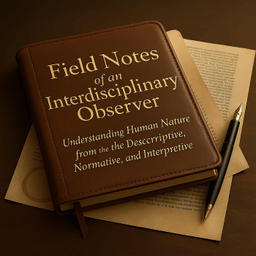
Podcast thumbnail for FuturePoint Conversations.... Podcast

FuturePoint Conversations.... Podcast

Claim This Podcast

by David Ragland, DBA, MS, PMP

22 episodes
Updated Daily
Accepts GuestsHas Sponsors

Podcast Overview

It's a complex world, let's make sense of it. <br/><br/><a href="https://profragland.substack.com?utm_medium=podcast">profragland.substack.com</a>

Language

🇺🇲

Publishing Since

7/24/2025

1 verified contact email on file for FuturePoint Conversations.... Podcast

Pitch yourself as a guest, propose sponsorships, or reach out directly to the host.

Recent Episodes

Episode thumbnail for SE2 Episode 4: Motivation in the Age of AI

October 9, 2025

SE2 Episode 4: Motivation in the Age of AI

<p>After a short hiatus, David and Audrey are back and ready to dive into one of leadership’s deepest questions: <strong>what truly motivates people</strong>? They open with Churchill’s 1940 speech as a masterclass in <strong>intrinsic motivation</strong>—appealing to identity, purpose, and legacy rather than perks. From there, they tour the major frameworks: <strong>Content theories</strong> (Maslow’s hierarchy; Herzberg’s hygiene vs. motivators; McClelland’s achievement/affiliation/power profiles), <strong>Process theories</strong> (Adams’ Equity; Vroom’s Expectancy; Locke & Latham’s Goal-Setting), and <strong>Behavioral control</strong> (Skinner’s reinforcement). They then stitch it all together with <strong>Lussier & Achua’s five-step integration</strong> and show how modern tools—<strong>Microsoft Viva</strong>, <strong>Workday</strong>, <strong>SAP SuccessFactors</strong>, and <strong>VR training</strong>—can enable (not replace) human leadership. The takeaway: motivation isn’t a switch; it’s a <strong>renewable system</strong> leaders cultivate through clarity, fairness, recognition, stretch, and purpose.</p><p>Key Takeaways</p><p>* <strong>Purpose beats perks:</strong> Churchill exemplifies intrinsic motivation.</p><p>* <strong>Content vs. Process:</strong> Meet human needs and shape belief (can I succeed, will it count, is it worth it?).</p><p>* <strong>Fairness matters:</strong> Perceived inequity drains discretionary effort.</p><p>* <strong>Goals work when sharp:</strong> Specific, challenging, measurable targets focus attention and persistence.</p><p>* <strong>Reinforce wisely:</strong> Timely, specific reinforcement turns behaviors into habits.</p><p>* <strong>Integrate:</strong> Identify needs → link to behavior → observe → reinforce → reassess.</p><p>* <strong>AI assists, leaders lead:</strong> Use tech to spot burnout, prompt recognition, map growth paths, and build self-efficacy.</p><p>“Motivation isn’t a switch to flip—it’s a system to cultivate.”</p><p>And for deeper explorations of this and other themes, please see The Multiplier Effect: AI and Organizational Dynamics, available on <a target="_blank" href="https://www.amazon.com/dp/B0DP7KS5HD"><strong>Amazon</strong></a>.</p> <br/><br/>This is a public episode. If you would like to discuss this with other subscribers or get access to bonus episodes, visit <a href="https://profragland.substack.com?utm_medium=podcast&#38;utm_campaign=CTA_1">profragland.substack.com</a>

Episode thumbnail for SE2 Episode 3: Effective Thinking: Systems, Biases, and AI-Enhanced Judgment

September 14, 2025

SE2 Episode 3: Effective Thinking: Systems, Biases, and AI-Enhanced Judgment

<p>In this episode of FuturePoint Conversations, David Ragland and Audrey explore one of leadership’s most critical disciplines: <strong>effective thinking</strong>. Drawing lessons from Enron’s collapse and a modern vignette about a CEO on the brink of a costly decision, they unpack how systems thinking—popularized by Peter Senge in The Fifth Discipline—helps leaders see beyond silos and anticipate unintended consequences. Audrey highlights common cognitive pitfalls such as confirmation bias, groupthink, faulty assumptions, inferences, and logical fallacies, including Kripkean dogmatism.</p><p>The conversation then turns to how AI can either magnify our errors or extend our perspective through simulations, digital twins, empathy training, and deliberation mapping. Finally, using the <strong>three lenses</strong>, David and Audrey connect psychology and neuroscience (descriptive), Aristotle’s phronesis (normative), and Shakespeare’s Macbeth (interpretive) to show how effective thinking blends science, ethics, and story. The takeaway: effective thinking isn’t a trait—it’s a discipline, and AI can help us practice it more responsibly.</p><p>And for deeper explorations of this and other themes, please see The Multiplier Effect: AI and Organizational Dynamics, available on <a target="_blank" href="https://www.amazon.com/dp/B0DP7KS5HD"><strong>Amazon</strong></a>.</p> <br/><br/>This is a public episode. If you would like to discuss this with other subscribers or get access to bonus episodes, visit <a href="https://profragland.substack.com?utm_medium=podcast&#38;utm_campaign=CTA_1">profragland.substack.com</a>

Episode thumbnail for SE2, Episode 2: Emotional Intelligence in the Age of AI

September 10, 2025

SE2, Episode 2: Emotional Intelligence in the Age of AI

<p>In this episode of FuturePoint Conversations, David Ragland and Audrey explore why emotional intelligence (EI) is more than a “soft skill” — it’s a survival skill for leadership. Drawing on Daniel Goleman’s five domains—self-awareness, self-regulation, motivation, empathy, and social skills—they show how EI forms the backbone of trust and high-performing teams.</p><p>We revisit Steve Jobs’ leadership journey as a vivid example: brilliance without empathy led to Apple’s decline, while his later growth in emotional intelligence fueled its revival. Audrey then shows how AI can act as an amplifier of EI, from real-time analytics that surface stress signals, to VR empathy training, personalized coaching platforms, and predictive tools that spot burnout before it spreads.</p><p>The episode also features the story of Clara, a rising leader who used an AI-powered “digital twin” to transform her feedback style and rebuild trust with her team.</p><p>Finally, through the three lenses—descriptive (psychology and neuroscience), normative (ethics and Aristotle’s phronesis), and interpretive (Shakespeare’s King Lear)—we see how emotional intelligence, supported by AI, remains central to effective, ethical leadership.</p><p>And for deeper explorations of this and other themes, please see The Multiplier Effect: AI and Organizational Dynamics, available on <a target="_blank" href="https://www.amazon.com/dp/B0DP7KS5HD"><strong>Amazon</strong></a>.</p> <br/><br/>This is a public episode. If you would like to discuss this with other subscribers or get access to bonus episodes, visit <a href="https://profragland.substack.com?utm_medium=podcast&#38;utm_campaign=CTA_1">profragland.substack.com</a>

22 total episodes available

Deep-dive analytics for FuturePoint Conversations.... Podcast

Frequently asked questions

Have a different question and can't find the answer you're looking for? Reach out to our support team by sending us an email and we'll get back to you as soon as we can.

What is FuturePoint Conversations.... Podcast?

It's a complex world, let's make sense of it. <br/><br/><a href="https://profragland.substack.com?utm_medium=podcast">profragland.substack.com</a>

How often does this podcast release new episodes?

This podcast updates daily.

Where can I listen to this podcast?

This podcast is available on 4 platforms including Apple Podcasts, Spotify, and more. You can also use the RSS feed directly.

Does this podcast accept guests?

Information about guest appearances is not available.

Legal Disclaimer

Pod Engine is not affiliated with, endorsed by, or officially connected with any of the podcasts displayed on this platform. We operate independently as a podcast discovery and analytics service.

All podcast artwork, thumbnails, and content displayed on this page are the property of their respective owners and are protected by applicable copyright laws. This includes, but is not limited to, podcast cover art, episode artwork, show descriptions, episode titles, transcripts, audio snippets, and any other content originating from the podcast creators or their licensors.

We display this content under fair use principles and/or implied license for the purpose of podcast discovery, information, and commentary. We make no claim of ownership over any podcast content, artwork, or related materials shown on this platform. All trademarks, service marks, and trade names are the property of their respective owners.

While we strive to ensure all content usage is properly authorized, if you are a rights holder and believe your content is being used inappropriately or without proper authorization, please contact us immediately at hey@podengine.ai for prompt review and appropriate action, which may include content removal or proper attribution.

By accessing and using this platform, you acknowledge and agree to respect all applicable copyright laws and intellectual property rights of content owners. Any unauthorized reproduction, distribution, or commercial use of the content displayed on this platform is strictly prohibited.