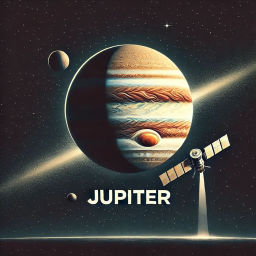
Podcast thumbnail for Jupiter

by Inception Point AI

1 episodes
Updated Weekly
Accepts GuestsHas SponsorsLocation 🇺🇸

Podcast Overview

Planet Jupiter: Exploring the Giant of the Solar SystemWelcome to "Planet Jupiter," the podcast dedicated to unraveling the mysteries of the largest planet in our solar system. Join us as we journey through the fascinating world of Jupiter, exploring its massive storms, iconic Great Red Spot, and intriguing moons. Each episode features interviews with leading astronomers, planetary scientists, and space mission experts who share their latest findings and insights. Stay informed about the newest discoveries, scientific missions, and technological advancements that help us understand Jupiter's complex atmosphere and magnetic field. Whether you're a space enthusiast or a curious learner, "Planet Jupiter" offers a captivating and educational experience. Subscribe now and embark on a journey to explore the wonders of Jupiter. FOr more info https://www.quietperiodplease.com/ This content was created in partnership and with the help of Artificial Intelligence AI.

Language

🇺🇲

Publishing Since

6/17/2024

2 verified contact emails on file for Jupiter

Pitch yourself as a guest, propose sponsorships, or reach out directly to the host.

Recent Episodes

Episode thumbnail for Planet Jupiter Destiny of a Cosmic Monarch

June 17, 2024

Planet Jupiter Destiny of a Cosmic Monarch

Jupiter is the largest planet in our solar system and is known for its distinctive features and fascinating characteristics. Here’s an overview of what makes Jupiter so unique:Basic Characteristics<ul><li>Size: Jupiter has a diameter of about 142,984 kilometers (88,846 miles), making it more than 11 times the diameter of Earth. It is so massive that it could fit all the other planets in the solar system inside it.</li><li>Mass: It has a mass of 1.898 × 10^27 kilograms, which is approximately 318 times the mass of Earth.</li><li>Orbit and Rotation: Jupiter orbits the Sun at an average distance of 778 million kilometers (484 million miles). It takes about 12 Earth years to complete one orbit around the Sun. However, a day on Jupiter (one full rotation) is only about 10 hours long, making it the fastest rotating planet in the solar system.</li></ul>Atmosphere and Composition<ul><li>Atmosphere: Jupiter’s atmosphere is composed primarily of hydrogen (about 90%) and helium (about 10%), with trace amounts of other gases such as methane, ammonia, and water vapor. The atmosphere features multicolored bands, created by strong winds and chemical reactions at different altitudes.</li><li>Great Red Spot: One of Jupiter's most famous features is the Great Red Spot, a gigantic storm that has been raging for at least 400 years. This anticyclonic storm is larger than Earth and is characterized by its reddish hue, which is still not fully understood.</li></ul>Magnetic Field and Moons<ul><li>Magnetic Field: Jupiter has a powerful magnetic field, about 20,000 times stronger than Earth’s. This magnetic field creates intense radiation belts and influences the planet’s many moons.</li><li>Moons: Jupiter has at least 79 known moons, with the four largest being the Galilean moons: Io, Europa, Ganymede, and Callisto. These moons are some of the most interesting objects in the solar system, with features such as active volcanism (Io), subsurface oceans (Europa), and diverse geological landscapes (Ganymede and Callisto).</li></ul>Exploration<ul><li>Space Missions:<ul><li>Pioneer 10 and Pioneer 11 were the first spacecraft to visit Jupiter in the early 1970s.</li><li>Voyager 1 and Voyager 2 provided detailed images and data about the planet and its moons in 1979.</li><li>Galileo orbited Jupiter from 1995 to 2003, offering extensive data on the planet and its moons.</li><li>Juno, launched in 2011, is currently in orbit around Jupiter, studying its atmosphere, magnetic field, and internal structure.</li></ul></li></ul>Interesting Facts<ul><li>Radiation Belts: Jupiter's intense magnetic field creates radiation belts that are so powerful they can damage spacecraft electronics.</li><li>Ring System: While not as prominent as Saturn's, Jupiter has a faint ring system composed mainly of dust particles ejected from its moons.</li><li>Auroras: Jupiter’s poles exhibit spectacular auroras, caused by interactions between the planet’s magnetic field and charged particles from the solar wind.</li></ul>Jupiter’s massive size, complex atmosphere, powerful magnetic field, and diverse moons make it a fascinating subject for both amateur and professional astronomers. Its ongoing exploration continues to reveal new and exciting information about the giant planet and its place in the solar system.

1 total episodes available

Deep-dive analytics for Jupiter

Frequently asked questions

Have a different question and can't find the answer you're looking for? Reach out to our support team by sending us an email and we'll get back to you as soon as we can.

What is Jupiter?

Planet Jupiter: Exploring the Giant of the Solar SystemWelcome to "Planet Jupiter," the podcast dedicated to unraveling the mysteries of the largest planet in our solar system. Join us as we journey through the fascinating world of Jupiter, exploring its massive storms, iconic Great Red Spot, and intriguing moons. Each episode features interviews with leading astronomers, planetary scientists, and space mission experts who share their latest findings and insights.

Stay informed about the newest discoveries, scientific missions, and technological advancements that help us understand Jupiter's complex atmosphere and magnetic field. Whether you're a space enthusiast or a curious learner, "Planet Jupiter" offers a captivating and educational experience. Subscribe now and embark on a journey to explore the wonders of Jupiter.

FOr more info https://www.quietperiodplease.com/

This content was created in partnership and with the help of Artificial Intelligence AI.

How often does this podcast release new episodes?

This podcast updates weekly.

Where can I listen to this podcast?

This podcast is available on 8 platforms including Apple Podcasts, Spotify, and more. You can also use the RSS feed directly.

Does this podcast accept guests?

Yes, this podcast regularly features guests.

Legal Disclaimer

Pod Engine is not affiliated with, endorsed by, or officially connected with any of the podcasts displayed on this platform. We operate independently as a podcast discovery and analytics service.

All podcast artwork, thumbnails, and content displayed on this page are the property of their respective owners and are protected by applicable copyright laws. This includes, but is not limited to, podcast cover art, episode artwork, show descriptions, episode titles, transcripts, audio snippets, and any other content originating from the podcast creators or their licensors.

We display this content under fair use principles and/or implied license for the purpose of podcast discovery, information, and commentary. We make no claim of ownership over any podcast content, artwork, or related materials shown on this platform. All trademarks, service marks, and trade names are the property of their respective owners.

While we strive to ensure all content usage is properly authorized, if you are a rights holder and believe your content is being used inappropriately or without proper authorization, please contact us immediately at hey@podengine.ai for prompt review and appropriate action, which may include content removal or proper attribution.

By accessing and using this platform, you acknowledge and agree to respect all applicable copyright laws and intellectual property rights of content owners. Any unauthorized reproduction, distribution, or commercial use of the content displayed on this platform is strictly prohibited.