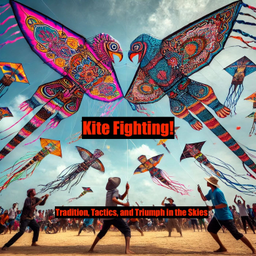
Kite Fighting!
Inception Point AI
About Kite Fighting!
Kite Fighting: A Cultural Phenomenon and Competitive Sport Kite fighting, a centuries-old practice that combines artistry, skill, and competition, has captivated enthusiasts across various cultures for generations. This unique sport, which involves maneuvering kites to cut the strings of opponents' kites, has deep roots in many Asian and Middle Eastern countries and has recently gained recognition in other parts of the world. However, alongside its rich cultural heritage and excitement, kite fighting carries significant risks that have led to controversy and, in some cases, legal restrictions. The origins of kite fighting can be traced back over a thousand years, with some historians suggesting that it began in China, the birthplace of kite-flying itself. From there, the practice spread along trade routes to other parts of Asia and the Middle East. In India, kite fighting has been a popular activity since at least the 12th century, with historical records mentioning kite flying and fighting during the Mughal period. The tradition became particularly associated with the spring festival of Makar Sankranti in western India, especially in the state of Gujarat. In Afghanistan, kite fighting has been a significant part of culture for centuries, gaining particular prominence during the reign of King Zahir Shah in the mid-20th century. Pakistan, particularly in the city of Lahore, has a strong tradition of kite fighting associated with the Basant festival, which marks the arrival of spring. In Brazil, particularly in the favelas of Rio de Janeiro, kite fighting emerged as a popular activity in the mid-20th century, developing its own unique styles and traditions. The cultural significance of kite fighting in many societies is profound, often intertwined with religious festivals, seasonal celebrations, and social gatherings. In India, the Uttarayan festival in Gujarat sees millions of people take to their rooftops to engage in kite fighting. The sky becomes a canvas of colorful kites, and the sound of "kai po che" (I've cut it!) echoes through the streets as competitors successfully cut others' kite strings. In Afghanistan, kite fighting was traditionally associated with the Nowruz festival, marking the Persian New Year. The activity became so ingrained in Afghan culture that it features prominently in Khaled Hosseini's novel "The Kite Runner," which introduced many Western readers to the practice. Beyond specific cultural contexts, kite fighting often serves as a social bonding activity, bringing together families and communities. The preparation of kites and strings, the excitement of competition, and the shared experience of a day spent looking skyward all contribute to its social importance. The kites used in kite fighting are specially designed for maneuverability and durability. While designs vary across regions, they generally share some common characteristics. Most fighter kites are diamond-shaped or rectangular, with a bow in the horizontal spar This content was created in partnership and with the help of Artificial Intelligence AI.
- Publisher
- Inception Point AI
- Category
- education · news · sports
- Language
- en
- Explicit
- No
- First episode
- 21 Aug 2024
- Latest episode
- 21 Aug 2024
Pod Engine is an independent podcast discovery and analytics service and is not affiliated with or endorsed by this podcast. Artwork and show content belong to their owners. Full legal notice.