
Hi this is Eytan Segev and I will teach you Face Reading and Body Language also called Physiognomy / Personology I have been studying, exploring and teaching thousands of people over 17 years
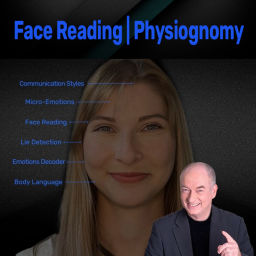
Learn to read faces and body language with Physiognomy / Personology
Claim This Podcastby Profiler Eytan Segev
3.5(2 reviews)
1 episodes
Updated Weekly
Accepts GuestsHas Sponsors
Podcast Overview
Hi this is Eytan Segev and I will teach you Face Reading and Body Language also called Physiognomy / Personology I have been studying, exploring and teaching thousands of people over 17 years
Language
🇺🇲
Publishing Since
4/27/2024
Reach the team behind Learn to read faces and body language with Physiognomy / Personology
Verified contact details for this show aren't on file yet — sign up to get notified when they land.
Recent Episodes
April 27, 2024
The History of Face Reading, Physiognomy, Personology
<p> Introduction and History of Face reading - personology , also known as physiognomy or personology, is the practice of analyzing facial features to discern a person's character, personality traits, and even potential fate. </p> <p><br></p> <p>This ancient art has a rich history spanning cultures and civilizations around the world. The roots of face reading can be traced back thousands of years, with evidence of its practice found in ancient Chinese, Indian, Greek, and Egyptian cultures. </p> <p><br></p> <p>In China, face reading has been documented as far back as the 6th century BCE, where it was considered an essential skill for rulers and officials to understand the character of their subjects and potential allies. </p> <p>Chinese face reading, known as "Mian Xiang," became intricately linked with Taoist and Confucian philosophies, as well as traditional Chinese medicine. </p> <p><br></p> <p>In ancient Greece, philosophers such as Aristotle and Pythagoras explored the concept of physiognomy, believing that a person's physical appearance was indicative of their inner character and moral virtues. </p> <p><br></p> <p>Similarly, in India, the ancient texts of Ayurveda, the traditional system of medicine, describe methods of analyzing facial features to diagnose health issues and understand psychological tendencies. </p> <p><br></p> <p>Throughout history, face reading has been intertwined with various cultural and religious beliefs. In medieval Europe, physiognomy gained popularity as a means of assessing a person's moral character and potential for criminal behavior. </p> <p>However, it also faced criticism and condemnation, particularly from religious authorities who viewed it as a form of superstition or divination. </p> <p><br></p> <p>During the Renaissance period, interest in face reading was revived, with scholars and artists delving into the study of physiognomy as a means of understanding human nature and expressing it through art. </p> <p>Figures such as Leonardo da Vinci explored the relationship between facial features and emotions, contributing to the development of both scientific and artistic perspectives on the subject. </p> <p><br></p> <p>In the modern era, face reading has evolved beyond its traditional roots, with psychologists and behavioral scientists incorporating aspects of facial analysis into their research on nonverbal communication and personality assessment. </p> <p><br></p> <p>Technologies such as facial recognition software have also brought new possibilities for analyzing facial features, although the accuracy and ethical implications of such tools remain subjects of debate. </p> <p><br></p> <p>Today, while face reading may not hold the same prominence it once did in ancient times, it continues to intrigue and fascinate people around the world. Whether approached from a cultural, philosophical, or scientific perspective, the study of facial features as a reflection of inner character remains a compelling aspect of human understanding and interpretation.</p> <p>for the online course:</p> <p>https://bodylanguage.college </p> --- Send in a voice message: https://podcasters.spotify.com/pod/show/profiler-eytan-segev/message
1 total episodes available
Deep-dive analytics for Learn to read faces and body language with Physiognomy / Personology
Frequently asked questions
Have a different question and can't find the answer you're looking for? Reach out to our support team by sending us an email and we'll get back to you as soon as we can.
- What is Learn to read faces and body language with Physiognomy / Personology?
- How often does this podcast release new episodes?
This podcast updates weekly.
- Where can I listen to this podcast?
This podcast is available on 7 platforms including Apple Podcasts, Spotify, and more. You can also use the RSS feed directly.
- Does this podcast accept guests?
No, this podcast does not typically feature guests.
Legal Disclaimer
Pod Engine is not affiliated with, endorsed by, or officially connected with any of the podcasts displayed on this platform. We operate independently as a podcast discovery and analytics service.
All podcast artwork, thumbnails, and content displayed on this page are the property of their respective owners and are protected by applicable copyright laws. This includes, but is not limited to, podcast cover art, episode artwork, show descriptions, episode titles, transcripts, audio snippets, and any other content originating from the podcast creators or their licensors.
We display this content under fair use principles and/or implied license for the purpose of podcast discovery, information, and commentary. We make no claim of ownership over any podcast content, artwork, or related materials shown on this platform. All trademarks, service marks, and trade names are the property of their respective owners.
While we strive to ensure all content usage is properly authorized, if you are a rights holder and believe your content is being used inappropriately or without proper authorization, please contact us immediately at hey@podengine.ai for prompt review and appropriate action, which may include content removal or proper attribution.
By accessing and using this platform, you acknowledge and agree to respect all applicable copyright laws and intellectual property rights of content owners. Any unauthorized reproduction, distribution, or commercial use of the content displayed on this platform is strictly prohibited.