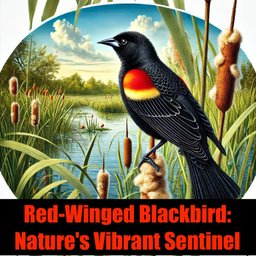
Podcast thumbnail for Red-Winged Blackbird:

Red-Winged Blackbird:

Claim This Podcast

by Inception Point AI

1 episodes
Updated Weekly
Accepts GuestsHas SponsorsLocation 🇺🇸

Podcast Overview

The Red-Winged Blackbird: A Naturalist's Perspective The Red-Winged Blackbird (Agelaius phoeniceus) is a familiar and striking sight in North America’s wetlands, marshes, and grasslands. With its bold red and yellow shoulder patches, or epaulettes, this bird is a vibrant symbol of spring and summer. As a naturalist, observing the behaviors, habitats, and lifecycle of the Red-Winged Blackbird offers insights into the complexity and beauty of the natural world. The male Red-Winged Blackbird is easily recognizable by its glossy black plumage and distinctive red and yellow shoulder patches. During the breeding season, these epaulettes are often displayed prominently as the male sings to defend his territory. In contrast, the female is more modestly colored, with streaky brown plumage that provides excellent camouflage among reeds and grasses. Males measure about 22 centimeters (8.7 inches) in length, while females are slightly smaller. Both sexes have sharp, pointed bills well-suited for their varied diet. The vocalizations of the Red-Winged Blackbird are equally distinctive, with the male’s territorial song—a loud, conk-la-ree!—being a common sound in their habitats. The Red-Winged Blackbird is highly adaptable and found across a wide range of environments in North America, from Alaska and Canada to the southern United States and into Central America. They are particularly abundant in marshes, wet meadows, and along the edges of ponds and lakes where cattails and other aquatic plants thrive. These wetlands provide ideal nesting sites and abundant food sources. In addition to wetlands, Red-Winged Blackbirds are also found in agricultural fields, grasslands, and even suburban areas. Their adaptability to different habitats is a key factor in their widespread distribution. Red-Winged Blackbirds are known for their highly territorial and polygynous breeding behavior. Males establish and fiercely defend territories that can range from one to several hectares in size. These territories often encompass several nesting sites, with one male typically mating with multiple females. The conspicuous displays and vocalizations of males serve both to attract females and to warn off rival males. Courtship involves elaborate displays, including puffing out the bright red epaulettes and performing aerial acrobatics. The male's song, a sharp conk-la-ree, is a declaration of both territorial ownership and mating readiness. Nest Building and Parental Care Females, on the other hand, are primarily responsible for building nests, incubating eggs, and feeding the young. Nests are often built among dense vegetation, such as cattails or reeds, providing concealment from predators. The nest itself is a well-constructed cup made of grasses, reeds, and mud. The female weaves the outer structure and lines the inner cup with finer materials to keep the eggs safe and warm. A typical clutch consists of three to four eggs, which the female incubates for about 11 to 12 days. After ha This content was created in partnership and with the help of Artificial Intelligence AI.

Language

🇺🇲

Publishing Since

6/25/2024

2 verified contact emails on file for Red-Winged Blackbird:

Pitch yourself as a guest, propose sponsorships, or reach out directly to the host.

Recent Episodes

Episode thumbnail for Red-Winged Blackbird

June 25, 2024

Red-Winged Blackbird

The Red-Winged Blackbird: A Naturalist's Perspective The Red-Winged Blackbird (Agelaius phoeniceus) is a familiar and striking sight in North America’s wetlands, marshes, and grasslands. With its bold red and yellow shoulder patches, or epaulettes, this bird is a vibrant symbol of spring and summer. As a naturalist, observing the behaviors, habitats, and lifecycle of the Red-Winged Blackbird offers insights into the complexity and beauty of the natural world. The male Red-Winged Blackbird is easily recognizable by its glossy black plumage and distinctive red and yellow shoulder patches. During the breeding season, these epaulettes are often displayed prominently as the male sings to defend his territory. In contrast, the female is more modestly colored, with streaky brown plumage that provides excellent camouflage among reeds and grasses. Males measure about 22 centimeters (8.7 inches) in length, while females are slightly smaller. Both sexes have sharp, pointed bills well-suited for their varied diet. The vocalizations of the Red-Winged Blackbird are equally distinctive, with the male’s territorial song—a loud, conk-la-ree!—being a common sound in their habitats. The Red-Winged Blackbird is highly adaptable and found across a wide range of environments in North America, from Alaska and Canada to the southern United States and into Central America. They are particularly abundant in marshes, wet meadows, and along the edges of ponds and lakes where cattails and other aquatic plants thrive. These wetlands provide ideal nesting sites and abundant food sources. In addition to wetlands, Red-Winged Blackbirds are also found in agricultural fields, grasslands, and even suburban areas. Their adaptability to different habitats is a key factor in their widespread distribution. Red-Winged Blackbirds are known for their highly territorial and polygynous breeding behavior. Males establish and fiercely defend territories that can range from one to several hectares in size. These territories often encompass several nesting sites, with one male typically mating with multiple females. The conspicuous displays and vocalizations of males serve both to attract females and to warn off rival males. Courtship involves elaborate displays, including puffing out the bright red epaulettes and performing aerial acrobatics. The male's song, a sharp conk-la-ree, is a declaration of both territorial ownership and mating readiness. Nest Building and Parental Care Females, on the other hand, are primarily responsible for building nests, incubating eggs, and feeding the young. Nests are often built among dense vegetation, such as cattails or reeds, providing concealment from predators. The nest itself is a well-constructed cup made of grasses, reeds, and mud. The female weaves the outer structure and lines the inner cup with finer materials to keep the eggs safe and warm. A typical clutch consists of three to four eggs, which the female incubates for about 11 to 12 days. After hatching, the chicks are altricial, meaning they are born blind and helpless, requiring significant parental care. Both parents feed the chicks, though the female does the majority of the brooding and feeding. Chicks fledge about 10 to 14 days after hatching but remain dependent on their parents for food for several more weeks. Social Behavior and Flocking Red-Winged Blackbirds are also highly social outside the breeding season, often forming large flocks that can include thousands of individuals. These flocks can be seen roosting together in communal sites, foraging in fields, and flying in synchronized patterns that provide protection from predators. The coordination in these flocks is fascinating, with each bird responding to the movements of its neighbors, creating fluid and dynamic shapes in the sky. Ecological Role The Red-Winged Blackbird plays a crucial role in its ecosystem. As both a predator and prey species, it helps maintain the balance of insect populations and serves...

1 total episodes available

Deep-dive analytics for Red-Winged Blackbird:

Frequently asked questions

Have a different question and can't find the answer you're looking for? Reach out to our support team by sending us an email and we'll get back to you as soon as we can.

What is Red-Winged Blackbird:?

The Red-Winged Blackbird: A Naturalist's Perspective The Red-Winged Blackbird (Agelaius phoeniceus) is a familiar and striking sight in North America’s wetlands, marshes, and grasslands. With its bold red and yellow shoulder patches, or epaulettes, this bird is a vibrant symbol of spring and summer. As a naturalist, observing the behaviors, habitats, and lifecycle of the Red-Winged Blackbird offers insights into the complexity and beauty of the natural world. The male Red-Winged Blackbird is easily recognizable by its glossy black plumage and distinctive red and yellow shoulder patches. During the breeding season, these epaulettes are often displayed prominently as the male sings to defend his territory. In contrast, the female is more modestly colored, with streaky brown plumage that provides excellent camouflage among reeds and grasses. Males measure about 22 centimeters (8.7 inches) in length, while females are slightly smaller. Both sexes have sharp, pointed bills well-suited for their varied diet. The vocalizations of the Red-Winged Blackbird are equally distinctive, with the male’s territorial song—a loud, conk-la-ree!—being a common sound in their habitats. The Red-Winged Blackbird is highly adaptable and found across a wide range of environments in North America, from Alaska and Canada to the southern United States and into Central America. They are particularly abundant in marshes, wet meadows, and along the edges of ponds and lakes where cattails and other aquatic plants thrive. These wetlands provide ideal nesting sites and abundant food sources. In addition to wetlands, Red-Winged Blackbirds are also found in agricultural fields, grasslands, and even suburban areas. Their adaptability to different habitats is a key factor in their widespread distribution. Red-Winged Blackbirds are known for their highly territorial and polygynous breeding behavior. Males establish and fiercely defend territories that can range from one to several hectares in size. These territories often encompass several nesting sites, with one male typically mating with multiple females. The conspicuous displays and vocalizations of males serve both to attract females and to warn off rival males. Courtship involves elaborate displays, including puffing out the bright red epaulettes and performing aerial acrobatics. The male's song, a sharp conk-la-ree, is a declaration of both territorial ownership and mating readiness. Nest Building and Parental Care Females, on the other hand, are primarily responsible for building nests, incubating eggs, and feeding the young. Nests are often built among dense vegetation, such as cattails or reeds, providing concealment from predators. The nest itself is a well-constructed cup made of grasses, reeds, and mud. The female weaves the outer structure and lines the inner cup with finer materials to keep the eggs safe and warm. A typical clutch consists of three to four eggs, which the female incubates for about 11 to 12 days. After ha

This content was created in partnership and with the help of Artificial Intelligence AI.

How often does this podcast release new episodes?

This podcast updates weekly.

Where can I listen to this podcast?

This podcast is available on 4 platforms including Apple Podcasts, Spotify, and more. You can also use the RSS feed directly.

Does this podcast accept guests?

No, this podcast does not typically feature guests.

Legal Disclaimer

Pod Engine is not affiliated with, endorsed by, or officially connected with any of the podcasts displayed on this platform. We operate independently as a podcast discovery and analytics service.

All podcast artwork, thumbnails, and content displayed on this page are the property of their respective owners and are protected by applicable copyright laws. This includes, but is not limited to, podcast cover art, episode artwork, show descriptions, episode titles, transcripts, audio snippets, and any other content originating from the podcast creators or their licensors.

We display this content under fair use principles and/or implied license for the purpose of podcast discovery, information, and commentary. We make no claim of ownership over any podcast content, artwork, or related materials shown on this platform. All trademarks, service marks, and trade names are the property of their respective owners.

While we strive to ensure all content usage is properly authorized, if you are a rights holder and believe your content is being used inappropriately or without proper authorization, please contact us immediately at hey@podengine.ai for prompt review and appropriate action, which may include content removal or proper attribution.

By accessing and using this platform, you acknowledge and agree to respect all applicable copyright laws and intellectual property rights of content owners. Any unauthorized reproduction, distribution, or commercial use of the content displayed on this platform is strictly prohibited.