
Anyone, as Freud tells us in <i>Reflections on War and Death</i>, forced to react against his own impulses may be described as a hypocrite, whether he is conscious of it or not. One might even venture to assert—it is still Freud's argument—that our contemporary civilisation favours this sort of hypocrisy and that there are more civilised hypocrites than truly cultured persons, and it is even a question whether a certain amount of hypocrisy is not indispensable to maintain civilisation. When this travesty of civilisation, this infallible state that has regimented and dragooned its citizens into obedience, goes to war, Freud is pained but not surprised that it makes free use of every injustice, of every act of violence that would dishonour the individual, that it employs not only permissible cunning but conscious lies and intentional deception against the enemy, that it absolves itself from guarantees and treaties by which it was bound to other states and makes unabashed confession of its greed and aspiration to power. For conscience, the idea of right and wrong, in the Freudian sense, is not the inexorable judge that teachers of ethics say it is: it has its origin in nothing but "social fear," and whereas in times of peace the state forbids the individual to do wrong, not because it wishes to do away with wrongdoing but because it wishes to monopolise it, like salt or tobacco, it suspends its reproach in times of war. The suppression of evil desires also ceases, and men, finding the moral ties loosened between large human units, commit acts of cruelty, treachery, deception and brutality the very possibility of which would have been considered incompatible with their degree of culture.<br />(Summary by J.C. Grey, from <i>The Bookman: A Review of Books and Life</i>, v.47: Mar-Aug 1918. First sentence edited for clarity.)
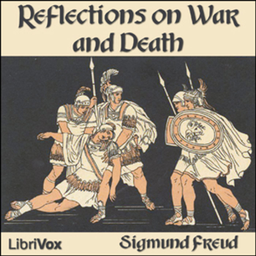
Reflections on War and Death by Sigmund Freud (1856 - 1939)
Claim This Podcastby ciesse
Podcast Overview
Anyone, as Freud tells us in <i>Reflections on War and Death</i>, forced to react against his own impulses may be described as a hypocrite, whether he is conscious of it or not. One might even venture to assert—it is still Freud's argument—that our contemporary civilisation favours this sort of hypocrisy and that there are more civilised hypocrites than truly cultured persons, and it is even a question whether a certain amount of hypocrisy is not indispensable to maintain civilisation. When this travesty of civilisation, this infallible state that has regimented and dragooned its citizens into obedience, goes to war, Freud is pained but not surprised that it makes free use of every injustice, of every act of violence that would dishonour the individual, that it employs not only permissible cunning but conscious lies and intentional deception against the enemy, that it absolves itself from guarantees and treaties by which it was bound to other states and makes unabashed confession of its greed and aspiration to power. For conscience, the idea of right and wrong, in the Freudian sense, is not the inexorable judge that teachers of ethics say it is: it has its origin in nothing but "social fear," and whereas in times of peace the state forbids the individual to do wrong, not because it wishes to do away with wrongdoing but because it wishes to monopolise it, like salt or tobacco, it suspends its reproach in times of war. The suppression of evil desires also ceases, and men, finding the moral ties loosened between large human units, commit acts of cruelty, treachery, deception and brutality the very possibility of which would have been considered incompatible with their degree of culture.<br />(Summary by J.C. Grey, from <i>The Bookman: A Review of Books and Life</i>, v.47: Mar-Aug 1918. First sentence edited for clarity.)
Language
🇺🇲
Publishing Since
11/4/2024
1 verified contact email on file for Reflections on War and Death by Sigmund Freud (1856 - 1939)
Pitch yourself as a guest, propose sponsorships, or reach out directly to the host.
Recent Episodes
November 4, 2024
Our Attitude Towards Death
November 4, 2024
The Disappointments of War
2 total episodes available
Deep-dive analytics for Reflections on War and Death by Sigmund Freud (1856 - 1939)
Frequently asked questions
Have a different question and can't find the answer you're looking for? Reach out to our support team by sending us an email and we'll get back to you as soon as we can.
- What is Reflections on War and Death by Sigmund Freud (1856 - 1939)?
- How often does this podcast release new episodes?
This podcast updates daily.
- Where can I listen to this podcast?
This podcast is available on 4 platforms including Apple Podcasts, Spotify, and more. You can also use the RSS feed directly.
- Does this podcast accept guests?
No, this podcast does not typically feature guests.
Legal Disclaimer
Pod Engine is not affiliated with, endorsed by, or officially connected with any of the podcasts displayed on this platform. We operate independently as a podcast discovery and analytics service.
All podcast artwork, thumbnails, and content displayed on this page are the property of their respective owners and are protected by applicable copyright laws. This includes, but is not limited to, podcast cover art, episode artwork, show descriptions, episode titles, transcripts, audio snippets, and any other content originating from the podcast creators or their licensors.
We display this content under fair use principles and/or implied license for the purpose of podcast discovery, information, and commentary. We make no claim of ownership over any podcast content, artwork, or related materials shown on this platform. All trademarks, service marks, and trade names are the property of their respective owners.
While we strive to ensure all content usage is properly authorized, if you are a rights holder and believe your content is being used inappropriately or without proper authorization, please contact us immediately at hey@podengine.ai for prompt review and appropriate action, which may include content removal or proper attribution.
By accessing and using this platform, you acknowledge and agree to respect all applicable copyright laws and intellectual property rights of content owners. Any unauthorized reproduction, distribution, or commercial use of the content displayed on this platform is strictly prohibited.