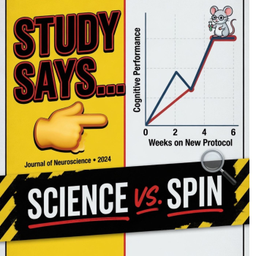
On Science vs. Spin, we break down viral research and show you what’s actually going on behind the curtain. Was the study done on humans—or rats? Was the sample size large enough to matter? Are we looking at real clinical outcomes… or just surrogate markers dressed up as breakthroughs?
Each episode teaches you how to think like a researcher, spot statistical sleight of hand, and separate meaningful evidence from media hype. Because once you understand how studies really work, you stop being misled—and start seeing the world more clearly.
Can Exercise Really Work as Well as Antidepressants?
You’ve probably seen the headline: exercise can be just as effective as antidepressants for treating depression. It is an appealing claim, especially as research increasingly demonstrates important mental-health benefits from physical activity. But comparing exercise with antidepressant medication is considerably more complicated than comparing two numbers from a clinical trial. In this episode of Science vs. Spin, we examine what randomized trials and systematic reviews actually tell us about exercise, depression, and antidepressant treatment. The verdict reveals an important difference between saying exercise treats depression and saying exercise can replace antidepressants.
29 Sept 2026
Does Childhood Trauma Actually Change the Brain? What Brain Scans Can—and Can’t—Tell Us
You’ve probably heard that childhood trauma “rewires the brain,” but what does that phrase actually mean? Brain-imaging studies have found differences associated with childhood adversity, yet those findings are often more complicated than popular headlines suggest. In this episode of Science vs. Spin, we separate what neuroscience has actually discovered from what the evidence cannot yet prove.
15 Sept 2026
Biomarkers Under the Microscope: Separating Real Science from Medical Hype
Biomarkers are sold as the future of medicine — earlier diagnoses, personalized treatment, objective tracking of disease — but the science behind that promise is shakier than the marketing suggests. This episode pulls apart where biomarkers genuinely help versus where they fail to predict what actually matters: quality of life and long-term survival. The gap is even wider in psychology and psychiatry, where reaching for a biological number risks turning complex human conditions into oversimplified metrics. We make the case for treating biomarkers as fallible tools that demand skepticism and clinical judgment, not as shortcuts to certainty.
8 Sept 2026
Why Personality Surveys Measure How You Talk, Not Who You Are
Self-surveys dominate psychology and social psychology because they are cheap and easy to administer. The correct question is not whether people can answer Likert items, but whether those answers remain comparable across people, groups, or decades and whether the resulting scores correspond to anything that actually matters.
6 Sept 2026
Technically True, Nutritionally Misleading: How Food Marketing Creates a Health Halo
Food marketing does not always require a false statement to mislead consumers. By emphasizing one beneficial nutrient while withholding information about quantity and competing food sources, advertisers can make an ordinary product appear nutritionally exceptional. This article examines how cherry-picking, selective framing, and the health-halo effect shape what consumers believe about food.
30 Aug 2026
Dr. Brown on Bad Research: How Flawed Science Gets Past Peer Review
Carlos talks with Dr. Brown about how flawed studies make it into publication and, from there, into headlines people trust. The conversation digs into common red flags — small sample sizes, p-hacking, conflicts of interest, and cherry-picked data — that separate rigorous science from spin dressed up as research. It's a practical guide to reading a study more critically before believing the claim built on top of it.
3 Aug 2026
Separating Signal from Noise: The Science, Myths, and Skepticism Surrounding DID
This episode examines the controversial diagnostic history and neuroscientific claims surrounding Dissociative Identity Disorder, pitting popular trauma-model narratives against rigorous scientific scrutiny. We analyze the strength of current neuroimaging evidence, evaluate methodological limitations in clinical studies, and explore how media portrayals and institutional biases can inflate diagnostic claims. By cutting through the noise of social media trends and therapeutic hype, we separate empirically validated research from iatrogenic artifacts to uncover what the data actually says about complex trauma and the human brain.
20 Jul 2026
When Trauma “Rewires” the Brain: Science, Overreach, and What We Actually Know
Popular trauma narratives claim that chronic stress reshapes the brain and body in ways that inevitably impair focus, flexibility, and emotional control while damaging physical health. This episode examines the evidence behind those claims, separating well-supported findings from oversimplified interpretations. We explore how neuroimaging, physiology, and animal research contribute to our understanding—and where the science is more uncertain than commonly portrayed.
25 May 2026
The Degree Dividend: Mapping the Statistical Link Between Education and Dementia
Across decades of public health data, researchers have noticed a stunning trend: as global education rates climb, age-adjusted dementia numbers are beginning to drop. This episode breaks down the complex longitudinal studies tracking how even a single additional year of schooling correlates with a significantly delayed onset of cognitive decline. We analyze the variables at play, investigating whether degrees themselves protect the mind or if they simply act as a proxy for healthier lifelong habits.
15 May 2026
The Cellular Link: How Youth Obesity Triggers Early-Onset Malignancies
Recent epidemiological data shows a devastating rise in aggressive, early-onset cancers among adults who experienced metabolic dysfunction before age 30. This episode examines the precise biomolecular pathways—including hyperinsulinemia, altered cytokine signaling, and chronic systemic inflammation—that accelerate tumor development in adipose tissue environments. Join clinical researchers as they dissect the newest peer-reviewed oncology studies to understand how early-life obesity fundamentally alters cellular mutation rates.
8 May 2026
Sunscreen Efficacy: Weighing Evidence for Melanoma Prevention and Vitamin D Implications
This podcast evaluates the scientific evidence supporting and questioning the role of sunscreen in melanoma prevention, drawing on randomized controlled trials, observational studies, and meta-analyses while addressing key limitations. It examines the interplay between sunscreen use and vitamin D synthesis, presenting arguments for potential interference alongside real-world data indicating minimal clinical impact. A balanced conclusion emphasizes evidence-based sun protection strategies tailored to individual risk profiles, particularly for high-risk ethnic groups in sunny environments.
6 May 2026
Surrogate Endpoints in Research Studies: Acceleration of Knowledge or Misleading Shortcuts?
This podcast episode explores the use of surrogate endpoints versus patient-important clinical outcomes in medical and psychological research studies, highlighting their role in accelerating trials while cautioning against over-reliance. It presents advantages such as faster, less expensive studies alongside critical limitations, including frequent failures to predict real clinical benefit as seen in cardiovascular, oncology, and Alzheimer’s research. Listeners receive a balanced framework for critically appraising research that employs surrogate markers.
5 May 2026
Shrinking Brains or Just Shaky Science? Dissecting the Obesity-Dementia Link
We put the "obesity shrinks your brain" headlines under the microscope to separate causal reality from confounding variables. This episode navigates the neurodegeneration debate, questioning if the data holds up or if we're seeing another case of correlation being sold as causation. Join us as we strip away the spin to see what the evidence actually says about the relationship between weight and white matter.
3 May 2026
The MIT AI Myth: Debunking the "95% Failure" Stat That Shook Markets
In 2025, a viral study claiming that 95% of corporate AI pilots were failing sent the Nasdaq into a tailspin—but there was one problem: the math was 100% wrong. We join Rob Wiblin to dissect how a flawed report managed to hijack the global AI narrative and what the evidence actually says about the success of generative AI in the enterprise. Learn how to spot "data torture" and why the real story of AI integration is far more optimistic than the headlines suggest.
26 Apr 2026
Vaping & Cancer: The 2026 Review – Real Risk or Overhyped Alarm?
A major 2026 review in the journal Carcinogenesis claims nicotine vapes are “likely” to cause lung and oral cancers based on DNA damage, inflammation, and mouse tumors. Public-health experts on the other side call the paper misleading, arguing vaping remains far safer than smoking and a proven tool for quitting. We examine both arguments, expose the limitations of the studies on each side, and end with practical, no-nonsense advice for listeners.
24 Apr 2026
Science vs Spin: Do Anti-Amyloid Drugs Actually Work for Alzheimer’s? The Cochrane vs Lancet Debate
This episode examines the heated debate between the Cochrane Review and The Lancet on anti-amyloid drugs for Alzheimer’s. We break down the modest benefits, real risks, and methodological differences between older and newer treatments. A balanced, evidence-based analysis for patients, families, and clinicians seeking clarity on this controversial topic.
21 Apr 2026
The Rat Study Problem: Why What Works in Mice Fails in Humans
In this episode, we examine the “Rat Study Problem” — the persistent challenge in biomedical research where treatments that succeed dramatically in mice frequently fail when tested in humans. The discussion explores biological differences in metabolism, immune response, disease progression, and environmental factors that limit the predictive value of rodent models. It highlights the high cost of translation failures and the growing need for more sophisticated, human-relevant research approaches to accelerate genuine medical breakthroughs.
20 Apr 2026
Why Most Headlines About Studies Are Misleading
Most people consume scientific research through headlines—but those headlines often distort study design, exaggerate results, and hide critical limitations like small sample sizes, animal models, and surrogate markers. In this episode, we break down the most common ways research is misrepresented in the media, including the misuse of relative risk, correlation vs. causation errors, and misleading health claims. Learn how to evaluate studies like a professional and develop the critical thinking skills needed to separate evidence-based science from media spin.
Host of Science vs. Spin?
Claim your podcast to manage its listing and keep your show details accurate.
Pod Engine is an independent podcast discovery and analytics service and is not affiliated with or endorsed by this podcast. Artwork and show content belong to their owners. Full legal notice.