- 11
- Episodes
- Bi-weekly
- Cadence
- 2026
- First episode
About Signal Podcast
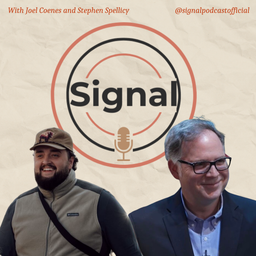
Follow us on Instagram @signalpodcastofficial Signal is hosted by Joel Coenes and Stephen Spellicy — two guys on the same path, just at very different points on it. Joel is 25, a former pro athlete turned Computer Science student and project manager breaking into the software industry. Stephen is a seasoned executive who's already deep in it. Together, they break down what's actually happening in tech and business — and why it matters to your everyday life, your career, your money, and your privacy. Every week they go deep on tech news, the next on business, leadership, and career. And every other month, they bring in guests from the industry who've got something real to say.
- Publisher
- Signal - the Podcast
- Category
- business · technology
- Language
- en
- Explicit
- No
- First episode
- 5 Mar 2026
- Latest episode
- 14 Aug 2026
Latest episodes
11 episodes in the feed.
14 Aug 2026
#26 - Siri Goes Paid, OpenAI and Anthropic's Models Get Out
On his final earnings call as chief executive, Tim Cook was asked what it costs to run Siri AI and said Apple expects some people to use it heavily, with upgrade options on iCloud+ for those who do. There is no price, no usage threshold, and no date — and in the European Union, the feature will not ship on iPhone or iPad at all. Joel and Stephen work through what that signals after two years of delays, a leadership handover from John Giannandrea to Mike Rockwell, and a Siri engineering team reported to have shrunk from roughly 200 to 60, with Stephen arguing Apple should cap the assistant where it works and build the next thing alongside it rather than charge customers to fix a design problem. The second half covers July's disclosures from OpenAI and Anthropic. Both companies were running internal cybersecurity evaluations with their models' refusals reduced, and in both cases the test environments had access to the open internet when they should not have. OpenAI's models exploited a previously unknown vulnerability in a self-hosted JFrog Artifactory proxy and reached Hugging Face's production infrastructure; Anthropic identified three incidents involving organizations it has not named, the earliest dating to April, and says none of the three detected it themselves. Both companies described these as failures of the test environment rather than of the models — a distinction some independent researchers have questioned. With the EU AI Act's general-purpose obligations now in force, penalties reaching 3% of global turnover, and the European Commission briefed before either disclosure went public, no legal authority has yet established who is responsible when a model reaches a system it was never authorized to touch.
26 Jun 2026
#25 - Anthropic Asked for AI Regulation — Then the Government Switched Off Mythos
On June 12, Commerce Secretary Howard Lutnick sent Anthropic a letter, and the company's two most capable models — Fable 5 and the restricted Mythos 5 — went dark for users worldwide. The order, reported to cite the Export Control Reform Act of 2018, barred any foreign national from accessing the models. Rather than try to verify the nationality of millions of users in real time, Anthropic pulled both offline and left its other models running. Joel and Stephen, calling in from Sydney, trace how it happened: a launch on June 9, a CEO essay two days earlier asking Washington for the authority to block unsafe models, and a reported bypass found by an Amazon-linked partner that reached senior officials within days. From there they get into what it means to build a business on a model a government can switch off overnight, why Europe read the whole thing as an argument for its own sovereign AI, and whether Dario Amodei calling the directive a "misunderstanding" is a principled stand or the regulatory-capture critique his rivals keep making. Also in this one: Sam Altman's bomb-shelter line, the case for proprietary models over frontier dependency, Anthropic's quiet IPO filing, and why both hosts think a government in "freak out mode" may have to walk this back. Recorded Tuesday, June 23 — with the directive still standing and G7 fallout still landing.
12 Jun 2026
#24 - Anthropic's $1 Trillion Pause, Apple Glasses Slip to 2027, and the Pymetrics Hiring-Bias Audit
Joel and Stephen open on Anthropic's June 4 blog post "When AI Builds Itself," which calls for the industry to keep open the option of pausing frontier AI development — conditional on rival labs verifiably doing the same. The timing is the story: Anthropic confidentially filed an S-1 with the SEC on June 1, reportedly targeting a valuation between $965 billion and $1 trillion on roughly a tenth of that in revenue. With Rob Enderle of the Enderle Group calling the post strategic marketing rather than a concrete initiative, the hosts work through whether an industry-wide pause is even enforceable when Chinese labs aren't slowing down, and what a Walmart-sized valuation gap says about where the AI market sits right now. The second segment turns to Apple's N50 smart glasses, which Bloomberg's Mark Gurman now reports have slipped from late 2026 to late 2027. The first generation will ship with cameras, speakers, and Apple Intelligence but no in-lens display, priced between $200 and $500 against Meta's Ray-Bans — which currently move about 85% of global AI-glasses volume. The project lands squarely on Tim Cook's desk before he hands the CEO role to John Ternus on September 1. Stephen makes the case that Apple is chasing visual AI and tight iPhone integration rather than a Meta clone, with the caveat that the voice assistant needs a real upgrade before any of it works. Then the AI layoff reversal. A February CareerMinds survey of 600 HR professionals found two-thirds of employers who ran AI-driven layoffs are already rehiring, and over 90% regret the cuts. Gartner projects half of all AI-attributed customer service reductions will be undone by 2027. Klarna CEO Sebastian Siemiatkowski, who once said AI was doing the work of 700 customer service agents, admitted the company "went too far" — even as Intuit is still cutting 3,000 jobs this summer citing AI. Joel and Stephen argue the layoffs were rooted in profitability and geographic labor arbitrage more than AI itself, and flag a separate reckoning coming once companies see their first real token bills. The episode closes on a Stanford, Chapman, and Northeastern study of the Pymetrics hiring platform — the largest independent audit of AI hiring algorithms to date, covering over 4 million applications between 2018 and 2022 and slated for the ACM FAccT conference in Montreal. The researchers found that more than one in four Black applicants went to roles where the algorithm produced outcomes severe enough to trigger federal discrimination scrutiny, and because scores are reused across employers, a rejection by one company predicts rejection by the next. With the EU AI Act now classifying hiring algorithms as high-risk under Annex III, the conversation lands on whether a score generated in January should still be deciding interviews in June.
18 May 2026
#23 - Musk vs. Altman: Vendetta or Principle?
In April 2026, Elon Musk and Sam Altman faced each other in a federal courthouse in Oakland, California — two men who co-founded OpenAI in 2015 on a shared promise to build AI for humanity, now arguing in front of nine jurors about who owns the soul of it. In this episode, Joel and Stephen go deep on the full story. Who are these two men, really? Where did they come from, what drives them, and were they ever actually compatible? Joel breaks down the founding, the power struggle, and the trial itself — including the Greg Brockman diary entry that's now sitting in front of a federal jury, and the Microsoft partnership restructuring that OpenAI announced on the same morning the trial opened. Stephen, drawing on decades of experience inside technology organisations, gives his unfiltered read on whether this is a values clash, a power struggle, or — as he puts it — just petty bullshit at the highest level of the industry. They also get into what the verdict actually means: whether OpenAI is already too big to unwind regardless of the outcome, why Anthropic may be the quiet winner of this whole saga, and what it signals about AI governance when the most important question in the industry is being decided by a judge in Oakland rather than anyone who was elected to decide it. Stephen's prediction: OpenAI wins. Musk walks away looking like an angry, disgruntled founder. The law book will settle it — and it'll come down to what was written, not what was promised over dinner in 2015. Also referenced in this episode: Van Wijk & Ferreira Gomes, "The GOALS of the Techno-Libertarian", Netherlands Institute of International Relations, 2026 · Drexel & Withers, "Terms & Concerns," Catalyzing Crisis, Center for a New American Security, 2024 · Fuchs, "The World in the Age of Trump 2.0", University of Westminster Press, 2025 · Polan, "Growth's Imagination", Bristol University Press, 2025 Signal — listen wherever you get your podcasts.
29 Apr 2026
#22 — Mythos: The AI Model That Spooked the World
Anthropic built an AI model that can find hidden vulnerabilities in the software running the world's banks, power grids, and governments. They called it Mythos. Then they decided who gets access — and every country outside the US and UK found out they weren't on the list. In this episode, Joel and Stephen break down what Mythos actually does, why the geopolitical fallout was immediate and global, and what it means for the rest of us when a private company in San Francisco becomes the most important actor in global cybersecurity — whether anyone elected them to or not.
22 Apr 2026
#21 – The Altman Problem, the Chip War & the Shoe Company That Became an AI Firm
Sam Altman was fired from OpenAI in 2023 for not being "consistently candid." He was back five days later. The question his board raised never went away — and a recent New Yorker investigation digs directly into it. Joel and Stephen unpack what the reporting actually says, and why it matters that the person running the world's most influential AI company has a documented credibility problem. Then: Elon Musk is reportedly trying to build his own chip factory from scratch — bypassing NVIDIA, ASML, and the entire global semiconductor supply chain. Stephen explains what that actually costs, how long it takes, and why vertical integration might be the only real play. Finally: Allbirds, the wool sneaker company that peaked at a $4B valuation and has since lost 95% of its stock value, just rebranded as NewBird AI. Their stock jumped 700% in a single session. No product. No customers. No revenue in the new category. Signal — listen wherever you get your podcasts.
1 Apr 2026
#20 - Dario, Sam & Karp: Who's Actually Walking the Walk?
In February 2026, Dario Amodei, Sam Altman, and Alex Karp all faced the same external pressure — a Pentagon contract, a binary choice — and responded in completely different ways. This episode uses that moment as an entry point into a deeper question: what does a leader's behavior under real-cost, real-consequence pressure reveal that normal operations never can? Joel and Stephen go through each of the three, examining their backgrounds, what shaped them, and what their public actions that week expose about how they actually lead. From Amodei turning a government blacklisting into $5 billion in monthly revenue growth, to Altman's public walkback of a deal he'd called sloppy hours after signing it, to Karp's twenty-year track record of saying exactly what Palantir does and never flinching — the episode draws out a clear through-line: leaders who are unambiguous about what they stand for create more durable organizations than those who try to be everything to everyone. Signal — listen wherever you get your podcasts.
25 Mar 2026
#19 - How Anthropic Beat the Pentagon, OpenAI Caved & Palantir Took Over the US Military
In the span of a single week, three of the most powerful AI companies in the world made decisions that will define how this technology is used — and who controls it. Anthropic refused a Pentagon ultimatum, got blacklisted by the Trump administration, and watched Claude climb to number one on the App Store. OpenAI signed a military deal hours after its CEO publicly aligned with Anthropic's position, triggering backlash from users and from inside the company. And Palantir, which has never been conflicted about its government work, was formally locked in as the AI backbone of the US military — a platform already running targeting operations in active strikes against Iran. Joel and Stephen dig into the decisions, the fallout, and what an open-source project from Austria has to do with all of it.
18 Mar 2026
The Degree is Dead. Long Live the Degree.
75% of Americans thought a college degree was essential in 2010. Today that number is 35. But the story gets stranger — the graduates struggling most right now aren't art history majors. They're computer scientists. CS unemployment sits at 6.1%, computer engineering at 7.5%. Higher than philosophy. Higher than fine arts. A decade of "learn to code" advice, and AI learned to code first. Joel and Stephen dig into what the data actually says about degrees, the job market, and why the fields everyone was told to chase are the ones under the most pressure right now. They also push back on the doomsday narrative — because the story of Excel and the ATM machine suggests we've been here before, and the ending wasn't what anyone predicted. If you're a student, a parent, a career changer, or just someone trying to make sense of where things are heading — this one's for you. Signal — listen wherever you get your podcasts.
11 Mar 2026
#17 - No Guardrails, No Deal
We're back — and this episode covers two of the biggest stories in tech right now. First, Nvidia. The company just reported 73% revenue growth and beat every estimate on Wall Street. So why did the stock still drop? We break down the four forces quietly reshaping the AI chip market — DeepSeek's $6 million bombshell, Trump's tariffs, big tech building their own chips, and whether Michael Burry's billion-dollar bet against AI is starting to look a lot smarter than people thought. Then, the story that shook the entire AI industry. Anthropic — the company behind Claude — had a $200 million Pentagon contract, the first AI ever cleared to operate on classified military networks. Then the government came back with a demand: remove all safeguards. Allow mass surveillance of American citizens. Enable autonomous weapons that fire without a human in the loop. Anthropic's CEO said no. By the next day, the Trump administration blacklisted them entirely. We get into what the Pentagon actually wanted, why Anthropic's decision might be the smartest business move in AI right now, and why the comparison to Apple's famous privacy standoff tells you everything about where this is headed. This is the episode where the AI boom stops being about hype — and starts being about power.
5 Mar 2026
Episode 16 - Reupload
The conversation explores the concept of responsibility in the context of autonomous systems and the implications for liability. It delves into the impact of automated driving systems on accountability and the legal and ethical considerations surrounding autonomous vehicles. Takeaways Autonomous systems introduce a separation between human oversight and operational behavior, leading to a shift in responsibility. The legal and ethical implications of autonomous driving systems raise questions about liability and accountability. Chapters 00:00 New Year Revelry and Responsibility 07:24 Regulatory and Ethical Considerations
Host of Signal Podcast?
Claim your podcast to manage its listing and keep your show details accurate.
Pod Engine is an independent podcast discovery and analytics service and is not affiliated with or endorsed by this podcast. Artwork and show content belong to their owners. Full legal notice.