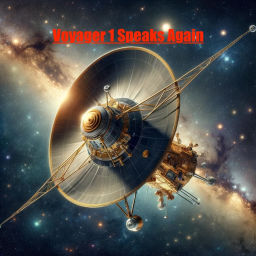
Podcast thumbnail for Voyager 1 Speaks Again

Voyager 1 Speaks Again

Claim This Podcast

by Inception Point AI

1 episodes
Updated Weekly
Accepts GuestsHas SponsorsLocation πŸ‡ΊπŸ‡Έ

Podcast Overview

Voyager 1: The Farthest Human-Made Object in Space Voyager 1 is a remarkable spacecraft that has captured the imagination of scientists and the public alike for over four decades. Launched by NASA on September 5, 1977, as part of the ambitious Voyager program, this robotic explorer has not only revolutionized our understanding of the outer solar system but has also become the first human-made object to venture into interstellar space. Its incredible journey continues to this day, providing valuable scientific data and inspiring future generations of space explorers. Mission Objectives and Achievements The primary mission of Voyager 1 was to conduct detailed studies of Jupiter and Saturn, their moons, and Saturn's rings. The spacecraft was equipped with a suite of scientific instruments, including cameras, spectrometers, and magnetometers, designed to gather data on the composition, structure, and dynamics of these distant worlds. On March 5, 1979, Voyager 1 made its closest approach to Jupiter, coming within 349,000 kilometers (217,000 miles) of the gas giant's cloud tops. During this flyby, the spacecraft captured stunning images of the planet's turbulent atmosphere, including the first detailed observations of the Great Red Spot, a massive, centuries-old storm system. Voyager 1's data revealed the complex structure and dynamics of this iconic feature, providing new insights into Jupiter's atmospheric processes. Perhaps one of the most significant discoveries made by Voyager 1 during its Jupiter encounter was the detection of active volcanoes on the moon Io. This finding marked the first time that ongoing geological activity had been observed on another celestial body, challenging prevailing theories about the formation and evolution of planetary systems. The spacecraft also captured images of Jupiter's other large moons, including Europa, Ganymede, and Callisto, revealing their diverse surfaces and hinting at the potential for subsurface oceans. After its successful Jupiter flyby, Voyager 1 set its sights on Saturn, making its closest approach to the ringed planet on November 12, 1980. During this encounter, the spacecraft uncovered intricate details in Saturn's ring system, identifying new ringlets and gaps, and even observing the effects of gravitational interactions between the rings and nearby moons. Voyager 1 also discovered several new moons orbiting Saturn, adding to the growing list of known satellites in the outer solar system. In addition to its planetary science objectives, Voyager 1 also carried out important studies of the interplanetary medium, the space between the planets filled with charged particles and magnetic fields. The spacecraft's measurements of solar wind properties and cosmic ray intensities provided valuable data for understanding the structure and dynamics of the heliosphere, the bubble-like region of space dominated by the Sun's influence. Interstellar Journey Following its successful encounters with Jupit This content was created in partnership and with the help of Artificial Intelligence AI.

Language

πŸ‡ΊπŸ‡²

Publishing Since

4/25/2024

2 verified contact emails on file for Voyager 1 Speaks Again

Pitch yourself as a guest, propose sponsorships, or reach out directly to the host.

Recent Episodes

Episode thumbnail for Voyager 1 Speaks Again

April 25, 2024

Voyager 1 Speaks Again

1 total episodes available

Deep-dive analytics for Voyager 1 Speaks Again

Frequently asked questions

Have a different question and can't find the answer you're looking for? Reach out to our support team by sending us an email and we'll get back to you as soon as we can.

What is Voyager 1 Speaks Again?

Voyager 1: The Farthest Human-Made Object in Space Voyager 1 is a remarkable spacecraft that has captured the imagination of scientists and the public alike for over four decades. Launched by NASA on September 5, 1977, as part of the ambitious Voyager program, this robotic explorer has not only revolutionized our understanding of the outer solar system but has also become the first human-made object to venture into interstellar space. Its incredible journey continues to this day, providing valuable scientific data and inspiring future generations of space explorers. Mission Objectives and Achievements The primary mission of Voyager 1 was to conduct detailed studies of Jupiter and Saturn, their moons, and Saturn's rings. The spacecraft was equipped with a suite of scientific instruments, including cameras, spectrometers, and magnetometers, designed to gather data on the composition, structure, and dynamics of these distant worlds. On March 5, 1979, Voyager 1 made its closest approach to Jupiter, coming within 349,000 kilometers (217,000 miles) of the gas giant's cloud tops. During this flyby, the spacecraft captured stunning images of the planet's turbulent atmosphere, including the first detailed observations of the Great Red Spot, a massive, centuries-old storm system. Voyager 1's data revealed the complex structure and dynamics of this iconic feature, providing new insights into Jupiter's atmospheric processes. Perhaps one of the most significant discoveries made by Voyager 1 during its Jupiter encounter was the detection of active volcanoes on the moon Io. This finding marked the first time that ongoing geological activity had been observed on another celestial body, challenging prevailing theories about the formation and evolution of planetary systems. The spacecraft also captured images of Jupiter's other large moons, including Europa, Ganymede, and Callisto, revealing their diverse surfaces and hinting at the potential for subsurface oceans. After its successful Jupiter flyby, Voyager 1 set its sights on Saturn, making its closest approach to the ringed planet on November 12, 1980. During this encounter, the spacecraft uncovered intricate details in Saturn's ring system, identifying new ringlets and gaps, and even observing the effects of gravitational interactions between the rings and nearby moons. Voyager 1 also discovered several new moons orbiting Saturn, adding to the growing list of known satellites in the outer solar system. In addition to its planetary science objectives, Voyager 1 also carried out important studies of the interplanetary medium, the space between the planets filled with charged particles and magnetic fields. The spacecraft's measurements of solar wind properties and cosmic ray intensities provided valuable data for understanding the structure and dynamics of the heliosphere, the bubble-like region of space dominated by the Sun's influence. Interstellar Journey Following its successful encounters with Jupit

This content was created in partnership and with the help of Artificial Intelligence AI.

How often does this podcast release new episodes?

This podcast updates weekly.

Where can I listen to this podcast?

This podcast is available on 8 platforms including Apple Podcasts, Spotify, and more. You can also use the RSS feed directly.

Does this podcast accept guests?

Yes, this podcast regularly features guests.

Legal Disclaimer

Pod Engine is not affiliated with, endorsed by, or officially connected with any of the podcasts displayed on this platform. We operate independently as a podcast discovery and analytics service.

All podcast artwork, thumbnails, and content displayed on this page are the property of their respective owners and are protected by applicable copyright laws. This includes, but is not limited to, podcast cover art, episode artwork, show descriptions, episode titles, transcripts, audio snippets, and any other content originating from the podcast creators or their licensors.

We display this content under fair use principles and/or implied license for the purpose of podcast discovery, information, and commentary. We make no claim of ownership over any podcast content, artwork, or related materials shown on this platform. All trademarks, service marks, and trade names are the property of their respective owners.

While we strive to ensure all content usage is properly authorized, if you are a rights holder and believe your content is being used inappropriately or without proper authorization, please contact us immediately at hey@podengine.ai for prompt review and appropriate action, which may include content removal or proper attribution.

By accessing and using this platform, you acknowledge and agree to respect all applicable copyright laws and intellectual property rights of content owners. Any unauthorized reproduction, distribution, or commercial use of the content displayed on this platform is strictly prohibited.