- 24
- Episodes
- 2
- Ratings
- Daily
- Cadence
- 2026
- First episode
About A Fisherman's Faith
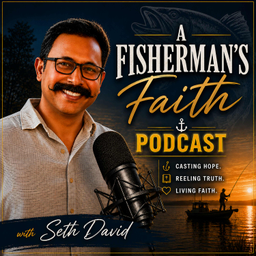
A Fisherman's Faith by Seth David Vivek is a podcast where Seth shares honest reflections on faith, life, relationships, and personal growth through the lens of biblical truth and everyday experiences. Each episode offers practical encouragement and Christ-centered wisdom to help listeners walk more closely with God in the midst of life's ordinary moments. sethdavidvivek.substack.com (https://sethdavidvivek.substack.com?utm_medium=podcast)
- Publisher
- Seth David Vivek
- Category
- religion & spirituality · society & culture
- Language
- en
- Explicit
- No
- First episode
- 9 Jul 2026
- Latest episode
- 12 Oct 2026
Latest episodes
24 episodes in the feed.
12 Oct 2026
A Fisherman’s Battle Within - Can Repentance Transform My Heart ?
For most of this week, my wife and I have been going through Romans chapters 6 through 8 during our morning devotions. As we have been reading and reflecting on these chapters, one thing has continued to stand out to me: the battle against sin is not something we face only when we first come to Christ. It is a daily battle, and repentance is part of our daily walk with Him. When we talk about repentance, we often think about turning away from sin when we first come to know the Lord. And that is certainly part of it. But repentance does not end there. As we continue walking with Christ, the Holy Spirit keeps working in our hearts, helping us recognize the things within us that do not reflect His character. He teaches us to turn away from those things and turn our hearts back toward God. I have come to realize that this process does not always come naturally to me. Examining my own heart and acknowledging my sinful nature requires a deliberate and intentional choice. Left to myself, my tendency is often to explain my actions, justify my reactions, and focus on what someone else has done rather than honestly examine what is happening within me. It is much easier to defend myself than to humble myself before the Lord. And that is where I believe the work of the Holy Spirit becomes so important. He helps us see ourselves honestly. He brings us to a place where we stop making excuses and begin surrendering our hearts to God. Let me give you an example. Have you ever had a conversation with someone that did not go the way you expected? Maybe someone said something that offended you, dismissed your opinion, or treated you in a way you felt was unfair. The conversation ends, but in your mind, it keeps going. You replay what was said. You think about what you should have said. You imagine how you could have responded differently, and sometimes you even prepare your argument for the next time you see that person. I have done that more times than I can count. And sometimes, as I replay those conversations, the Lord helps me see something I did not want to see at first. Yes, the other person may have spoken harshly. Yes, their actions may have been wrong. But what about my own heart? Was I holding on to anger? Was my pride wounded? Was I more concerned about proving that I was right than understanding the other person? Was I unwilling to let go because I wanted the last word? Those are not always comfortable questions to ask. But they are necessary questions if we genuinely want the Lord to transform us. In Romans 6:1–2, Paul asks a question that challenges the way we understand grace. He writes, “Are we to continue in sin so that grace may increase?” And then he answers, “May it never be!” In other words, the grace of God is never an excuse for us to become comfortable with sin. We do not receive His grace so that we can continue living however we want. We receive His grace as people who have been brought into a new life in Christ, a life in which sin is no longer meant to rule over us. That does not mean we will never struggle or fail. It means we should no longer be content to remain where we are. When the Lord reveals something in our hearts that needs to change, our response should not be to ignore it or justify it. Our response should be repentance. And this brings me to something else I have been reflecting on in Romans 7. Paul explains that the law makes us aware of sin. The law is like a mirror. A mirror does not create the dirt on our face; it simply reveals what is already there. In the same way, God’s Word exposes things in our hearts that we might otherwise overlook. As we read Scripture, we may begin to recognize our impatience, our resentment, our pride, our desire to control situations, or our unwillingness to forgive. We may even discover that something we have always considered part of our personality is actually an area where the Lord wants to bring change. When that happens, we face a choice. We can say, “Anybody would have reacted that way,” or “They deserved what I said.” We can keep building a case to defend ourselves. Or we can come before the Lord and ask, “Lord, what are You showing me about my own heart? What needs to change in me?” That second response requires humility. And humility is not something we can manufacture simply by trying harder. We need the Holy Spirit to work in us, soften our hearts, and help us become willing to acknowledge the truth about ourselves. Paul expresses the struggle of the Christian life so honestly in Romans 7:19. He writes, “For the good that I want, I do not do, but I practice the very evil that I do not want.” I can relate to that struggle. There are times when I know what the right response should be, yet I find myself reacting in a way that does not reflect the person I want to be in Christ. I may recognize the right thing to do, but in the moment, my pride, frustration, or desire to defend myself gets in the way. I am not sharing this because I believe I have mastered the battle against the flesh. I certainly have not. And I do not want to give the impression that walking with Christ means we reach a point where we no longer struggle with sin. I am sharing this because I believe we need to be honest about the battle we face and about our need for the Lord every single day. We also need to recognize what the battle is really about. It is easy to focus entirely on what other people have done wrong. We cannot control their attitudes, their words, or their choices. But we are responsible for how we respond. And if we spend all our energy trying to correct everyone else while refusing to examine ourselves, we may miss the very work God wants to do in our own hearts. This is why repentance and humility are so closely connected. When we become willing to acknowledge our failures, we open ourselves to the transforming work of the Holy Spirit. We begin to recognize that we do not have the strength or wisdom to live this life faithfully through our own efforts. We need to depend on Him. In Romans 8:6, Paul writes, “For the mind set on the flesh is death, but the mind set on the Spirit is life and peace.” I find that verse especially meaningful when I think about those everyday moments when I feel offended, frustrated, or misunderstood. When my mind is governed by the flesh, I want to protect my pride, prove that I am right, hold on to resentment, or control the outcome. My thoughts keep returning to what the other person did and how I can defend myself. But when I bring those thoughts before the Lord and allow the Holy Spirit to redirect my heart, I begin to see things differently. Perhaps I need to listen instead of argue. Perhaps I need to admit that my own words were hurtful. Perhaps I need to forgive, even when I still feel hurt. Or perhaps I need to trust God with a situation I cannot resolve myself. That change does not always happen instantly. Sometimes I recognize my failure only after the conversation is over, when I have had time to reflect on my response. But even then, I can bring it before the Lord, acknowledge where I was wrong, ask for His forgiveness, and seek His help to respond differently the next time. That, to me, is part of what it means to live a life of daily repentance. It is not about pretending we never fail. It is about refusing to make peace with the sin God is revealing in us. It is about continually returning to Him with a humble and willing heart. And we must remember that repentance does not lead us into hopelessness. It leads us back to the grace of God. Romans 8:1 reminds us, “Therefore there is now no condemnation for those who are in Christ Jesus.” What a wonderful assurance that is. When we acknowledge our sin and turn to the Lord, we do not have to remain trapped in shame or condemnation. We can receive His forgiveness and continue walking with Him. His grace does not tell us that sin does not matter. His grace reminds us that our failures do not have to define the rest of our lives. And there is another reason this matters deeply to me. As the Lord teaches us to repent and we begin to experience His grace more fully, that grace should also change the way we love other people. When we begin to understand how much patience the Lord has shown us, how often He has corrected us, and how graciously He has received us when we have fallen short, it becomes harder to look at someone else’s failures with a judgmental heart. This is especially important when we encounter people who have drifted away from the Lord. Perhaps they have made choices that have hurt themselves or others. Perhaps they have been away from the faith for a long time. We may be tempted to remind them of their failures, question their sincerity, or make them feel that they have gone too far to return. But what if, instead, we allowed the grace we have received from Christ to shape the way we approach them? What if we were willing to walk alongside them with patience, speak the truth in love, and let them know that the door is open when they are ready to turn back to the Lord? That does not mean we approve of sinful choices or pretend that sin has no consequences. We can hold firmly to God’s truth while still treating people with compassion. We can recognize that we are not the ones who restore a person’s heart. That work belongs to God. But our lives and our responses can reflect His grace and help remind people that their failures do not have to be the end of their story. Sometimes, the most meaningful thing we can offer someone is not a reminder of everything they have done wrong, but a patient presence that points them back to the One who is able to forgive, restore, and transform them. And perhaps the Lord can use the very things He is teaching us through our own struggles to help us become that kind of person to someone else. When we have honestly faced our own sin, we become less eager to condemn others. When we have experienced the Lord’s forgiveness, we become more willing to extend forgiveness. And when we recognize how desperately we need His grace every day, we begin to see others through the same lens of mercy and hope. That is one of the ways repentance transforms the heart. It changes not only how we walk with God, but also how we treat the people He places in our lives. And before I close, I want to remind us that none of this is magic. We cannot simply wish for a transformed heart and expect it to happen without a willingness to surrender. Dying to the flesh requires a deliberate and intentional choice to sacrifice the desires, attitudes, and habits that pull us away from God. And that surrender is not always easy. There is a real struggle involved, and at times, there is suffering as we learn to let go of what our flesh wants and yield ourselves to the leading of the Holy Spirit. Our pride may resist. Our desire to have things our own way may fight back. But this is where we must choose to trust the Lord, even when obedience is uncomfortable and surrender comes at a cost. We cannot accomplish this transformation through our own strength, but we must be willing to participate in the work the Holy Spirit is doing within us. Day by day, moment by moment, we choose to deny ourselves, surrender our desires to Him, and allow Him to shape us into the image of Christ. So, as I reflect on Romans 6 through 8, I am reminded that the battle within is real. The struggle against our sinful nature is something we must take seriously, but we do not have to face it in our own strength. The Lord calls us to recognize our sin, humble ourselves before Him, and depend on the Holy Spirit to lead us into a life that reflects Christ more faithfully. I know I still have much to learn. There are times when I get it wrong, times when I see my own pride only after the fact, and times when I need to return to the Lord and ask Him to change my heart. But I am thankful that He does not leave us to struggle alone. He continues to teach us, correct us, forgive us, and draw us closer to Himself. My prayer is that we would become people who are willing to let God examine our hearts, people who do not use His grace as an excuse to remain unchanged, and people who extend to others the same patience, forgiveness, and love that we have received from Him. Because when repentance becomes part of our daily walk with Christ, it does more than help us recognize our sin. By the work of the Holy Spirit, it begins to transform the way we think, the way we respond, and the way we love. Thank you for joining me on A Fisherman’s Faith. Love you all in our Lord’s love, and until next time, keep loving, learning, listening, and living for Christ. This is a public episode. If you would like to discuss this with other subscribers or get access to bonus episodes, visit sethdavidvivek.substack.com (https://sethdavidvivek.substack.com?utm_medium=podcast&utm_campaign=CTA_1)
29 Sept 2026
Rusted Shears, a Trimmed Bush, and an Unfinished Story.
Hello, everyone. This is Seth David Vivek, and welcome back to another episode of “A Fisherman’s Faith” Podcast. Have you ever looked at someone you love and quietly thought, “I just don’t see how this can change”? Maybe you’ve prayed for years. Maybe you’ve watched the same struggles continue. Maybe you still say, “I trust God,” but somewhere deep inside, you’ve begun to wonder whether the story is already written. I’ve been there. And this morning, the Lord used something as simple as an old, rusted pair of hedge shears to remind me of something I don’t want to forget, we may see the condition of something, but God sees its purpose. A couple of days ago, Sister Lisa asked me to help move a couple of tables from her porch back to the sisters she had borrowed them from. After making my final delivery at Sister Camille’s house, we talked for a little while about some car problems and a few other things. As I was getting ready to leave, I noticed an old pair of hedge shears sitting on her deck. Sister Camille asked me if I wanted them, and I said, “Sure.” I really didn’t know why I took them. The handle was sticky, the blades were rusty, and they looked like they had been sitting around for quite some time. But I put them in my SUV and went home. This morning, I noticed them again. I took them out, wrapped the handles with some duct tape, put a little WD-40 on the blades, and thought, “Let’s see if these things still work.” I took them to the bushes in front of my house and started trimming. To my surprise, they worked really well. The blades were still sharp, and within a few minutes, I had finished the job. I stood there looking at those old shears and the bush I had just trimmed, and the Lord brought a thought to my heart: How easily I could have judged those shears by their appearance and missed the purpose they still had. How often do I do the same thing with people? How often do we look at someone’s past, mistakes, or circumstances and decide there isn’t much left to expect? After watching someone struggle for a long time, we can become tired. We may still love them, but our expectation can quietly disappear. Scripture reminds us in 1 Samuel 16:7, “Man looks at the outward appearance, but the LORD looks at the heart.” I see the outside. God sees the heart. That does not mean we ignore reality. Brokenness is real, choices have consequences, and sometimes wisdom requires boundaries. But what I can see is not the complete picture. Think about Saul. Before his encounter with Christ, he was persecuting believers, yet God was not finished with him. Think about Joseph. He was betrayed by his brothers, sold into slavery, falsely accused, and imprisoned. His circumstances looked nothing like the future God had prepared for him, yet God was working through a story Joseph could not fully see. And this becomes especially personal when I think about someone who is my own blood, someone I love very deeply. There have been times when I have pleaded with God, “Lord, how long? What do You want me to do? How can this change?” There are days when I become discouraged because I don’t see the change I’m praying for. But the Lord has been teaching me something very simple: I am responsible for my obedience, not for controlling someone else’s heart. I can pray. I can love. I can speak truth when the opportunity is there. I can set appropriate boundaries. But I cannot change another person. Only God can do that. I have seen this truth in the lives of men I have known within a true body of Christ, men whom the world had essentially written off. Their past was real, and their failures were real. But through daily repentance, humility, obedience, and a willingness to receive correction, I watched men begin to walk differently. Their stories taught me that a person’s past does not give me the authority to determine their future. Ephesians 2:10 says, “For we are His workmanship, created in Christ Jesus for good works.” That includes you, and it includes the people you are praying for. Maybe today you feel like those old hedge shears. Maybe you look at your past and think, “I’ve made too many mistakes.” Maybe you wonder whether you have wasted too much time or whether there is still any purpose left for you. If that’s you, bring your life honestly before the Lord. Repent where you need to repent, receive His grace, and keep walking with Christ. And if there is someone you have become discouraged about, bring that person before the Lord. Ask Him to give you patience, wisdom, humility, and love. Trust Him with what you cannot control. Philippians 1:6 gives me great comfort: “For I am confident of this very thing, that He who began a good work in you will perfect it until the day of Christ Jesus.” The work is His. The timing is His. My responsibility is to remain faithful to Him. But something happened this Sunday that caused me to look at this message from another angle. I had written this podcast transcript on Friday. Then, during our church service on Sunday, Sister Regina Adams shared a testimony and quoted Philippians 2:3: “Do nothing from selfishness or empty conceit, but with humility consider one another as more important than yourselves.” As I listened to her, the Lord brought the message back to my heart. I had been thinking about how easily we judge someone by what we see. But Philippians 2:3 challenged me to examine my own heart. Humility is not simply being willing to admit that I might be wrong. It means learning to value another person above my own thoughts, preferences, assumptions, and judgments. That can be difficult when we believe we know what someone needs, especially when we love them and have watched their choices for a long time. But Scripture calls me to something higher than my own judgment: “Consider one another as more important than yourselves.” That does not mean calling wrong things right, ignoring consequences, or abandoning wisdom and discernment. It means remembering that another person is not merely the sum of their mistakes, their circumstances, or what I currently see. Philippians 2:4 continues, “do not merely look out for your own personal interests, but also for the interests of others.” That changes the way I pray. Instead of only asking, “Lord, change this person,” I can also ask, “Lord, show me how to love this person better. Show me where I am wrong. Show me what I cannot see. Help me to speak when I should speak, remain silent when I should remain silent, and serve when You give me the opportunity.” So today, I want to leave you with one simple thought: don’t write the final chapter when God is still writing the story. You may not know how the story will end. I don’t either. But we know the One who holds it. Psalm 34:18 says, “The LORD is near the brokenhearted and saves those who are crushed in spirit.” So, keep walking in truth. Keep your heart humble. Keep bringing the people you love before the Lord. And remember that you are not responsible for writing their story. When we walk in obedience and remain willing to listen to the Lord, He can use an old pair of rusted shears, a trimmed bush, a Sunday testimony, and so much more to reveal something much deeper: we are not the authors of one another’s stories, and we are not the judges of one another’s worth. We are called to walk humbly, consider others more important than ourselves, and let God do His work. If this episode spoke to you, share it with someone who may need this reminder today. Maybe someone who is carrying a burden you cannot fix for them. Remind them that they can bring that burden to the Lord and leave it there. This is Seth David Vivek, and this is “A Fisherman’s Faith”. Thanks for reading and listening. You can listen to *A Fisherman’s Faith* on major podcast platforms, including Spotify, Apple Podcasts, iHeartRadio, Substack, Castbox, and Listen Notes. Until next time, keep your eyes on Christ, keep your heart humble, and keep pressing forward. Love you all in our Lord’s love. This is a public episode. If you would like to discuss this with other subscribers or get access to bonus episodes, visit sethdavidvivek.substack.com (https://sethdavidvivek.substack.com?utm_medium=podcast&utm_campaign=CTA_1)
23 Sept 2026
Gratitude Seems to Be the Best Posture of a Broken Heart.
Last week, I was dealing with a work deliverable. I did meet the deliverable, but there was some friction and tension around it, and eventually I had to go back and work on it all over again, this time in a somewhat different format and presentation style. Yesterday, I started working at 4:30 in the morning. From a very young age, I’ve learned that my brain seems to work better in the early morning, and apparently that hasn’t changed much over the years. There is something about those quiet hours before the day begins that helps me think, focus, and get things done. As I was thinking about the difficulty I had faced at work, I was talking with a dear brother and an elder in our church who continues to disciple me every week with so much grace and wisdom. He told me something that was simple to say but very difficult for me to digest. He said, “The best way to face every challenging situation is with a grateful heart.” And then he gave me what I think is the key to understanding that kind of gratitude: “Nobody owes me anything, but I should keep on giving anyway.” That sounds simple, doesn’t it? But when you really stop and examine your own heart, it is not simple at all. So much of our frustration comes from expectations. We expect people to understand us. We expect them to appreciate what we do. We expect our work to be recognized. We expect people to respond the way we think they should respond. And when those expectations aren’t met, something begins to rise up in us. We become frustrated, disappointed, or even resentful. But what happens when I truly believe that nobody owes me anything, and yet I choose to keep giving anyway? That changes everything. I’m no longer giving because I expect something back. I’m giving because I have already received. And I have received far more than I could ever repay. That conversation brought me back to something else this brother had shared with me during one of our Zoom calls. He said that as believers, we are permanently in debt to Christ. We can never repay what He has done for us. And yet, Christ calls us to live with a grateful heart, and one of the ways that gratitude is expressed is by loving one another. That reminded me of something Brother AZ Adams said in our church service on Sunday. He made the same point in a way that stayed with me: the way God expects us to respond to the extraordinary love we owe Him is by loving one another without expectations. I found myself thinking about that most of Sunday night. How is it actually possible to love somebody without expecting anything in return? How do I serve without needing recognition? How do I give without needing appreciation? How do I love someone who may not understand me, may not appreciate me, or may not respond to me the way I think they should? And I think the answer goes much deeper than simply trying harder to be a better person. Jesus said in John 13:34, “A new commandment I give to you, that you love one another, even as I have loved you.” That is the standard. Not loving others because they deserve it. Not loving others because they have earned it. Not loving others because we expect something in return. We love because Christ first loved us. First John 4:19 says, “We love, because He first loved us.” That changes the source of the love. Because if I’m trying to produce that kind of love out of my own strength, eventually I’m going to run out. My patience runs out. My kindness runs out. My willingness to forgive runs out. My generosity becomes conditional. My love becomes dependent upon how people treat me. But when I come to the end of myself, something different begins to happen. I think that is one of the hardest lessons God has been teaching me over the last several years. I have to come to the end of my own sufficiency, my own righteousness, my own strength, and even my own ability to fix things. And when those things begin to die in me, there is room for the life of Christ to flow through me. Paul said in Galatians 2:20, “I have been crucified with Christ; and it is no longer I who live, but Christ lives in me.” That is not just a beautiful Scripture to quote. That is a very painful reality to live through, because the flesh does not surrender easily. I can testify to that in my own life. I am not there yet. I cannot manufacture this kind of life in myself, and I certainly cannot get there by simply making a stronger resolution tomorrow morning. But I am beginning to understand that this is the work of the Holy Spirit in me. In His grace, He continues to reveal truth and bring light into places in my heart that I would probably rather leave alone. And for that, I am extremely grateful. When I look back over the last few years of my life, I sometimes think they have been some of the most difficult years, but at the same time, they have also been some of the richest years spiritually. There have been things happening in my family, circumstances involving my children, disappointments, pain, and paths that my sons have taken that I never imagined when they were young. There have been moments when I have felt completely broken. But perhaps that brokenness has been one of God’s greatest instruments of grace in my life. Psalm 51:17 says, “The sacrifices of God are a broken spirit; a broken and a contrite heart, God, You will not despise.” There is something about being broken that exposes the truth about ourselves. When everything is going well, it is easy to believe that we are strong. It is easy to believe that we are patient, loving, forgiving, generous, and spiritually mature. But put us in a situation where our expectations are disappointed, where someone misunderstands us, where our plans fall apart, or where someone we love chooses a path we would not have chosen, and suddenly we discover what is really inside us. The Lord has been showing me that my flesh is much stronger than I like to admit. And the flesh cannot simply be educated into submission. It has to be brought to the cross. That is why I think brokenness can become a place of revelation. Not because pain itself is good, but because God can use what breaks us to show us how much we have been depending on ourselves. And perhaps that is what my brother was trying to help me see when he told me, “Nobody owes you anything, but keep giving anyway.” Maybe gratitude is not primarily a feeling. Maybe gratitude is a posture of the heart that says, “Lord, everything I have already received from You is more than I could ever deserve. So I don’t need to keep looking at what others owe me.” Christ doesn’t owe me anything, and yet He gave me everything. Romans 5:8 says, “But God demonstrates His own love toward us, in that while we were yet sinners, Christ died for us.” When I really understand that, my perspective begins to change. I don’t have to keep a ledger of who appreciated me and who didn’t. I don’t have to keep track of who gave back and who didn’t. I don’t have to make sure everything is fair according to my understanding. I can simply ask, “Lord, how can Your life flow through me into this situation?” That is a very different question. And maybe that is what it means to become a channel of divine grace. I don’t become the source. Christ is the source. I simply become available to Him. So even something as ordinary as a difficult work deliverable can become a spiritual lesson. The frustration I experienced wasn’t wasted. It exposed something in me. It showed me how quickly expectations can become demands. And it gave me another opportunity to ask the Lord to teach me gratitude. I am still learning. I am still being broken. I am still discovering how much of me needs to die so that more of Christ can live through me. But I am grateful that the Lord doesn’t wait for me to become perfect before He teaches me. He meets me right in the middle of my weakness, my failures, my disappointments, and my brokenness, and He patiently continues His work. Philippians 1:6 gives me great encouragement: “He who began a good work in you will perfect it until the day of Christ Jesus.” So maybe the lesson for me this week is very simple. Nobody owes me anything. But I have received everything in Christ. And because I have received such extraordinary love, I want to learn to give extraordinary love without expectations. Not because I have mastered it, not because I have arrived, but because Christ is still working in me. And perhaps that is what a grateful heart really looks like. It is not a heart that has no pain. It is not a heart that never gets frustrated. It is a heart that, even in the middle of those things, keeps turning back to Christ and saying, “Lord, You have already given me more than I could ever repay. Teach me to love others with the love You have given me.” Thanks so much for reading and listening to this fisherman’s lesson in faith. Love you all in our Lord’s love. A note to my readers & Listeners: If you’re a podcast listener, you can also access and listen to my podcast, “A Fisherman’s Faith”, on iHeartRadio, Spotify, and Apple Podcasts. This is a public episode. If you would like to discuss this with other subscribers or get access to bonus episodes, visit sethdavidvivek.substack.com (https://sethdavidvivek.substack.com?utm_medium=podcast&utm_campaign=CTA_1)
Reach and audience
Public platform figures. Ratings count people who left a rating, not total listeners.
- Apple Podcasts (US)
- 5.0 / 5
- 1 ratings
- Spotify
- 5.0 / 5
- 1 ratings
Contact A Fisherman's Faith
- Guest appearances
- Does not typically book guests
Based on episode analysis; this does not confirm that the show is currently accepting guests.
Host of A Fisherman's Faith?
Claim your podcast to manage its listing and keep your show details accurate.
Pod Engine is an independent podcast discovery and analytics service and is not affiliated with or endorsed by this podcast. Artwork and show content belong to their owners. Full legal notice.
Explore this show
Podcast research with Pod Engine