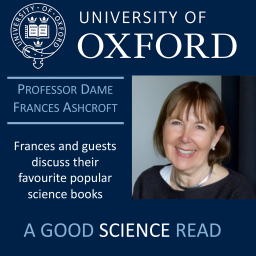
Interested in science and the people behind the science? Looking for an informative, entertaining, thought-provoking and accessible read? Join Professor Dame Frances Ashcroft and her guests as they discuss their favourite popular science books, sharing their love of science, and the books they consider most enjoyable and that offer something to everyone. Episodes will be published fortnightly.
Professor Ashcroft is Professor of Physiology at the University of Oxford and a Fellow of Trinity College Oxford. Her own books include 'Life at the Extremes: the science of survival' and 'The Spark of Life: electricity in the human body'.
A Good Science Read: How our brains make our selves
Professor Dame Uta Frith and Professor Frances Ashcroft discuss 'Our Brains Our Selves: what a neurologist’s patients taught him about the brain' by Masud Husain Masud Husain is a neurologist and a Professor of Cognitive Neuroscience at the University of Oxford. This book tells the stories of seven of his patients, whose personal and social identities were deeply affected by their neurological condition. He shows how their very different problems have illuminated our understanding of how our brains work and how they generate our sense of self. The book also illustrates how impaired brain function can lead to a loss of our social identity. It is written with great insight and compassion.
Professor Dame Uta Frith is Emeritus Professor of Cognitive Development at the Institute of Cognitive Neuroscience at University College London, and a Fellow of the Royal Society. She has a special interest in autism and dyslexia and pioneered much of the key research into these brain conditions. Her book 'Autism: Explaining the Enigma' provided the first account of what happens inside the mind of a person with autism.
30 May 2025
A Good Science Read: the Coming Plagues
Science writer Georgina Ferry and Professor Frances Ashcroft analyze Laurie Garrett's *The Coming Plague* and Jeremy Farrar and Anjana Ahuja's *Spike*, exploring humanity's preparedness for emerging infectious diseases in this interview.
22 Apr 2025
A Good Science Read: Masters of Science Writing
Professors Dinah Birch CBE and Frances Ashcroft analyze John Carey's science writing anthology and Katherine Rundell's book on endangered species, exploring science writing and endangered species in this interview.
4 Mar 2025
A Good Science Read: Metabolism
Professor Tim Coulsen and Professor Frances Ashcroft discuss Burn: the Misunderstood Science of Metabolism by Herman Pontzer and Transformer: The Deep Chemistry of Life and Death by Nick Lane. Both these books are concerned with science of metabolism – the process by which food is burnt to produce energy – but they approach it from different perspectives. Burn is an engaging account of Herman Pontzer’s studies of human metabolism in different populations. He discusses the ways in which metabolism controls every aspect of our health, why exercise doesn’t increase result in weight loss, and why the only way to lose weight is to reduce your calorie intake. Transformer asks how did life originate? What is it that animates our cells, what are the metabolic reactions that power our cells, and how are they regulated?. At the heart of metabolism is a series of reactions known as the Krebs cycle and Nick Lane offers radical new insights into how this originated and evolved.
Tim Coulsen is Professor of Zoology at the University of Oxford and a Professorial Fellow of Jesus College, Oxford. His research considers how ecosystems change in response to changes in the number of the top predator species. He has also recently published a popular science book The Universal History of Us.
Websites: https://www.biology.ox.ac.uk/people/tim-coulson https://nick-lane.net/ https://globalhealth.duke.edu/people/pontzer-herman
24 Jan 2025
A Good Science Read: 'The Fly Trap' and 'As If Human: AI and Artificial Intelligence'
Professor Sir Charles Godfray and Professor Frances Ashcroft discuss The Fly Trap by Fredrik Sjöberg and As if Human: AI and Artificial Intelligence by Neil Shadbolt and Roger Hampson. Professor Charles Godfray and Professor Frances Ashcroft discuss The Fly Trap by Fredrik Sjöberg and As if Human: AI and Artificial Intelligence by Neil Shadbolt and Roger Hampson.
The Fly Trap describes the life of the author on a remote island in the Swedish archipelago where he hunts for hoverflies. Partly autobiographical, partly a discourse on insects, collecting, and the life of some extraordinary butterfly collectors, it is an enchanting read, quite lyrical in some places and very funny in others. As if Human: AI and Artificial Intelligence discusses the ethical challenges posed by artificial intelligence. It addresses questions such as: what moral principles should we endow machines with?; who is accountable when things go wrong?; how do we use AI to empower rather than oppress people? How do we control privacy? It concludes with a set of guidelines (which the authors term ’proverbs’) on how a good citizen should approach the future.
Sir Charles Godfray is Professor of Population Biology at the University of Oxford and Director of the Oxford Martin School and of the Oxford Martin Programme on the Future of Food. He is also a Fellow of both the Royal Society and of Balliol College Oxford. His research interests include food security, biodiversity, and environmental science. He also has a passion for insects, particularly a group of tiny parasitic wasps.
15 Oct 2024
Why Sex Matters
Professor Russell Foster and Professor Frances Ashcroft discuss The Red Queen: Sex and the Evolution of Human Nature by Matt Ridley and Dr Tatiana's Sex Advice to All Creation by Olivia Judson. Series 2 Episode 9
The Red Queen is an excellent and accessible overview of sexual evolution. It discusses why sex matters, why most organisms have 2 genders, why we are not all hermaphrodite, what strategies animals employ to pass on their genes, and how sex influences the evolution of human nature. Dr Tatiana's Sex Advice to All Creation is written like agony aunt advice column in which all kinds of animals ask for help with their sex lives. This provides the framework for a highly entertaining and informative discussion of the evolutionary biology of sex and the extraordinary variety of ways of reproduction employed by organisms from stick insects to chimpanzees.
Russell Foster is Professor of Circadian Neuroscience at the University of Oxford and a Fellow of both Brasenose College Oxford and the Royal Society of London. His research concerns our circadian rhythms – the 24-hour cycles that are part of our internal body clock - and how they are regulated by light. He is also an expert on sleep.
Websites
https://www.ndcn.ox.ac.uk/team/russell-foster
https://www.mattridley.co.uk/
15 Oct 2024
A Good Science Read: A Walk on the Wild Side
Professor Richard Fortey joins Professor Frances Ashcroft to discuss Entangled Life by Merlin Sheldrake and Wilding by Isabella Tree. Series 2 Episode 8
Entangled Life is fascinating journey into the world of fungi - what they are, how they evolved, their hyphal networks below the ground, their mycorrhizal relationships with plants, their symbiotic interactions with algae in lichens, and the mind-altering chemicals they make. Wilding describes how the switch from intensive farming to minimal intervention led to a spectacular return of wildlife on the Knepp estate in Sussex, including rare species such as turtle doves, nightingales and purple emperor butterflies.
Richard Fortey is a fellow of the both Royal Society and the Royal Society of Literature. He is the author of numerous popular science books and has presented many radio and TV programmes on natural history. His research has focussed on trilobites but he also has a passion for fungi. His most recent book is Close Encounters of the Fungal Kind.
Websites
https://royalsociety.org/people/richard-fortey-11450/
https://www.merlinsheldrake.com/
https://knepp.co.uk/
15 Oct 2024
A Good Science Read: On the Origin of Modern Humans
Professor Chris Miller and Professor Frances Ashcroft discuss Who we are and how we got here by the Harvard geneticist David Reich. Series 2 Episode 7
Professor Chris Miller and Professor Frances Ashcroft discuss Who we are and how we got here by the Harvard geneticist David Reich.
The book is a compelling account of the origin of modern humans. Reich explains how our recent ability to study ancient DNA has dramatically revised our understanding of how humans spread all over the world. He describes evidence for interbreeding between ancient humans, Neanderthals and Denisovans and shows how we carry in our genes indications that we are descended from ghost populations that no longer exist but must once have done so. He considers how modern human populations are related to each other in ways no-one expected and ponders the implications of the human genome revolution for society.
Chris Miller is Emeritus Professor of Biochemistry at Brandeis University and a member of the US National Academy of Sciences.
Websites
https://www.brandeis.edu/biochemistry/faculty/miller-chris.html
https://reich.hms.harvard.edu/
13 May 2024
A Good Science Read: How everything works
Dr Roger Highfield joins Professor Frances Ashcroft to discuss Pain: A Ladybird Expert book by Irene Tracey and A Short History of Nearly Everything by Bill Bryson. Pain is a very short book but it encompasses everything you want to know about pain in a clear and informative way. What it is, how we measure it, why we need it, and how we can – and often alas, cannot – treat it. A Short History of Nearly Everything is a highly accessible and entertaining account that of the world we live on that ranges from the creation of the solar system, to the structure of the atom, plate tectonics, the rise of life, the development of modern humans and how your cells work. The book won the Royal Society Aventis Science Book Prize in 2004 and the Descartes Prize in 2005, and was the biggest selling non-fiction book of the decade.
Roger is the Science Director of the Science Museum Group, a group of five museums that includes the Science Museum in London. He is also a Visiting Professor of Public engagement at the Universities of Oxford and University College London, a Fellow of the Academy of Medical Sciences and Honorary president of the Association of British Science Writers. Previously, Roger was the science editor of The Daily Telegraph for more than 20 years, and Editor of New Scientist for 4 years. He has written or co-authored nine books, most recently The Dance of Life, Symmetry Cells and How we become Human.
Websites
https://www.rogerhighfield.com/my-sites
https://www.sciencemuseum.org.uk/home
https://en.wikipedia.org/wiki/Bill_Bryson
https://www.ox.ac.uk/about/organisation/university-officers/vice-chancellor
29 Apr 2024
A Good Science Read: How humans changed the landscape and ourselves
Professor Peter Burge joins Professor Frances Ashcroft to discuss Dust: The Modern World in a Trillion Particles by Jay Owens and The Species that Changed Itself or How prosperity reshaped humanity by Edwin Gale. Dust is all around us and we breathe it in with every breath we take, but it is not something most of think much about. Yet it impacts all our lives in multiple ways, causing environmental disaster and damaging our health. In Dust, Jay Owens combines history, politics, travel writing and science to tell the story of dust, from particulates that cause air pollution, to toxic dust from dried up seas, radioactive nuclear fallout and the role of dust in shaping the climate.
The Species that Changed Itself combines biology, anthropology, history, epidemiology, and science with fascinating stories and literary references to tell the story of our phenotype. Our phenotype – the way we look and behave – things like height, weight, skin colour and so on, is determined by the interaction between our genes and our environment. But unlike all other species we have created our own environment and in doing so, Gale argues, we have reshaped ourselves - both our physical bodies and our behaviour.
Peter Burge is an Honorary Consultant at the Oxford University Hospitals, a Departmental Lecturer in orthopaedic surgery at the University of Oxford and a past President of the British Society for Surgery of the Hand.
15 Apr 2024
A Good Science Read: Evolution - from Fossils to Finches
Professor Paul Smith and Professor Frances Ashcroft discuss Wonderful Life by Stephen Jay Gould and The Beak of the Finch by Jonathan Weiner. Wonderful Life focuses on the weird and wonderful fossils found in the Burgess Shale in the Canadian Rockies – their discovery, what they tell us about evolution and their re-evaluation many years later. The Beak of the Finch is also about evolution but rather than fossils it is about evolution in action on a tiny volcanic island in the Galapagos. It describes the painstaking work of Peter and Rosemary Grant who studied Darwin’s famous finches for over 40 years and showed that evolution can take place in real time. Their story is interwoven with that of Darwin and his studies of the Galapagos finches.
Professor Paul Smith is Director of the Oxford University Museum of Natural History, Professor of Natural History at the University of Oxford and a Fellow of Kellogg College Oxford. He is both a geologist and a palaeontologist whose research has focussed on the origin of vertebrates. He has worked extensively in the Arctic and in 2017 he was awarded the Polar medal for outstanding achievements in the field of polar research
Websites
https://oumnh.ox.ac.uk/people/paul-smith
https://oumnh.ox.ac.uk/
https://eeb.princeton.edu/people/b-rosemary-grant
1 Apr 2024
A Good Science Read: The Secret Life of the Cuckoo
Professor Richard Boyd joins Professor Frances Ashcroft to discuss Cuckoo - Cheating by Nature by Nick Davies. The cuckoo is a ruthless parasite that lays its egg in another bird’s nest, tricks them into accepting the egg as its own and entices them to feed its chick. This book is a riveting account of an extraordinary bird and it reads like a detective story. Nick Davies asks every question you can possibly imagine about how the female cuckoo and the cuckoo chick itself manage to deceive their host, and he describes the intricate experiments he and his colleagues have conducted to unravel the answers. He interweaves this with stories of naturalists from the past who have studied the cuckoo. He writes beautifully and his passion for the cuckoo and the natural world shines through.
Richard Boyd, Emeritus Professor of Physiology at the University of Oxford and Emeritus Fellow of Brasenose College is a distinguished physiologist and an Honorary Fellow of the Physiological Society. He also happens to have a passion for birds.
Website: https://www.zoo.cam.ac.uk/directory/nick-davies
18 Mar 2024
A Good Science Read: The importance of Mathematics and Engineering
Professor Marcus du Sautoy joins Professor Frances Ashcroft to discuss A Mathematician’s Apology by GH Hardy and Exactly: How Engineers Created the Modern World by Simon Winchester. A Mathematician’s Apology is GH Hardy’s panegyric on pure mathematics in which he claims that pure maths is the pinnacle of the sciences and that it has an inherent beauty. Exactly tells the stories of the pioneering engineers who developed the precision tools and machinery that underpin the modern world. Along the way, the author addresses questions like why is precision important, how do we measure it, can we be too precise?
Marcus du Sautoy is Simonyi Professor of the Public Understanding of Science at the University of Oxford and a Fellow of the Royal Society of London. A distinguished mathematician with a particular interest in symmetry and number theory, he is also the author of several popular science books about mathematics, including the critically acclaimed The Music of the Primes, and he has presented numerous TV programmes.
Website: https://www.simonyi.ox.ac.uk/
4 Mar 2024
A Good Science Read: The Story of Penicillin
Professor Matthew Freeman and Professor Frances Ashcroft discuss "The Mould in Dr Florey's Coat" by Eric Lax This book tells the true story of the penicillin miracle – penicillin being the mould in Dr Florey’s coat. When most people are asked who discovered penicillin they invariably answer Alexander Fleming. But he was merely one of the people involved and arguably not even the most important. This book sets the record straight and tells the story of how it was 3 Oxford scientists, Howard Florey, Ernst Chain and Norman Heatley who isolated penicillin and turned it into a life-saving drug. It is a remarkable story, very well told, about a scientific breakthrough conducted on a shoestring budget in the middle of the second world war, that has benefitted all humanity.
Matthew Freeman is Professor of Pathology at the University of Oxford and a Fellow of both Lincoln College Oxford and the Royal Society of London. He is also Head of the Dunn School of Pathology which plays a very special part in the story the book tells about the discovery of penicillin.
Website: https://www.path.ox.ac.uk/research-group/matthew-freeman/
27 Feb 2024
A Good Science Read
Professor Frances Ashcroft gives a short introduction to this exciting new series
Reach and audience
Public platform figures. Ratings count people who left a rating, not total listeners.
Apple Podcasts (US)
5.0 / 5
1 ratings
Spotify
4.7 / 5
245 ratings
Podcast Authority Score: 22 / 100
A composite of feed quality, social presence, YouTube performance and engagement. Read the methodology.
Quality
32
Social presence
0
YouTube
0
Engagement
27
Contact A Good Science Read
Guest appearances
Books guests
Based on episode analysis; this does not confirm that the show is currently accepting guests.
Host of A Good Science Read?
Claim your podcast to manage its listing and keep your show details accurate.
Pod Engine is an independent podcast discovery and analytics service and is not affiliated with or endorsed by this podcast. Artwork and show content belong to their owners. Full legal notice.
Explore this show Podcast research with Pod Engine