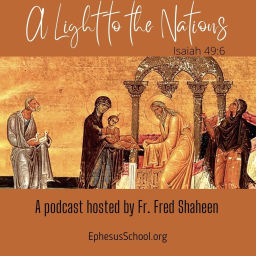
This is a podcast focusing on biblical texts and terminology and not topics. Episodes discuss how the biblical teaching is communicated through the function of words.
Acts 17:22-31.
The Apostle Paul, in Athens, takes the opportunity to preach in the Areopagus. One man, Dionysius, is among those who hear and join him. Athens is named after the goddess Athena. Its name is grammatically plural (detectable in the final “s” - “Athens”), reflecting the many statues and temples erected to the goddess in the city. This was common in the ancient world. Anyone visiting Athens would immediately know to whom the city pertained. Such convention sheds light on an otherwise puzzling fact: in the Bible, “God” in Hebrew (“Elohim”) is grammatically plural. Why is that so? And how is the God that Paul preached unlike the other deities, known and unknown, that were worshipped in the ancient world?
This is Episode 88 of A Light to the Nations, a production of the Ephesus School Network.
Notes:
Genesis 1:1
אֱלֹהִ֑ים (Elohim)
“Sing A New Song” composed and performed by Raphael Shaheen.
18 Sept 2026
The Son Of Man.
The Son Of Man.
When Jesus refers to himself in the Gospels, it is almost exclusively as “Son of Man;” that is to say, not “Son of God” as in “a king.” Moreover, Jesus is systematically referred to as “a teacher” in the Gospels more than any other appellation. In both of these aspects - Son of Man and teacher - the Gospels are following the lead of both Ezekiel and Isaiah, respectively. In Ezekiel, the title is a belittling of the kings of Judah and Israel who were supposed to be the representatives of God. Because of their disobedience, God makes a mere Son of Man (ben-Adam) his plenipotentiary. In Isaiah, we hear that the servant of the Lord is assigned to restore not only the redeemed of Israel, but is also given as a light to the nations, “so that the salvation of the Lord might reach to the end of the earth” (Isaiah 49:6). This servant is struck by the will of the Lord, after which his progeny is raised via the word, the seed of instruction. Thus, he is a teacher.
Enter in the Gospels Jesus, the Son of Man, the Teacher…
Notes
Genesis 3:5
Isaiah 49:6;53:6,10-11
Ezekiel 3:1-2
Psalm 45:6-7;82:4,6-7
Matthew 21:23;25:31-33
Philippians 2:5-11
Crystal Ball rehearsal and Bobbi Jo performed by Prince.
7 Aug 2026
The Temple Of God.
The Temple Of (The Biblical) God.
When we hear St. Paul say in 1 Corinthians, “you are the temple of God, and the spirit of God dwells in you“ we often imagine that he means each one of us is a temple. But that is not true. The “you” of 1 Corinthians 3:16 is not addressed to individuals but to the Church. It is the Church that constitutes the one temple, or “God’s building” as St. Paul had put it in verse 9. It is in the gathering together of his Church, his “called ones” (in Greek ecclesia) that the spirit of God dwells. And in this way the Church is his temple. And since we are dealing with the Biblical God, it is not a temple made of stones. The temple of this God is radically different from the temples of other gods of the ancient world. Those deities could be depicted in representative statues, which were housed in temples made of stone and built by the hands of men. They were attached to both a city and a king, who was the deity’s plenipotentiary. The God of the Bible is not like that. He has no statue, and he doesn’t speak to an earthly king in a palace or temple made of stone. In fact, his first interaction with a people is through Abraham, who is not a king, but rather a Shepherd, a Bedouin sheik (see Genesis 13).
So when Paul addresses the Corinthian Church in the first century, it is with this understanding of temple - a dwelling place of the spirit of God. Not a building made of stone, but rather anywhere God‘s people are gathered around his word, which is the expression of his will, and led by his spirit. Let’s hear how St. Paul, in chapter 3 of 1 Corinthians, uses the metaphor of architecture - “you are God’s building” and expands on it to show that the work one does in building up the Church can have a permanent, lasting value, or be considered utterly worthless.
Photo by Brett Jordan.
Reach and audience
Public platform figures. Ratings count people who left a rating, not total listeners.
YouTube views
20,808
Score snapshot 15 Sept 2025
Apple Podcasts (US)
5.0 / 5
10 ratings
Spotify
5.0 / 5
4 ratings
Podcast Authority Score: 43 / 100
A composite of feed quality, social presence, YouTube performance and engagement. Read the methodology.
Quality
25
Social presence
0
YouTube
76
Engagement
77
Contact A Light to the Nations
Guest appearances
Books guests
Based on episode analysis; this does not confirm that the show is currently accepting guests.
Host of A Light to the Nations?
Claim your podcast to manage its listing and keep your show details accurate.
Pod Engine is an independent podcast discovery and analytics service and is not affiliated with or endorsed by this podcast. Artwork and show content belong to their owners. Full legal notice.
Explore this show Podcast research with Pod Engine