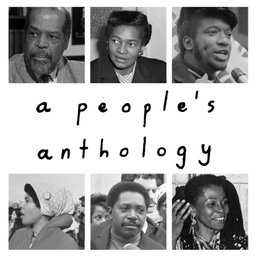
Podcast thumbnail for A People’s Anthology

A People’s Anthology

Claim This Podcast

by Boston Review

4.3(29 reviews)
6 episodes
Updated Daily
Accepts GuestsHas SponsorsLocation 🇺🇸

Podcast Overview

This mini-series features a reading series of radical essays and speeches. Each episode highlights a short text related to Black liberation struggles in the United States, from Claudia Jones to the Combahee River Collective. Introduced by historians and researchers and read by a range of poets, scholars, and activists. A companion series to Jacobin's People's History Podcast.

Language

🇺🇲

Publishing Since

2/23/2021

2 verified contact emails on file for A People’s Anthology

Pitch yourself as a guest, propose sponsorships, or reach out directly to the host.

Recent Episodes

Episode thumbnail for 6. Assata Shakur — “Women in Prison: How It Is With Us”

February 23, 2021

6. Assata Shakur — “Women in Prison: How It Is With Us”

<p>Read by Aja Monet and introduced by Jackie Wang. </p><br> <br/> <p>The teacher, poet, and revolutionary Assata Shakur was born in Flushing Queens. She became a socialist during her college years, and after a visit to the Oakland chapter of the Black Panthers, she joined the Party. Eventually Assata became head of the Harlem Panthers, and went on to join the Black Liberation Army—a loosely organized, underground offshoot of the Black Panthers, which advocated guerilla warfare against the US government.</p><br/><br/> <p>She became the target of federal surveillance for this work, and was arrested in 1973. She wrote “<strong>Women in Prison: How it is With Us”</strong> during this period, recounting the experiences of the women she was incarcerated with and the racism that led to their imprisonment—especially the&nbsp;criminalization of&nbsp;their survival and their willingness to defend themselves.</p> <br> <br> <p>“Women can never be free in a country that is not free. We can never be liberated in a country where the institutions that control our lives are oppressive. We can never be free while our men are oppressed. Or while the amerikan government and amerikan capitalism remain intact. But it is imperative to our struggle that we build a strong Black women’s movement. It is imperative that we, as Black women, talk about the experiences that shaped us; that we assess our strengths and weaknesses and define our own history. It is imperative that we discuss positive ways to teach and socialize our children.”&nbsp;— Assata Shakur<strong><br> </strong></p>

Episode thumbnail for 5. The Combahee River Collective Statement

February 23, 2021

5. The Combahee River Collective Statement

<p>Read and introduced by Beverly Smith, one of the original members of the Combahee River Collective.</p><br/><br/> <p>For the fifth episode,&nbsp;we sat down with <strong>Beverly Smith, </strong>one of three co-writers of the 1977 statement. Renowned for its description of oppressions as “interlocking,” the statement serves as both an update on the “triple oppression” that&nbsp;Claudia Jones&nbsp;laid out in 1949, and as an inspiration for&nbsp;Kimberlé W. Crenshaw’s&nbsp;coining of the term “intersectionality” a decade later.</p><br/><br/> <p>As Keeanga-Yamahtta Taylor writes in&nbsp;How We Get Free: “It is difficult to quantify the enormity of the political contribution made by the women in the collective, because so much of their analysis is taken for granted in feminist politics today—especially their description of&nbsp;oppressions as happening ‘simultaneously,’&nbsp;thus creating new measures of oppression and inequality. In other words,&nbsp;Black women could not quantify their oppression only in terms of sexism or racism, or of homophobia experienced by Black lesbians. They were not ever a single category, but it was the merging or enmeshment of those identities that compounded how Black women experienced oppression.”<br> </p>

Episode thumbnail for 4. Fred Hampton — “Power Anywhere There’s People”

February 23, 2021

4. Fred Hampton — “Power Anywhere There’s People”

<p>Read by Malcolm London and introduced by Asad Haider.</p><br/><br/> <p>Born in 1948, Fred&nbsp;Hampton was a talented organizer from an early age,&nbsp;brokering peace among street gangs in his hometown of Chicago and striving to build a&nbsp;class-conscious, multiracial movement&nbsp;he called the “rainbow coalition.”</p><br/><br/> <p>An active Black Panther, Hampton was constantly surveilled by the FBI and Chicago police. He was considered such a&nbsp;threat to national security that, at the age of 21, the FBI and police murdered him&nbsp;in his bed while he slept.</p><br/><br/> <strong>Hampton’s speech&nbsp;“</strong><strong>Power Anywhere There’s People”</strong> was delivered at a church just a few months before his assassination, and outlines his belief in the&nbsp;importance of engaging&nbsp;the masses through socialist public service programs.</p><br/><br/> <p>“We have to understand very clearly that there’s a man in our community called a capitalist. Sometimes he’s Black and sometimes he’s white. But that man has to be driven out of our community, because anybody who comes into the community to make profit off the people by exploiting them can be defined as a capitalist. And we don't care how many programs they have, how long a dashiki they have. Because political power does not flow from the sleeve of a dashiki; political power flows from the barrel of a gun. It flows from the barrel of a gun!” — Fred Hampton<strong><br> </strong></p>

6 total episodes available

Deep-dive analytics for A People’s Anthology

Frequently asked questions

Have a different question and can't find the answer you're looking for? Reach out to our support team by sending us an email and we'll get back to you as soon as we can.

What is A People’s Anthology?

This mini-series features a reading series of radical essays and speeches. Each episode highlights a short text related to Black liberation struggles in the United States, from Claudia Jones to the Combahee River Collective. Introduced by historians and researchers and read by a range of poets, scholars, and activists.

A companion series to Jacobin's People's History Podcast.

How often does this podcast release new episodes?

This podcast updates daily.

Where can I listen to this podcast?

This podcast is available on 4 platforms including Apple Podcasts, Spotify, and more. You can also use the RSS feed directly.

Does this podcast accept guests?

Yes, this podcast regularly features guests.

Legal Disclaimer

Pod Engine is not affiliated with, endorsed by, or officially connected with any of the podcasts displayed on this platform. We operate independently as a podcast discovery and analytics service.

All podcast artwork, thumbnails, and content displayed on this page are the property of their respective owners and are protected by applicable copyright laws. This includes, but is not limited to, podcast cover art, episode artwork, show descriptions, episode titles, transcripts, audio snippets, and any other content originating from the podcast creators or their licensors.

We display this content under fair use principles and/or implied license for the purpose of podcast discovery, information, and commentary. We make no claim of ownership over any podcast content, artwork, or related materials shown on this platform. All trademarks, service marks, and trade names are the property of their respective owners.

While we strive to ensure all content usage is properly authorized, if you are a rights holder and believe your content is being used inappropriately or without proper authorization, please contact us immediately at hey@podengine.ai for prompt review and appropriate action, which may include content removal or proper attribution.

By accessing and using this platform, you acknowledge and agree to respect all applicable copyright laws and intellectual property rights of content owners. Any unauthorized reproduction, distribution, or commercial use of the content displayed on this platform is strictly prohibited.