- 18
- Episodes
- 9
- Ratings
- Weekly
- Cadence
- 2026
- First episode
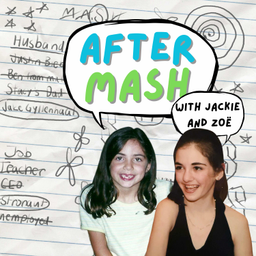
About AfterMASH
In elementary school, a silly game called MASH laid out our lives for us, answering society’s most desired questions: who will we marry, what kind of house will we live in, and how many kids will we have? Maybe you were like us, and you survived the suburban-kid-to-college pipeline and graduated thinking you had all the answers. But then you found yourself in your twenties or thirties, having done everything “right”, but somehow nowhere near the future you had envisioned for yourself. Well, we are here to talk about it! Join Jackie and Zoë every other week as we attempt to answer new questions, using the old faithful game of MASH. aftermash.substack.com (https://aftermash.substack.com?utm_medium=podcast)
- Publisher
- AfterMASH Podcast
- Category
- society & culture · society & culture
- Language
- en
- Explicit
- No
- First episode
- 24 Feb 2026
- Latest episode
- 29 Sept 2026
Latest episodes
18 episodes in the feed.
29 Sept 2026
How to Find Strength: a conversation with Emily Socolinsky, owner of Fivex3 Training
Dancer turned powerlifter, Emily Socolinsky, joins Jackie and Zoe to discuss her incredible career. Her story is at once very relatable and also incredibly powerful. In this episode, Emily talks about her young adulthood as a dancer and teacher, her back spasms and years of pain and how frustrating it was to not know what to do about it, how she found strength and started the gym, and what running it during Covid was like. She also tells us the story of her sister’s cancer diagnosis and eventual passing, and how that shaped her relationship to community, charity, and life. She ends with advice for anyone looking to get started with strength training, no matter their age or current strength status.Full show notes available on our substack, https://aftermash.substack.com/ (https://aftermash.substack.com/) If you want to learn more about Emily, check out her website www.fivex3.com (http://www.fivex3.com). She offers online and in-person coaching, and is generally a wealth of knowledge about all things strength and aging! You can find her at: Her website, fivex3.com (https://www.fivex3.com/) Her Youtube (https://www.youtube.com/channel/UC540Fr32K--jGQfAOmqJ0VQ) channel Instagram @fivex3 (https://www.instagram.com/fivex3) Her podcast Fivex3 Radio (https://www.fivex3.com/2022/10/27/fivex3-radio-podcast/), wherever you get your podcasts! The style of lifting that Emily and I practice is Starting Strength. This is a straightforward program of lifting where you do three of four main lifts per session, 2-3 times a week. To learn more, check out their website startingstrength.com (https://startingstrength.com/). Also, in this episode Emily mentions a few instagram accounts she personally recommends for anyone wanting to expose themselves to more strong women. Here were her suggestions! Girls Gone Strong @thegirlsgonestrong (https://www.instagram.com/thegirlsgonestrong/) Molly Galbraith @themollygalbraith (https://www.instagram.com/themollygalbraith/) Jen Thompson @jenthompson132 (https://www.instagram.com/jenthompson132/) Sioux-z Hartwig-Gary @siouxz52kg (https://www.instagram.com/siouxz52kg/) Bailey Haslam @baileyhaslam_ (https://www.instagram.com/baileyhaslam_/) This is a public episode. If you would like to discuss this with other subscribers or get access to bonus episodes, visit aftermash.substack.com (https://aftermash.substack.com?utm_medium=podcast&utm_campaign=CTA_1)
15 Sept 2026
Pet Peeves, Hot-Takes, and Aspirations
It’s been about 9 months on this project, and we’ve made it to episode 15. For this installment of our every-5-episodes joint episode, we talk pet peeves and hot-takes, and to end on a positive note, aspirations. Topics range from pigeons to Taylor Swift, and it gets pretty spicy in there! Do you agree with us? Let us know! <3, AfterMASH team This is a public episode. If you would like to discuss this with other subscribers or get access to bonus episodes, visit aftermash.substack.com (https://aftermash.substack.com?utm_medium=podcast&utm_campaign=CTA_1)
1 Sept 2026
Hobbyamory, bridal culture, and why Zoe’s wedding almost didn’t happen
Jackie and I sit down to talk about what has been our most requested episode: weddings. Parting from my typical book report (and hopefully saying goodbye to that format entirely, for my own sanity), we let the capitalism of it be and just chat about weddings. We start with a recently published article from the New York Times, For Some Singles, ‘Hobbyamory’ Has Replaced Hookups by Sadiba Hasan because it is the spider graph of this podcast that leads to weddings in the center. From there, we talk a brief history of the wedding before devolving into our personal takes on weddings. Then, the juiciest story of Zoe’s brief 32 years on this planet - planning her wedding. We think it’s a fun episode, we hope you do to! Zoe & The AfterMash clan. Sources For Some Singles, ‘Hobbyamory’ Has replaced Hookups (https://www.nytimes.com/2026/08/09/style/single-dating-hobbies-hobbyamory.html) How Wedding Expectations have Changed in the Past 90 Years (https://www.brides.com/how-wedding-expectations-have-changed-8743616) An interview with the OG wedding planner (https://bridalguide.com/planning/roles/celebrity-wedding-planner-marcy-blum/) Magazines: * The Knot (30th anniversary edition) * BRIDE This is a public episode. If you would like to discuss this with other subscribers or get access to bonus episodes, visit aftermash.substack.com (https://aftermash.substack.com?utm_medium=podcast&utm_campaign=CTA_1)
18 Aug 2026
What's the big deal with GLP-1s?
If I say “miracle drug” what comes to mind for you? If your head hasn’t been under a rock the last few years, my guess is you will immediately think of GLP-1s, the most popular of which is semaglutide, sold under the brand names Ozempic and Wegovy. According to google search volumes, “Ozempic” first outpaced “Adderall” in early 2023, and has stayed above ever since. (I mention Adderall because it is a widely popular, often off-label, drug intended to treat a health condition predominantly moderated in the brain, similar to Ozempic.) This is in stark contrast to bariatric surgery, the only other approved medical treatment that reliably causes its users to lose as much weight as a GLP-1, which hasn’t budged in popularity over this time. In fact, we can see the trend-behind-the-trend when we look at a few other related search terms: weight loss and fat. One thing that is extremely interesting to me is how, despite Ozempic entering mainstream consciousness around 2023, it took until 2026 for searches for weight loss or fat to start spiking. In fact, searches for weight loss rose nearly 40% between its relatively stable pre-2026 baseline and its new 2026 norm. This, along with some fascinating anecdotes from some friends and some seriously questionable Instagram ads, got me wondering what exactly is the Ozempic Effect? Is it really a Miracle drug, as all of the headlines are claiming? How does it even work in our body? Turns out, the answers to these questions are far stranger, more nuanced, and more interesting than I could have ever anticipated. Tune in to find out! XOXO,Jackie PS - obligatory “tell us what you think!” request, “share with friends!” request, and “we love you, thank you for listening!” comment. But seriously - if you have any thoughts, please let us know! Resource List I once again bit off more than I should have chewed with this topic, hence why the works cited is so long. But hopefully my excessive researching can be your easy guide to learning more! Related podcast episodes * Our previous episode on dating apps, where we introduce the concept of stock buybacks: Why does Dating Suck So Much? (https://aftermash.substack.com/p/why-does-dating-suck-so-much?r=7id9oy&utm_campaign=post&utm_medium=web) * Our previous episode on diamond engagement rings, where we talk about the idea of interpreting people’s decisions in the context they are living in: The Secret History of the Diamond Engagement Ring (https://aftermash.substack.com/p/shoulda-put-a-ring-on-it-or-not) * While we are at it, I am apparently on a kick of episodes that point out the financial incentives for businesses trying to sell you fixes to our modern society: here’s our previous episode on The Booming Business of Fertility Preservation (https://aftermash.substack.com/p/childless-cat-ladies-scramble-eggs) * The Journal podcast episode that discusses hair loss drugs making people sick: A Quick Fix for Hair Loss Is Making Some Men Sick (https://podcasts.apple.com/au/podcast/a-quick-fix-for-hair-loss-is-making-some-men-sick/id1469394914?i=1000703510789) * Huberman Lab podcast episode with a very thorough overview of hunger, satiety, and GLP-1 science: The Science of Hunger & Medications to Combat Obesity | Dr. Zachary Knight (https://podcasts.apple.com/pt/podcast/the-science-of-hunger-medications-to-combat-obesity/id1545953110?i=1000659242263) * Diabolical Lies covered “pretty privilege” in a paywalled podcast ep; if you want to explore this topic and are willing to pay, I highly recommend this analysis of why someone would want to lose weight in the first place (and how marketing distorts the picture): How ‘The Botox Psyop’ Broke Our Brains in the Name of Beauty (https://podcasts.apple.com/us/podcast/how-the-botox-psyop-broke-our-brains-in-the-name-of-beauty/id1761438573?) Info about obesity and diabetes * Obesity is measured via BMI, which is calculated as weight (kg) ÷ height (m²). For an average-height woman (5’4”), she is obese (BMI 30+) when she weighs 175lb, and she is severely obese at 233lb (BMI 40+). * Many doctors hold strong negative attitudes towards people with obesity, supporting Zoe’s point that we need to start treating weight like it’s just one medical fact in a suite of facts relevant to someone’s health, and not like it’s the Most Important Fact. To learn more about this stigma, this meta analysis is helpful: Impact of weight bias and stigma on quality of care and outcomes for patients with obesity - PMC (https://pmc.ncbi.nlm.nih.gov/articles/PMC4381543/) * Causes: * (PDF) Altered Hypothalamic functional connectivity in adolescents with severe obesity (https://www.researchgate.net/publication/400362804_Altered_Hypothalamic_functional_connectivity_in_adolescents_with_severe_obesity) * Genes and obesity | CDC (https://archive.cdc.gov/www_cdc_gov/genomics/resources/diseases/obesity/obesedit.htm) * Causes of obesity: a review - ScienceDirect (https://www.sciencedirect.com/science/article/pii/S147021182404572X) * Demographics: * Obesity and Severe Obesity Prevalence in Adults: United States, August 2021–August 2023 (https://www.cdc.gov/nchs/products/databriefs/db508.htm) * Regional disparities in type 2 diabetes prevalence and associated risk factors in the United States (https://dom-pubs.onlinelibrary.wiley.com/doi/10.1111/dom.15797) * Health impacts: * Consequences of Obesity (https://www.cdc.gov/obesity/php/about/consequences.html) - CDC * The important role of comorbidities in the management of obesity - PMC (https://pmc.ncbi.nlm.nih.gov/articles/PMC12927885/) * Obese people often suffer from malnutrition: Malnutrition in Obesity: Is It Possible? (https://karger.com/ofa/article/15/1/19/828887/Malnutrition-in-Obesity-Is-It-Possible) About appetite and how GLP-1s relate: * Can GLP-1 Be a Target for Reward System Related Disorders? A Qualitative Synthesis and Systematic Review Analysis of Studies on Palatable Food, Drugs of Abuse, and Alcohol - PMC (https://pmc.ncbi.nlm.nih.gov/articles/PMC7848227/) Info about weight loss * Long-term weight loss maintenance, article in AJCN (https://ajcn.nutrition.org/article/S0002916523295362/fulltext) * Weight Maintenance after Dietary Weight Loss: Systematic Review and Meta-Analysis on the Effectiveness of Behavioural Intensive Intervention (https://www.ncbi.nlm.nih.gov/pmc/articles/PMC8953094/) About GLP-1 drugs (how they work in the body and mind) * Five things to know about GLP-1s and addiction (https://med.stanford.edu/news/insights/2025/04/ozempic-addiction-glp-1s-mounjaro-lembke.html) by Stanford Medicine * Ozempic Quiets Food Noise in the Brain—But How? | Scientific American (https://www.scientificamerican.com/article/ozempic-quiets-food-noise-in-the-brain-but-how/) * Psychiatric effects of GLP‐1 receptor agonists: A systematic review of emerging evidence - PMC (https://pmc.ncbi.nlm.nih.gov/articles/PMC12673456/) * Side effects: Semaglutide: Double-edged Sword with Risks and Benefits - PMC (https://pmc.ncbi.nlm.nih.gov/articles/PMC11790292/) * A new era of weight loss: Mental health effects of GLP-1 drugs (https://www.apa.org/monitor/2025/07-08/weight-loss-drugs-mental-health) * The STEP 1 trial for semaglutide, which is the source of the 15% body weight loss stat: Once-Weekly Semaglutide in Adults with Overweight or Obesity | New England Journal of Medicine (https://www.nejm.org/doi/full/10.1056/NEJMoa2032183) * Performing strength activities in addition to being on a GLP-1 reduces the muscle and bone loss: Bone Health After Exercise Alone, GLP-1 Receptor Agonist Treatment, or Combination Treatment: A Secondary Analysis of a Randomized Clinical Trial (https://jamanetwork.com/journals/jamanetworkopen/fullarticle/2820308) * Hubermann Lab podcast episode with a very thorough overview of hunger, satiety, and GLP-1 science: The Science of Hunger & Medications to Combat Obesity | Dr. Zachary Knight (https://podcasts.apple.com/pt/podcast/the-science-of-hunger-medications-to-combat-obesity/id1545953110?i=1000659242263) Demographics of users and and cost info about GLP-1s * New Weight Loss Drugs: GLP-1 Agonist Use and Side Effects in the United States | RAND (https://www.rand.org/pubs/research_reports/RRA4153-1.html) * Poll: 1 in 8 Adults Say They Are Currently Taking a GLP-1 Drug for Weight Loss, Diabetes or Another Condition, Even as Half Say the Drugs Are Difficult to Afford | KFF (https://www.kff.org/public-opinion/poll-1-in-8-adults-say-they-are-currently-taking-a-glp-1-drug-for-weight-loss-diabetes-or-another-condition-even-as-half-say-the-drugs-are-difficult-to-afford/) * Costly GLP-1 Drugs are Rarely Covered for Weight Loss by Marketplace Plans | KFF (https://www.kff.org/affordable-care-act/costly-glp-1-drugs-are-rarely-covered-for-weight-loss-by-marketplace-plans/) * The GLP-1 Access Gap: Mapping Who Can Actually Afford America’s Miracle Weight-Loss Drugs | The Health Management Academy (https://hmacademy.com/blog/glp1-access-gap-affordability-by-state) * Related: demographic data for depression prevalence and treatment Disparity in Depression Treatment among Racial and Ethnic Minority Populations in the United States - PMC (https://pmc.ncbi.nlm.nih.gov/articles/PMC2668139/) The insane $ that GLP-1 manufacturers are making (and spending) * The Heavy Price of GLP-1 Drugs: How Financialization Drives Pharmaceutical Patent Abuse and Health Inequities for GLP-1 Therapies (https://www.i-mak.org/glp-1/) * Novo’s Wegovy and Ozempic US advertising spend doubles rival Eli Lilly, data shows | Reuters (https://www.reuters.com/business/media-telecom/novos-wegovy-ozempic-us-advertising-spend-doubles-rival-eli-lilly-data-shows-2026-01-28/) * Novo Nordisk sues Eli Lilly, alleging misleading GLP-1 advertising (https://www.cnbc.com/2026/07/21/novo-nordisk-sues-eli-lilly-glp-1-ads.html) Should health insurers cover GLP-1s? * Fiscal Impact of Expanded Medicare Coverage for GLP-1 Receptor Agonists to Treat Obesity - PMC (https://pmc.ncbi.nlm.nih.gov/articles/PMC12032556/): This is the article that claims Medicare coverage for GLP-1 drugs would net increase $47.7 billion in spending over 10 years. * A Value-Based Price for Anti-Obesity Medications - July 17, 2025 - USC Schaeffer (https://schaeffer.usc.edu/research/a-value-based-price-for-anti-obesity-medications/): This is the article that claims that Medicare coverage would save $245 billion over 10 years if they covered GLP-1s What happens when you stop taking GLP-1s? * Does Stopping Ozempic Cause Rebound Weight Gain and Health Problems? | Scientific American (https://www.scientificamerican.com/article/does-stopping-ozempic-cause-rebound-weight-gain-and-health-problems/) * Related: how to wean off of antidepressants: Discontinuation of antidepressants after remission with antidepressant medication in major depressive disorder: a systematic review and meta-analysis - PMC (https://www.ncbi.nlm.nih.gov/pmc/articles/PMC7815511/) This is a public episode. If you would like to discuss this with other subscribers or get access to bonus episodes, visit aftermash.substack.com (https://aftermash.substack.com?utm_medium=podcast&utm_campaign=CTA_1)
4 Aug 2026
Talking MASH with Shannon McNamara
I started listening to podcasts in 2018. I remember the first podcast I devoured was Real Talk Radio. At some time around 2020, I re-found pop culture. Among the roll-call of podcasters was Shannon McNamara of FluentlyForward. Her kindness and curiosity shine through every episode. And she has a unique analytical twist founded on unabashed honesty. Additionally, she always lifted up other creatives. So as we continue on this AfterMASH journey, I figured, I’ll shoot my shot. And lo-and-behold, Jackie and I get to sit down and “Talk MASH” with Shannon. And let me tell you, she does not disappoint. She is as open and kind-hearted and beautiful inside and out as you would hope she would be. In this conversation, we take it from the beginning to the end: her upbringing, the midlife crisis of Shannon’s twenties that brought us Fluently Forward, and what her life looks like now. At the end, we even talk a bit of pop culture (swoon). And of course, her advice to her twenty-year old self - it’s a good one! Apologies in advance for the technical difficulties I experienced, but Jackie and Shannon really hit it off - it was fun listening to what I missed. Also, I said that Billie Eillish’s mom was on Armchair Expert, it was actually the other white-male-podcaster-with-all-the-answers, Rich Roll, and you can listen here (https://richroll.com/podcast/maggie-baird-624/) if you’re curious. And final update, I have not yet reached out to her psychic, but if I'm good with my budget this month, I'll be reaching out next :). You can find Shannon at @FluentlyForward on socials and wherever podcasts are streamed. She will take your mind on a twisty journey and you’ll be a better person for it! Thank you, Shannon for your time! <3 AfterMASH Team. This is a public episode. If you would like to discuss this with other subscribers or get access to bonus episodes, visit aftermash.substack.com (https://aftermash.substack.com?utm_medium=podcast&utm_campaign=CTA_1)
21 Jul 2026
Stress, Burnout, and Learning to Listen to Your Body
Nothing like pulling out a handful of hair in the shower to wake you up to the fact that you've been effing stressed lately. Oops. The bad news: my hair is now 20% less voluminous than it was before. The good news: we got excellent fodder for a deep dive into a topic that I believe we will all benefit from learning more about. Thank you for your sacrifice, 20% of my hair. In this episode, we discuss: - Defining some terms: wouldn’t be a Jackie episode if we didn’t get real technical about the differences between burnout, stress, allostatic (over)load, and the (para)sympathetic nervous system. - Talking about the impact of chronic stress on the body: what is chronic stress and how does it show up? - Discussing why we have to deal with chronic stress: what happens in our modern society that lead to lots of stress and not a lot of stress relief? - And, lastly, if you are someone experiencing a lot of stress, what can you do about it? If you or someone you know suffers from any of the following, you should definitely give it a listen! - Trouble falling or staying asleep (including 3am wakeups)- Hair loss at a greater rate than normal- More frequent sickness- A recent increase in tummy fat you can’t seem to kick- Shoulder / neck tightness or jaw clenching- Recurring migraines- Irregular periods- Upset stomach, diarrhea (*in the tune of the pepto bismol commercial from our youth*)Full show notes on our substack!xoxo Jackie This is a public episode. If you would like to discuss this with other subscribers or get access to bonus episodes, visit aftermash.substack.com (https://aftermash.substack.com?utm_medium=podcast&utm_campaign=CTA_1)
7 Jul 2026
Cootie Catching with AfterMASH: Get to know us!
If you have been following our podcast since we started, you may think you already have a good sense of who we are, your two intrepid hosts. Here are some of the things you may have gathered from our previous episodes: * Zoe is a doctor, lives in the suburbs, is married, owns a house, has a dog and suddenly not one but TWO cats, and wants nothing more in the world than to one day add a horse to the menagerie. * Jackie is a data analyst, lives in the city, is not yet married, rents an apartment, has no pets, and hates diamond engagement rings (but will not judge you if you have a diamond engagement ring). But do you know Jackie’s four rules to living a good life? Do you know why Zoe went from definitely NEVER wanting to be a doctor to ultimately deciding why it was the right career for her? What did Jackie learn from her previous failed relationships and how has that shaped her dating life? Why did Zoe change her mind on wanting kids? After this episode, you should walk away with a much better understanding of who we are, why we feel the way we do, and what were some of the lessons or bumps on the road that got us to where we are today. And, as a bonus, for anyone who was inspired and wants to make your own cootie catcher, here’s (https://www.wikihow.com/Make-a-Cootie-Catcher-%28Origami-Fortune-Teller%29) a set of simple instructions for how to fold! We had an absurd amount of fun revisiting this staple of our childhood and we promise you will too. Share your cootie catchers with us in the comments! This is a public episode. If you would like to discuss this with other subscribers or get access to bonus episodes, visit aftermash.substack.com (https://aftermash.substack.com?utm_medium=podcast&utm_campaign=CTA_1)
23 Jun 2026
Reduce, Reuse, Recycle
There were two months in 2024 where I relied exclusively on bottled-water. I was in Florida for one month, and if you have ever tried their tap water, you understand. The next month I was in Peru where I was actively trying to avoid E. coli. All these plastic water bottles - and that time I could bring water through their version of TSA - sent my millennial soul in a tizzy. The reduce-reuse-recycle indoctrination of my youth had fell by the wayside as dehydration and gastrointestinal collapse were on the line. But most interestingly, since I’ve been back, if I’ve needed water and didn’t have my own reusable bottle with me, rather than forego the idea of hydration entirely, I just bought a plastic water bottle. Why? Unsure. maybe I learned that the world wouldn’t end? Maybe it’s because for some reason, a cold Smart Water just hits? Maybe I justified it by reusing that water bottle so it was no longer “single-use”? I could not tell you. But I can assure you, it’s not a habit. In this week’s episode of AfterMASH, we visit an American Public School Classic: Reduce-Reuse-Recycle. By which I actually mean, recycling because that is all I remember actually learning - Jae and Jackie, too. I remember every year my classroom would have the blue recycling bin with a sheet of paper taped over it stating what can be recycled. And despite this, I’m not always clear on what can be recycled to this day. I’m just grateful to live in a town with single-stream recycling so that I don’t have to worry that my mistake will ruin the entire recycling collection bin. But this episode isn’t re-hashing what is and is not recycling, because at the end of the day that actually doesn’t cut it. All those “low-waste lifestyle” lists you see, every single one of those HABITS you curate over time and beat yourself over for breaking - the totes, the reusable water bottles, the meal plans - only add up to about 1 ton of CO2 emission a year. I also have a personal hypothesis that they only encourage overconsumption - I actually spoke with a girl who for some reason needed to have a matching water bottle with her fiancé. And every time he lost his, which was often, she would buy two completely new water bottles for each of them, rather than just replace his? Wild. One ton of CO2 emissions a year is not nothing when you’re talking about bringing the average annual carbon footprint per person from a 15 down to a 2 in accordance to the Paris Accord (politics aside). Every ton counts. Additionally, it keeps crap of out of turtles’ nostrils, which is important - because another part of my curriculum was breathing through a straw to mimic what it was like to live with COPD, and that was HARD. Anyway, I digress. Back to carbon footprint, which is the measure of gas emissions we chose to focus on when quantifying environmental impact of human activities. The big drivers of carbon footprint: diet, where you chose to live, if/how much you depend on a car, and how often you use air travel. TLDR: if you are a vegan who lives in a city, doesn’t own a car, and choses vacation based on America’s very limited rail-system, you are winning. But, your annual carbon footprint is still about 4, which twice as much as the goal. And that is because you are but one person. And human consumption and living habits are a small part of the environmental puzzle. Corporations and manufacturing have a ton of work to do to help reduce emissions and other variables of environmental strain such as finite resource depletion, toxin leeching, de-forestation and consequential jeopardy of species, etc. One place to start is extended producer liability, which is a policy approach that assigns producers greater responsibility for the end-of-life management of products they introduce to the market. The goal is to encourage innovations in product design such that the product itself is less harmful and more durable. Violations lead to fines and public humiliation. Google AI says that it has affected upstream manufacturing, but I haven’t put time in to research it. So, if you know anything, comment below! These policies apply to electronics, mercury, thermostats, batteries, pharmaceuticals, pain, fluorescent lighting, and mattress. What I suggest, is that you visit your town website to see what agreements they have for disposal of these items. For instance, you can often bring your empty paint cans to the local hardware store. Or alternatively, you can bring these items to the dump, which at least in my town is an organized Mecca of trash that they take responsibility for wasting responsibility. One day, I hope to meet Charlie Kelly and Frank there (that’s an Always Sunny reference). Along the lines of EPLs, this research did force me to spend time on a question that floated in my mind: I assume all corporations suck. Their allegiance is to their shareholders (by definition). So, how do you know which companies are actually trying to do better and not just greenwashing? First, there are the concepts of Public Benefit Corporation (PBC) and B Corp certification. PBCs are for-profit corporate entities who are legally obligated to aim towards “general public benefit” over maximizing shareholder profit. Some PBCs include anthropic (yes), Ben and Jerry’s (score), Bluesky, King Arthur Flour, Patagonia, Seventh generation, and a company called Tilamook (also ice cream). A B-corp is a third-party certification issued by the nonprofit network B Lab - it is a label earned by a for-profit that completes and passes some “Impact Assessment”. The B-corp label requires companies to be transparent and legal accountable for ongoing accreditation by the B-corp. Without doing much [any] research, this sounds like saying a chicken is free-range because it gets 2 square-feet to roam as opposed to just sitting in a wired cage with a few other buddies. Additionally, I stumbled upon three companies that seek to evaluate companies, typically in the fashion space, on their environmental, labor, and animal welfare practices. With the help of ChatGPT, I put together a table that compared these companies missions, rubrics, and findings. Then I looked at what their best, average, and worst rated companies were for the year of 2024; and then I compared their ratings for three companies. The table is below, so draw your own conclusions. My conclusion, even the “best” among them have so far to go it is simply laughable… … and then they got by Shien ; ) (after we recorded this episode). For a true paradigm shift in environmental responsibility and stewardship, my research has lead me to the concept of a Circular Economy. This is a model of resource production and consumption that involves sharing, leasing, reusing, repairing, refurbishing, and recycling materials and products that extend the product life cycle for as long as possible. The goal is to reduce resource depletion of finite resources and minimize effects of waste generation. You can think of this through an expansion of the original 3R lesson plan to an All Grown Up 10R conceptualization: (source (https://www.sciencedirect.com/science/article/pii/S0921344919304598)) With these Rs in mind, your first instinct should be to refuse crap in the first place (as in, say “no”), and think about resources you already have at hand. You do not get to recycling until the eighth step… That is also shown in the Butterfly Diagram, where the goal is to stay as close to the “body” of the butterfly as possible. Recycling, at the edge of the “stock management” wing of the butterfly, is really a last ditch effort. Visit the Ellen MacArthur Foundation to take your own deep dives (https://www.ellenmacarthurfoundation.org/topics/circular-economy-introduction/key-ideas) on a circular economy. The high level goal of a circular economy is to build a modular human environment that can be assembled and then disassembled (after centuries), built without toxins, minimizing reliance on finite resources to extend product life cycle for as long as possible and reduce resource depletion of finite resources and minimize effects of waste generation. A gleaming example of this is the Bullitt Center (https://bullittcenter.org) in Seattle. This integrated building design was made possible by a philanthropist with lofty goals. It is the greenest commercial building in the world. At least that’s what the website says. It opened in 2013 and features 500+ solar panels, geothermal walls, six-story composting toilets, and its own rain water collection system. It is built without toxins and is aimed to last for 250 years. And you bet it faced hurdles to overcome from banks who didn’t know how to back a building that was supposed to last that long, the DPH who was scrupulous about their water collection system, and manufactures who had to remove over 350 toxins from their construction products. So what does this mean for you? Coming from someone who enjoys her suburban lifestyle and will always depend on a car: shift your mindset. Recycling is a distraction, I’d go as far to as to say a virtue signal at this point. It matters, but not nearly to the extent we’ve been told it does from an environmental perspective. Minimizing plastic can be important to you for other reasons I didn’t address in this article: it’s cheaper and it’s theorized to be better for your health (although definitions, quantifications, and randomized-control-trials yet to exist to illustrate exactly how). Beyond that, step it up: when you see your blue recycling bin, you should be thinking “reduce” actually. When you’re looking to buy something new, take inventory of what you have and how it can make do. After that, find the scratchiest-wool-sweater-that-you-can-take-from-the-office-to-the-club-year-after-year, check-out thrift stores, take time to find companies you can endorse, and understand EPL and disposal options set up by your local municipality. These are meaningful ways to engage with your community and garner support for efforts that make a difference. Because environmental solutions are bigger than even the summation of personal efforts. Personally, I’ve been relying on my library instead of buying books (and then, if I really love the book, I buy it on ThriftBooks), I’ve started using Who Gives a Crap toilet paper and paper towel (truly LOVE) and Blueland cleaning products (the multi-surface cleaner smells like Fruit Loops :) ), and I’m less scared of my dump because I learned that I don’t need ten forms of identification and to drag my house there to prove residency…I can just drive in. And fortunately, I have a very handy and scrappy husband to pick up a lot of slack. But really, don’t sweat the small stuff. Even the most environmentally enlightened among us are exceedingly limited in personal impact. So if you’re thirsty, I recommend a Smart Water. Sources On Low-Waste Lifestyle * If you want to calculate your every action (https://www.co2everything.com/category/household-activities) * Some chick’s blog post on going zero-waste (https://www.goingzerowaste.com/blog/the-truth-about-zero-waste-living/) * Critical Mass Theory on wiki (https://en.wikipedia.org/wiki/Critical_mass_(sociodynamics)) * A brief LCA on a cup of coffee (https://www.youtube.com/watch?v=Z9V5PsY9t44) … Or a more comprehensive one about the lifecycle of a T shir (https://www.youtube.com/watch?v=BiSYoeqb_VY)t from Ted-Ed. * Pantheon Enterprises (https://pantheonchemical.com/reduce-reuse-recycle/) * Recycle Nation (https://recyclenation.com/2015/05/history-of-three-r-s/) * NY times archived article on the first Earth Day celebration in 1970 (https://timesmachine.nytimes.com/timesmachine/1969/11/30/89149514.html?pageNumber=1') On Plastics and Health (to be taken as a preliminary medical thought process!) * Microplastics and our health (https://med.stanford.edu/news/insights/2025/01/microplastics-in-body-polluted-tiny-plastic-fragments.html) * And this one from Harvard (https://med.stanford.edu/news/insights/2025/01/microplastics-in-body-polluted-tiny-plastic-fragments.html) * What Amsterdam has to say about microplastics (https://research.vu.nl/ws/portalfiles/portal/227179799/Microplastics_and_human_health.pdf\) * What the WHO had to say in 2022 about microplastics (https://iris.who.int/server/api/core/bitstreams/9cc4f66a-4c22-4a51-a910-3e7f739e3b31/content) * Perhaps the OG article (https://www.sciencedirect.com/science/article/abs/pii/S0048969719344468?fr=RR-2&ref=pdf_download&rr=a0ff64631d5a4268) * And another review (https://www.sciencedirect.com/science/article/pii/S001393512301770X?via%3Dihub) On Extended Producer Liabilities * National Conference of State Legislature (https://www.ncsl.org/environment-and-natural-resources/extended-producer-responsibility)s * Yay CT! (https://productstewardship.us/press_releases/extended-producer-responsibility-programs-proven-successful-in-connecticut/#:~:text=For%20instance%2C%20the%20mandatory%20thermostat,had%20access%20to%20140%20sites.) * CT River Conservatory (https://www.ctriver.org/post/extended-producer-responsibility-epr), On Rating Brands * Re/make rubric (https://docs.google.com/spreadsheets/d/13UkgehAgbz652FfXc9v9fX4XBhiThejtIZkmyf8eXrM/edit?gid=199910481#gid=199910481) * Re/make links to reports and fact sheets (https://remake.world/resources/#factsheet) * Stand.Earth Methodology (https://stand.earth/fashion/resources/2025-scorecard/methodology/) * Stand.Earth 2025 Report (https://stand.earth/fashion/resources/2025-scorecard/) * Good on You rubric: Fashion Brands (https://how-we-rate.instantdocsbase.com/help/for-fashion-brands) * Good on You rubric: Beauty Brands (https://how-we-rate.instantdocsbase.com/help/for-beauty-brands) * Good on You methodology (https://how-we-rate.instantdocsbase.com/help/whats-the-rating-process) & this page on large v. small brands. (https://how-we-rate.instantdocsbase.com/help/what-key-factors-may-affect-how-brands-are-scored) On Circular Economy * Cervantes Puma, G. C., Salles, A., Turk, J., Rajčić, V., Muñoz Puche, A., Korniejenko, K., ... & Bragança, L. (2024). Circular economy best practices in the built environment. In Circular Economy Design and Management in the Built Environment: A Critical Review of the State of the Art (pp. 5-24). Cham: Springer Nature Switzerland. * https://usca.bcorporation.net/benefit-corporation * https://en.wikipedia.org/wiki/Circular_economy And finally, the books Jackie mentioned: * Doing Good Better by William MacAskill (I am personally waiting for it to be covered on If Books Could Kill) * Tipping Point by Michael Pollen (who has to time of writing, escaped the aforementioned podcast’s wrath). Thanks for reading AfterMASH's Substack! This post is public so feel free to share it. This is a public episode. If you would like to discuss this with other subscribers or get access to bonus episodes, visit aftermash.substack.com (https://aftermash.substack.com?utm_medium=podcast&utm_campaign=CTA_1)
9 Jun 2026
"Fur Babies" > Babies (?)
Dude, why does everyone have a pet but nobody has a baby? What should we make of the rise of doggy daycares and pet clothing? Is this late stage capitalism? Is it the increasing unaffordability of having kids? Is it the loneliness epidemic? Maybe all of the above?? Join Jackie and Zoe as we learn about the history of pet keeping in America, recent trends in pet ownership, and we use virtue ethics to evaluate our relationships to our furry friends.Whether you have a pet, are considering getting one, or don’t want one but just want to understand what the hell a Bark box is, join us. If you want to learn more about our messy relationships with animals, I highly recommend the book Some We Love, Some We Hate, Some We Eat (https://www.harpercollins.com/products/some-we-love-some-we-hate-some-we-eat-second-edition-hal-herzog?variant=39278403780642) by Hal Herzog, PhD And the paper that Zoe claims she will definitely read is: Autonomy, Slavery, and Companion Animals (https://digitalcommons.calpoly.edu/cgi/viewcontent.cgi?article=2166&context=bts) by Heather Kendrick, PhD Dude, I went down such a rabbit hole when researching for this episode. Every paper mentioned, and a few others besides, are linked below. "My Little Son, My Everything": Comparative Caregiving and Emotional Bonds in Dog and Child Parenting by Udvarhelyi-Tóth et al, 2025 (https://pubmed.ncbi.nlm.nih.gov/41375417/) Majority of Americans think of their pets as family members | Pew Research Center (https://www.pewresearch.org/short-reads/2023/07/07/about-half-us-of-pet-owners-say-their-pets-are-as-much-a-part-of-their-family-as-a-human-member/) Separation-related behaviour indicates the effect of functional breed selection in dogs (Canis familiaris) - ScienceDirect (https://www.sciencedirect.com/science/article/abs/pii/S0168159119301443) The 2020 Five Domains Model: Including Human–Animal Interactions in Assessments of Animal Welfare - PMC (https://pmc.ncbi.nlm.nih.gov/articles/PMC7602120/) The Welfare of Dogs as an Aspect of the Human–Dog Bond: A Scoping Review - PMC (https://pmc.ncbi.nlm.nih.gov/articles/PMC11240373/) We love our pets, and our spending proves it : Beyond the Numbers (https://www.bls.gov/opub/btn/volume-12/we-love-our-pets-and-our-spending-proves-it-1.htm) Similarities and differences between dog–human and human–human relationships - PMC (https://pmc.ncbi.nlm.nih.gov/articles/PMC12012045/) A $1,000 Dog Grooming Session? The Wellness Industry Is Booming. - The New York Times (https://www.nytimes.com/2026/03/09/business/dog-grooming-wellness-costs.html?unlocked_article_code=1.WlA.yP5S.SKEJrDd9yXPS&smid=nytcore-android-share) Animal Liberation (book) - Wikipedia (https://en.wikipedia.org/wiki/Animal_Liberation_(book)) The Case for Animal Rights - Wikipedia (https://en.wikipedia.org/wiki/The_Case_for_Animal_Rights) The Animal Welfare Science of Working Dogs: Current Perspectives on Recent Advances and Future Directions (https://www.frontiersin.org/journals/veterinary-science/articles/10.3389/fvets.2021.666898/full) Operational Details of the Five Domains Model and Its Key Applications to the Assessment and Management of Animal Welfare - PMC (https://pmc.ncbi.nlm.nih.gov/articles/PMC5575572/) All in the Family: Pets and Family Structure - PMC (https://pmc.ncbi.nlm.nih.gov/articles/PMC12177977/) Dog Population & Dog Sheltering Trends in the United States of America (https://www.mdpi.com/2076-2615/8/5/68) Future estimated annual expenditures of raising a child, assuming a higher inflation rate of 4 percent after 2020 (https://www.brookings.edu/wp-content/uploads/2022/08/Brookings_Cost-to-raise-a-child_inflation-adjusted-2.pdf) 2025 AVMA Pet Ownership and Demographics Sourcebook This is a public episode. If you would like to discuss this with other subscribers or get access to bonus episodes, visit aftermash.substack.com (https://aftermash.substack.com?utm_medium=podcast&utm_campaign=CTA_1)
26 May 2026
Middle Class Who?
The American Middle Class! This episode started as a desire to understand the base definitions of income and class in order to better understand my own personal position (and privilege) in society. But it turns out a Merriam-Webster consensus of this stuff does not exist. Which is preposterous, because in middle school I learned about The Scientific Method, which tells me that to build a useful experiment you must have a definition of your population and your problem. So join me (Zoe), an Upper Middle Class White B***ch with Expensive Hobbies, and Jackie (who also identifies as upper middle class), as we create a definition of the American Middle Class so that maybe we (and we alone) can solve the problems facing it. Show notes on our substack (https://aftermash.substack.com/p/middle-class-who?r=7id9oy)! But here's a sneak peek of the resulting definition I come up with: Zoë’s Diagnostic Criteria for The American Middle Class (modeled after the Diagnostic and Statistical Manual of Mental Disorders): Four or more of the following metrics must have been present during the same 3 years within the associated geographic location of the household unit during that time period. AND at least one metric achieved must be (1) Having achieved at least the median income of associated geographic location for the last 3 years OR (2) Have not been delinquent on mortgage payments for more than 60 consecutive days. - Having achieved at least the median income of associated geographic location for the last 3 years - Have not been delinquent on mortgage payments for more than 60 consecutive days - Able to afford a healthcare plan - Every working adult has a reasonably-functioning car (exclusive of dependents) - Emergency fund of with at least three months worth of expenses covered - Can save for retirement at the rate of your maximum employee-matched retirement account or ROTH-IRA max contributions for the year - Have not been delinquent on credit card debts as it relates to necessities of living for more than three consecutive months in the last 3 years - The value of the Consumers Good Index can fluctuate 10% without changing behavior This is a public episode. If you would like to discuss this with other subscribers or get access to bonus episodes, visit aftermash.substack.com (https://aftermash.substack.com?utm_medium=podcast&utm_campaign=CTA_1)
24 May 2026
Don't read Yesteryear
We wanted to love Yesteryear, the buzzy new book by first-time artist Caro Claire-Burke. It's everywhere right now, and like you, we were sucked in by the titillating premise: a tradwife influencer who lives on a farm waking up in the 1850s and learning what "traditional life" really entails. It's catchy, it's unique, it makes you wonder what the twist is at the end of the book. But we swear, it isn't worth it, and we will break down for you why. This is our first bonus episode! We will be back on Tuesday with our regularly scheduled programming. This is a public episode. If you would like to discuss this with other subscribers or get access to bonus episodes, visit aftermash.substack.com (https://aftermash.substack.com?utm_medium=podcast&utm_campaign=CTA_1)
12 May 2026
Why Does Dating Suck So Much?
Dating sucks; anyone who has spent any amount of time “on the market” in their 20s or 30s can tell you that. We all love to hate on dating apps. “They don’t work,” we gleefully confess to each other, which is a universal truth we all know... because all of us are still swiping. Dating apps are like social media, or #grindset culture: we love to hate them and yet we secretly can’t stop using them. The tech overlords commodified one of the most fundamental tenets of being alive: the seeking of human connection. But that doesn't make it any less important. So what can we do about it? Why?? Why do dating apps suck so much?? Do they actually, or do we just love to hate them?? What actually works in seeking and keeping a partner, according to science?? Will I ever get married or will I die alone?? This and more in today’s episode. Side note: if you are seeking love, I recommend reading the book that helped change my relationship with seeking relationships: How to Not Die Alone, by Logan Ury. The sources referenced in the podcast: Stock Buybacks Are a Key Example of Extractive Corporate Power (https://rooseveltinstitute.org/wp-content/uploads/2020/07/RI_Stock-Buybacks-key-example-of-extractive-corporate-power-Fact-Sheet-201910.pdf) The real effects of share repurchases - ScienceDirect (https://www.sciencedirect.com/science/article/abs/pii/S0304405X15001476) 10 Essential Pieces of Expert Dating Advice | Psychology Today (https://www.psychologytoday.com/us/blog/the-psychology-of-relationships/202402/10-quick-pieces-of-dating-advice-from-relationship) U.S. women are outpacing men in college completion, including in every major racial and ethnic group (https://www.pewresearch.org/short-reads/2024/11/18/us-women-are-outpacing-men-in-college-completion-including-in-every-major-racial-and-ethnic-group/) "Scarcity of College Men and the Decline in Marriage Among Non-College Americans" (https://papers.ssrn.com/sol3/papers.cfm?abstract_id=5086363), by Clara Chambers, Benjamin Goldman, and Joseph Winkelmann. “Where Have All the Good Men Gone?” Gendered Interactions in Online Dating - PMC (https://pmc.ncbi.nlm.nih.gov/articles/PMC4043335/) What's The Biggest Challenge Men Face On Dating Apps? (https://web.archive.org/web/20180209145512/http://hingeirl.com/hinge-reports/whats-the-biggest-challenge-men-face-on-dating-apps-a-qa-with-aviv-goldgeier-junior-growth-engineer/) Aspirational pursuit of mates in online dating markets | Science Advances (https://www.science.org/doi/10.1126/sciadv.aap9815) From Looking for Love to Swiping the Field: Online Dating in the U.S. | Pew Research Center (https://www.pewresearch.org/internet/2023/02/02/from-looking-for-love-to-swiping-the-field-online-dating-in-the-u-s/) Dating App Use Linked to Worse Mental Health | Psychology Today (https://www.psychologytoday.com/us/blog/the-asymmetric-brain/202512/dating-app-use-linked-to-worse-mental-health) Why investors don’t fund dating | andrewchen (https://andrewchen.com/why-investors-dont-fund-dating/) Dating App Revenue and Usage Statistics (2026) - Business of Apps (https://www.businessofapps.com/data/dating-app-market/) Red Flag/Green Flag: What to Look for When You’re Dating (https://www.gottman.com/blog/red-flag-green-flag-what-to-look-for-when-youre-dating/) (PDF) Leveling the Playing Field (https://www.researchgate.net/publication/278039644_Leveling_the_Playing_Field) This is a public episode. If you would like to discuss this with other subscribers or get access to bonus episodes, visit aftermash.substack.com (https://aftermash.substack.com?utm_medium=podcast&utm_campaign=CTA_1)
28 Apr 2026
New Years Resolution Checkin
In this fifth episode of After MASH podcast, Jackie and Zoe are breaking from the typical format. Instead of one host subverting a childhood belief about xyz thing, we’re just chatting. And this week, as we leave the first third of the year (**sweats casually**), Jackie and I are checking in on our new years resolutions. We’re talking about how we feel about them (Jackie LOVES them), how we got about them (Zoe swoons over a process), what they are (not run of the mill), and how we’re doing (all right). And that’s all the detail you’re going to get. If you care about two 31 year old friends talking about our resolutions, take a listen. At the very least, take this time to reflect on what you hoped you would get done this year and how it’s going. And it’s never too late to start. The calendar is arbitrary, after all. Best, Zoë, Jackie, and Jae This is a public episode. If you would like to discuss this with other subscribers or get access to bonus episodes, visit aftermash.substack.com (https://aftermash.substack.com?utm_medium=podcast&utm_campaign=CTA_1)
14 Apr 2026
We're all going to D!3
Medical school can never prepare you for the humanity that you will bear witness to as a doctor. Shonda Rhimes may try, but the heavy-handed storylines distract from the pearls of honesty. And taking inspiration from Dr. House will probably get you fired. In this episode, I want to introduce you to the conversation and tools that have the potential to guide you and ease your mind in the scariest moments of your life: advanced care planning. Do you want CPR, a breathing tube, dialysis, blood transfusions? Who do you want making these decisions if you are unable to? What does any of these even mean? I (a doctor) walk Jackie (not a doctor) through what this looks like. Resources that I found along the way that may help you are: Prepare (https://prepareforyourcare.org/en/prepare/welcome) toolkit, which walks you through your wishes and planforclarity.org (http://planforclarity.org/) that helps with the financial implications of end of life. Other helpful resources include Respecting Choices (https://respectingchoices.org/), Get Palliative Care (https://getpalliativecare.org/resources/types-of-care/). If you would like to explore more conversations around death and dying, in this (https://www.nytimes.com/2024/11/16/magazine/doctor-ellen-wiebe-maid-interview.html) [exlcusive] NY times The Interview, a doctor with MAiD discusses a mother’s choice to die with her surviving son, (“The Interview: The Doctor WHo Helped Me Understand My Mom’s Choice to Die). Another conversation I come back to that is between the hosts of Sick Boy podcast and the late Audrey Parker, titled “Audrey Parker Dies Today - Medical Assistance in Dying” and can be found on Spotify. Sickboy has a few other conversations on MAiD, which I have not yet listen to but do encourage you to listen to if you’re curious. Then there are the books. First and foremost: Being Mortal: Medicine and What Matters the End by Atul Gatwande. If my MIL and I actually succeed in opening an advanced care living facility, it’s because of this book. Other books that come to mind on the topic of death and its wishes, and grief include When Breath Becomes Air by Paul Kalanithi, which WILL make you cry; I’m Glad My Mom Died by Jennette McCurdy; My Sister’s Keeper by Jodi Picoult; and My Grandmother Asked Me To Tell YOu She’s Sorry by Fredrik Backman. All of these books WILL make you cry, it’s not a challenge, it’s just a fact. Thanks for reading AfterMASH's Substack! This post is public so feel free to share it. And because I’m an APA girl, here are the other citations that came up in my research: Lamont EB, Christakis NA. Prognostic disclosure to patients with cancer near the end of life. Ann Intern Med. 2001 Jun 19;134(12):1096-105. doi: 10.7326/0003-4819-134-12-200106190-00009. PMID: 11412049. Pound G, Jones D, Eastwood GM, Paul E, Hodgson CL; ANZ-CODE Investigators. Survival and functional outcome at hospital discharge following in-hospital cardiac arrest (IHCA): A prospective multicentre observational study. Resuscitation. 2020 Oct;155:48-54. doi: 10.1016/j.resuscitation.2020.07.007. Epub 2020 Jul 19. PMID: 32697963. Okubo M, Komukai S, Andersen LW, Berg RA, Kurz MC, Morrison LJ, Callaway CW; American Heart Association’s Get With The Guidelines—Resuscitation Investigators. Duration of cardiopulmonary resuscitation and outcomes for adults with in-hospital cardiac arrest: retrospective cohort study. BMJ. 2024 Feb 7;384:e076019. doi: 10.1136/bmj-2023-076019. Erratum in: BMJ. 2024 Apr 18;385:q900. doi: 10.1136/bmj.q900. PMID: 38325874; PMCID: PMC10847985. Sawyer, K. N., Camp-Rogers, T. R., Kotini-Shah, P., Del Rios, M., Gossip, M. R., Moitra, V. K., ... & American Heart Association Emergency Cardiovascular Care Committee; Council on Cardiovascular and Stroke Nursing; Council on Genomic and Precision Medicine; Council on Quality of Care and Outcomes Research; and Stroke Council. (2020). Sudden cardiac arrest survivorship: a scientific statement from the American Heart Association. Circulation, 141(12), e654-e685. Patel MS, Raza SS, Bhakta A, Ewing T, Bukur M, Vagefi PA, Salim A, Malinoski DJ. Patients on state organ donor registries receive similar levels of intensive care compared to those who are not: an opportunity to increase public intent to donate. Clin Transplant. 2016 Jun;30(6):682-7. doi: 10.1111/ctr.12734. Epub 2016 Apr 6. PMID: 26992655. Sellers MT, McGinnis HS, Alperin M, Sweeney JF, Dodson TF. Deterrents to Organ Donation: A Multivariate Analysis of 766 Survey Respondents. J Am Coll Surg. 2018 Apr;226(4):414-422. doi: 10.1016/j.jamcollsurg.2017.12.029. Epub 2018 Jan 5. PMID: 29309946. This is a public episode. If you would like to discuss this with other subscribers or get access to bonus episodes, visit aftermash.substack.com (https://aftermash.substack.com?utm_medium=podcast&utm_campaign=CTA_1)
31 Mar 2026
The Secret History of the Diamond Engagement Ring
Jackie has been staunchly opposed to diamond engagement rings ever since learning that blood diamonds were a thing. However, she realizes that she must be missing something, because we all know blood diamonds are a thing, and yet Every Single One of her friends got a diamond engagement ring anyway. So, what gives? Are diamond rings the epitome of the late stage capitalism hellscape we live in today (as Jackie thinks), or an enduring tradition of love and fidelity (as everyone else seems to believe)? How will Jackie sleep at night when she learns that the answer might just be “both”? And, if you are thinking about getting engaged any time soon, what should you do? Tune in to find out. Fun fact: Leonardo DiCaprio, who starred in the 2006 thriller Blood Diamonds (based on the brutal civil war in Sierra Leone), was so disgusted by what he learned about the industry that he now forbids his dates from wearing diamonds to red carpet events, and he has invested in a lab grown diamond company. If you want to learn more about blood diamonds, I highly recommend the book Blood Diamonds: Tracking the Deadly Path of the World’s Most Precious Stones, by Greg Campbell The Global Witness page talking about the Kimberley Process and why they ultimately withdrew: The Kimberley Process | Global Witness (https://globalwitness.org/en/campaigns/conflict-diamonds/the-kimberley-process/) How Taylor Swift’s Engagement Ring Is Changing the Diamond Game | The New Yorker (https://www.newyorker.com/culture/the-lede/how-taylor-swifts-engagement-ring-is-changing-the-diamond-game) How an Ad Campaign Invented the Diamond Engagement Ring - The Atlantic (https://www.theatlantic.com/international/archive/2015/02/how-an-ad-campaign-invented-the-diamond-engagement-ring/385376/) The original 1982 article in The Atlantic that showed the world for the first time that diamond engagement rings are a myth: Have You Ever Tried to Sell a Diamond? - The Atlantic (https://www.theatlantic.com/magazine/archive/1982/02/have-you-ever-tried-to-sell-a-diamond/304575/) Comparing Lab Grown vs Mined Is Growing Diamonds a Sustainable Alternative to Diamond Mining? - IGS - International Gem Society (https://www.gemsociety.org/article/sustainable-alternative-to-diamond-mining/) Some stats from 2024 Engagement Ring Trends Study | Jewelers Mutual (https://www.jewelersmutual.com/resources/individuals/rings/engagement-ring-study-2024) More stats, specifically lab grown diamond info, from Diamond Statistics: Industry Trade & Production Figures (https://www.edahngolan.com/lab-grown-diamond-statistics/) Fun fact: diamond engagement rings aren’t ubiquitous in the rest of the world: Edahn Golan @ Innov8: Interpreting The Shifts In The Diamond Industry - best jewellery magazines India (https://gjepc.org/solitaire/edahn-golan-innov8-interpreting-the-shifts-in-the-diamond-industry/) Share of brides in the U.S. who received a diamond engagement ring-1990| Statista (https://www.statista.com/statistics/238115/share-of-brides-in-the-us-with-a-diamond-engagement-ring/) The study that talks about the inverse relationship between cost of ring and wedding, and marriage duration: "A Diamond Is Forever'' And Other Fairy Tales: The Relationship Between Wedding Expenses And Marriage Duration (https://www.csus.edu/faculty/m/fred.molitor/docs/wedding%20expenses%20and%20marriage%20duration1.pdf) This is a public episode. If you would like to discuss this with other subscribers or get access to bonus episodes, visit aftermash.substack.com (https://aftermash.substack.com?utm_medium=podcast&utm_campaign=CTA_1)
17 Mar 2026
One Big Professional Distraction
If you wake up in the morning feeling like a “Professional”, I have some questions about your identity. In this episode, Zoe will be talking about what she believes the real problem is with the educational loan caps enacted in the One Big Beautiful Bill from the perspective of the medical journey. If you’re someone who knows how to read legislation, you can find the OBBB here (https://www.congress.gov/bill/119th-congress/house-bill/1/text). I am not. I know of a podcaster by the name of Jennifer Briney who has built a career of watching C-SPANN so you can also listen to her give a two (https://congressionaldish.com/cd320-one-big-beautiful-bill-a-dangerous-law/) part (https://congressionaldish.com/cd321-one-big-beautiful-bill-the-money/) rundown. I just focused on the federal loan caps for education. As far as student loans data is concerned, Education Data Initiative (https://educationdata.org), US News & World Report (https://www.usnews.com/education/best-colleges/paying-for-college/articles/see-how-student-loan-borrowing-has-changed), and the Center on Budget and Policy Priorities (https://www.cbpp.org/research/state-budget-and-tax/state-higher-education-funding-cuts-have-pushed-costs-to-students#_ftn1) were my main sources. And good ol’ studentaid.gov (http://studentaid.gov) spelled out the current federal aid funding available to students. Ivywise (https://www.ivywise.com/blog/us-vs-uk-college-costs/) told me a bit about financing for university in the UK. I asked Merriam-Webster (https://www.merriam-webster.com/dictionary/professional) what the definition of “professional” is. And obviously reddit its thoughts on medical school loans: How much is everyone realistically pulling out for loans for med school? (https://www.reddit.com/r/premed/comments/1bq3f3c/how_much_is_everyone_realistically_pulling_out/) The average debt thing makes no sense to me (https://www.reddit.com/r/medicalschool/comments/14ppdj8/the_average_debt_thing_makes_no_sense_to_me/) Are med students really in this much debt??? (https://www.reddit.com/r/whitecoatinvestor/comments/1jayeai/are_med_students_really_in_this_much_debt/) I’m looking at 560k debt after graduating medical school. What specialties can I reasonably work and pay off my loans? (https://www.reddit.com/r/whitecoatinvestor/comments/1l6gwws/im_looking_at_560k_debt_after_graduating_medical/) And because I’m an APA girl at heart, this is the study on Title IV eligible versus non-eligible for-profit schools (aka DeVry, Phoenix, Kaplan Universities) - pretend there’s a hanging line: Cellini, S. R., & Goldin, C. (2014). Does federal student aid raise tuition? New evidence on for-profit colleges. American Economic Journal: Economic Policy, 6(4), 174-206. And the list of resources at the end of my notes which may be redundant to above but it’s important I don’t miss anything because plagiarism is the eighth deadly sin (or maybe the first, depending on who you ask): Key Changes to Federal Student Loans Made in the Recent One Big Beautiful Bill Act (https://sfs.harvard.edu/2025-changes-federal-student-loans) NAICU - Frequently Asked Questions About the One Big Beautiful Bill Act (https://www.naicu.edu/policy-advocacy/advocacy-resources/reconciliation-advocacy-center/frequently-asked-questions-about-the-one-big-beautiful-bill-act/) Subsidized and Unsubsidized Loans | Federal Student Aid (https://studentaid.gov/understand-aid/types/loans/subsidized-unsubsidized) University of Connecticut Tuition and Fees | SoFi (https://www.sofi.com/university-of-connecticut-tuition-and-fees/#:~:text=The%20UConn%20cost%20for%20four,is%20$115%2C360%20for%20four%20years.) Average Cost of College Over Time: Yearly Tuition Since 1970 (https://educationdata.org/average-cost-of-college-by-year) How Much Student Loan Debt Does the Average College Graduate Have? (https://www.usnews.com/education/best-colleges/paying-for-college/articles/see-how-student-loan-borrowing-has-changed) U.S. vs. U.K. College Costs | IvyWise (https://www.ivywise.com/blog/us-vs-uk-college-costs/) How much does a university degree cost and is it worth it? (https://www.bbc.com/news/articles/cwyegp0dnq9o) College 'sticker prices' have risen dramatically. Here's why : NPR (https://www.npr.org/2025/11/20/nx-s1-5600854/college-costs-have-risen-dramatically-in-the-last-20-years-heres-why) Cellini, S. R., & Goldin, C. (2014). Does federal student aid raise tuition? New evidence on for-profit colleges. American Economic Journal: Economic Policy, 6(4), 174-206. Trustees approve 2026 budget, frozen base tuition for main campus and no increase for Indiana residents at Purdue Northwest and Purdue Fort Wayne for 2025-26, 2026-27 (https://www.purdue.edu/newsroom/2025/Q2/trustees-approve-2026-budget-frozen-base-tuition-for-main-campus-and-no-increase-for-indiana-residents-at-purdue-northwest-and-purdue-fort-wayne-for-2025-26-2026-27/) The Hidden Costs of College: Why Tuition Keeps Rising (https://meetpaidly.com/blog/understanding-rising-college-costs) State Higher Education Funding Cuts Have Pushed Costs to Students, Worsened Inequality | Center on Budget and Policy Priorities (https://www.cbpp.org/research/state-budget-and-tax/state-higher-education-funding-cuts-have-pushed-costs-to-students#_ftn1) Average Medical School Debt [2025]: Student Loan Statistics (https://educationdata.org/average-medical-school-debt) How Much Does It Cost To Become A Doctor In The UK? - Study Medicine Europe (https://www.studymedicineeurope.com/article/how-much-does-it-cost-to-become-a-doctor-in-the-uk) How much is everyone realistically pulling out for loans for med school? : r/premed (https://www.reddit.com/r/premed/comments/1bq3f3c/how_much_is_everyone_realistically_pulling_out/) Financial Aid for 2026 Incoming Health Professional Students Post-OBBB (https://www.studentdoctor.net/2025/12/11/financial-aid-for-2026-incoming-health-professional-students-post-obbb/#:~:text=Reduced%20Access%20for%20Low%2DIncome,students%20and%20students%20of%20color.) Analyzing the Effects of the OBBB's Student Loan Limits on Tuition - AAF (https://www.americanactionforum.org/research/analyzing-the-effects-of-the-obbbs-student-loan-limits-on-tuition/#:~:text=This%20research%20analyzes%20the%20effects,loan%20limits%20for%20these%20programs.) Source of the stat that female-dominated fields get paid less because they are female-dominated: Rich Girl Nation by Katie Gatti Tassin This is a public episode. If you would like to discuss this with other subscribers or get access to bonus episodes, visit aftermash.substack.com (https://aftermash.substack.com?utm_medium=podcast&utm_campaign=CTA_1)
3 Mar 2026
The Booming Business of Fertility Preservation
In this, our inaugural episode, Jackie and Zoe introduce the podcast and the game of MASH. Once we are all on the same page about the best way to predict the future (circa 2006), Jackie takes us on a journey to learn about the hottest new trend in elective surgeries for women in their 30s: egg freezing. What is it, how does it work, how much does it cost, and why would one do it? For the audience who isn’t on the market, don’t worry: even if you don’t have eggs or don’t want to freeze them, there’s still a lot to learn about capitalism, biology, and health insurance (yay adult things.) If you are considering freezing your eggs, check out the essay series I published on our substack that walks you through all of the science and gives you a step by step decision making framework! Check it out here! (https://open.substack.com/pub/aftermash/p/how-to-decide-if-you-should-freeze?utm_campaign=post-expanded-share&utm_medium=web) I also strongly recommend the following two resources: Everything Egg Freezing (https://www.elanzawellness.com/everythingeggfreezing) by Catherine Hendy and Brittany Hawkins and Society for Assisted Reproductive Technology (https://sartcorsonline.com/EmbryoOutcome/PublicSARTOutcomeTables?reportingYear=2023&ClinicPKID=) Sources for specific statistics and tables mentioned in the episode: The study that is the source of the graph and two tables shown: Predicting the likelihood of live birth for elective oocyte cryopreservation by Goldman et al 2017 (https://academic.oup.com/humrep/article/32/4/853/2968357) Utilization rate of frozen eggs: Outcomes of Social Egg Freezing by Kakkar et al 2023 (https://pmc.ncbi.nlm.nih.gov/articles/PMC10342811/) , Planned oocyte cryopreservation by Hirsch et al 2024 (https://pubmed.ncbi.nlm.nih.gov/38654466/) , and Planned oocyte cryopreservation-10-15-year follow-up by Blakemore et al 2021 (https://pubmed.ncbi.nlm.nih.gov/33712289/) The best age to freeze your eggs: Optimal timing for elective egg freezing by Mesen et al 2015 (https://pmc.ncbi.nlm.nih.gov/articles/PMC4457646/) Comparing IVF vs using previously frozen eggs for a woman who is 40: Baby Budgeting by Devine et al 2015 (https://pmc.ncbi.nlm.nih.gov/articles/PMC4457614/) Likelihood of getting pregnant in a given month, by age (“fecundity”): Age and fecundability in a North American preconception cohort study by Wesselink et al 2017 (https://pmc.ncbi.nlm.nih.gov/articles/PMC5712257/) Origins of infertility; tl;dr approximately ⅓ from female partner, ⅓ from male partner, and ⅓ unexplained or combo of both: Seven out of 10 couples treated by IVF achieve parenthood following either treatment, natural conception or adoption by Troude et al 2017 (https://www.sciencedirect.com/science/article/pii/S1472648316304588) The earlier you have your first successful pregnancy, the less likely you will be to need Assisted Reproductive Technologies later (note: correlation != causation) The Supply of and Demand for Assisted Reproductive Technologies in the United States by Stephen et al 2017 (https://pmc.ncbi.nlm.nih.gov/articles/PMC4744138/) Long term outcomes of egg freezing Fifteen years of autologous oocyte thaw outcomes from a large university-based fertility center by Cascante et al 2022 (https://www.fertstert.org/article/S0015-0282%2822%2900254-0/fulltext) IVF rates in the US US IVF usage increases in 2023, leads to over 95,000 babies born | American Society for Reproductive Medicine (https://www.asrm.org/news-and-events/asrm-news/press-releasesbulletins/us-ivf-usage-increases-in-2023-leads-to-over-95000-babies-born/) The vast majority of women considering egg freezing would be more likely to do so if covered by employer, but it wouldn’t change their timelines Employee benefit or occupational hazard? How employer coverage of egg freezing impacts reproductive decisions of graduate students by Cardozo et al 2020 (https://pmc.ncbi.nlm.nih.gov/articles/PMC8244361/) This is a public episode. If you would like to discuss this with other subscribers or get access to bonus episodes, visit aftermash.substack.com (https://aftermash.substack.com?utm_medium=podcast&utm_campaign=CTA_1)
24 Feb 2026
Episode 0: Trailer
In elementary school we thought life as an adult was simple: first comes love, then comes marriage, then you come with a baby carriage. A silly game called MASH even laid out our lives for us, answering who we would marry, what kind of house we would live in, and how many kids we would have. Maybe you were like us, and you survived the suburban-kid-to-college pipeline and graduated thinking you had all the answers. But then you found yourself in your mid-twenties, having done everything “right”, but somehow nowhere near the future you had envisioned for yourself. Well, we’re here to talk about it! Join Jackie and Zoë every other week as we attempt to answer new questions using the old faithful game of MASH. Coming to all podcast apps near you every other Tuesday! Check out our website: https://aftermash.substack.com/ (https://aftermash.substack.com/) This is a public episode. If you would like to discuss this with other subscribers or get access to bonus episodes, visit aftermash.substack.com (https://aftermash.substack.com?utm_medium=podcast&utm_campaign=CTA_1)
Reach and audience
Public platform figures. Ratings count people who left a rating, not total listeners.
- Apple Podcasts (US)
- 5.0 / 5
- 4 ratings
- Spotify
- 5.0 / 5
- 5 ratings
Contact AfterMASH
- Guest appearances
- Books guests
Based on episode analysis; this does not confirm that the show is currently accepting guests.
Host of AfterMASH?
Claim your podcast to manage its listing and keep your show details accurate.
Pod Engine is an independent podcast discovery and analytics service and is not affiliated with or endorsed by this podcast. Artwork and show content belong to their owners. Full legal notice.
Explore this show
Podcast research with Pod Engine