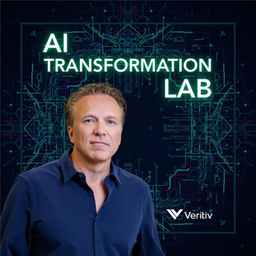
The way work gets done is changing.
The AI Transformation Lab Podcast explores the shift from generative AI to agentic AI — where intelligent systems move beyond responding to prompts and begin executing real work.
Hosted by Chris Bradley, Chief Marketing Officer at Veritiv, this show is built for leaders, builders, and operators who want more than better AI responses — they want measurable outcomes and competitive leverage.
Each episode breaks down the inflection point happening in AI right now:
The move from prompt-response tools to outcome-driven systems
What agentic AI means for productivity, strategy, and scale
How to direct intelligent systems responsibly and effectively
The mindset shift required to operate at the next level
This isn’t about hype or surface-level trends.
It’s about capability.
If you want to understand where AI is actually heading — and how to lead in that future — start here.
Chris Bradley, CMO at Veritiv, explores how "just-in-time" principles apply to AI agents, revealing that human attention, not capacity, becomes the new constraint in knowledge work.
28 Sept 2026TRANSCRIPT
Charting the Path to an AI-Native Operation
Host Alex Thompson explores how Bridgestone's hoshin kanri, a strategic planning framework, guides organizations toward an AI-native operation through continuous improvement and radical change.
14 Sept 2026TRANSCRIPT
AI Standard Work
Chris Bradley argues that distinction now decides whether an enterprise AI program compounds or stalls. Ohno's rule was that without a standard there can be no kaizen. The AI version is stricter: you cannot automate a process that was never standardized, because there is nothing for the agent to execute. Most failed pilots, he suggests, are operations problems that AI happened to expose.
31 Aug 2026
Jidoka for Agents: Building AI That Knows When to Stop
Sakichi Toyoda's breakthrough was not a loom that could handle a broken thread. It was a loom that noticed the thread had broken and stopped itself — which meant one operator could run dozens of machines instead of standing guard over one. That principle became jidoka, and Chris Bradley argues it is the most useful idea available to anyone deploying AI agents in an enterprise today.
17 Aug 2026
Context, Loops, and Graphs
Chris Bradley argues the churn is hiding something worth understanding. Those terms don't replace each other; they stack. And each one names a layer of the same discovery: that the model is not what separates an AI program that works from one that doesn't.
3 Aug 2026
The ROI Reckoning
Chris Bradley takes on the number that reset the enterprise AI conversation — a widely-cited MIT study finding 95% of pilots delivered no measurable return — and locates the real cause. Much of what is sold as agentic AI is generative AI wearing an agent title. It advises. A person still completes the work. And the promised time savings were never structurally possible.
20 Jul 2026
The Art of Rightsizing AI
In this episode, Chris Bradley makes sense of a landscape that shifted fast in June and July. A new most-capable model. A family that ships in three deliberate sizes. And a wave of open-weight models from the US and China that companies can run inside their own walls. His frame for all of it is rightsizing: matching the model to the work the way a manager matches a person to a task. He sorts the work into three tiers, the Clerk for high-volume routine work, the Operator for the reliable execution that runs the business, and the Expert for the hard, high-stakes reasoning.
6 Jul 2026
Build vs. Buy in the Age of Agentic AI
In this episode I turn that gut check into a decision you can defend. The key is a better question — not “should we build or buy?” but “how much orchestration does this work actually need?” That question sorts every AI decision into three tiers. Work that lives inside one app — buy the AI already there. Work that crosses standard systems — bridge them with an orchestration platform. Work that runs through your customized core, where no pre-built connector reaches — build it.
22 Jun 2026
The Nine Wastes of AI
Most teams look at a slow process and ask one question — can AI do this faster? It’s the wrong first question. The better one is harder: should this work exist at all? In this episode I borrow a seventy-year-old lens from the Toyota Production System — the wastes of Lean — and point it at knowledge work, where waste hides far better than it ever did on a factory floor.
8 Jun 2026
Kaizen + Agentic AI: The Enterprise AI Transformation Playbook
In this episode, Chris Bradley makes the case that Continuous Improvement is the non-negotiable core of agentic AI. Recorded from Veritiv's Customer Service center in Jacksonville — the day before a three-day Kaizen — he lays out a simple model for bringing AI to any process: three levels, Automate, Improve, and AI-Native Rebuild. Level one paves the cow path. Level two strips the waste with Lean before automating. Level three rebuilds the process from scratch around what agents can now do — and you can't earn it without doing level two first.
25 May 2026
Your Agentic DNA — The Portable Layer That Travels With You
This episode is about the fix — building a portable layer of identity, memory, and skills that travels with you across every environment. I call it your Agentic DNA. A small set of files you own, that capture the version of you AI needs to know about, that deploy into any new harness in minutes instead of months.
11 May 2026
Tools That Changed How I Work — OpenAI Codex
In this episode, I walk through the seven capabilities that define Codex now — full file access, persistent memory, plugins, skills, GPT Image 2.0, browser and computer use, and automations — and where each one actually changes the work.
27 Apr 2026
Tools That Changed How I Work: Anthropic’s Claude Desktop (Code, Cowork & Chat)
The big three AI labs are all building superapps — but each is packaging them differently. Google blurs everything together inside Antigravity. OpenAI is consolidating into Codex. Anthropic took a third path: three distinct surfaces inside one Claude desktop app — Chat, Cowork, and Code.
13 Apr 2026
Tools That Changed How I Work: Google Antigravity
In Episode 1, I mentioned a competitive analysis I ran in thirty minutes that would have taken two weeks. A global network analysis — fifty-plus competitor locations, fifteen manufacturing hubs, proximity calculations, coverage gaps, and a full action plan for leadership.
30 Mar 2026
Tools That Changed How I Work: Google NotebookLM
Most AI tools know the internet. NotebookLM knows your sources.
That distinction sounds small. It isn't. When you're doing serious research — regulatory analysis, competitive intelligence, executive briefing prep — the difference between a tool that synthesizes the web and a tool that synthesizes your documents is the difference between fast and trustworthy.
16 Mar 2026
The AI Fluency Playbook: Three Habits That Keep You Ahead
In Episode 3, Chris Bradley introduces a three-habit framework built for continuous AI fluency: the AI Pulse, a monthly calibration that keeps your mental model of AI's capabilities current; the Workflow Lab, a weekly thirty-minute session dedicated to examining and redesigning one workflow at a time; and the Workflow Pause, an in-the-moment reflex that catches automation opportunities before you execute on autopilot.
The episode also shows how ODIF — the agentic direction framework from Episode 2 — maps directly onto workflow redesign, making every Lab session more rigorous and every output more immediately usable.
2 Mar 2026
Beyond Prompt Engineering: A Masterclass in Agentic Direction
The gap between AI users who've adapted to 2026 capabilities and those still using 2024 techniques is creating a significant productivity divide and the difference isn't about being smarter, it's about understanding what changed.
In this episode of the AI Transformation Lab Podcast, host Chris Bradley, Chief Marketing Officer at Veritiv and head of their AI Transformation Lab, reveals how agentic AI tools have fundamentally shifted how we work with artificial intelligence. Bradley walks through a real example: a competitive analysis that took one to two weeks in early 2025 now takes thirty minutes, with exponentially better results. He unpacks the techniques driving this transformation and explains why elaborate prompting strategies have become obsolete.
19 Feb 2026
The Leap from Generative to Agentic AI
In this episode of the AI Transformation Lab Podcast, host Chris Bradley, Chief Marketing Officer at Veritiv and head of the AI Transformation Lab, explores the fundamental shift from generative AI to agentic AI and why this distinction will reshape how knowledge work gets done in 2025 and beyond.
Inside a recent episode
Just-in-Time for Agents
Published 13 Oct 2026 · Transcript excerpt
[…] It was a human constraint. And for the first time, single-piece flow is economical in an office. That's the opportunity. But our first day shows the trap inside it. The agent can flow. The people downstream of it still can't. Every process moves at the speed of its slowest step. Lean practitioners have known that forever. Speed up any other step and you don't speed up the process. You just build a pile in front of the slow one. In credit and rebuild, the slow step was never drafting. It was human review. The agent made drafting 20 times faster, and the only measurable effect was a bigger pile in front of the reviewers. 200 drafts sitting in a queue is inventory, same as parts stacked between machines on a factory floor in the 1950s. […]
Pod Engine is an independent podcast discovery and analytics service and is not affiliated with or endorsed by this podcast. Artwork and show content belong to their owners. Full legal notice.
Explore this show Podcast research with Pod Engine