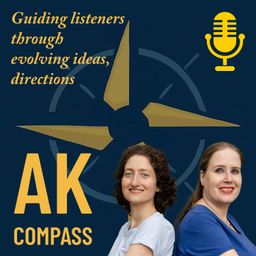
Do climate change and sustainability events and courses really help create change? In this episode of the AK Compass Podcast, Karolina Czako and Ágnes Gárdonyi look at what these gatherings can achieve—and where their impact often falls short.
Climate and sustainability events and short courses can bring together like-minded people across generations and interest groups, from scientific and religious communities to feminist and environmental movements. They can help participants understand sustainability principles, connect different perspectives, and work toward transdisciplinary solutions. They can also help people prepare for a changing world, especially when topics like mental health and biodiversity are still often overlooked in favor of trending corporate reporting.
The conversation also explores what these events make us question: what we value, what “home” means, and how rising temperatures could make some places less livable within our lifetimes. Karolina and Ágnes discuss energy return on investment over human history, as well as deep adaptation and collapsology. These approaches focus on understanding human impact on Earth rather than only on regulation, reporting, and paperwork.
Finally, they ask whether climate events themselves practice what they preach. Can they reduce energy use and food waste, choose hybrid formats where travel would add unnecessary emissions, and pursue credible green certifications? In a time of geopolitical and climate challenges, heat domes, and rising food and energy prices, the real question is not only what we learn at these events, but what we do afterwards.
29 Sept 2026
Who Is Responsible for Sustainability: Individual vs. Industry
Have you ever wondered whether your everyday choices really matter when it comes to sustainability?
In this episode of the AK Compass Podcast, Karolina Czako and Ágnes Gárdonyi look at individual and industrial responsibility and discuss how the two should be treated in a balanced way.
They start with the choices we can make in daily life: bringing our own containers, choosing locally sourced food and cosmetics where possible, and finding realistic ways to create less waste. Talking with family and friends can help us see what works in our own daily lives. The aim isn’t to just stay in our comfort zones, but it isn’t to demand perfection either.
Companies also have a great role. They have far more power to change how products and services are designed, how supply chains work, and where investment goes. Karolina and Ágnes discuss why polluter-pays rules need to be enforced, why businesses should consider long-term value alongside short-term profit, and why the right technology should serve people and the environment, but not dictate what change is possible.
They also explore greenwashing and the EmpCo anti-greenwashing directive. What’s the difference between plastic described as “ocean-bound” and plastic actually recovered from the ocean or a river? And why is a specific claim, such as the number of bottles saved, more useful than a vague promise to be “eco-friendly”?
At its heart, this is a conversation about making an impact at the scale available to us: through our choices, the companies we support, and the decisions businesses make about their environmental and social future.
15 Sept 2026
Madrid & Toledo: Community, Siesta and Spain’s Hidden History
In this episode, Karolina Czakó and Ágnes Gárdonyi look back on Karolina’s time as a guest student in Madrid. They talk about the everyday atmosphere of the city: families spending time together in public squares with children playing outside, and a daily rhythm shaped by the siesta. Around midday, life slows down; work and conversations continue in the afternoon after the siesta, which is unknown in many other cultures.
They also share what it’s like to move around Madrid and beyond: the simple use of the metro system, the high-speed trains, and the quiet beauty of Atocha station with its indoor garden. Karolian also shares a funny and cautionary story about thinking you’re on time and still somehow missing the train.
Toledo is a calm escape from the city. As the former capital of Spain, it carries layers of history: Various cultural and historical influences are still visible in the streets and on the buildings. The episode also reféect on why the capital moved to Madrid, and how Spain tends to honor its past instead of erasing it, including the Moorish times.
Reach and audience
Public platform figures. Ratings count people who left a rating, not total listeners.
Spotify
5.0 / 5
1 ratings
Contact AK Compass Podcast
Guest appearances
Books guests
Based on episode analysis; this does not confirm that the show is currently accepting guests.
Host of AK Compass Podcast?
Claim your podcast to manage its listing and keep your show details accurate.
Pod Engine is an independent podcast discovery and analytics service and is not affiliated with or endorsed by this podcast. Artwork and show content belong to their owners. Full legal notice.
Explore this show Podcast research with Pod Engine