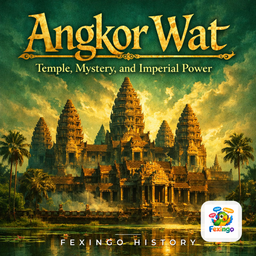
About Angkor Wat: Temple, Mystery, and Imperial Power — Fexingo History
Angkor Wat, the sprawling temple complex in modern-day Cambodia, stands as both an architectural marvel and a symbol of imperial ambition. This show explores the rise and fall of the Khmer Empire, from its 9th-century origins under Jayavarman II to its zenith under Suryavarman II, who built Angkor Wat in the 12th century as a state temple and microcosm of the Hindu universe. We delve into the cosmic design of the five lotus-bud towers, the vast baray reservoirs that sustained a hydraulic city, and the transition from Hinduism to Theravada Buddhism under Jayavarman VII, who constructed the enigmatic Bayon with its 216 smiling faces. Lucas and Luna guide listeners through the inscriptions of Yaśovarman I, the role of the devaraja cult, and the empire’s eventual decline after the Siamese sack of Angkor in 1431. We also examine modern debates over heritage management, looting, and tourism, as well as the enduring mystery of Angkor’s ‘disappearance’ into the jungle. Why does this temple continue to captivate the global imagination? Join us as we uncover the spiritual, political, and ecological forces that shaped—and continue to shape—Angkor Wat.
#AngkorWat #KhmerEmpire #SuryavarmanII #JayavarmanVII #Bayon #AncientCambodia #HinduArchitecture #BuddhistArt #TempleMountain #Devaraja #AngkorThom #SoutheastAsiaHistory #UrbanHydrology #ImperialPower #HeritageManagement #History #WorldHistory #FexingoHistory
Keep every episode free: buymeacoffee.com/fexingo (https://buymeacoffee.com/fexingo)
Most histories of Angkor Wat focus on the kings and priests, but this episode reveals the massive, often overlooked workforce that built it. We explore the lives of the artisans, engineers, and conscripted laborers who shaped the temple’s five towers and intricate bas-reliefs. Lucas and Luna discuss the social hierarchy at work, the role of the Devata and Apsara carvers, and how the hydraulic empire relied on a disciplined population to manage the barays and transport sandstone from Phnom Kulen. From the Brahmin priests overseeing rituals to the uncounted thousands moving stone, we uncover the human cost behind the spiritual architecture of Suryavarman II.
#AngkorWat #KhmerEmpire #SuryavarmanII #SoutheastAsiaHistory #Archaeology #TempleConstruction #KhmerArt #BasRelief #Devata #Apsara #PhnomKulen #Sandstone #Laterite #Baray #HydraulicEmpire #LaborHistory #Conscription #FexingoHistory #History
Keep every episode free: buymeacoffee.com/fexingo (https://buymeacoffee.com/fexingo)
21 Oct 2026
Angkor Wat's Lost Astronomers and Celestial Maps
While Angkor Wat is renowned for its architecture and bas-reliefs, this episode explores the sophisticated astronomical knowledge embedded in its design. We examine how Khmer engineers aligned the temple complex with solar and lunar events, reflecting a deep understanding of celestial mechanics. Lucas and Luna discuss the role of brahmin priests and astronomers in determining construction dates and ritual calendars. The conversation touches on the integration of Vedic cosmology with practical engineering, using tools like gnomons and water clocks to track time. We also look at recent archaeological findings that suggest a broader network of observatories across the Khmer Empire. By analyzing inscriptions and structural alignments, we uncover how astronomy was not just spiritual but essential for agriculture and imperial administration. This episode moves beyond the visual grandeur to reveal the intellectual rigor behind Angkor Wat’s creation.
#AngkorWat #KhmerEmpire #Astronomy #SuryavarmanII #CelestialMechanics #VedicCosmology #Archaeoastronomy #SoutheastAsiaHistory #TempleArchitecture #BrahminPriests #SolarAlignment #LunarCalendar #Gnomon #WaterClocks #ImperialAdministration #HistoricalEngineering #History #FexingoHistory #PodcastEpisode
Keep every episode free: buymeacoffee.com/fexingo (https://buymeacoffee.com/fexingo)
20 Oct 2026
Angkor Wat's Hidden City: The Life Behind the Stone
While Angkor Wat is famous for its towering spires and military bas-reliefs, we explore the human infrastructure that made it possible. Lucas and Luna discuss the role of the devata and apsara not just as divine figures, but as reflections of the royal household and the thousands of artisans who lived in the shadow of the temple. We look at the inscriptions from the reign of Suryavarman II that reveal a complex society of skilled craftsmen, priests, and laborers whose daily lives were recorded in stone. This episode moves beyond the myth of the devaraja to examine the practical reality of maintaining a hydraulic empire, including the management of water systems like the baray and the economic networks that brought sandstone from Phnom Kulen. By focusing on the 'silent stones' of the artisans and the administrative details found in Khmer epigraphy, we uncover how imperial power was sustained through meticulous record-keeping and social organization rather than just divine right.
#AngkorWat #SuryavarmanII #KhmerEmpire #Devata #Apsara #BasRelief #PhnomKulen #Sandstone #HydraulicEmpire #Baray #Devaraja #Vaishnavism #KhmerArchitecture #SoutheastAsiaHistory #TempleConstruction #ArtisansOfAngkor #FexingoHistory #History
Keep every episode free: buymeacoffee.com/fexingo (https://buymeacoffee.com/fexingo)
Contact Angkor Wat: Temple, Mystery, and Imperial Power — Fexingo History
Guest appearances
Does not typically book guests
Based on episode analysis; this does not confirm that the show is currently accepting guests.
Host of Angkor Wat: Temple, Mystery, and Imperial Power — Fexingo History?
Claim your podcast to manage its listing and keep your show details accurate.
Pod Engine is an independent podcast discovery and analytics service and is not affiliated with or endorsed by this podcast. Artwork and show content belong to their owners. Full legal notice.
Explore this show Podcast research with Pod Engine