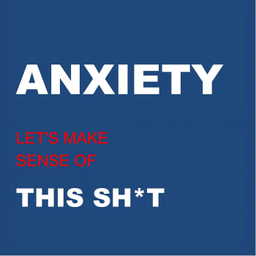
Anxiety Podcast is part of the Making Sense of It series. This show serves skeptical, busy adults (25–55) who want 2–5 minute, evidence-based anxiety resets they can feel in their body immediately—at work, in bed, or before a meeting. We own panic, acute anxiety, nervous system reset, vagus nerve, health anxiety, anticipatory worry, and scenario-specific protocols. We never drift into trauma/CPTSD framing, grief/loss content, or vague "just relax" advice. Speed, specificity, and mechanism-in-one-sentence are the brand promise. --- Listen on Spotify and Apple Podcasts. Search for this show on Spotify for weekly episodes on anxiety, worry, panic, and practical calm tools — new episodes every week. Topics include: Anxiety: Let's Make Sense Of This Shit. Audio for this show is produced with AI assistance. Episodes are researched, scripted, and reviewed for accuracy before release.
Become a supporter of this podcast: https://www.spreaker.com/podcast/anxiety-podcast--6351689/support (https://www.spreaker.com/podcast/anxiety-podcast--6351689/support?utm_source=rss&utm_medium=rss&utm_campaign=rss).
Anxiety Is a Body System, Not a Thinking Problem: How to Calm It
In this episode, we tear anxiety apart piece by piece and rebuild it as a system you can actually work with. Forget the tired advice to just relax and light a candle. Host Fabian walks you through the real machinery inside your body, from the amygdala's lightning-fast alarm to the anxiety loop that keeps it running. You will learn why you cannot logic your way out of a racing heart, how your own breath chemistry can fuel panic, and which two-minute techniques send your nervous system the safety signals it actually understands. Whether it is Sunday-night dread, pre-meeting jitters, or a two a.m. thought spiral, this episode gives you tools with real mechanisms behind them, not decoration.
Key Takeaways:
• Anxiety is a body system, not a thinking problem, and systems can be worked with
• Understanding the amygdala's alarm sequence makes calming techniques feel obvious, not like tricks
• Slow exhales signal safety to your nervous system faster than reasoning ever could
• Avoidance relieves anxiety short-term but teaches your brain the alarm was necessary
• Physical signals calm the body first, then the thinking brain regains control
What You'll Discover:
• Why the body reacts before the mind catches up, and why logic loses to adrenaline
• The four-step anxiety loop from Aaron Beck's cognitive-behavioral framework, and where it breaks
• How hyperventilation drops carbon dioxide and creates symptoms that mimic real danger
• Why CO2 hypersensitivity turns your own breath chemistry into a perceived threat
• How to distinguish everyday anxiety from anxiety disorders that deserve professional care
Recommended Resources:
• National Institute of Mental Health (NIMH) anxiety disorder information pages: https://www.nimh.nih.gov/health/topics/anxiety-disorders (https://www.nimh.nih.gov/health/topics/anxiety-disorders)
• Anxiety and Depression Association of America (ADAA): https://adaa.org (https://adaa.org)
• Harvard Health Publishing stress response resources: https://www.health.harvard.edu (https://www.health.harvard.edu)
• Aaron Beck's work through the Beck Institute for Cognitive Behavior Therapy: https://beckinstitute.org (https://beckinstitute.org)
Coming Up Next
Next week, we walk through real listener scenarios step by step, from the desk before the big meeting to the airport gate, with two full practical-tool segments you can run the moment the episode ends. Bring your two a.m. spiral, because we are finally giving it the off switch.
📩 Have questions or want to share your experience? Reach out at anxiety@senseofthisshit.com (mailto:anxiety@senseofthisshit.com).
💛 Join Our Supporters Club ($3 a month) 💛 Ad-free listening + early episodes — help keep independent media alive. Click Here: https://www.spreaker.com/podcast/anxiety-podcast--6351689/support (https://www.spreaker.com/podcast/anxiety-podcast--6351689/support)
If you or someone you know is in crisis, call or text 988 (Suicide & Crisis Lifeline) or text HOME to 741741 (Crisis Text Line). In an emergency, call 911. This podcast is not a substitute for professional care.
26 Sept 2026
Shoulder-Drop Technique: Calm Anxiety at Your Desk Now
In this episode, discover the invisible shoulder-drop: a discreet anxiety reset you can do in under three seconds while sitting in a meeting, on a video call, or at your desk without anyone noticing. Host Fabian breaks down exactly how to combine a quiet exhale with a subtle shoulder release, why this tiny movement signals safety to your nervous system through the vagus nerve, and how to anchor the technique to triggers like calendar chimes so it fires automatically when anxiety climbs. Learn the four common mistakes that make this technique pointless, the real science behind muscle tension and calm, and a simple one-week plan to turn this micro-move into a reflex your body owns.
Key Takeaways:
• Master a two-second shoulder-drop technique that stays completely invisible to coworkers and video call cameras
• Learn why a long exhale during muscle release activates your parasympathetic nervous system
• Discover how to anchor the technique to existing daily triggers so it happens without willpower
• Avoid the four common mistakes that turn this reset into a pointless gesture
• Walk away with a concrete one-week plan and a measurable way to track real progress
What You'll Discover:
• Why your clenched shoulders feed a feedback loop that keeps your amygdala on high alert
• How interoception works and why your body listens to physical signals, not arguments
• The vagus nerve connection between slow breathing and measurable calm
• Edmund Jacobson's century-old relaxation science, compressed into seconds
• B.J. Fogg's anchoring research and why existing routines beat phone reminders every time
Recommended Resources:
• Tiny Habits by B.J. Fogg - https://www.tinyhabits.com (https://www.tinyhabits.com)
• Why Zebras Don't Get Ulcers by Robert Sapolsky
• Progressive Relaxation by Edmund Jacobson
• Lehrer & Gevirtz's heart rate variability biofeedback research in Frontiers in Psychology - https://www.frontiersin.org (https://www.frontiersin.org)
Coming Up Next
Next week, we explore what to do when the invisible techniques aren't enough—practical ways to recognize when it's time to seek professional support, and how to do it without shame. Because knowing when to get help is a skill worth mastering too.
📩 Have questions or want to share your experience? Reach out at anxiety@senseofthisshit.com.
💛 Join Our Supporters Club ($3 a month) 💛 Ad-free listening + early episodes — help keep independent media alive. Click Here: https://www.spreaker.com/podca... (https://www.spreaker.com/podcast/anxiety-podcast--6351689/support)
If you or someone you know is in crisis, call or text 988 (Suicide & Crisis Lifeline) or text HOME to 741741 (Crisis Text Line). In an emergency, call 911. This podcast is not a substitute for professional care.
19 Sept 2026
Stall Sigh: Stop Panic Behind a Locked Door Now
In this episode, we cover Private bathroom-stall physiological sigh when panic needs cover. The conversation opens with: Welcome to Anxiety Podcast. I am Fabian, and this is the show where the nervous system becomes something simple enough to use. Today we are talking about anxiety that hits in the worst possible location. The meeting room, the crowded bus, the train that stops between stations. Your chest tightens, your heart races, and you cannot fall apart here. So you do what most of us do. You find the bathroom stall, lock it, and close your eyes. And then the Listen for the key context, practical takeaways, and the most important points to carry forward.
What You'll Discover:
• Core context for Private bathroom-stall physiological sigh when panic needs cover
• Practical steps you can use today
• How stress shows up in the body during this pattern
• What to watch for when intensity rises
• One takeaway to practice after listening
Key Takeaways:
• Small actions compound over time
• Body cues matter as much as thoughts
• Support and pacing reduce overwhelm
Recommended Resources:
• The Body Keeps the Score by Bessel van der Kolk
• grounding exercises
• somatic experiencing
📩 Have questions or want to share your experience? Reach out at anxiety@senseofthisshit.com.
💛 Join Our Supporters Club ($3 a month) 💛 Ad-free listening + early episodes — help keep independent media alive. Click Here: https://www.spreaker.com/podca... (https://www.spreaker.com/podcast/anxiety/support)
If you or someone you know is in crisis, call or text 988 (Suicide & Crisis Lifeline) or text HOME to 741741 (Crisis Text Line). In an emergency, call 911. This podcast is not a substitute for professional care.
Reach and audience
Public platform figures. Ratings count people who left a rating, not total listeners.
Apple Podcasts (US)
5.0 / 5
3 ratings
Podcast Authority Score: 54 / 100
A composite of feed quality, social presence, YouTube performance and engagement. Read the methodology.
Quality
95
Social presence
0
YouTube
0
Engagement
32
Contact ANXIETY: Let’s Make Sense of This Sh*t
Guest appearances
Books guests
Based on episode analysis; this does not confirm that the show is currently accepting guests.
Questions about ANXIETY: Let’s Make Sense of This Sh*t
Who hosts ANXIETY: Let’s Make Sense of This Sh*t?
Fabian and [Host Name] host the show. Published by Fabian.
How often do new episodes come out?
The show publishes daily, based on its RSS feed.
Does ANXIETY: Let’s Make Sense of This Sh*t take guests?
Yes. Guests have been identified in episode analyses.
Host of ANXIETY: Let’s Make Sense of This Sh*t?
Claim your podcast to manage its listing and keep your show details accurate.
Pod Engine is an independent podcast discovery and analytics service and is not affiliated with or endorsed by this podcast. Artwork and show content belong to their owners. Full legal notice.
Explore this show Podcast research with Pod Engine