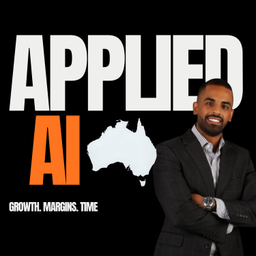
Podcast thumbnail for Applied AI Australia

Applied AI Australia

Claim This Podcast

by Ramon Rodriguez

21 episodes
Updated Daily
Accepts GuestsHas SponsorsLocation 🇦🇺

Podcast Overview

Applied AI Australia is the podcast for Australian executives turning AI into measurable business outcomes. Hosted by Ramon Rodriguez - an executive, not a career consultant. This show cuts through AI hype to focus on what matters: Growth and Margins. Now part of Acquire Intelligence, the podcast brings commercially grounded AI strategy and practical executive insight to CEOs, CIOs,CFOs, boards, and senior operators navigating rapid change and competitive pressure. Each week, Applied AI Australia delivers real-world conversations, operator perspectives, and practical frameworks leaders can apply quickly , often within 48 hours. This is not a tech podcast. It is practical AI leadership for executives accountable for results. Subscribe.

Language

🇺🇲

Publishing Since

8/21/2025

1 verified contact email on file for Applied AI Australia

Pitch yourself as a guest, propose sponsorships, or reach out directly to the host.

Recent Episodes

Episode thumbnail for Does AI Always Mean Fewer People? How CEOs Move Teams Into Higher-Value Work | Emma Fawcett, CEO Compare Club

July 27, 2026

Does AI Always Mean Fewer People? How CEOs Move Teams Into Higher-Value Work | Emma Fawcett, CEO Compare Club

<p><strong>Does AI always mean fewer people?</strong></p><p>In some parts of a business, it can.</p><p>The leadership challenge begins when AI removes, compresses or changes existing work. Leaders need to decide what stops, where the capacity goes, what higher-value work replaces it and what standard the team must now meet.</p><p>In this episode of <strong>Applied AI Australia</strong>, powered by Acquire Intelligence, Ramon Rodriguez speaks with Emma Fawcett, CEO of Compare Club, about leading that shift across a real business.</p><p>AI does not make people less important. It makes the right people, the right culture and the right work more important.</p><p>Emma draws on her experience, including leading MYOB’s largest division, where one million customers generated four million calls a year and waited up to 40 minutes for support.</p><p>Before approving an eight-figure technology program, Emma’s team stepped back to understand why customers were calling. They found that around 20% of calls came from customers who could not understand their bill.</p><p>By fixing those root causes before investing in new technology, the team cut call volume by roughly half. The business later reached 86% digital service and lifted customer satisfaction by around 20 percentage points.</p><p>At Compare Club, the same discipline underpins the Make Work Better program.</p><p>The business has identified 135 potential AI use cases, with each required to define the problem, expected return and where the freed capacity will go.</p><p>The results include:</p><p>• Board reporting reduced from nine days to two<br>• A monthly finance task reduced from 39 hours to around 25 minutes<br>• A recruitment tool that narrowed 400 applications to 30 for human review</p><p>Each example shows what happens when leaders treat saved time as capacity to be deliberately redirected, rather than the final result.</p><p><strong>What you’ll learn</strong></p><p>• Why AI programs stall when leaders begin with the tool<br>• What the right team looks like in an AI-enabled business<br>• Why emotional intelligence, curiosity and adaptability matter<br>• How to raise standards without creating fear<br>• Why saved time is not value until leaders decide where the capacity goes<br>• How to communicate changing roles and higher-value work honestly</p><p><strong>Your 48-hour action</strong></p><p>Choose one AI initiative already being discussed and ask:</p><ol><li><p>What low-value work does this remove?</p></li><li><p>Where will the freed capacity go?</p></li><li><p>What higher-value work should people do instead?</p></li><li><p>What capability must the team build next?</p></li><li><p>How will we explain the shift in a way that builds trust rather than fear?</p></li></ol><p>If the leadership team cannot answer those questions, the initiative is not ready to scale.</p><p><strong>Chapters</strong></p><p>• 00:00 Outcomes before technology<br>• 00:16 Welcome and guest introduction<br>• 01:10 Why AI starts in the wrong place<br>• 02:18 Four million calls and the eight-figure trap<br>• 08:58 EQ over IQ in the AI era<br>• 15:17 Who owns AI and Make Work Better<br>• 17:35 Nine days to two, 39 hours to 25 minutes<br>• 20:22 Cathy Bot and 135 AI use cases<br>• 29:38 Reducing 400 CVs to 30<br>• 35:50 Leading people through AI change<br>• 38:51 Moving people into higher-value work<br>• 46:40 From channel chaos to 86% digital service<br>• 49:57 Stop the Work and the 70/20/10 model<br>• 56:38 Put AI on the calendar<br>• 1:00:03 Where to find Emma and Compare Club<br>• 1:01:09 Final takeaways</p><p><strong>About Applied AI Australia</strong></p><p>Applied AI Australia is powered by Acquire Intelligence. We help Australian companies turn AI investment into measurable business value.</p><p>We help you, decide what to fund, what work must change, where value should land and who owns the result.</p><p>Get in touch - </p><p><a href="https://www.appliedaiaustralia.com.au/book-briefing" target="_blank" rel="noopener noreferer">https://www.appliedaiaustralia.com.au/book-briefing</a></p><p>Ramon: linkedin.com/in/ramonrod<br>Guest: Emma Fawcett, CEO of Compare Club</p>

Episode thumbnail for Fast Tech, Slow Org: The AI Execution Gap | Salesforce SVP & CMO ANZ Leandro Perez

July 20, 2026

Fast Tech, Slow Org: The AI Execution Gap | Salesforce SVP & CMO ANZ Leandro Perez

<p><strong>Fast Tech, Slow Org: The AI Execution Gap | Salesforce SVP &amp; CMO ANZ Leandro Perez</strong></p><p><strong>Subscribe</strong> if your leadership team is investing in AI but still cannot clearly explain what work has changed.</p><p>AI progress is easy to perform.</p><p>Pilots launch. Platforms get bought. Agents get tested. Boards receive updates.</p><p>Value is harder.</p><p>It shows up when workflows change, ownership is clear, metrics move, customers get a better outcome, and the organisation knows what the agent is allowed to do.</p><p>That is the AI execution gap.</p><p>In this episode of Applied AI Australia, powered by Acquire Intelligence, Ramon Rodriguez speaks with Leandro Perez, SVP &amp; CMO ANZ at Salesforce, about what has to change before AI capability becomes business value.</p><p>The conversation goes past tools and into the operating reality: agents need owners, metrics, supervision, escalation paths, business context, clean data and better work design.</p><p>Leandro also raises one of the sharper leadership shifts: this may be the last generation of managers who only manage people. As agents enter workflows, leaders will need to manage both people and AI systems.</p><p>The core message:</p><p>The tool is not the transformation. The proof is whether the work changed.</p><p><strong>What you’ll learn:</strong></p><ul><li>Why AI pilots, tools and training do not automatically create business value</li><li>What changes when AI moves from answering questions to acting inside workflows</li><li>Why agents need owners, metrics, supervision and escalation paths</li><li>How poor data and weak context limit AI performance</li><li>Why customer service, sales and marketing metrics need to change</li><li>What leaders should ask before scaling AI agents</li></ul><p>Key stats and examples:</p><ul><li>76% of Australian service leaders are looking at or using AI</li><li>56% of employees are using personal AI tools without disclosing it</li><li>Salesforce says 84% of cases are now handled autonomously in one support use case</li><li>More than 2.2 million cases have been deflected through Salesforce’s support agent</li><li>Salesforce has more than 300 agents operating internally</li><li>One prospecting agent had to be slowed down after following up outside normal business expectations</li></ul><p><br></p><p><strong>48-hour action: Pick one AI agent, pilot or workflow and ask:</strong></p><ol><li>What work has changed?</li><li>Who owns the outcome?</li><li>What metric proves value?</li><li>What authority does the agent have?</li><li>Where does a human step in?</li><li>What outcome has improved?</li><li>What needs to change before this scales?</li></ol><p>If you cannot answer those questions, you may be scaling AI activity, not AI value.</p><p>“Treat agents like an employee. You don’t just hire someone and leave them in the corner.” - Leandro Perez</p><p><strong>Chapters:</strong></p><ul><li>Fast tech, slow org</li><li>AI activity versus AI progress</li><li>Why AI pilots fail to become value</li><li>Why personal AI does not equal enterprise AI</li><li>Salesforce’s internal agent lessons</li><li>Why business experts need to manage agents</li><li>Data, privacy and guardrails</li><li>Who owns an agent when it goes wrong?</li><li>How to set success metrics for agents</li><li>Why AI changes old performance metrics</li><li>What leaders should do next</li></ul><p><br></p><p><strong>About Applied AI Australia:</strong></p><p>Applied AI Australia is powered by Acquire Intelligence. We help Australian companies turn AI into revenue, margin, time back, and better operating discipline.</p><p><strong>Need immediate execution support?</strong></p><p>From 10 December 2026, APP 1.7 requires organisations using automated systems to make, or substantially influence, decisions about individuals to disclose that fact in their privacy policy. Serious or repeated privacy interferences can carry penalties up to $50 million.</p><p>If your AI agents, scoring tools, triage systems or automated workflows touch customer decisions, you need a decision map before you can know what must be disclosed.</p><p>Acquire Intelligence runs six-week, governance-led sprints to build compliant decision maps from scratch before enforcement arrives.</p><p><strong>Websites:</strong></p><p><a href="www.appliedaiaustralia.com.au" target="_blank" rel="noopener noreferer">www.appliedaiaustralia.com.au</a><a href="www.acquireintelligence.ai " target="_blank" rel="noopener noreferer">www.acquireintelligence.ai </a><br><strong>Ramon:</strong><a href="https://www.linkedin.com/in/ramonrod/" target="_blank" rel="noopener noreferer">linkedin.com/in/ramonrod</a></p><p><strong>Guest:</strong></p><p>Leandro PerezSVP &amp; CMO ANZ, Salesforcelinkedin.com/in/leandro-perez</p>

Episode thumbnail for 10 December 2026: The AI Decision Deadline Executives Can’t Ignore

July 2, 2026

10 December 2026: The AI Decision Deadline Executives Can’t Ignore

<p>10 December 2026: The AI Decision Deadline Executives Can’t Ignore</p><p><br></p><p>From 10 December 2026, Australian organisations covered by the Privacy Act face new automated decision-making disclosure obligations under APP 1.7.</p><p><br></p><p>If AI, automation, scoring tools, workflow engines or legacy SaaS platforms help make decisions about customers, employees or applicants, executives need to know where those decisions happen and whether they are disclosed.</p><p><br></p><p>This episode gives leaders a practical way to find the gap before the deadline.</p><p><br></p><p>Map The Decisions Before You Rewrite The Policy</p><p><br></p><p>Many organisations can list their AI tools.</p><p><br></p><p>Fewer can show every automated or AI-assisted decision those tools shape.</p><p><br></p><p>That is the exposure.</p><p><br></p><p>APP 1.7 makes automated decision-making a privacy policy issue. But the real work starts earlier.</p><p><br></p><p>Executives need a decision inventory.</p><p><br></p><p>Send One Email To Expose The Gap</p><p><br></p><p>Send this to your General Counsel:</p><p><br></p><p>“Can you show me the current map of every automated or AI-assisted decision that affects customers, employees or applicants, and confirm which of those decisions are already disclosed in our privacy policy?”</p><p><br></p><p>A clear answer means the organisation has visibility.</p><p><br></p><p>An unclear answer means the organisation has mapping work to do.</p><p><br></p><p>Challenge The Three False Comforts</p><p><br></p><p>This episode breaks down three assumptions that can leave executives exposed:</p><p><br></p><p>* Vendor contracts do not replace internal accountability.</p><p>* Human approval does not always remove automated decision-making risk.</p><p>* Older automation can still be caught by technology-neutral rules.</p><p><br></p><p>Build The Decision Inventory From Outcomes</p><p><br></p><p>The practical fix starts with the people affected by the decision.</p><p><br></p><p>Start with customer, employee and applicant outcomes.</p><p><br></p><p>Then work backwards to the systems, data, vendors, workflows and approvals that shape those outcomes.</p><p><br></p><p>That is how leaders find the decisions that a tool register misses.</p><p><br></p><p>What You’ll Learn</p><p><br></p><p>* Why 10 December 2026 matters for Australian executives using AI and automation</p><p>* What APP 1.7 changes under the Privacy Act</p><p>* Why automated decision-making is broader than generative AI</p><p>* How to test whether your organisation has a decision inventory</p><p>* Why vendor contracts and human review may not be enough</p><p>* How old SaaS platforms and scoring tools can still create disclosure obligations</p><p>* How to map automated decisions from customer outcomes backwards</p><p>* Why larger organisations may need 8 to 16 weeks to build a usable decision map</p><p><br></p><p>Timestamps</p><p><br></p><p>0:00 — The boardroom story</p><p>0:54 — Welcome to Applied AI Australia</p><p>1:09 — APP 1.7 and the new disclosure rule</p><p>1:42 — What executives need to know</p><p>2:14 — Send this email to your GC</p><p>3:55 — Why the answer may be unclear</p><p>4:31 — Build a decision map, not just a vendor list</p><p>6:52 — Test vendor accountability</p><p>8:27 — Test human-in-the-loop approvals</p><p>11:50 — Test legacy automation</p><p>14:00 — Understand the penalty exposure</p><p>15:28 — Start with customer outcomes</p><p><br></p><p>About Applied AI Australia</p><p><br></p><p>Applied AI Australia helps executives turn AI complexity into business outcomes: growth, margin, time back and better operating discipline.</p><p><br></p><p>Each week, Ramon Rodriguez breaks down the AI shifts that matter for Australian leaders, boards and executive teams, so they can stay clear, current and in control with AI.</p><p><br></p><p>Need Execution Support?</p><p><br></p><p>Acquire Intelligence runs governance-led sprints to help organisations identify, map and manage automated and AI-assisted decisions before the 10 December 2026 deadline.</p><p><br></p><p>Visit Acquire Intelligence to close the gap.</p><p><br></p><p>Legal & Scope Disclaimer</p><p><br></p><p>This episode provides commercial and operational strategy only. It does not constitute formal legal advice. Your obligations under the Privacy Act depend on your specific circumstances. You must obtain independent advice from your General Counsel or external legal team to settle your compliance posture and privacy policy wording.</p>

21 total episodes available

Similar Podcasts

Discover related shows you might enjoy

Deep-dive analytics for Applied AI Australia

Frequently asked questions

Have a different question and can't find the answer you're looking for? Reach out to our support team by sending us an email and we'll get back to you as soon as we can.

What is Applied AI Australia?

Applied AI Australia is the podcast for Australian executives turning AI into measurable business outcomes. Hosted by Ramon Rodriguez - an executive, not a career consultant. This show cuts through AI hype to focus on what matters: Growth and Margins. Now part of Acquire Intelligence, the podcast brings commercially grounded AI strategy and practical executive insight to CEOs, CIOs,CFOs, boards, and senior operators navigating rapid change and competitive pressure. Each week, Applied AI Australia delivers real-world conversations, operator perspectives, and practical frameworks leaders can apply quickly , often within 48 hours. This is not a tech podcast. It is practical AI leadership for executives accountable for results. Subscribe.

How often does this podcast release new episodes?

This podcast updates daily.

Where can I listen to this podcast?

This podcast is available on 4 platforms including Apple Podcasts, Spotify, and more. You can also use the RSS feed directly.

Does this podcast accept guests?

Yes, this podcast regularly features guests.

Legal Disclaimer

Pod Engine is not affiliated with, endorsed by, or officially connected with any of the podcasts displayed on this platform. We operate independently as a podcast discovery and analytics service.

All podcast artwork, thumbnails, and content displayed on this page are the property of their respective owners and are protected by applicable copyright laws. This includes, but is not limited to, podcast cover art, episode artwork, show descriptions, episode titles, transcripts, audio snippets, and any other content originating from the podcast creators or their licensors.

We display this content under fair use principles and/or implied license for the purpose of podcast discovery, information, and commentary. We make no claim of ownership over any podcast content, artwork, or related materials shown on this platform. All trademarks, service marks, and trade names are the property of their respective owners.

While we strive to ensure all content usage is properly authorized, if you are a rights holder and believe your content is being used inappropriately or without proper authorization, please contact us immediately at hey@podengine.ai for prompt review and appropriate action, which may include content removal or proper attribution.

By accessing and using this platform, you acknowledge and agree to respect all applicable copyright laws and intellectual property rights of content owners. Any unauthorized reproduction, distribution, or commercial use of the content displayed on this platform is strictly prohibited.