ArchaeaCast
Hosted by Theopi Rados · Priyanka Chatterjee, Connor Hines, Alex Phillips, Theopi Rados
5.0from 14 ratings
- 10
- Episodes
- 14
- Ratings
- 2024
- First episode
About ArchaeaCast
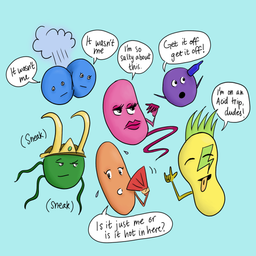
A podcast about the coolest domain of life: Archaea. We talk about some of the most interesting organisms on Earth. Join us to learn about halophiles, acidophiles, hyperthermophiles, methanogens - you name it! Every episode, we discuss a new topic about the science of archaea and at the end, we interview a guest expert!
- Publisher
- Priyanka Chatterjee, Connor Hines, Alex Phillips, Theopi Rados
- Category
- science
- Language
- en
- Explicit
- No
- First episode
- 22 Oct 2024
- Latest episode
- 2 Oct 2025
Latest episodes
10 episodes in the feed.
2 Oct 2025
Archaea as a Model: A Real Teacher’s Pet
Dr. Kelly Zatopek from New England Biolabs Inc discusses archaea as model systems and their use in biotechnology in an interview with Theopi Rados.
9 Sept 2025
Archaeal Viruses: Nice Guys get Infections too
Priyanka Chatterjee and Dr. Alex Phillips explore archaeal viruses, while Theopi Rados interviews Prof. Rachel Whitaker about virus diversity and evolution.
3 Jun 2025
Methanogens: Living on a Knife’s Edge
Professor Nicole Buan discusses methanogens, archaea that may have killed the dinosaurs, with Connor Hines in this interview, highlighting their ecological relevance and unique energy conservation methods.
20 May 2025
Archaea and Us: Heroes or Villains?
Welcome to ArchaeaCast! In our sixth episode, our hosts Priyanka Chatterjee and Dr. Connor Hines discuss the archaea that are very close to home–the ones that can live in and on us! In the second part of the episode, Priyanka interviews Dr. Christine Moissl-Eichinger, from the Medical University of Graz in Austria. **** For nomenclature changes, current nomenclature can be found here (https://gtdb.ecogenomic.org/genome?gid=GCA_003086455.1) **** Sources Triantafyllou K, Chang C, Pimentel M. 2014. Methanogens, Methane and Gastrointestinal Motility. J Neurogastroenterol Motil 20:31–40. Probst AJ, Auerbach AK, Moissl-Eichinger C. 2013. Archaea on Human Skin. PLOS ONE 8:e65388. Matarazzo F, Ribeiro AC, Faveri M, Taddei C, Martinez MB, Mayer MPA. 2012. The domain Archaea in human mucosal surfaces. Clin Microbiol Infect Off Publ Eur Soc Clin Microbiol Infect Dis 18:834–840. Dridi B, Henry M, Khéchine AE, Raoult D, Drancourt M. 2009. High Prevalence of Methanobrevibacter smithii and Methanosphaera stadtmanae Detected in the Human Gut Using an Improved DNA Detection Protocol. PLOS ONE 4:e7063. Takakura W, Pimentel M. 2020. Small Intestinal Bacterial Overgrowth and Irritable Bowel Syndrome – An Update. Front Psychiatry 11:664. Hook SE, Wright A-DG, McBride BW. 2010. Methanogens: Methane Producers of the Rumen and Mitigation Strategies. Archaea 2010:945785. Probiotics: Usefulness and Safety. NCCIH. https://www.nccih.nih.gov/health/probiotics-usefulness-and-safety (https://www.nccih.nih.gov/health/probiotics-usefulness-and-safety). Archaebiotics: Archaea as Pharmabiotics for Treating Chronic Disease in Humans? | IntechOpen. https://www.intechopen.com/chapters/56434 (https://www.intechopen.com/chapters/56434). Kim JY, Whon TW, Lim MY, Kim YB, Kim N, Kwon M-S, Kim J, Lee SH, Choi H-J, Nam I-H, Chung W-H, Kim J-H, Bae J-W, Roh SW, Nam Y-D. 2020. The human gut archaeome: identification of diverse haloarchaea in Korean subjects. Microbiome 8:114. Moissl-Eichinger C, Probst AJ, Birarda G, Auerbach A, Koskinen K, Wolf P, Holman H-YN. 2017. Human age and skin physiology shape diversity and abundance of Archaea on skin. Sci Rep 7:4039. Bovaer®. @anh. https://www.dsm-firmenich.com/anh/products-and-services/products/methane-inhibitors/bovaer.html (https://www.dsm-firmenich.com/anh/products-and-services/products/methane-inhibitors/bovaer.html). **** We’d love to hear from you! Contact us at archaeacast@gmail.com (mailto:archaeacast@gmail.com)
27 Feb 2025
Acidophiles: Oh, Sour Child o’Mine
Welcome to ArchaeaCast! In our fifth episode, our hosts Priyanka Chatterjee and Dr. Connor Hines talk about Acidophiles, the heavy metal rockin’ Archaea! In the second part of the episode, Connor Hines interviews Prof. (https://sites.utexas.edu/baker-lab/)Paul Blum (https://neurocarrus.com/paul-blum-ph-d/), from the University of Nebraska Lincoln. **** Article link (https://news.yahoo.com/yellowstone-national-park-death-oregon-013505047.html) for: “Yellowstone National Park Death: Oregon Man Died In Acidic Hot Spring Trying To ‘Hot Pot’” Video (https://www.youtube.com/watch?v=WnPrtYUKke8) showing Cans dissolving in Acid Sacki Dog Meme (https://imgur.com/a/rDfQ3O9%20%20https://microbewiki.kenyon.edu/index.php/Ferroplasma_acidiphilum) Picture of “Ferroplasma acidiphilum (https://wastemagazine.es/bacteria.htm)” **** For nomenclature changes, current nomenclature can be found here (https://gtdb.ecogenomic.org/genome?gid=GCA_003086455.1) **** Sources Howland, J. L. (2000). The surprising archaea: discovering another domain of life. Oxford University Press. ISBN: 9780195111835 Chen, Lanming, et al. "The genome of Sulfolobus acidocaldarius, a model organism of the Crenarchaeota (https://doi.org/10.1128/jb.187.14.4992-4999.2005)." Ferrer, Manuel, et al. "The cellular machinery of Ferroplasma acidiphilum is iron-protein-dominated. (https://doi.org/10.1038/nature05362)" McCarthy, Samuel, et al. "Expanding the limits of thermoacidophily in the archaeon Sulfolobus solfataricus by adaptive evolution (http://dx.doi.org/10.1128/AEM.03225-15)." Krzmarzick, Mark James, et al. "Diversity and niche of archaea in bioremediation (https://doi.org/10.1155/2018/3194108)." Rastädter, Kerstin, et al. "The cell membrane of Sulfolobus spp.-homeoviscous adaption and biotechnological applications. (https://www.ncbi.nlm.nih.gov/pmc/articles/PMC7312580/)" Baker-Austin, Craig, and Mark Dopson. "Life in acid: pH homeostasis in acidophiles. (https://doi.org/10.1016/j.tim.2007.02.005)" Mikael Sehlin, H. B. L. E., and E. Börje Lindström. "Oxidation and reduction of arsenic by Sulfolobus acidocaldarius strain BC. (https://doi.org/10.1111/j.1574-6968.1992.tb05045.x)" “Abandoned Mine Drainage (https://www.epa.gov/nps/abandoned-mine-drainage)” “Where do acid-sulfate hot springs come from and why are they important? (https://www.usgs.gov/observatories/yvo/news/where-do-acid-sulfate-hot-springs-come-and-why-are-they-important)” Nordstrom, D. Kirk, James W. Ball, and R. Blaine McCleskey. "Ground water to surface water: chemistry of thermal outflows in Yellowstone National Park." Geothermal biology and geochemistry in Yellowstone National Park (2005): 73-94.
11 Feb 2025
Thermophiles: Some like it hot…like, really really hot
Welcome to ArchaeaCast! In our fourth episode, our hosts Dr. Connor Hines and Dr. Alex Philips talk about Thermophiles, the Archaea which are almost too hot to handle! In the second part of the episode, Theopi Rados interviews Prof. Rachel Whitaker, (https://sib.illinois.edu/directory/profile/rwhitakr) from the University of Illinois at Urbana-Champaign. **** Picture of Pyrococcus furiosus (https://upload.wikimedia.org/wikipedia/commons/6/60/P_furiosus.jpg) **** For nomenclature changes, current nomenclature can be found here **** Sources Atomi, Haruyuki, et al. 2004. https://doi.org/10.1128/jb.186.14.4829-4833.2004 (https://doi.org/10.1128/jb.186.14.4829-4833.2004) Boyd, Eric S., et al. 2013. https://doi.org/10.3389/fmicb.2013.00062 (https://doi.org/10.3389/fmicb.2013.00062) Brochier-Armanet, et al. 2006. https://doi.org/10.1155/2006/582916 (https://doi.org/10.1155/2006/582916) Charles-Orszag, et al. 2021. https://doi.org/10.3389/fmicb.2021.707124 (https://doi.org/10.3389/fmicb.2021.707124) Charles-Orszag, Arthur, et al. 2023. https://doi.org/10.1016/j.bpj.2022.11.1527 (https://doi.org/10.1016/j.bpj.2022.11.1527) Erauso, Gaël, et al. 1993. https://doi.org/10.1007/BF00252219 (https://doi.org/10.1007/BF00252219) Fiala, Gerhard, and Karl O. Stetter. 1986. https://doi.org/10.1007/BF00413027 (https://doi.org/10.1007/BF00413027) Forterre, Patrick. 2002. https://doi.org/10.1016/S0168-9525(02)02650-1 (https://doi.org/10.1016/S0168-9525(02)02650-1) Fröls, Sabrina, et al. 2007. https://doi.org/10.1128/jb.01016-07 (https://doi.org/10.1128/jb.01016-07) Grogan, Dennis W., Geraldine T. Carver, and John W. Drake. 2001. https://doi.org/10.1073/pnas.141113098 (https://doi.org/10.1073/pnas.141113098) Han, Wenyuan, et al. 2017. https://doi.org/10.3390/ijms18071340 (https://doi.org/10.3390/ijms18071340) Hsieh, Tao-shih, and Jody L. Plank. 2006. https://doi.org/10.1074/jbc.M513252200 (https://doi.org/10.1074/jbc.M513252200) Mackwan, Reena R, et al. 2008. https://doi.org/10.1534/genetics.108.089086 (https://doi.org/10.1534/genetics.108.089086). Pulschen, Andre Arashiro, et al. 2020. https://doi.org/10.1016/j.bpj.2022.11.1527 (https://doi.org/10.1016/j.bpj.2022.11.1527) Russell, M. J., A. J. Hall, and W. Martin. 2010. https://doi.org/10.1111/j.1472-4669.2010.00249.x (https://doi.org/10.1111/j.1472-4669.2010.00249.x) Wolferen, Marleen van, et al. 2020. https://doi.org/10.1128/mbio.03014-19 (https://doi.org/10.1128/mbio.03014-19) Yang, Xi, et al. 2020. https://doi.org/10.1073/pnas.1921848117 (https://doi.org/10.1073/pnas.1921848117)
5 Dec 2024
Asgardarchaea: The Ancient Norse gods of Microbes
Welcome to ArchaeaCast! In our third episode, our hosts Priyanka Chatterjee and Connor Hines talk about Asgardarcheota, Norse mythology named Archaea! In the second part of the episode, Dr. Alex Phillips interviews Prof. Brett Baker (https://sites.utexas.edu/baker-lab/), from the University of Texas at Austin. **** For nomenclature changes, current nomenclature can be found here (https://gtdb.ecogenomic.org/genome?gid=GCA_003086455.1) **** Sources Scientists Break Record By Finding Northernmost Hydrothermal Vent Field (https://www.sciencedaily.com/releases/2008/07/080724153941.htm) Complex archaea that bridge the gap between prokaryotes and eukaryotes (https://pubmed.ncbi.nlm.nih.gov/25945739/) Cultured Asgard Archaea Shed Light on Eukaryogenesis (https://www.sciencedirect.com/science/article/pii/S009286742030386X?ref=cra_js_challenge&fr=RR-1) Genomic reconstruction of a novel, deeply branched sediment archaeal phylum with pathways for acetogenesis and sulfur reduction (https://www.nature.com/articles/ismej2015233) Asgard archaea illuminate the origin of eukaryotic cellular complexity (https://www.nature.com/articles/nature21031) Isolation of an archaeon at the prokaryote–eukaryote interface (https://www.nature.com/articles/s41586-019-1916-6) Casting light on Asgardarchaeota metabolism in a sunlit microoxic niche (https://www.nature.com/articles/s41564-019-0404-y) Fantastic article on the history of Metagenomics (https://merenlab.org/2020/07/27/history-of-metagenomics/) Press release (https://www.jamstec.go.jp/e/about/press_release/20200116/) which includes the E3 image from JAMSTEC, and a great video (https://www.youtube.com/watch?v=XZ2pGEq_x9Q) on E3 from JAMSTEC. Other work cited: Booth A, Doolittle WF. Eukaryogenesis, how special really? Proc Natl Acad Sci U S A. 2015 Aug 18;112(33):10278-85. doi: 10.1073/pnas.1421376112. Epub 2015 Apr 16. PMID: 25883267; PMCID: PMC4547297. Jørgensen, Steffen Leth, et al. "Quantitative and phylogenetic study of the Deep Sea Archaeal Group in sediments of the Arctic mid-ocean spreading ridge." Frontiers in microbiology (2013) Stackebrandt E, Frederiksen W, Garrity GM, Grimont PAD, Kämpfer P, Maiden MCJ, Nesme X, Rosselló-Mora R, Swings J, Trüper HG, Vauterin L, Ward AC, Whitman WB. Report of the ad hoc committee for the re-evaluation of the species definition in bacteriology. Int J Syst Evol Microbiol. 2002 May;52(Pt 3):1043-1047. doi: 10.1099/00207713-52-3-1043. PMID: 12054223. **** ArchaeaCast episodes drop every other Tuesday on your favorite audio platform! We’d love to hear from you! Contact us at archaeacast@gmail.com (mailto:archaeacast@gmail.com)
15 Nov 2024
Halophiles: A great day to be a little extra salty
Welcome to ArchaeaCast! In our second episode, our hosts Priyanka Chatterjee and Connor Hines talk about Halophiles, the salt-loving Archaea! In the second part of the episode, Dr. Alex Phillips interviews Prof. Amy Schimd, from Duke University. **** Some species and genera names have changed since this episode was recorded. Current nomenclature can be found here (https://gtdb.ecogenomic.org/genome?gid=GCA_003086455.1). **** Bibliography: Cited in the episode: Pietrangelo, A. "Pink Himalayan Salt: Benefits, Risks, and Alternatives." Healthline, 2 Sept. 2023 Papp, ZJ. "Morphological and Microchemical Characterization of Himalayan Salt Samples." Revue Roumaine de Chimie, vol. 61, no. 3, Mar. 2016 Duarte CM et al D. Discovery of Afifi, the shallowest and southernmost brine pool reported in the Red Sea. Sci Rep. 2020 Wilkanski, B. Life in the Dead Sea. Nature 138, 467 (1936). Yim, K.,et al et al. Occurrence of viable, red-pigmented haloarchaea in the plumage of captive flamingoes. Sci Rep 5, 16425 (2015). Giani M et al Haloarchaeal Carotenoids: Healthy Novel Compounds from Extreme Environments. Mar Drugs. 2019 Sep 6;17(9):524. Aharon Oren, John E. Hallsworth, Microbial weeds in hypersaline habitats: the enigma of the weed-like Haloferax mediterranei, FEMS Microbiology Letters, 2014. DasSarma S, et al Extremophilic models for astrobiology: haloarchaeal survival strategies and pigments for remote sensing. Extremophiles. 2020 Jan;24(1):31-41. doi: 10.1007/s00792-019-01126-3. Cited in the interview: Biotechnological applications of haloarchaea: Mitra, R., Xu, T., Xiang, H. et al. Current developments on polyhydroxyalkanoates synthesis by using halophiles as a promising cell factory. Microb Cell Fact 19, 86 (2020). Haloarchaea can survive months of desiccation: Kottemann M, Kish A, Iloanusi C, Bjork S, DiRuggiero J. Physiological responses of the halophilic archaeon Halobacterium sp. strain NRC1 to desiccation and gamma irradiation. Extremophiles. 2005 Jun;9(3):219-27. doi: 10.1007/s00792-005-0437-4. Epub 2005 Apr 21. PMID: 15844015. Halite deposits on Mars:M. M. Osterloo et al. Chloride-Bearing Materials in the Southern Highlands of Mars.Science (http://Mars.Science)319,1651-1654(2008), among others Haloarchaea can survive for millennia in salt inclusions: Fendrihan S, Dornmayr-Pfaffenhuemer M, Gerbl FW, Holzinger A, Grösbacher M, Briza P, Erler A, Gruber C, Plätzer K, Stan-Lotter H. Spherical particles of halophilic archaea correlate with exposure to low water activity--implications for microbial survival in fluid inclusions of ancient halite. Geobiology. 2012 Sep;10(5):424-33. doi: 10.1111/j.1472-4669.2012.00337.x. Epub 2012 Jul 15. PMID: 22804926; PMCID: PMC3495301, among others Halo handbook (protocols) (https://haloarchaea.com/halohandbook/) by Mike Dyall-Smith **** Cool videos and pictures: Hot tub of despair (https://www.latimes.com/science/sciencenow/la-sci-sn-jacuzzi-death-brine-20161102-story.html), Pink Lakes (https://realestateagentspain.com/en/salt-lakes-eng/) **** ArchaeaCast episodes drop every other Tuesday on your favorite audio platform! We’d love to hear from you! Contact us at archaeacast@gmail.com (mailto:archaeacast@gmail.com)
30 Oct 2024
History of Archaea: Our nice ancient neighbors ("Grandpa, is that you?")
Welcome to ArchaeaCast! In our first episode, our hosts Priyanka Chatterjee and Connor Hines talk about the history of Archaea, how we discovered that they were different from bacteria, and discuss their unique classification. **** For nomenclature changes, current nomenclature can be found at: https://gtdb.ecogenomic.org/genome?gid=GCA_003086455.1 (https://gtdb.ecogenomic.org/genome?gid=GCA_003086455.1) **** Bibliography: Singer, Charles J. (1931). A short history of biology, a general introduction to the study of living things. Oxford: Clarendon Press. Woese, Carl R., Otto Kandler, and Mark L. Wheelis. "Towards a natural system of organisms: proposal for the domains Archaea, Bacteria, and Eucarya." Proceedings of the National Academy of Sciences 87.12 (1990): 4576-4579. Cavalier-Smith, Thomas. "A revised six-kingdom system of life." Biological Reviews 73.3 (1998): 203-266. Cavalier-Smith, Thomas. "Only six kingdoms of life." Proceedings of the Royal Society of London. Series B: Biological Sciences 271.1545 (2004): 1251-1262. Ruggiero, Michael A., et al. "A higher level classification of all living organisms." PloS one 10.4 (2015): e0119248. Koonin, Eugene V. "Origin of eukaryotes from within archaea, archaeal eukaryome and bursts of gene gain: eukaryogenesis just made easier?." Philosophical Transactions of the Royal Society B: Biological Sciences 370, no. 1678 (2015): 20140333. Noller, H. Carl Woese (1928–2012). Nature 493, 610 (2013). https://doi.org/10.1038/493610a (https://doi.org/10.1038/493610a) Pauling, L., & Zuckerkandl, E. (1963). Chemical paleogenetics. Acta Chem. Scand, 17, S9–S16. Woese, C. R., & Fox, G. E. (1977). Phylogenetic structure of the prokaryotic domain: The primary kingdoms. Proceedings of the National Academy of Sciences, 74(11), 5088–5090.\ **** ArchaeaCast episodes drop every other Tuesday on your favorite audio platform! We’d love to hear from you! Contact us at archaeacast@gmail.com (mailto:archaeacast@gmail.com)
22 Oct 2024
Archaea: What even are they?
Welcome to ArchaeaCast! In this primer episode, our hosts Priyanka Chatterjee and Connor Hines introduce our podcast and subject of study - Archaea! **** Bibliography: Cavicchioli R, Curmi PM, Saunders N, Thomas T. Pathogenic archaea: do they exist? Bioessays. 2003 Nov;25(11):1119-28. doi: 10.1002/bies.10354. PMID: 14579252. **** Pictures of Haloquadratum walsbyi, misnomered as a bacterium, can be found here: https://www.nature.com/articles/news041011-3 (https://www.nature.com/articles/news041011-3) *** Current, more up-to-date nomenclature can be found at: https://gtdb.ecogenomic.org/genome?gid=GCA_003086455.1 (https://gtdb.ecogenomic.org/genome?gid=GCA_003086455.1) **** ArchaeaCast episodes drop every other Tuesday on your favorite audio platform! We’d love to hear from you! Contact us at archaeacast@gmail.com (mailto:archaeacast@gmail.com)
Who has been a guest on ArchaeaCast
Names identified in recent episode analyses. Showing up to five guests.
- Kelly Zatopek
- Prof Rachel Whitaker
- Nicole Buan
Reach and audience
Public platform figures. Ratings count people who left a rating, not total listeners.
- Apple Podcasts (US)
- 5.0 / 5
- 8 ratings
- Spotify
- 5.0 / 5
- 6 ratings
Podcast Authority Score: 9 / 100
A composite of feed quality, social presence, YouTube performance and engagement. Read the methodology.
- Quality
- 4
- Social presence
- 0
- YouTube
- 0
- Engagement
- 32
Contact ArchaeaCast
- Guest appearances
- Books guests
Based on episode analysis; this does not confirm that the show is currently accepting guests.
Host of ArchaeaCast?
Claim your podcast to manage its listing and keep your show details accurate.
Pod Engine is an independent podcast discovery and analytics service and is not affiliated with or endorsed by this podcast. Artwork and show content belong to their owners. Full legal notice.
Explore this show
Podcast research with Pod Engine