- 18
- Episodes
- 4
- Ratings
- Weekly
- Cadence
- 2026
- First episode
About Around India in Half an Hour
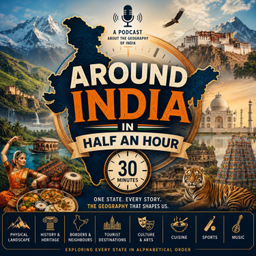
I'm Ray, and this is the sister show to my world geography podcast - except now I'm staying home. 28 states, 8 union territories, one episode each, working alphabetically from Andhra Pradesh onward. I grew up in India and I'm still learning how much of it I never really know - the history, the food, the languages, the people from each state who changed the country or the world. I research, write, record, and mix every episode myself, mistakes and all. New episode every Tuesday, 7pm. If you've ever wanted to actually know your own country properly, this one's for you.
- Publisher
- Ray Z
- Category
- education
- Language
- en
- Explicit
- No
- First episode
- 25 May 2026
- Latest episode
- 13 Oct 2026
Latest episodes
18 episodes in the feed.
13 Oct 2026
Episode 16: Meghalaya - The Abode of Clouds, Ruled by Its Daughters
It's home to the wettest places on the planet, bridges grown from living tree roots over the course of decades, and one of the few societies anywhere where property and surname pass down through women rather than men. Ray heads into Meghalaya for a chief who died resisting a British road, a coal-mining industry banned for a decade and still running anyway, and the self-declared rock capital of India, tucked into hills that rarely see a dry month.
6 Oct 2026
Episode 15: Manipur - The Land of Jewels, Carrying More Than One Story
A state smaller than most countries has produced more Olympic sporting medals per capita than anywhere else in India, invented the game the world turned into modern polo, and built its culture around a lake with islands that float. Ray heads into Manipur for the dancing Sangai deer, a two-thousand-year-old royal chronicle, and the honest, difficult story of an ethnic conflict that has shaped the state's last three years and is still not resolved.
2 Oct 2026
Episode 14: Maharashtra - Ten Pounds a Year, and Everything That Came After
In 1661, a king received Bombay as part of a wedding dowry and leased it out for ten pounds a year. The state that grew up around that city now produces roughly one-seventh of India's economy. Ray heads into Maharashtra for a lava plateau and a meteor crater, cave temples carved from solid rock, Shivaji's hill forts, India's first girls' school, and a political year unlike any other, including a border dispute with Karnataka that has not been resolved.
29 Sept 2026
Episode 13: Madhya Pradesh - Literally the Middle of Everything
It's India's second-largest state, named simply for sitting in the middle of the map — and it somehow ended up with more wild tigers than anywhere else on Earth, ten-thousand-year-old rock paintings, a river that flows the wrong way, and the birthplaces of Lata Mangeshkar, Kishore Kumar, and Rahul Dravid. Ray heads into the geographic heart of India for Khajuraho's temples, a Gond queen who refused to surrender to Akbar's army, and the hardest chapter in the state's history: Bhopal, 1984.
21 Sept 2026
Episode 12: Kerala - God's Own Country, On Its Own Terms
Forty-four rivers, a 590-kilometre coastline, and one of the odder footnotes in democratic history: in 1957, Kerala elected the second communist government anywhere in the world to ever win power at the ballot box. Ray heads down the Malabar Coast for backwater houseboats, a banana-leaf Onam feast, a Neelakurinji bloom that only happens once every twelve years, and the story of how the state just swapped out a decade of one government for another in 2026.
5 Sept 2026
Episode 11.5 (Bonus): Bengaluru — The Land of Heroes, Under Load
A bonus episode, sitting outside the normal alphabetical run: Bengaluru gets its own full hour because a city responsible for roughly 40% of India's IT exports deserves more than a few paragraphs inside the main Karnataka episode. We start with Kempe Gowda's 1537 mud fort and the interconnected lake system he built to manage monsoon water, through the British cantonment era, J.N. Tata's 1909 endowment of the Indian Institute of Science, and the postwar wave of public-sector aerospace and defense units that quietly built the engineering talent base everything else grew from. Then the actual tech story: 1984's software policy liberalization, Texas Instruments' landmark 1985 R&D center, Infosys and Wipro's rise, and how "Bangalored" entered the English language by the early 2000s. We're honest about what that success has cost, too — brutal traffic, a housing crunch, and a genuine water crisis serious enough that Bellandur Lake, receiving 40% of the city's untreated sewage, has caught fire more than a dozen times since 2016. Plus Narayana Murthy, Kiran Mazumdar-Shaw, ISRO's Satish Dhawan, legendary dosa institutions CTR and Vidyarthi Bhavan, and why longtime residents still miss the city's old nickname: the Pensioners' Paradise.
4 Sept 2026
Episode 11: Karnataka — Where Stone Learned to Tell Stories (Special Extended Episode)
This is a special, extended episode — Karnataka is home turf for the host, and it gets the long-form treatment as a result. We trace the state from the Kadamba dynasty in the 4th century through the Chalukyas' temple-building at Badami and Pattadakal, the Hoysalas' astonishing soapstone carving at Belur and Halebidu, and the Vijayanagara Empire's golden age at Hampi before its abrupt fall at Talikota in 1565. From there: Kittur Rani Chennamma's 1824 revolt against the British, Hyder Ali and Tipu Sultan's resistance to colonial expansion — including an honest look at why Tipu remains one of India's most genuinely contested historical figures — the decades-long Ekikarana unification movement, and the 1973 renaming from Mysore State to Karnataka. We bring it fully up to date with Siddaramaiah's May 2026 resignation, D.K. Shivakumar's ascension, the Lingayat-Vokkaliga-AHINDA caste dynamics that shape Karnataka elections, the long-running Cauvery water dispute with Tamil Nadu, and the state's ongoing Kannada-language identity debates. Plus Kittur Chennamma, Sir M. Visvesvaraya, Kuvempu, Dr. Rajkumar's 108-day kidnapping by Veerappan, Rahul Dravid and Anil Kumble, Hampi, Shravanabelagola's giant Jain monolith, Mysore silk, and why Karnataka quietly produces 70% of India's coffee. Bengaluru itself is deliberately left for its own dedicated bonus episode.
8 Aug 2026
Episode 10: Jharkhand — The Land of Forests, and What Lies Beneath Them
Ask any Indian cricket fan where MS Dhoni is from, and they'll say Ranchi instantly. Ask what state that's in, and you'll get a lot more hesitation — which sums up Jharkhand's whole situation: it produces roughly forty percent of India's mineral wealth and the country's most successful cricket captain, and still has one of the lowest name-recognition rates of any Indian state. This episode covers the deep history of tribal resistance that shaped the place — the 1855 Santhal Hul, and the 1899 Ulgulan led by twenty-four-year-old Birsa Munda, whose death in British custody is still commemorated as both a national holiday and the state's own founding date. We bring it up to the present with Jamsetji Tata's 1907 founding of India's first planned industrial city at Jamshedpur, the Naxalite insurgency's long history in the state's forested districts, Chief Minister Hemant Soren's 2024 arrest and return to office, and the government's current push to pivot the state's economy past mining altogether. Plus litti chokha, Sohrai wall painting, Deepika Kumari's archery career, and why a state this mineral-rich still struggles to convert that wealth into recognition — or, for many of its own tribal residents, into a better standard of living.
28 Jul 2026
Episode 9: Himachal Pradesh — The Land the British Never Wanted to Leave
In March 1959, a young man crossed some of the highest mountain passes on Earth on foot, fleeing an army he had no way of fighting, and was eventually given shelter in a half-forgotten former British hill station in northern India. He's still there. This episode uses that story — the Dalai Lama's arrival in Dharamshala, and the Tibetan government-in-exile it produced — as one entry point into Himachal Pradesh, a state built almost entirely out of vertical terrain. We cover the Anglo-Gorkha War and the patchwork of princely hill kingdoms that came before it, the 1905 Kangra earthquake that killed over 20,000 people, Shimla's decades as the summer capital of the British Raj, and Dr. Y.S. Parmar's three-decade campaign for the 1971 statehood that finally united it all. We bring things up to the present with the catastrophic 2023 monsoon floods and what the government's own disaster report actually blamed them on, the state's ongoing fight with Delhi over apple import duties, dham feasts, Kangra tea, home-fermented rice beer, the Guinness World Record-holding Nati folk dance, and notable Himachalis from democracy pioneer Shyam Saran Negi to WWE's seven-foot-tall The Great Khali. Presented factually, including on the parts of this history that different governments still describe very differently.
23 Jul 2026
Episode 8: Haryana — Where the Gita Was Spoken and Medals Are Made
Five thousand years ago, on a battlefield in northern India, a warrior lost his nerve and God explained why he must fight anyway. That conversation became the Bhagavad Gita. That battlefield is Kurukshetra. And Kurukshetra is in Haryana — forty minutes from Gurugram's glass towers, where employees close billion-dollar deals with Fortune 500 companies before driving home past village wrestling pits producing Olympic champions. Haryana holds the largest Harappan site ever discovered — larger than Mohenjo-daro itself — and the ground where three empires rose or fell at the Battles of Panipat: Babur founding the Mughal Empire in 1526, Akbar defeating the last Hindu emperor of Delhi in 1556, and the Marathas suffering a catastrophic defeat in 1761 that reshaped the balance of power in the subcontinent. Ray takes you through this dense, contradictory state — from Rakhigarhi's 4,500-year-old DNA discoveries to the Grand Trunk Road that determined who controlled North India for two millennia, from the 1966 split from Punjab to Gurugram's transformation from mustard fields into a corporate hub hosting 250 Fortune 500 companies. We meet Kapil Dev, who captained India to its first Cricket World Cup. We meet Neeraj Chopra, a farmer's son who ended India's hundred-year wait for individual Olympic athletics gold. We meet the wrestlers of Haryana's akhadas — Sakshi Malik, Bajrang Punia, the Phogat sisters — who turned village mud pits into an Olympic medal pipeline unmatched anywhere else in India. We eat bajra khichdi and butter-laden parathas at the legendary Murthal dhabas. We stand at Jyotisar, where Krishna is said to have spoken the Gita. And we ask what it means for a state to be simultaneously India's breadbasket, its most aggressive new corporate frontier, and the birthplace of its most decorated Olympic wrestlers — all within the same afternoon's drive. New episodes every Tuesday at 7pm. Next week — Himachal Pradesh.
13 Jul 2026
Episode 7: Gujarat — Where India Does Business with the World
On a full moon night in winter, the Great Rann of Kutch turns the ground to silver. A flat white salt desert stretching 27,000 square kilometres, reflecting the moonlight so completely that sky and earth become one. Come monsoon, it floods. Come summer, it evaporates. Come winter — the flamingos arrive in their tens of thousands. Gujarat is a state of extremes. The longest coastline of any Indian state. The only place on Earth where Asiatic lions still roam wild. Home to two of the most significant Harappan cities in existence — Lothal, with the world's oldest known dockyard, and Dholavira, a UNESCO World Heritage city that managed water in an arid desert 4,500 years ago. And the state that gave India Gandhi, Sardar Patel, and the Dandi March. Ray takes you through the full sweep — from the Bronze Age port of Lothal to the golden age of the Solanki dynasty and the exquisite Rani ki Vav stepwell; from Champaner's pre-Mughal mosques to Surat's role as the Mughal empire's greatest port; from the Bhuj earthquake of 2001 to Gujarat's rapid reinvention as India's most industrialised state. We meet Vikram Sarabhai, who imagined India in space and made it happen. We meet Dhirubhai Ambani, who left Gujarat as a teenager and built one of Asia's largest conglomerates. We meet Narsinh Mehta, whose 550-year-old devotional poem was Gandhi's favourite song. We eat dhokla, thepla, undhiyu, and fafda with jalebi. We watch Navratri Garba fill a stadium with thousands of dancers for nine straight nights. We stand at Somnath Temple above the Arabian Sea. And we learn that in Gujarat, commerce and culture have never been in conflict — they have always been the same impulse. New episodes every Tuesday at 7pm. Next week — Haryana.
6 Jul 2026
Episode 6: Goa — Where India Learned to Exhale
There is a word in Konkani — borrowed from Portuguese, worn smooth by four centuries of use — that captures something no other Indian language has quite managed to name. Susegad. Quiet. Contented. Unhurried. It is the philosophy of a place that spent 451 years negotiating between the world that arrived and the world that was already here. Goa is India's smallest state by area. It was also the last to be liberated — not in 1947 when the rest of India became free, but in December 1961, when Operation Vijay ended Portuguese rule in 36 hours of air, sea, and land strikes. Before that came 450 years of colonial history: the grandeur of Old Goa as the "Rome of the East," the Goan Inquisition that demolished temples and forced conversions, and a Catholic community whose Konkani is laced with Portuguese words to this day. Ray takes you through the full sweep — from the ancient Kadamba dynasty and the Usgalimal rock engravings to Albuquerque's conquest, Saint Francis Xavier's body in the Basilica of Bom Jesus, and the freedom fighters who waited decades for liberation. We meet Lata Mangeshkar, whose family roots in the Mangeshi village gave India its Nightingale. We meet Charles Correa, whose architecture recovered the Indian spatial tradition. We meet Leander Paes — eighteen Grand Slam titles from a state of 1.6 million people. We eat vindaloo made the proper way — not the mild restaurant version, but the fierce, vinegar-sharp pork preparation that bears the name of the Portuguese vinho e alhos. We eat sorpotel, xacuti, cafreal, and bebinca. We drink feni. We walk through Fontainhas. We stand before Dudhsagar Falls. We find the 12th-century Tambdi Surla temple hidden in the forest. And we learn what susegad actually means. New episodes every Tuesday at 7pm. Next week — Gujarat.
2 Jul 2026
Episode 5: Chhattisgarh — Where the Forest Holds Ancient Secrets
India's 26th state was born in November 2000. But its history goes back thousands of years — to the ancient kingdom of Dakshina Kosala, birthplace of Rama's mother Kausalya, site of the oldest known paintings in India, and home to forest communities who have lived in relationship with this land since before recorded history. Chhattisgarh is the rice bowl of central India, the land of thirty-six forts, and the state with the third-largest forest cover in the country. It holds 15 percent of India's iron ore reserves. It contains Bastar — one of the most biodiverse, culturally extraordinary, and politically contested landscapes in all of India. Ray takes you through it all. The Kalachuri dynasty and the ancient Buddhist city of Sirpur. The tribal rebellions against British rule that resisted colonial authority for decades. The Bhilai Steel Plant and the Soviet-Indian industrial partnership that created a city from nothing. We meet Guru Ghasidas, who walked village to village telling the most marginalised people of Chhattisgarh that they were equal to everyone else. We meet Teejan Bai — expelled by her community for singing, married at 12 — who became the world's greatest exponent of Pandavani and took the Mahabharata to stages in Japan and Europe. We eat Aamat — the wild, sour, forest-flavoured soup of Bastar. We stand at Chitrakote, the widest waterfall in India. And we watch the Bastar Dussehra — 75 days of ritual, the longest festival in India. New episodes every Tuesday at 7pm. Next week — Goa.
23 Jun 2026
Episode 4: Bihar — Where Civilisation Began
Before Rome was a city, there was Pataliputra. The Greek ambassador Megasthenes visited it in the 3rd century BCE and declared it the largest, most magnificent city on Earth. It was the capital of the Mauryan Empire — the first to unite the Indian subcontinent — governed by Ashoka the Great, whose Chakra sits at the centre of India's flag to this day. Bihar is where the Buddha attained enlightenment. Where Mahavira founded Jainism. Where Chanakya wrote the world's first systematic treatise on economics and statecraft. Where Aryabhata calculated the value of pi and proposed that the Earth rotates on its axis — a thousand years before Europe caught up. Where Nalanda University educated 10,000 students from across Asia for seven centuries, until it was burned in 1193 CE and its library took three months to stop burning. Ray takes you through the full sweep of Bihar's extraordinary history — from the Licchavi republic of Vaishali, one of the world's earliest democratic polities, through the Mauryan and Gupta golden ages, Sher Shah Suri who gave India the rupee and the Grand Trunk Road, to Gandhi's first Satyagraha in Champaran and JP Narayan's Total Revolution. We meet Bismillah Khan, whose shehnai played at India's first Independence Day. We meet Ramdhari Singh Dinkar, whose poetry made Hindi roar. We meet Vidyapati, who gave Maithili its classical voice five centuries ago. And we eat litti chokha — the smoky, stuffed wheat ball that Sher Shah's army marched on, and that a homesick Bihari makes first whenever they miss home. We stand at Bodh Gaya at dawn. We walk through the ruins of Nalanda. We wade into the Ganges at sunset for Chhath Puja — the most democratic festival in India, with no priest, no temple, just a devotee, the water, and the sun. New episodes every Tuesday at 7pm. Next week — Chhattisgarh.
17 Jun 2026
Episode 3: Assam — Where the River Runs Wild
A river so wide you cannot see the other bank. Tea gardens stretching to the horizon. A one-horned rhinoceros moving through the morning mist. And a 600-year-old kingdom that repelled 17 Mughal invasions and never once surrendered. This is Assam — the gateway to India's Northeast, threaded through by the mighty Brahmaputra, and home to some of the most extraordinary stories this country has to tell. Ray takes you through the dramatic landscape of the Brahmaputra valley, the world's largest river island at Majuli, and the tea gardens that put Assam in a billion morning cups. We trace the history — from the ancient Kamakhya temple and the saint Sankardeva who built Assam's cultural soul, to the great Ahom kingdom and the Battle of Saraighat where Lachit Borphukan defeated the Mughals on the river. We meet Bhupen Hazarika, whose voice was the sound of the Brahmaputra itself. We meet Hima Das — the Dhing Express — a farmer's daughter who became India's first world athletics gold medallist. We eat Masor Tenga and Khar and bamboo-shoot pork and til pitha made for Bihu. We visit Kaziranga, where the one-horned rhinoceros was pulled back from the edge of extinction in one of conservation's greatest victories. And we dance Bihu. Because in Assam, that is how you say: this is who we are. New episodes every Tuesday at 7pm. Next week — Bihar.
8 Jun 2026
Episode 2: Arunachal Pradesh - Where the Mountains Touch the Sky
India's first light falls here. Before Mumbai wakes, before Delhi stirs, the sun touches the Himalayan peaks of Arunachal Pradesh — the Land of the Dawn-Lit Mountains — and India's day begins. The largest state in the Northeast, Arunachal Pradesh stretches from the subtropical forests of the Brahmaputra plains to the permanent snowfields of the high Himalayas. It is home to over 26 major tribes and more than 100 sub-tribes, each with their own language, their own festivals, their own relationship with the land. Over 500 bird species. Four big cat species in a single national park. Sixty-plus tribal languages. And one of the great Buddhist monasteries of the world, perched at 3,000 metres above sea level. Ray takes you through the dramatic geography, the peaceful integration of Tawang into India in 1951, and the living tribal cultures of the Adi, Apatani, Monpa, and Nyishi peoples. We eat bamboo-cooked rice and smoked pork and drink rice beer from a bamboo cup. We cross the Sela Pass at 4,176 metres. We stand in the courtyard of Tawang Monastery at dawn. We camp in a rice field in Ziro Valley as independent music plays under the stars. This is India's frontier. Its most remote corner. Its first morning. New episodes every Tuesday at 7pm. Next week — Assam.
3 Jun 2026
Episode 1: Andhra Pradesh - Where the River Meets the Sea
We begin our journey through India in the southeast — on the shores of the Bay of Bengal, in a state that will feed you, surprise you, and leave a mark you weren't expecting. Andhra Pradesh is the rice bowl of South India. Two of the subcontinent's mightiest rivers — the Godavari and the Krishna — pour through its fertile delta plains before meeting the sea. It is also home to the spiciest cuisine in India, a classical dance form celebrated worldwide, a literary tradition over a thousand years old, and a single temple that receives more human visitors every day than any other religious site on the planet. Ray takes you through the history — from the Satavahana empire and ancient Buddhist Amaravati to the golden age of Vijayanagara. We meet the man who designed India's national flag, the singer who recorded 40,000 songs, the philosopher who became President, and the badminton champion who made a nation stand up. We eat gongura pachadi, pesarattu, avakaya, and the legendary Tirupati Laddu. We visit the hanging pillar of Lepakshi, the Papikondalu gorge, the coffee hills of Araku, and the most visited temple on Earth. Andhra Pradesh is more than its greatest hits. Come hungry. Come curious. New episodes every Tuesday at 7pm. Next week — Arunachal Pradesh.
25 May 2026
Episode 0: Intro - Where the Yatra Begins
Every great yatra needs a starting point. This is ours. Before Ray takes you through the states and union territories of the world's largest democracy, he sits down to tell you everything — what Around India in Half an Hour really is, how it works, why it exists, and what you can expect every single Tuesday at 7pm when a new episode lands. This is not a show about the India you already know from postcards and travel brochures. This is about the real India — all of it. The 28 states and 8 Union Territories, each one a world unto itself. Each with its own language, its own landscape, its own kitchen, its own history, its own heartbeat. We go alphabetically, which means we begin with Andhra Pradesh and end, years from now, with West Bengal. Every state gets the same curiosity, the same depth, and the same half hour of your time. Each episode covers the full picture — the geography and physical landscape, the borders and neighbouring states and countries, the sweep of history from ancient kingdoms to the modern era, the way people live today, the remarkable personalities who shaped that corner of India, the food and flavours unique to that region, the must-visit places, the classical and folk arts, the cinema, the sport, and how the rest of India and the world sees that state. No dry facts. No surface-level tourism. Just honest, vivid storytelling that makes each state feel real — like you've actually been there, or like you're desperately planning to go. In this intro episode, Ray also gives you a taste of what's coming — from the spice-fired coastline of Andhra Pradesh to the dawn-lit mountains of Arunachal Pradesh, from the tea gardens and rhino sanctuaries of Assam to the sand dunes of Rajasthan, the backwaters of Kerala, the French boulevards of Puducherry, and the remote island paradise of the Andamans. That's just the beginning — 36 episodes of states and union territories are waiting. India is not one thing. It never was. It is 36 distinct, proud, breathtaking worlds — and this show is going to sit with each one of them, long enough to actually understand it. If you've ever looked at a map of India and felt that quiet pull of curiosity — wondered what daily life actually looks like in Manipur, or Meghalaya, or Mizoram — this show was made for you. New episodes every Tuesday at 7pm. Subscribe now, and don't miss a single state. The yatra begins here.
Reach and audience
Public platform figures. Ratings count people who left a rating, not total listeners.
- Spotify
- 5.0 / 5
- 4 ratings
Contact Around India in Half an Hour
- Guest appearances
- Does not typically book guests
Based on episode analysis; this does not confirm that the show is currently accepting guests.
Host of Around India in Half an Hour?
Claim your podcast to manage its listing and keep your show details accurate.
Pod Engine is an independent podcast discovery and analytics service and is not affiliated with or endorsed by this podcast. Artwork and show content belong to their owners. Full legal notice.
Explore this show
Podcast research with Pod Engine