- 67
- Episodes
- Weekly
- Cadence
- 2026
- First episode
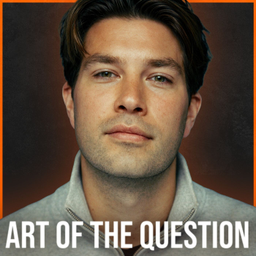
About Art of the Question
Conversations about science, technology, philosophy, psychology, self-improvement, media, and culture.
- Publisher
- Julius Moorman
- Category
- science · technology
- Language
- en
- Explicit
- No
- First episode
- 8 Mar 2026
- Latest episode
- 26 Oct 2026
Latest episodes
67 episodes in the feed.
26 Oct 2026
Is AI Killing Creativity? - Prof. Adam Green - #67
Adam Green is a professor and cognitive neuroscientist at Georgetown University in Washington, DC, where he directs a lab studying how the brain produces creative ideas. He earned his PhD in cognitive neuroscience at Dartmouth, did postdoctoral training at Yale, and serves as Editor-in-Chief of Creativity Research Journal. He co-founded the Society for the Neuroscience of Creativity and, with James Kaufman, leads the Creativity Ontology Project, a collaboration of 200 creativity researchers working to pin down what the word creativity actually means. His lab helped turn creativity into something measurable through semantic distance and showed that electrically stimulating the frontopolar cortex can make people more creative. His recent study of hundreds of thousands of college application essays found that after ChatGPT arrived, students' life stories became more alike even as they looked more creative on the surface. Expect to learn how creativity can be defined as a process rather than a product, how semantic distance turns creativity into a number, what happened when researchers zapped the frontopolar cortex with electrical stimulation, why a walk or run in a familiar place helps ideas come, why creativity feels so rewarding, why creativity may be humanity's biggest evolutionary advantage, whether anyone can learn to be more creative, why almost every creativity intervention works, how a strict constraint gave us Green Eggs and Ham, whether AI can truly be creative, how ChatGPT made college essays more alike while fooling the experts, and why thinking for yourself is worth more in the AI era. Adam Green online: Lab: cng.georgetown.edu Society for the Neuroscience of Creativity: tsfnc.org 0:00 Intro 1:07 Defining creativity 8:27 Internally directed attention 10:53 The Creativity Ontology Project 12:20 Measuring creativity with analogies 18:50 The brick test 19:57 Zapping the brain for creativity 23:15 From observation to intervention 25:43 How to be more creative 28:38 Why walks spark ideas 31:13 Why creativity feels good 35:23 Why creativity is so desirable 39:21 Malevolent creativity 40:43 Can anyone be creative 41:44 Creativity is a state 44:35 Creativity anxiety 46:37 Constraints and Dr. Seuss 52:04 Can AI be creative 56:12 Using AI in creative work 1:00:44 Start with your own ideas 1:02:08 The college essay study 1:06:57 AI blind spots and homogenization 1:08:37 Socratic learning with AI 1:10:05 Thinking for yourself with AI 1:11:50 Where to follow Adam's work
22 Oct 2026
Why Are People Leaving Big Cities? - Prof. Steven Pedigo - #66
Steven Pedigo is an urban economic development expert and professor who has advised more than 100 cities, universities and companies on growth and innovation. Raised in a small town in rural East Texas, he studied at the University of Texas at Austin, Carnegie Mellon and the University of Illinois, and spent about 15 years working alongside urbanist Richard Florida, author of The Rise of the Creative Class. He later became the inaugural director of the Urban Lab at NYU's Schack Institute of Real Estate, founded the LBJ Urban Lab at the University of Texas at Austin, and is a founding partner of the advisory firm CivicSol. In this episode he traces how Austin grew from a sleepy college town into one of America's fastest growing cities, and what that growth cost the people who lived there. He also explains why the predicted death of big cities like New York and Los Angeles was overstated, and why Americans have now largely stopped moving. Expect to learn whether people are really leaving big cities like New York and Los Angeles, why second tier cities like Austin and Nashville boomed, why Americans have stopped moving, how AI is shrinking entry level jobs for graduates, how Richard Florida's creative class theory shaped Austin, what rapid growth costs a city's culture and affordability, why residents are pushing back on data centers, whether a city can grow without losing its identity, why Europe lags behind the US on innovation, whether companies are really leaving California for Texas, what European and American cities can learn from each other, and how climate change could reshape where Americans move. Steven Pedigo online: Website: https://iamstevenpedigo.com (https://iamstevenpedigo.com) CivicSol: https://civicsol.com (https://civicsol.com) X: @iamstevenpedigo LinkedIn: https://www.linkedin.com/in/iamstevenpedigo (https://www.linkedin.com/in/iamstevenpedigo) Instagram: @iamstevenpedigo 0:00 Introduction 0:34 How Steven got into urbanism 2:46 Why cities breed acceptance 4:27 Growing up in Amsterdam 7:14 Are people leaving big cities 10:25 Cost of living and clustering 13:06 Amsterdam versus Texas house prices 15:08 Why Americans stopped moving 18:05 AI and the graduate job market 20:05 Why Austin became so popular 22:07 The creative class theory 25:13 How the pandemic accelerated Austin 27:35 Austin's growing pains 29:47 The death of Austin story 31:44 Can cities grow and keep identity 33:39 Why city priorities changed 36:27 Why residents oppose data centers 41:21 Federal investment and the CHIPS Act 44:28 America's university advantage 45:31 Why Europe lags on innovation 47:01 Immigration and American innovation 48:37 Are companies leaving California 52:04 Lessons between European and US cities 54:45 How cities attract and keep talent 57:13 Where city migration goes next 58:29 Climate change and migration 1:00:06 Austin the teenage city 1:01:19 Where to follow Steven
19 Oct 2026
The Dystopian Rise of Flock Cameras - Prof. Steven Keener - #65
Steven Keener is an assistant professor of criminology at Christopher Newport University in Virginia and one of the few researchers who has studied Flock license plate reader cameras in depth. He directs CNU's Center for Crime, Equity, and Justice Research and Policy, which he co-founded in 2021, and serves on the board of Justice Forward Virginia, a nonpartisan criminal justice reform organization. He earned his Ph.D. in Public Policy and Administration from Virginia Commonwealth University, specializing in criminology and criminal justice policy. When a federal judge forced the release of every publicly funded license plate camera location in Hampton Roads, Keener and his colleagues ran the first full geospatial analysis of how these cameras are deployed. They found that race and poverty, not violent crime, best predict where the cameras go. That research is published as "Surveillance Inequality: Race, Poverty and the Geography of Automated License Plate Reader Cameras." Expect to learn what Flock cameras capture beyond your license plate, how pandemic stimulus money helped Flock dominate the market, why the "nothing to hide" argument falls short, how a Dutch court stopped the tax authorities from using highway cameras, whether Flock cameras violate the Fourth Amendment, why state guardrail laws keep failing, how federal agencies get side door access to local camera data, how police officers have used the cameras to stalk people, why the cameras cluster in Black and low income neighborhoods, whether the cameras reduce crime, and how one Virginia town got rid of them. Steven Keener online: Email: steven.keener@cnu.edu (mailto:steven.keener@cnu.edu) CNU profile: https://cnu.edu/faculty/stevenkeener.html (https://cnu.edu/faculty/stevenkeener.html) Research: Surveillance Inequality: Race, Poverty and the Geography of Automated License Plate Reader Cameras 0:00 Introduction 0:41 What Flock cameras are 1:53 License plate readers before Flock 4:03 How Flock won over police 5:25 How the cameras work 7:35 What the cameras capture 9:17 Tracking pedestrians and drones 10:02 The nothing to hide argument 11:53 Wrongly accused by cameras 15:06 A Dutch highway camera case 19:25 Are Flock cameras legal 22:10 The Schmidt v Norfolk lawsuit 25:02 A rare bipartisan issue 26:29 Virginia's guardrails law 30:08 Police hot lists 32:45 Penalties for misuse 33:36 Searches logged as 123 36:49 Stalking and audit logs 38:57 Mapping where the cameras are 40:09 Judge forces locations public 43:33 Race and poverty findings 45:02 The legacy of redlining 47:00 Testing the crime explanation 49:27 Predictive policing and tech washing 51:59 How placement was decided 53:38 Do the cameras reduce crime 57:43 Is a safe version possible 1:02:29 Where surveillance is heading 1:06:01 How Harrisonburg removed Flock 1:07:42 Data centers and surveillance 1:09:32 Bluetooth scanners and tsunami cameras 1:11:55 Steven's next research 1:12:58 Where to follow Steven
Contact Art of the Question
- Guest appearances
- Books guests
Based on episode analysis; this does not confirm that the show is currently accepting guests.
Host of Art of the Question?
Claim your podcast to manage its listing and keep your show details accurate.
Pod Engine is an independent podcast discovery and analytics service and is not affiliated with or endorsed by this podcast. Artwork and show content belong to their owners. Full legal notice.
Explore this show
Podcast research with Pod Engine