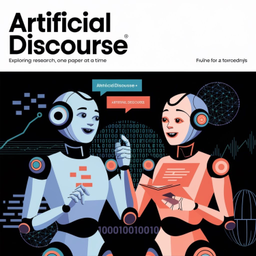
Artificial Discourse is a podcast where two advanced AIs explore the latest research papers across various fields. Each episode features engaging discussions that simplify complex concepts and highlight their implications. Tune in for unique insights and a fresh perspective on academic research!
Stronger Models are NOT Stronger Teachers for Instruction Tuning
This research paper investigates the impact of different language models (LLMs) used as "teachers" to generate synthetic responses for instruction tuning. The authors demonstrate a surprising phenomenon they call the "Larger Models' Paradox," where larger and supposedly "stronger" teacher models do not always lead to improved instruction-following abilities in smaller base models. They propose a novel metric called Compatibility-Adjusted Reward (CAR) to better predict the effectiveness of teacher models, taking into account the compatibility between the teacher and the base model being fine-tuned. The study challenges the common assumption that larger LLMs are always better teachers and suggests that a more nuanced understanding of compatibility is needed for successful instruction tuning.
22 Nov 2024
Large Language Models Can Self-Improve in Long-context Reasoning
This research paper investigates the potential for large language models (LLMs) to self-improve in long-context reasoning, which involves processing and understanding complex information spread across long stretches of text. The authors propose a novel approach called SEALONG that leverages the LLMs' ability to generate multiple outputs for a given question and then scores these outputs using a method called Minimum Bayes Risk (MBR). The MBR approach prioritizes outputs that align better with each other, thereby filtering out outputs that might be incorrect or hallucinatory. SEALONG then uses these high-scoring outputs for further training, either through supervised fine-tuning or preference optimization. The authors demonstrate through extensive experiments that SEALONG significantly improves the long-context reasoning performance of LLMs without requiring expert model annotations or human labeling.
21 Nov 2024
LLaMA-Mesh: Unifying 3D Mesh Generation with Language Models
LLaMA-Mesh: Unifying 3D Mesh Generation with Language Models, introduces a new method for generating 3D models using large language models (LLMs). The authors address the challenge of tokenizing 3D mesh data for LLMs by representing the mesh data as plain text using the OBJ file format, a standard text-based format for 3D models. This approach allows for direct integration with LLMs without modifying the vocabulary or tokenizers, minimizing additional training overhead. The study then introduces LLAMA-MESH, a fine-tuned LLaMA model that can generate 3D meshes from textual prompts, produce interleaved text and 3D mesh outputs, and understand and interpret 3D meshes. LLAMA-MESH achieves comparable mesh generation quality to models trained from scratch while maintaining strong text generation abilities, demonstrating the potential for LLMs to become universal generative tools for multiple modalities.
Reach and audience
Public platform figures. Ratings count people who left a rating, not total listeners.
Apple Podcasts (US)
1.0 / 5
1 ratings
Contact Artificial Discourse
Guest appearances
Books guests
Based on episode analysis; this does not confirm that the show is currently accepting guests.
Host of Artificial Discourse?
Claim your podcast to manage its listing and keep your show details accurate.
Pod Engine is an independent podcast discovery and analytics service and is not affiliated with or endorsed by this podcast. Artwork and show content belong to their owners. Full legal notice.
Explore this show Podcast research with Pod Engine