
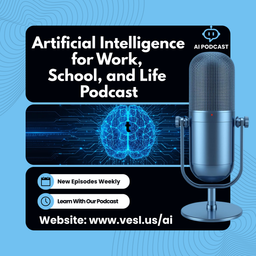
Artificial Intelligence for Work, School, and Life
Claim This Podcastby Maestro Sersea
Podcast Overview
<p>Welcome to "Artificial Intelligence for Work, School, and Life" – the weekly podcast where education meets innovation. I'm Maestro Sersea, an AI enthusiast and educator with over 30 years of teaching experience, and whether you're individual seeking AI skills for work, a teacher wondering how AI can transform your classroom, a school administrator navigating new technologies, or a lifelong learner curious about the background and potential of Artificial Intelligence, you're in the right place.</p><p>Each episode, we'll explore the practical, the profound, and sometimes the surprising ways artificial intelligence is reshaping how we work, teach, and learn.</p><p>From personalized learning paths to AI tutoring systems, from ethical considerations to hands-on classroom strategies – we're here to demystify AI in education and help you navigate this exciting frontier. Let's discover together how AI is not just changing education but making it more human than ever before.</p><p></p>
Language
🇺🇲
Publishing Since
8/17/2025
Reach the team behind Artificial Intelligence for Work, School, and Life
Verified contact details for this show aren't on file yet — sign up to get notified when they land.
Recent Episodes
July 24, 2026
The Plagiarism Problem: Academic Integrity in the AI Era
<p><strong>The Plagiarism Problem: Academic Integrity in the AI Era</strong></p><p><strong>The AI Integrity Crisis: Rethinking Honesty, Authorship, and Learning in the Digital Age</strong></p><p>When a student submits a paper written by ChatGPT as their own original work, what exactly has gone wrong? The question seems simple, but its answer reveals deep tensions about the purpose of education, the meaning of authorship, and the limits of institutional rules designed for a world that no longer exists.</p><p> </p><p>The scale of AI-enabled academic dishonesty is difficult to overstate. Within weeks of ChatGPT's launch in November 2022, educators worldwide reported a flood of AI-generated student submissions. A 2023 survey by the Stanford Graduate School of Education found that more than 60 percent of students admitted to using AI in ways that went beyond their instructors' stated guidelines. AI detection tools like Turnitin's AI detector and GPTZero were rushed to market but quickly revealed significant limitations—high rates of false positives flagging human writing as AI-generated, and true positives that sophisticated students could evade by lightly editing AI outputs.</p><p> </p><p>But the integrity crisis is more nuanced than a simple story of students cheating. Consider the range of AI uses a student might make: using AI to brainstorm ideas (widely considered acceptable), having AI suggest vocabulary improvements (contested), using AI to generate a rough outline (debated), asking AI to write a first draft that the student then revises substantially (increasingly contested), and submitting an AI-written essay verbatim with no personal engagement whatsoever (universally condemned). Where exactly is the line, and who should draw it?</p><p> </p><p>Most educators agree on the extreme cases. A student who reads, thinks, researches, drafts, and uses AI only to polish word choice or check grammar has engaged in the learning process the assignment was designed to produce. A student who copies an AI output without reading or revising has not learned the content, has not practiced the skills the assignment was meant to develop, and has misrepresented their work to the institution. The latter is a genuine integrity violation with real educational consequences.</p><p> </p><p>The pedagogical solution is not primarily technological—AI detection software is too unreliable, and the arms race between detection and evasion is one educators cannot win. The deeper solution is assignment redesign. Assignments that require students to demonstrate specific, personal knowledge—their own field research, their personal analysis of a text they read in class, their reflections on a laboratory experience they conducted—cannot be adequately completed by AI. Oral presentations, in-class writing, portfolios that document the writing process, and assignments that build on class-specific discussions all make AI-ghostwriting far more difficult and less tempting.</p><p> </p><p>The crisis also demands honest conversation with students about why writing matters. Writing is not merely a way of demonstrating knowledge to a teacher. Writing is thinking made visible—it is the process through which ideas are clarified, arguments are tested, and understanding is deepened. When a student outsources this process to an AI, they are not just violating a rule; they are cheating themselves out of the most important benefit of the assignment.</p>
July 10, 2026
Critical Thinking in the Age of AI: Skills We Must Preserve
<p><strong>Critical Thinking in the Age of AI: Skills We Must Preserve</strong></p><p><strong>The Thinking We Cannot Outsource: Why Critical Skills Still Matter in an AI World</strong></p><p>Artificial intelligence can write an essay. It can solve equations, summarize research, draft emails, generate code, and translate between languages. There is very little an AI cannot produce on demand, quickly, fluently, and at zero marginal cost. In this environment, a dangerous temptation emerges: the temptation to let AI think for us.</p><p> </p><p>This temptation is not new—humans have always adopted tools that extended cognitive capability, from writing to calculators to search engines. Each new technology has prompted anxiety about the skills it might erode. Some of those anxieties proved well-founded; others did not. The arrival of AI is qualitatively different in scale and scope, however, and educators must respond with greater urgency.</p><p> </p><p>Critical thinking—the disciplined ability to analyze, evaluate, and form independent judgments—is the skill that distinguishes a thoughtful person from a sophisticated parrot. It requires sitting with a hard question long enough to develop an opinion grounded in evidence and reasoning, not merely retrieving an answer. AI can provide an answer in seconds. The question is whether students are learning to ask whether that answer is right, meaningful, or applicable to their specific situation.</p><p> </p><p>The concept of cognitive load is relevant here. When AI handles the difficult parts of a task—finding information, organizing arguments, constructing sentences—students may be saving cognitive effort in ways that prevent learning from occurring. Research in educational psychology consistently finds that productive struggle—working through difficulty without immediate assistance—is essential for building the mental schemas that enable deep understanding. An AI that eliminates productive struggle may be reducing short-term frustration while undermining long-term learning.</p><p> </p><p>Metacognition—awareness of one's own thinking—is another critical skill at risk. Strong learners monitor their own understanding, recognize when they are confused, and adjust their strategies accordingly. Students who habitually outsource thinking to AI may develop less metacognitive awareness, becoming less capable of recognizing their own knowledge gaps.</p><p> </p><p>Information literacy—the ability to evaluate sources, identify bias, and distinguish credible from misleading information—is perhaps the most urgently threatened skill. AI language models can generate citations for articles that do not exist, statistics from studies that were never conducted, and quotes from experts who said no such thing. A student without strong information literacy skills will accept these fabrications uncritically.</p><p> </p><p>The solution is not to ban AI from classrooms. It is to design learning experiences that require genuine human thinking, that make the reasoning process visible, and that teach students to treat AI as a powerful but fallible tool—not an oracle. The most important question in an AI-saturated world is not "What does AI say?" but "What do I think, and why?"</p><p> </p>
June 26, 2026
AI in Higher Education: Opportunities and Challenges
Dr. John Smith, a leading AI ethicist, and Dr. Jane Doe, a renowned higher education administrator, discuss how AI transforms research and instruction while addressing academic integrity challenges in universities.
14 total episodes available
Deep-dive analytics for Artificial Intelligence for Work, School, and Life
Frequently asked questions
Have a different question and can't find the answer you're looking for? Reach out to our support team by sending us an email and we'll get back to you as soon as we can.
- What is Artificial Intelligence for Work, School, and Life?
<p>Welcome to "Artificial Intelligence for Work, School, and Life" – the weekly podcast where education meets innovation. I'm Maestro Sersea, an AI enthusiast and educator with over 30 years of teaching experience, and whether you're individual seeking AI skills for work, a teacher wondering how AI can transform your classroom, a school administrator navigating new technologies, or a lifelong learner curious about the background and potential of Artificial Intelligence, you're in the right place.</p><p>Each episode, we'll explore the practical, the profound, and sometimes the surprising ways artificial intelligence is reshaping how we work, teach, and learn.</p><p>From personalized learning paths to AI tutoring systems, from ethical considerations to hands-on classroom strategies – we're here to demystify AI in education and help you navigate this exciting frontier. Let's discover together how AI is not just changing education but making it more human than ever before.</p><p></p> - How often does this podcast release new episodes?
This podcast updates daily.
- Where can I listen to this podcast?
This podcast is available on 4 platforms including Apple Podcasts, Spotify, and more. You can also use the RSS feed directly.
- Does this podcast accept guests?
No, this podcast does not typically feature guests.
Legal Disclaimer
Pod Engine is not affiliated with, endorsed by, or officially connected with any of the podcasts displayed on this platform. We operate independently as a podcast discovery and analytics service.
All podcast artwork, thumbnails, and content displayed on this page are the property of their respective owners and are protected by applicable copyright laws. This includes, but is not limited to, podcast cover art, episode artwork, show descriptions, episode titles, transcripts, audio snippets, and any other content originating from the podcast creators or their licensors.
We display this content under fair use principles and/or implied license for the purpose of podcast discovery, information, and commentary. We make no claim of ownership over any podcast content, artwork, or related materials shown on this platform. All trademarks, service marks, and trade names are the property of their respective owners.
While we strive to ensure all content usage is properly authorized, if you are a rights holder and believe your content is being used inappropriately or without proper authorization, please contact us immediately at hey@podengine.ai for prompt review and appropriate action, which may include content removal or proper attribution.
By accessing and using this platform, you acknowledge and agree to respect all applicable copyright laws and intellectual property rights of content owners. Any unauthorized reproduction, distribution, or commercial use of the content displayed on this platform is strictly prohibited.