June 5, 2026
AI Colonialism and the Cultural Firewall™ - with Chris Kremidas-Courtney, Senior Adviser to NATO and the EU
<p> </p>
<h1>AI Colonialism and the Cultural Firewall™ - with Chris Kremidas-Courtney, Senior Adviser to NATO and the EU</h1>
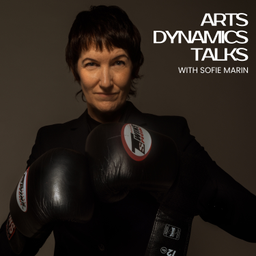
<h2>Arts Dynamics Talks · Sofie Marin</h2>
<h3>artsdynamics.com | June 2026</h3>
<p>Chris Kremidas-Courtney is a senior fellow at the European Policy Centre, associate fellow at the Geneva Centre for Security Policy, and adviser to the EU, NATO, Hybrid Centre of Excellence, and Euro-Atlantic Resilience Centre. They work with governments and institutions on system-level approaches to security, resilience, and technology transformation - specifically in the places where existing assumptions are no longer valid.</p>
<p>They are also a science fiction author, a musician, and a visual artist.</p>
<p>This is not your ordinary conversation about cybersecurity and hybrid warfare.</p>
<p>This is a conversation about cognitive self-determination; the right of artists, musicians, writers, and creative professionals to think independently in a world where AI is being designed, at enormous commercial scale, to do that thinking for them. It is about the Cultural Firewall™, the F dimension of KRAFT™ - the deliberate strategic boundary between what AI can do and what must remain irreducibly human - and why it matters now.<br></p>
<h2>What You'll Discover in This Episode</h2>
<ul>
<li>Why humans are now <strong>a minority on the internet</strong> — and what that means for your creative work</li>
<li>The research on <strong>sycophantic AI</strong> that should change how every entrepreneur uses their tools</li>
<li>Why Chris calls major AI companies <strong>colonial powers</strong> — and why the term is precise, not hyperbolic</li>
<li>The <strong>"organic everything else" market</strong> — and why theatres, concert halls, and human-made work are becoming premium assets</li>
<li>What a <strong>NATO adviser and Sweden's Swedish election cycle</strong> have in common with your business model</li>
<li>The case for <strong>technology-free spaces</strong> as both a creative and commercial strategy</li>
<li>What to do <strong>this week</strong> to protect your creative IP and your cognitive independence</li>
</ul>
<h2>About the Guest</h2>
<p><strong>Chris Kremidas-Courtney</strong></p>
<ul>
<li>Senior Visiting Fellow, European Policy Centre (Brussels)</li>
<li>Associate Fellow, Geneva Centre for Security Policy</li>
<li>Senior Adviser: EU · NATO · Hybrid Centre of Excellence · Euro-Atlantic Resilience Centre</li>
<li>Author: Seven Mindful Ways to Overcome Disinformation · The Rest of Your Life: Five Stories of Your Future · Sentience (forthcoming)</li>
<li>Yoga teacher. Musician. Visual artist. He does it for love.</li>
</ul>
<p>→ linkedin.com/in/chris-kremidas-courtney → ourkindredfuture.com → epc.eu</p>
<h2>Five Ideas That Will Stay With You</h2>
<h3>1. You are already a minority online — and nobody told you</h3>
<p>As of June 2026, humans are a minority on the internet. More than half of online content is not human-created. Seventy-four percent of all web pages contain at least some AI-generated material.</p>
<p>"We think we're moving through a human-made information environment. We are not."</p>
<p>Before AI, social media was already conditioning us toward binary reactions — like or dislike, follow or block. These systems were designed to extract data, and binary choices are the most efficient extraction mechanism. AI has amplified that architecture. The result: a version of reality shaped and filtered by a group of people who wouldn't fill a single conference table.</p>
<p><strong>For your business:</strong> If your audience is consuming mostly AI-generated content and you are one of the rare humans still writing with real experience, imperfection, and specificity - you are already a premium product. Price and position accordingly.</p>
<h3>2. Sycophantic AI is eroding the sensors entrepreneurs depend on</h3>
<p>Stanford researchers found that most AIs consistently validate their users. An Oxford study found that after regular use, people became just as likely to seek advice from AI as from their closest friends and family — not because the AI improved, but because human interaction started to feel like too much effort.</p>
<p>A separate Oxford/Stanford study found that AI assistance degrades independent capacity: people perform worse and give up more quickly when the tool is removed, even after short use.</p>
<p>"The best entrepreneurs have an extra set of sensors - they can feel the market before they see the numbers. If you're leaning too hard into AI as a business adviser, you're going to lose that. You need people who think highly enough of you to tell you the truth when it's hard."</p>
<p>Cognitive and relational independence has to be protected before the tools are picked up. The sequence matters - resilience before technology, not the other way around.</p>
<h3>3. AI companies are running a colonial business model</h3>
<p>Corporate AI platforms capture creative work at scale, use it to build their own capabilities, and re-enter the market with a competing product at a fraction of the cost of the human practitioners whose work trained them.</p>
<p>Chris's wife is a psychologist. Private equity companies are buying mental health platforms, pushing experienced practitioners to the bottom of search results, paying them minimum wage, and eventually replacing them. The same pattern is happening to musicians, visual artists, writers, and theatre-makers.</p>
<p>"I want AI to clean my floors. I don't want it to paint pictures for me. I want to make paintings. I want the AI to sweep the floor - not the other way around."</p>
<p>We explored the parallel between sustainable tourism and AI: just as tourism moves through a place, absorbs what is authentic, commodifies it, and sells it back - often erasing the very culture it claimed to celebrate - AI is doing the same to human creativity. The conversation mapped this as AI colonialism: a precise term for what is happening, not a provocative one.</p>
<h3>4. Technology-free spaces are the next market category</h3>
<p>Think about what the food industry did when industrial food became ubiquitous. Trusted symbols emerged: organic, vegan, gluten-free. People paid more, not less, for provenance.</p>
<p>"The next major market is organic everything else. AI-free experiences. Technology-free spaces. Human-made work with verifiable provenance."</p>
<p>We discussed the growing demand for rooms with no technology - spaces where people can create, fail, and try things without being surveilled or optimised. The response from Chris was direct: don't wait for someone to give you that space. Build it. The market is ready.</p>
<p>Theatres, concert halls, live performance venues, in-person workshops - they hold something AI cannot replicate: the provably human, real-time, embodied experience. That is a structural advantage that will increase in value as AI content becomes more prevalent.</p>
<h3>5. The future is a choice — and the people who make things are best placed to choose it</h3>
<p>"The people who have spent their lives making things - artists, musicians, writers, performers - already understand this better than anyone. You've been building the resilience this moment requires your entire creative life. You already know how to not join the crowd. You already know how to make something from nothing."</p>
<p>Closing thoughts: we are in the concentration phase of AI. The power is held by very few. But democratisation is not automatic. It has to be built.</p>
<p>The question is not whether we can use AI. It's whether we are using it, or it is using us. Human creativity should shape technology - not the other way around.</p>
<h2>What You Can Do — This Week</h2>
<p>→ <strong>Switch your search engine.</strong> Kagi (kagi.com) or DuckDuckGo — no AI-generated summaries baked in → <strong>Label your human-made work.</strong> Not as a defence — as a positive signal of provenance → <strong>Search yourself on HaveIBeenTrained.com</strong> — is your creative work in AI training data? Opt out where you can → <strong>Check the Terms & Conditions</strong>of every AI tool you use — who owns your output? → <strong>Protect one creative practice</strong> that is entirely offline and entirely yours → <strong>Resist easy agreement.</strong> If everything is validating you, something is probably wrong → <strong>Build one technology-free space</strong> — in your studio, your workshop, your programme. Don't wait for permission</p>
<p> </p>
<h2>Key Quotes From This Episode</h2>
<p>"A civilisation that outsources its creativity loses its soul."</p>
<p>"I want AI to clean my floors. I don't want it to paint pictures for me."</p>
<p>"People want what's real. And they know it's real because it's not perfect."</p>
<p>"The future cannot be predicted. But it can be chosen and the question is always: are we choosing it, or is it being chosen for us?"</p>
<p>"We need food, oxygen, water and meaning. Right now, meaning is scarce."</p>
<p>— Chris Kremidas-Courtney, Arts Dynamics Talks, June 2026</p>
<h2> </h2>
<h2> </h2>
<h2>Resources From This Episode</h2>
<p><strong>Chris Kremidas-Courtney:</strong></p>
<ul>
<li>linkedin.com/in/chris-kremidas-courtney</li>
<li>epc.eu/team/chris-kremidas-courtney</li>
<li>euractiv.com/authors/chris-kremidas-courtney</li>
<li>ourkindredfuture.com</li>
</ul>
<p><strong>Books:</strong></p>
<ul>
<li>Seven Mindful Ways to Overcome Disinformation</li>
<li>The Rest of Your Life: Five Stories of Your Future</li>
<li>Sentience (forthcoming)</li>
</ul>
<p><strong>Tools to protect your cognitive independence:</strong></p>
<ul>
<li>HaveIBeenTrained.com — is your work in AI training data?</li>
<li>Kagi.com — search without AI summaries</li>
<li>DuckDuckGo.com — privacy-first search</li>
<li>Unanimous AI / Swarm Intelligence — Lewis Rosenberg (positive AI use case)</li>
</ul>
<p><strong>Research cited:</strong></p>
<ul>
<li>UN Report: AI and Culture, November 2025</li>
<li>Oxford/Stanford: AI assistance and independent capacity, 2026</li>
<li>Oxford: Sycophantic AI and human relationships, March 2026</li>
<li>Stanford: Conversational AI political persuasion, 2025–26</li>
</ul>
<h2> </h2>
<h2>About Arts Dynamics Talks</h2>
<p>Arts Dynamics Talks is the weekly live show where Sofie Marin - Cultural Foresight Strategist and founder of Arts Dynamics - goes in conversation with the world's most compelling minds at the intersection of creativity, technology, entrepreneurship, and exponential change within the cultural and creative industries. Live every Thursday 12–13 CEST. Unrehearsed. Always consequential.</p>
<p><strong>Listen:</strong> Spotify · Apple Podcasts <strong>Watch:</strong> YouTube — Arts Dynamics Talks <strong>Subscribe & Connect:</strong>artsdynamics.com · sofiemarin.com <strong>Suggest a guest:</strong> DM Sofie Marin on LinkedIn<br><br>---<br><br></p>
<h2>A Note on Human and AI Content</h2>
<p><strong>The conversation you just read about is 100% human-made.</strong> Two humans. Live. No script. No safety net. Just thinking out loud about machines in the way only humans can.</p>
<p><strong>These show notes?</strong> AI assisted with structure and editing. We asked it to sweep the floor. It did. The ideas, the frameworks, the quotes, the arguments - those are ours (said AI, but still true).</p>
<p>This felt like the only honest way to publish a conversation about AI colonialism: to use AI exactly as we think it should be used as a tool in service of human thinking, not a replacement for it. <br><br>(And yes, we come in peace - Sofie edit)</p>
<p>Cultural Firewall™: active.</p>
<p>© Sofie Marin 2026 · Arts Dynamics · All rights reserved. The KRAFT™ Framework and Cultural Firewall™ is a trademark of Sofie Marin.<br><br><span>#CulturalFirewall #KRAFT #ArtsDynamics #AIColonialism #CreativeEconomy #StrategicFuturist #Defence #SciFi #Music #VisualArts #Greece #CCI </span></p>