
Curious, kid-friendly Jewish ideas and everyday questions with Tali, Noam, and Lama.
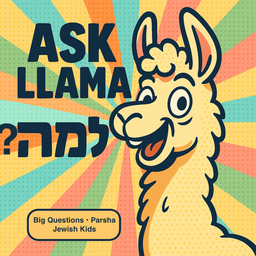
Ask Llama
Claim This Podcastby TaleWizard
5.0(1 reviews)
22 episodes
Updated Daily
Accepts GuestsHas Sponsors
Podcast Overview
Curious, kid-friendly Jewish ideas and everyday questions with Tali, Noam, and Lama.
Language
🇺🇲
Publishing Since
8/24/2025
2 verified contact emails on file for Ask Llama
Pitch yourself as a guest, propose sponsorships, or reach out directly to the host.
Recent Episodes
May 8, 2026
Behar-Bechukotai: The Garden that Needed Shabbat
When Tali becomes personal trainer to a tiny tomato plant, her plan is simple: water it, cheer for it, measure it, sing to it, and help it grow every six seconds. But after Tomato Goldberg Jr. turns into more of a puddle than a plant, Sabba helps Tali, Noam, and Lama ask a surprising Torah question: why does the ground need a Shabbos? In this episode, kids discover the mitzvah of shmita from Parashat Behar — the seventh year when the land in Eretz Yisrael rests. With a polite hungry goat, a very suspicious llama, and one extremely over-helped garden, we learn that stopping is not doing nothing. Sometimes rest teaches us patience, trust, generosity, and how to let go. In this episode, kids will discover - what shmita means - why the Torah says the land gets a kind of Shabbos - how shmita follows a six-years-and-one-year rhythm - why shmita produce is not guarded like private treasure - how letting the land rest can teach people to share, trust, and stop trying to control everything Words we hear in this episode - שְׁמִטָּה / shmita - release, letting go; the seventh year when the land rests - שַׁבָּת / Shabbos - rest, stopping; the weekly holy day of rest - שַׁבַּת הָאָרֶץ / Shabbat ha’aretz - the land’s Shabbos/rest - אֶרֶץ / eretz - land; here, the Land of Israel and the ground that rests - שָׁנָה שְׁבִיעִית / shanah shevi’it - the seventh year - הֶפְקֵר / hefker - ownerless/open for others; not guarded like private treasure - בִּטָּחוֹן / bitachon - trust; relying on Hashem - וַתְרָנוּת / vatranut - generosity, yielding, letting go Try it at home Choose a plant, toy, or project that you really care about. Set a small “do not over-help” timer for a few minutes. While you wait, talk about this question: when does caring mean doing more, and when does caring mean giving something space? You can also make a simple shmita rhythm clap: work, work, work, work, work, work, rest. Try it slowly, then talk about why the seventh beat feels different. Big Question Wh
April 29, 2026
Lag BaOmer and the Rabbi Who Started at Forty
• Tali and Llama argue over the longest marshmallow stick. • We learn that Lag BaOmer is day 33 of the Omer. • Rabbi Akiva begins as a shepherd and starts learning Torah at age 40. • Rachel encourages Akiva to become a Torah learner and is honored as a real partner in his story. • The dripping water and stone story teaches that small steady steps can change us. • Rabbi Akiva teaches: “Love your fellow as yourself.” • We gently discuss the sadness of Rabbi Akiva’s students and the lesson of treating others with kavod. • Lag BaOmer is framed as a day that can hold both memory and hope. Take-home idea: Pass something kindly today — a marshmallow stick, a pencil, or a turn to talk.
April 20, 2026
Counting the Omer
hen Tali tries to race all the way to Shavuot by tearing pages off a giant countdown calendar, she accidentally creates a hilarious Omer tornado and discovers that some journeys are meant to happen one day at a time. Along with Noam, Lama, and Sabba, listeners travel from a breezy barley field to a forty-nine-step ladder to find out what the Omer is, why we count it, and how counting days and weeks helps us get ready for Shavuot. In this episode, kids will discover • what the Omer is • why Omer counting starts right after Pesach • why we count both days and weeks • how 10 days can also be 1 week and 3 days • how counting can turn waiting into excitement and preparation Words we hear in this episode • עֹמֶר - the Omer • סְפִירַת הָעֹמֶר - counting the Omer • יוֹם - day • שָׁבוּעַ - week • חַג שָׁבוּעוֹת - Shavuot Try it at home Make your own Omer chart with 49 boxes or steps. Each night, color in one more box and say whether you just added one more day or finished a whole week. Big Question Why do we count the Omer every day, and how do seven weeks of seven days help us get ready for Shavuot? Family Note Customs for counting the Omer can vary. If your family has its own way of counting or saying the blessing, ask a rabbi or parent to show you your practice.
22 total episodes available
Deep-dive analytics for Ask Llama
Frequently asked questions
Have a different question and can't find the answer you're looking for? Reach out to our support team by sending us an email and we'll get back to you as soon as we can.
- What is Ask Llama?
- How often does this podcast release new episodes?
This podcast updates daily.
- Where can I listen to this podcast?
This podcast is available on 4 platforms including Apple Podcasts, Spotify, and more. You can also use the RSS feed directly.
- Does this podcast accept guests?
No, this podcast does not typically feature guests.
Legal Disclaimer
Pod Engine is not affiliated with, endorsed by, or officially connected with any of the podcasts displayed on this platform. We operate independently as a podcast discovery and analytics service.
All podcast artwork, thumbnails, and content displayed on this page are the property of their respective owners and are protected by applicable copyright laws. This includes, but is not limited to, podcast cover art, episode artwork, show descriptions, episode titles, transcripts, audio snippets, and any other content originating from the podcast creators or their licensors.
We display this content under fair use principles and/or implied license for the purpose of podcast discovery, information, and commentary. We make no claim of ownership over any podcast content, artwork, or related materials shown on this platform. All trademarks, service marks, and trade names are the property of their respective owners.
While we strive to ensure all content usage is properly authorized, if you are a rights holder and believe your content is being used inappropriately or without proper authorization, please contact us immediately at hey@podengine.ai for prompt review and appropriate action, which may include content removal or proper attribution.
By accessing and using this platform, you acknowledge and agree to respect all applicable copyright laws and intellectual property rights of content owners. Any unauthorized reproduction, distribution, or commercial use of the content displayed on this platform is strictly prohibited.