
David Gray-Hammond relays brief stories from his Autistic experience, and explores what his neurodivergence means to him. <br/><br/><a href="https://news.neurohubcommunity.org/s/autistic-storytime-with-david?utm_medium=podcast">news.neurohubcommunity.org</a>
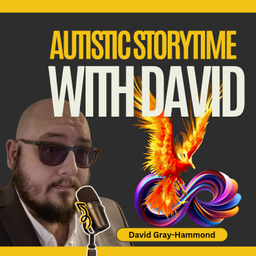
Autistic Storytime With David
Claim This Podcastby David Gray-Hammond
16 episodes
Updated Daily
Accepts GuestsHas SponsorsLocation 🇬🇧
Podcast Overview
David Gray-Hammond relays brief stories from his Autistic experience, and explores what his neurodivergence means to him. <br/><br/><a href="https://news.neurohubcommunity.org/s/autistic-storytime-with-david?utm_medium=podcast">news.neurohubcommunity.org</a>
Language
🇺🇲
Publishing Since
3/21/2025
1 verified contact email on file for Autistic Storytime With David
Pitch yourself as a guest, propose sponsorships, or reach out directly to the host.
Recent Episodes
April 26, 2026
Lilipadding And Monotropic Split
<p>In this episode of Autistic Storytime With David, we explore two interconnected concepts developed by fellow advocate and researcher Tanya Adkin: <strong>monotropic split</strong>, the cognitive injury that occurs when a monotropic person's attention is forced to fracture across too many competing demands, and <strong>lilipadding</strong>, a practical framework for navigating transitions and recovering from Autistic burnout one manageable step at a time. Drawing on personal experience and years of peer mentoring, David unpacks why autistic burnout so often feels like personal failure, why it isn't, and what a genuinely sustainable path forward looks like.</p><p><p>NeuroHub Community Journal | Newsletter | Announcements is a reader-supported publication. To receive new posts and support my work, consider becoming a free or paid subscriber.</p></p><p></p> <br/><br/>This is a public episode. If you would like to discuss this with other subscribers or get access to bonus episodes, visit <a href="https://news.neurohubcommunity.org?utm_medium=podcast&utm_campaign=CTA_1">news.neurohubcommunity.org</a>
April 14, 2026
Not All Awareness Is Good Awareness
This is a free preview of a paid episode. To hear more, visit <a href="https://news.neurohubcommunity.org?utm_medium=podcast&utm_campaign=CTA_7">news.neurohubcommunity.org</a><br/><br/><p>Every April, the puzzle pieces come out, the buildings go blue, the corporate social media posts arrive, right on schedule.</p><p>Every April, a lot of Autistic people brace themselves.</p><p>This episode of Autistic Storytime With David is one I’ve wanted to make for a long time. We’re talking about harmful autism organisations, specifically, Autism Speaks; and why …</p>
March 22, 2026
Autistic People Failed Between Services
<p>There is a place many Autistic people end up that doesn’t exist on any official map. It’s not a clinic, or a service. It’s not even acknowledged as a system failure. Yet, it is one of the most dangerous places an Autistic person can be.</p><p>It is the space between mental health services and substance use services. A place where responsibility is passed back and forth, while the person at the centre quietly deteriorates.</p><p>The Loop That Never Ends</p><p>Autistic people experience significantly higher rates of mental health difficulties than the general population. Research consistently shows elevated prevalence of anxiety, depression, trauma-related distress, and suicidality among Autistic adults.</p><p>Alongside this, there is growing evidence that Autistic people are also at increased risk of problematic substance use; often as a means of coping with overwhelming environments, chronic stress, and unmet support needs. My own research (Papdapoulos et al, 2025; Munday et al, 2025) paints an intense image of the scale of substance use in the Autistic community.</p><p>These issues do not exist in isolation, they are deeply connected across an ecology of distressing environments that coalesce and take form as the negative outcomes that we see.</p><p>Despite this, services continue to treat them as though they exist in near boxes.</p><p>Here’s how it often plays out:</p><p>* An Autistic person seeks help from mental health services.</p><p>* They disclose their struggles , anxiety, depression, overwhelm, and, crucially, their substance use.</p><p>* They are told:</p><p>“We can’t begin treatment while there is active substance use. You’ll need to engage with addiction services first.”</p><p>So they try again.</p><p>This time, with substance use services.</p><p>* They explain their use, but also their mental health difficulties, the distress that drives it.</p><p>* They are told:</p><p>“Your mental health needs stabilising first. We can’t support you at this level without mental health input.”</p><p>And just like that, they are sent back. Back and forth, and back again.</p><p>Fragmented Systems, Real Harm</p><p>This is fragmentation. It’s a system designed around categories trying to respond to lives that do not fit neatly into them. For Autistic people, this fragmentation is particularly harmful. It is often ignored that distress does not pause while services negotiate responsibility.</p><p>* Mental health does not stabilise in the absence of support.</p><p>* Substance use does not reduce while underlying distress escalates.</p><p>Instead, what we see is a predictable pattern:</p><p>* Worsening mental health</p><p>* Increased reliance on substances</p><p>* Escalation to crisis</p><p>* Disengagement from services</p><p>* Long-term harm that could have been prevented</p><p>The longer someone is left in this gap between services, the harder it becomes to return.</p><p>Why Autistic People Are Disproportionately Affected</p><p>To understand why this issue is so acute for Autistic people, we need to move beyond individualised, pathology-based explanations. Autistic distress is ecosystemic, it does not arise solely from within the bodymind. Distress has just as much sociopolitical context and it does a medical one.</p><p>1. Chronic Environmental Overload</p><p>Many Autistic people exist in environments that are persistently overwhelming; sensory, social, and cognitive demands that exceed capacity over long periods of time.</p><p>This creates a baseline of stress that is already elevated before any additional challenges arise.</p><p>2. Relational Disconnection</p><p>Autistic people frequently experience misunderstanding, exclusion, and invalidation within relationships; including within healthcare systems.</p><p>This compounds distress and reduces the likelihood of seeking support early.</p><p>3. Institutional Barriers</p><p>Services are often not designed with Autistic needs in mind.</p><p>Rigid communication styles, inaccessible environments, and deficit-based assumptions all create barriers to effective support.</p><p>4. Substance Use as Regulation</p><p>Substance use, in this context, is often not about risk-taking or lack of insight. It is about regulation. A way of managing overwhelming internal and external experiences when no other accessible support is available.</p><p>When we understand this, the false divide between “mental health” and “substance use” begins to collapse. They are interconnected responses to the same ecology of distress.</p><p>The Cost Of Being Passed Between Services</p><p>Every time an Autistic person is told “not here”;</p><p>* Trust erodes.</p><p>* Shame increases.</p><p>* Hope diminishes.</p><p>Over time, many begin to internalise the message:</p><p>“I am too complex to be helped.”</p><p>When that belief takes hold, help-seeking often stops.</p><p>This is where outcomes worsen most significantly, because people are not just falling through gaps in services. They are being pushed into them.</p><p>The Problem With “Stability First”</p><p>One of the most common justifications for this fragmentation is the idea that one issue must be “stabilised” before the other can be addressed. This logic fails in practice. Mental health cannot stabilise without addressing the factors that sustain distress, including substance use.</p><p>Substance use cannot meaningfully reduce without addressing the distress it is managing. Requiring one to be resolved before the other creates an impossible threshold; a barrier that many Autistic people simply cannot cross.</p><p>Toward An Ecosystemic Approach</p><p>If we are to improve outcomes for Autistic people experiencing mental health difficulties and substance use, we need a fundamental shift in how we understand distress. This is where an ecosystemic model becomes essential.</p><p>Rather than locating the problem solely within the individual, an ecosystemic approach recognises that distress emerges through interactions between:</p><p>* Bodymind (sensory processing, cognition, emotional experience)</p><p>* Immediate environment (home, relationships, daily demands)</p><p>* Broader systems (healthcare, education, social policy, cultural norms)</p><p>From this perspective, substance use is not an isolated behaviour to be eliminated. Instead, it is part of a wider adaptive response to overwhelming conditions. This also means that mental health is not a standalone issue to be treated in isolation, rather, it is inseparable from the environments and systems a person is navigating.</p><p>What Needs To Change</p><p>If services are serious about improving outcomes, several shifts are urgently needed.</p><p>1. Integrated Support, Not Sequential Gatekeeping</p><p>Mental health and substance use services must stop operating as separate entry points with competing thresholds. Support should be integrated, with both needs addressed simultaneously.</p><p>2. Harm Reduction Over Compliance</p><p>Expecting immediate abstinence or “stability” before offering support excludes those who need it most. A harm reduction approach allows for engagement without unrealistic preconditions.</p><p>3. Neurodivergence-Competence</p><p>Services must develop genuine understanding of Autistic experience; not as a checklist of traits, but as a fundamentally different way of experiencing the world. This includes adapting environments, communication styles, and expectations.</p><p>4. Relational Continuity</p><p>Above all, services must prioritise staying with people, not passing them on or redirecting them elsewhere. Holding responsibility long enough for meaningful support to occur.</p><p>A Simple But Radical Question</p><p>Instead of asking:</p><p><strong>“Which service should take the lead?”</strong></p><p>We need to start asking:</p><p><strong>“What does this person need to reduce harm and stay connected?”</strong></p><p>Because people do not live in service categories. They should not have to become less complex to access care.</p><p>Closing: The Space Between Doors</p><p>Right now, across the UK and beyond, there are Autistic people sitting in that invisible waiting room. Trying to hold themselves together, using whatever they can to cope. Being told, again and again:</p><p>“Not here.”</p><p>We can do better than this. Not by building more pathways, instead by refusing to let people fall between the ones we already have.</p><p><p>NeuroHub Community Ltd is a reader-supported publication. To receive new posts and support my work, consider becoming a free or paid subscriber.</p></p> <br/><br/>This is a public episode. If you would like to discuss this with other subscribers or get access to bonus episodes, visit <a href="https://news.neurohubcommunity.org?utm_medium=podcast&utm_campaign=CTA_1">news.neurohubcommunity.org</a>
16 total episodes available
Deep-dive analytics for Autistic Storytime With David
Frequently asked questions
Have a different question and can't find the answer you're looking for? Reach out to our support team by sending us an email and we'll get back to you as soon as we can.
- What is Autistic Storytime With David?
- How often does this podcast release new episodes?
This podcast updates daily.
- Where can I listen to this podcast?
This podcast is available on 4 platforms including Apple Podcasts, Spotify, and more. You can also use the RSS feed directly.
- Does this podcast accept guests?
No, this podcast does not typically feature guests.
Legal Disclaimer
Pod Engine is not affiliated with, endorsed by, or officially connected with any of the podcasts displayed on this platform. We operate independently as a podcast discovery and analytics service.
All podcast artwork, thumbnails, and content displayed on this page are the property of their respective owners and are protected by applicable copyright laws. This includes, but is not limited to, podcast cover art, episode artwork, show descriptions, episode titles, transcripts, audio snippets, and any other content originating from the podcast creators or their licensors.
We display this content under fair use principles and/or implied license for the purpose of podcast discovery, information, and commentary. We make no claim of ownership over any podcast content, artwork, or related materials shown on this platform. All trademarks, service marks, and trade names are the property of their respective owners.
While we strive to ensure all content usage is properly authorized, if you are a rights holder and believe your content is being used inappropriately or without proper authorization, please contact us immediately at hey@podengine.ai for prompt review and appropriate action, which may include content removal or proper attribution.
By accessing and using this platform, you acknowledge and agree to respect all applicable copyright laws and intellectual property rights of content owners. Any unauthorized reproduction, distribution, or commercial use of the content displayed on this platform is strictly prohibited.