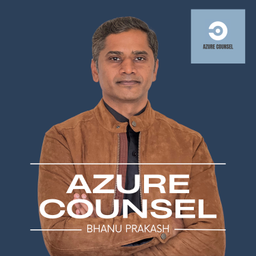
Podcast thumbnail for Azure Counsel Podcast

Azure Counsel Podcast

Claim This Podcast

by Bhanu Prakash - Azure Counsel

14 episodes
Updated Daily
Accepts GuestsHas Sponsors

Podcast Overview

Azure Counsel Podcast brings you practical tutorials and deep dives into Microsoft Azure, serverless computing, Event Hubs, IoT, and cloud architecture. Learn how to build scalable, real-world applications using Azure Functions, Service Bus, Cosmos DB, and more. Perfect for developers, architects, and cloud professionals seeking hands-on guidance, automation tips, and workflow optimizations. Watch the full video of each episode on my Youtube channel: https://www.youtube.com/@azurecounsel

Language

🇺🇲

Publishing Since

10/3/2025

1 verified contact email on file for Azure Counsel Podcast

Pitch yourself as a guest, propose sponsorships, or reach out directly to the host.

Recent Episodes

Episode thumbnail for IaaS vs PaaS vs SaaS Explained: The Hidden Responsibility Trap Behind Cloud Costs, Architecture Mistakes & System Ownership in Azure & AWS

June 18, 2026

IaaS vs PaaS vs SaaS Explained: The Hidden Responsibility Trap Behind Cloud Costs, Architecture Mistakes & System Ownership in Azure & AWS

<p>Most engineers assume IaaS, PaaS, and SaaS are just different hosting options.</p><p>They’re not.</p><p>They are <strong>three fundamentally different responsibility contracts</strong> that determine how much of your system you own, maintain, and pay for—often in ways that only become visible after production failures or unexpected cloud bills.</p><p>In this episode, we break down the real trade-offs behind cloud adoption models and why teams frequently end up with higher costs, slower delivery cycles, and more operational complexity—even after “moving to the cloud.”</p><p>This is not a definitions video.<br>This is a <strong>decision-making framework for real-world cloud architecture.</strong></p><p>Cloud complexity rarely comes from technology.</p><p>It comes from <strong>misaligned ownership decisions</strong>.</p><p>🧱 IaaS — Maximum Control, Maximum MaintenanceInfrastructure as a Service gives you full control over virtual machines, operating systems, and runtime environments.</p><p>But control comes with hidden cost:</p><p>• OS patching and security updates<br>• Middleware upgrades and compatibility fixes<br>• Scaling scripts and capacity planning<br>• Infrastructure troubleshooting at odd hours</p><p>In real-world engineering teams, this can consume <strong>30–40% of engineering capacity</strong> without producing business features.</p><p>👉 Insight: If it’s not deeply specialized infrastructure work, IaaS becomes a <strong>maintenance tax</strong>.</p><p>⚙️ PaaS — Speed, but with Architectural CouplingPlatform as a Service is where most modern cloud systems belong.</p><p>You deploy code. The platform handles scaling, infrastructure, and runtime management.</p><p>But the trade-off is subtle and often misunderstood:</p><p>It’s not lock-in—it’s <strong>integration coupling</strong>.</p><p>Over time, systems become tightly bound to:</p><p>• Event-driven triggers<br>• Managed identity flows<br>• Platform-specific bindings<br>• Native scaling behaviors</p><p>🧩 SaaS — The Hidden Cost of Rebuilding What Already ExistsSoftware as a Service is often misunderstood as “limited control.”</p><p>But the real issue is different:</p><p>Teams often rebuild existing capabilities instead of adopting them.</p><p>Examples:</p><p>• Authentication systems<br>• Notification pipelines<br>• Admin dashboards<br>• Internal tools</p><p>This leads to months of engineering effort spent recreating commodity software.</p><p>👉 Insight: If it’s not your competitive advantage, building it is usually technical debt in disguise.</p><p>🧠 The Mental Model That Makes This SimpleThink of it like this:</p><p>• IaaS = Your own kitchen (you cook, clean, manage everything)<br>• PaaS = Food delivery (you focus on the application, not infrastructure)<br>• SaaS = Restaurant (you just consume the outcome)</p><p>The mistake most teams make?</p><p>Building a kitchen… when all they needed was dinner.</p><p>🎯 The Decision FrameworkBefore choosing a model, ask:</p><p>• Is this commodity functionality? → SaaS<br>• Is this core application logic? → PaaS<br>• Is this deep infrastructure control? → IaaS</p><p>Simple, but precise.</p><p>🔥 Why This MattersMost cloud cost overruns, scaling issues, and operational complexity are not caused by poor tools.</p><p>They are caused by <strong>wrong responsibility placement at the architecture layer</strong>.</p><p>Once you choose the wrong model, every downstream decision becomes more expensive:</p><p>• More operational overhead<br>• Slower delivery cycles<br>• Higher cloud bills<br>• Increased system fragility</p><p>🚀 What You’ll Take Away• A clear mental model for IaaS vs PaaS vs SaaS<br>• How responsibility shifts affect cost and complexity<br>• Why PaaS systems become hard to migrate over time<br>• When SaaS prevents unnecessary engineering work<br>• How to avoid over-engineering cloud systems</p><p>🎓 About Azure CounselAzure Counsel focuses on real-world cloud architecture beyond tutorials.</p><p>We explore:</p><p>• Azure Functions &amp; Serverless systems<br>• Event-driven architecture patterns<br>• API Management &amp; integration design<br>• Cost optimization strategies<br>• Production debugging and scaling lessons</p><p>If you&#39;re building systems that need to scale reliably and cost-effectively, this channel is built for you.</p><p></p>

Episode thumbnail for Cloud Computing Explained: Why Your Cloud Costs Are Higher Than Expected (IaaS vs PaaS vs SaaS, Hidden Costs, Lift & Shift Mistakes)

June 4, 2026

Cloud Computing Explained: Why Your Cloud Costs Are Higher Than Expected (IaaS vs PaaS vs SaaS, Hidden Costs, Lift & Shift Mistakes)

<p>Everyone says cloud computing reduces cost.<br>In reality? Many teams migrate to the cloud—and end up paying 2–3x more.</p><p>In this episode, we break down the uncomfortable truth behind rising cloud bills and why simply “moving to the cloud” doesn’t guarantee savings. If you’ve ever lifted a workload from on-premises into the cloud and expected instant efficiency, this is where things usually go wrong.</p><p>This is not a beginner-friendly “what is cloud” explanation.<br>This is a <strong>mental model reset</strong> for developers, architects, and engineers who want to understand how cloud actually works at scale.</p><p>Most teams assume cloud computing means running servers somewhere else.<br>But cloud is fundamentally about <strong>shifting responsibility</strong>:</p><p>• From hardware → configuration<br>• From infrastructure → architecture decisions<br>• From fixed cost → dynamic cost behavior</p><p>If you don’t understand this shift, you don’t eliminate complexity—you just move it into places that are harder to see, manage, and optimize.</p><p>Migrating without redesigning architecture leads to identical inefficiencies—now billed per second.<br>Cloud doesn’t fix bad systems. It amplifies them.</p><p>You provision for peak load… but run idle most of the time.<br>And unlike on-prem, the cloud keeps charging you whether you use it or not.</p><p>Result:<br>• Underutilized compute<br>• Wasted budget<br>• Invisible cost leaks</p><p>Choosing tools before defining goals.</p><p>Kubernetes. VMs. Containers.<br>All powerful—but often misused.</p><p>The real question most teams skip:<br><strong>What are you optimizing for?</strong></p><p>• Cost?<br>• Scalability?<br>• Performance?<br>• Operational simplicity?</p><p>Without clarity, every decision compounds in the wrong direction.</p><p>Cloud does NOT remove complexity.<br>It <strong>relocates it</strong>.</p><p>Instead of managing servers directly, you now manage:</p><p>• Configuration<br>• Security policies<br>• Scaling logic<br>• Observability</p><p>Same complexity—different layer.</p><p>The more control you take in the cloud, the more responsibility you inherit.</p><p>And that responsibility shows up as:<br>• Higher cost<br>• Increased operational overhead<br>• Greater system fragility</p><p>Understanding this trade-off is the key to building cost-efficient, scalable cloud systems.</p><p>• Why cloud costs increase after migration<br>• The hidden risks of lift-and-shift strategies<br>• How idle infrastructure silently drains your budget<br>• Why tool-first thinking leads to bad architecture decisions<br>• The true meaning of “responsibility shift” in cloud computing<br>• How to think about cost, scale, and control correctly</p><p>• Cloud Architects designing scalable systems<br>• Developers moving from on-prem to cloud<br>• DevOps Engineers optimizing cloud spend<br>• Teams struggling with unexpected Azure/AWS bills<br>• Anyone trying to understand IaaS, PaaS, and SaaS decisions</p><p>In the next episode, we break down <strong>IaaS vs PaaS vs SaaS</strong>—not in theory, but in terms of:</p><p>• What you actually manage<br>• What you’re responsible for<br>• What you’re really paying for</p><p>Azure Counsel focuses on real-world cloud architecture—beyond tutorials and into production-grade thinking.</p><p>We cover:<br>• Serverless &amp; Azure Functions<br>• Event-driven architecture<br>• API Management &amp; integrations<br>• Cost optimization strategies<br>• Real-world debugging &amp; scaling lessons</p><p>If your cloud bill keeps rising and you’re not sure why—this episode gives you the clarity most teams miss.</p><p>💥 The Real Problem: It’s Not the Cloud⚠️ The 3 Costly Mistakes Killing Cloud ROI1. The Lift &amp; Shift Trap2. The “Ghost Server” Problem3. The Architect’s Blindspot🧠 The Critical Insight Most Engineers Miss⚖️ The Core Trade-Off🚀 What You’ll Learn in This Episode🎯 Who This Is For🔜 What’s Next🎓 About Azure Counsel</p>

Episode thumbnail for Azure API Management Explained: Request Flow, Policies, Backends & API Gateway Design for Scalable Cloud APIs

May 21, 2026

Azure API Management Explained: Request Flow, Policies, Backends & API Gateway Design for Scalable Cloud APIs

<p>Most developers treat Azure API Management (APIM) like a simple reverse proxy.<br>That assumption is exactly why APIs fail in production.</p><p>In this episode, Bhanu from Azure Counsel breaks down how <strong>Azure API Management actually works under the hood</strong> — from the moment a client sends a request to the moment a response is returned.</p><p>This is not a surface-level overview.<br>It’s a <strong>production-focused deep dive into APIM’s execution model</strong>, designed to fix the mental model gaps that cause real-world outages.</p><p>🚀 What You’ll Learn• Why your API gateway isn’t doing enough — and where responsibilities actually belong<br>• How misconfigured backends become silent performance and scaling bottlenecks<br>• Why rate limits and quotas fail to protect your backend when implemented incorrectly<br>• How to eliminate policy duplication using <strong>Policy Fragments (DRY principle)</strong><br>• Where API failures really happen — and how to debug them using logging and monitoring<br>• How <strong>policy expressions</strong> enable dynamic routing and zero-downtime control<br>• The full anatomy of Azure API Management: APIs, Products, Backends, Named Values, Tags<br>• The <strong>end-to-end request lifecycle</strong>: inbound → backend → outbound pipeline</p><p>🧠 The Core Problem: Mental Model FailureMost APIM issues are not configuration bugs — they are <strong>architecture mistakes</strong>.</p><p>If you don’t understand:<br>• When Products and Subscriptions are enforced<br>• Where authentication and authorization actually happen<br>• How policies execute across inbound, backend, and outbound stages</p><p>You will eventually ship an API that works in testing… but fails under real production load.</p><p>⚙️ Azure API Management Anatomy (Explained Simply)This episode breaks down the core building blocks:</p><p>• <strong>APIs</strong> → Define contracts, operations, and versioning<br>• <strong>Products</strong> → Control access, subscriptions, and quotas<br>• <strong>Backends</strong> → Route traffic safely to Functions, Logic Apps, or services<br>• <strong>Named Values</strong> → Manage environment configuration and secrets<br>• <strong>Policy Fragments</strong> → Reusable governance and security logic<br>• <strong>Tags</strong> → Enable governance, search, and DevOps automation</p><p>You’ll understand how these components work together at runtime — and why placing logic in the wrong layer leads to instability.</p><p>🚦 End-to-End Request FlowWe walk through the complete execution path:</p><p>Client Request → Inbound Policies → Backend Routing → Backend Execution → Outbound Policies → Response</p><p>This clarity is critical for:<br>• Debugging failures<br>• Optimizing latency<br>• Enforcing security<br>• Scaling APIs reliably</p><p>🔎 Why This MattersAPIs don’t fail because of code alone — they fail because of <strong>gateway misconfiguration and architectural gaps</strong>.</p><p>Without a clear understanding of APIM:<br>• Traffic leaks through without proper control<br>• Rate limits fail silently<br>• Policies become unmaintainable<br>• Latency increases unpredictably</p><p>This episode gives you the <strong>execution-order clarity</strong> needed to design APIs that are secure, scalable, and production-ready.</p><p>👨‍💻 Who This Episode Is For• Azure Developers building HTTP APIs<br>• Backend Engineers working with Azure Functions, Logic Apps, or Web APIs<br>• Cloud Architects designing API gateways and integration platforms<br>• DevOps teams managing API security, throttling, and observability</p><p>🧠 Key Takeaways• APIM is not just a proxy — it’s a full API governance layer<br>• Backend misconfiguration is a hidden production risk<br>• Policy design determines scalability and maintainability<br>• Observability is critical for debugging real-world API failures<br>• Understanding request flow is non-negotiable for production systems</p><p>If your APIs have ever:<br>• failed under load<br>• behaved differently in production vs testing<br>• suffered from latency spikes or throttling issues<br>• or become unmanageable due to policy complexity</p><p>This episode gives you the <strong>blueprint to fix your API gateway architecture.</strong></p><p>🎥 <strong>Watch the full walkthrough:</strong><br><a href="https://youtu.be/laouD7QErzU" target="_new" rel="noopener">https://youtu.be/laouD7QErzU</a></p><p><br></p>

14 total episodes available

Deep-dive analytics for Azure Counsel Podcast

Frequently asked questions

Have a different question and can't find the answer you're looking for? Reach out to our support team by sending us an email and we'll get back to you as soon as we can.

What is Azure Counsel Podcast?

Azure Counsel Podcast brings you practical tutorials and deep dives into Microsoft Azure, serverless computing, Event Hubs, IoT, and cloud architecture. Learn how to build scalable, real-world applications using Azure Functions, Service Bus, Cosmos DB, and more. Perfect for developers, architects, and cloud professionals seeking hands-on guidance, automation tips, and workflow optimizations.

Watch the full video of each episode on my Youtube channel: https://www.youtube.com/@azurecounsel

How often does this podcast release new episodes?

This podcast updates daily.

Where can I listen to this podcast?

This podcast is available on 4 platforms including Apple Podcasts, Spotify, and more. You can also use the RSS feed directly.

Does this podcast accept guests?

No, this podcast does not typically feature guests.

Legal Disclaimer

Pod Engine is not affiliated with, endorsed by, or officially connected with any of the podcasts displayed on this platform. We operate independently as a podcast discovery and analytics service.

All podcast artwork, thumbnails, and content displayed on this page are the property of their respective owners and are protected by applicable copyright laws. This includes, but is not limited to, podcast cover art, episode artwork, show descriptions, episode titles, transcripts, audio snippets, and any other content originating from the podcast creators or their licensors.

We display this content under fair use principles and/or implied license for the purpose of podcast discovery, information, and commentary. We make no claim of ownership over any podcast content, artwork, or related materials shown on this platform. All trademarks, service marks, and trade names are the property of their respective owners.

While we strive to ensure all content usage is properly authorized, if you are a rights holder and believe your content is being used inappropriately or without proper authorization, please contact us immediately at hey@podengine.ai for prompt review and appropriate action, which may include content removal or proper attribution.

By accessing and using this platform, you acknowledge and agree to respect all applicable copyright laws and intellectual property rights of content owners. Any unauthorized reproduction, distribution, or commercial use of the content displayed on this platform is strictly prohibited.