- 14
- Episodes
- 2026
- First episode
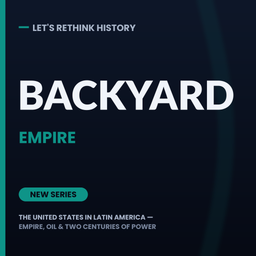
About Backyard Empire: The United States in Latin America
For two centuries the United States has treated the Western Hemisphere as its sphere of influence — and how, and why, is a messier and more revealing story than the textbook version. From the war with Mexico and the USS Maine to the Cold War interventions, the corporations that drew their own borders, and the invasions of Grenada and Panama — told from primary documents, declassified cables, and peer-reviewed scholarship. Narrated by AI voices from sourced, human-reviewed research. © 2026 Selway Solutions LLC · Educational & Institutional Use License (https://history.selwaysolutions.io/index.html#license) · Contact (mailto:nick@selwaysolutions.io)
- Publisher
- Nick Mackenzie
- Category
- society & culture
- Language
- en
- Explicit
- No
- First episode
- 11 Jun 2026
- Latest episode
- 16 Jun 2026
Latest episodes
14 episodes in the feed.
16 Jun 2026
How ITT Tried to Buy a Coup: Telephones, Electricity, and the Fall of Allende
Most of this series is about things dug out of the ground. This one is about the wires and the current — the telephone systems and power grids a modern country can't function without, owned by foreign corporations. International Telephone & Telegraph (ITT) owned the phone systems of Cuba, Chile, and beyond; the American & Foreign Power Company owned the electric utilities of Cuba and nine more Latin American countries. They charged high rates, paid little tax, and resisted local control — until governments began nationalizing them, starting with Castro's Cuba. Then the most notorious case: when Salvador Allende was elected in Chile in 1970 and moved to nationalize ITT's phone company, ITT — chairman Harold Geneen and board member John McCone, a former CIA director — offered money to the CIA (a reported $1 million) and pushed to wreck Chile's economy to stop him, a scandal exposed in leaked memos and 1973 Senate hearings. We keep the crucial caveat front and center: ITT was an eager instigator, not the puppet-master — the CIA ran its own operations (Episode 4) and rejected some ITT proposals. A study in how far a corporation tried to go to protect a monopoly. Narrated by AI voices from sourced, human-reviewed research.
16 Jun 2026
How Capital Flight Replaced Private Armies: Maquiladoras and Fast Fashion
Strip the banana plantation of its bananas and the copper mine of its copper, and what's left is the system: a zone of foreign-owned production, walled off from the national economy, exempt from taxes, with a young disposable workforce and the law bent to keep them quiet. That system came back as the maquiladora. This episode of Backyard Empire — the series' modern capstone — follows the enclave economy into the present. Mexico's 1965 Border Industrialization Program and then NAFTA built tax-free export zones where U.S. and European apparel brands make clothes through local subcontractors; the factories primarily employ young women under long shifts and poverty wages; mandatory pregnancy testing was used to avoid maternity costs (documented by Human Rights Watch); and independent unions are suppressed through 'protection' and 'paper' unions. The model spread to Central America's Free Trade Zones (Honduras, El Salvador, Guatemala) and on to Asia. The heart of it is the new way the system keeps order: La Forestal had a private police force, United Fruit could call the Marines — the maquiladora just threatens to leave. Demand more, and the factory reopens in a cheaper country. We keep the contested questions (exploitative vs. better-than-alternatives) open. Narrated by AI voices from sourced, human-reviewed research.
16 Jun 2026
The Human Machine Behind C&H Sugar: Hawaiʻi's Plantation Labor System
The bag of 'C&H Pure Cane Sugar from Hawaiʻi' in an American kitchen was the end of a long, engineered chain. This episode of Backyard Empire — a companion to the Hawaiʻi overthrow episode — looks at the economic and human machinery of sugar. After Native Hawaiians were dispossessed of their land, a tiny haole elite came to control nearly half the islands and planted them in cane. Because the Native population had collapsed from disease and would not be made into plantation hands, the planters imported over 300,000 contract laborers from China, Japan, Korea, the Philippines, and Portugal — and housed them in separate camps and paid them different wages by ethnicity, on purpose, so they could not unite. For decades the early strikes broke along ethnic lines and were defeated. Meanwhile the Big Five integrated forward through the C&H cooperative, refining and marketing their sugar on the mainland at Crockett, California — itself a company town. We end where the system broke: the multi-ethnic workforce uniting under the ILWU after WWII. We keep the disputed figures contested and the workers' experience at the center. Narrated by AI voices from sourced, human-reviewed research.
15 Jun 2026
How Sugar Barons Stole the Hawaiian Kingdom
Everywhere else in this series, the empire owned the economy. In Hawaiʻi, it took the country. This episode of Backyard Empire tells three linked stories. In January 1893, a committee of mostly American sugar businessmen — backed by the U.S. minister and Marines landed from the USS Boston — overthrew Queen Liliuokalani and ended a sovereign kingdom; five years later the U.S. annexed the islands by a joint resolution of Congress, over the objections of most Native Hawaiians. The families behind it ran Hawaiʻi for half a century as the 'Big Five' (Castle & Cooke, Alexander & Baldwin, C. Brewer, American Factors, Theo H. Davies) — controlling sugar, shipping, banking, and politics, and dividing a multi-ethnic plantation workforce by ethnicity. That held until 1946, when the workers struck together under the ILWU, shut nearly every plantation for 79 days, and broke the oligarchy. This is the series' limit case — an enclave that annexed a nation. We keep the Native Hawaiian perspective central, note the 1993 Apology Resolution, and keep the contested questions (overthrow vs revolution; legality of annexation-by-resolution) open. Narrated by AI voices from sourced, human-reviewed research.
15 Jun 2026
How Corporate Monoculture Built Slave Empires in Sugar and Henequen
After the United States took the Caribbean stage in 1898, American capital turned whole societies into single-crop suppliers. This episode of Backyard Empire follows monoculture as a system of control. In Cuba, US sugar corporations like the Cuban-American Sugar Company bought out local planters, built mill-town enclaves, and left workers dependent on the tiempo muerto, the 'dead season' of hunger between harvests, while the Platt Amendment kept the door open for US intervention. In Puerto Rico and the Dominican Republic, absentee American sugar companies took the best coastal land. And in Mexico's Yucatan, the henequen 'green gold' boom — the fiber for the binder twine of the world's mechanical reapers — ran on a secret 1902 pact between International Harvester and the Molina export house, and on the debt peonage of Maya laborers and deported Yaqui prisoners, the system John Kenneth Turner exposed in Barbarous Mexico. The capital here is overwhelmingly American. We keep the disputed numbers contested and the human cost — bondage and hunger — at the center. Part one of a two-part set; the companion covers Hawaii. Narrated by AI voices from sourced, human-reviewed research.
15 Jun 2026
The British Company That Owned an Argentine Forest — and Massacred Its Workers
For half a century, a forest in northern Argentina supplied the world with the chemical that turned hides into leather — and a single British company owned the forest, the towns, the railways, the police, and the money the workers were paid in. This episode of Backyard Empire tells the story of La Forestal — The Forestal Land, Timber and Railways Company — and the quebracho/tannin enclave it ran in the Gran Chaco from 1906 to 1963: how a provincial debt handed it some two million hectares of 'axe-breaker' forest; the closed enclave it built (company towns, company scrip, its private police the Gendarmeria Volante, suppressed schooling) while controlling the world's tannin supply; the 1919-1921 strikes by the anarcho-syndicalist FORA; and the 1921 massacre, when the company's police and the paramilitary Patriotic League killed hundreds of workers and their families. Then the ending: ~90% of the forest cut, the company gone in 1963, ghost towns and a ruined landscape left behind, while the same British capital shifted to cheaper African wattle. The capital was British, not American — the U.S. enters only as a leather market; the death toll (~500-600) and company-vs-state responsibility are kept contested. Narrated by AI voices from sourced, human-reviewed research.
15 Jun 2026
The Nickel Mine That Got Its Critics Killed
In the 1960s, foreign companies won the right to mine nickel on Q'eqchi' Maya land at Lake Izabal, Guatemala — a 40-year concession on terms so generous that a group of professors at the national university formed a commission just to read the contract. They concluded it was a giveaway, and within months the men on that commission began to die. This episode of Backyard Empire traces the concession handed out by the post-1954 military state, first to the American Hanna Mining Company and then to Canada's INCO through its EXMIBAL subsidiary; the forced displacement of the Q'eqchi' Maya amid a U.S.-backed counterinsurgency; and the assassinations of 1970-71 — Julio Camey Herrera killed, Alfonso Bauer Paiz wounded, and the wheelchair-using congressman Adolfo Mijangos Lopez gunned down just weeks before the company got its favorable terms. Then the long tail: the mine's revival under Canadian HudBay and Russian-owned Solway, the El Estor evictions and killings that produced lawsuits in Canadian courts, and the 2023 Inter-American Court ruling. The capital was American, then Canadian, then Russian — not primarily U.S.; the American thread is the U.S.-backed military state that guarded the concession. Narrated by AI voices from sourced, human-reviewed research.
14 Jun 2026
Blood and Marble: The Amazon Rubber Boom's Forgotten Genocide
At the turn of the twentieth century the modern world ran on rubber — and rubber grew wild in one place: the Amazon. This episode of Backyard Empire follows the boom that built marble opera houses a thousand miles up the river and, on the Putumayo, produced one of the era's great atrocities. We trace the bicycle-and-automobile tire demand that made jungle sap a fortune; the surreal wealth of Manaus and Iquitos; and the horror beneath it — Julio Cesar Arana's British-registered Peruvian Amazon Company enslaving, torturing, and killing the Huitoto and Bora peoples to tap the trees. We follow the three witnesses who exposed it — Benjamin Saldana Rocca, the American engineer Walter Hardenburg, and the British consul Roger Casement — and the smuggled seeds that, by founding the Asian plantations, collapsed the boom around 1912. Finally, the American coda: Henry Ford's Fordlandia. An honest note throughout: the worst actor was British-registered Peruvian capital, not American, and the death toll is genuinely contested. Narrated by AI voices from sourced, human-reviewed research.
14 Jun 2026
How the Tin Barons Bought Bolivia
For half a century, three mining families owned Bolivia's tin — and through the tin, owned Bolivia. Simon Patiño ran his empire from New York and Europe to keep it beyond Bolivian taxes; with the Aramayo and Hochschild houses he formed the oligarchy Bolivians called La Rosca, 'the screw.' This finale of Backyard Empire's 'The Mines' arc traces how that grip drew blood: on December 21, 1942, the army fired on striking miners and their families at Patiño's Catavi-Siglo XX complex, killing an unknown number — Maria Barzola among them, shot carrying the national flag. The massacre became the founding wound of one of the hemisphere's most militant labor movements: the 1944 miners' federation under Juan Lechin, the radical 1946 Pulacayo Thesis, and the 1952 National Revolution, which nationalized the mines under COMIBOL and broke the barons. We keep the death toll honestly contested, distinguish Bolivia's own decisions from U.S. wartime pressure over its strategic tin, and note COMIBOL's mixed later legacy. Narrated by AI voices from sourced, human-reviewed research.
14 Jun 2026
The Mining Empire That Poisoned a Town for a Century
High in the Peruvian Andes, an American company spent the twentieth century turning a landscape and its people into inputs. This episode of Backyard Empire — part two of 'The Mines' — follows the Cerro de Pasco Corporation's mechanism: the La Oroya smelter's smoke ruined the surrounding farmland, the company bought the dead fields cheaply and fenced the rest, and self-sufficient Andean communities were pushed into the mines as wage labor (the land fight at Rancas became Manuel Scorza's novel Drums for Rancas). The human cost concentrated in La Oroya, for years one of the most lead-contaminated towns on earth, where nearly all the children carried elevated blood-lead levels. We carry it through the 1974 nationalization into Centromin, the American firm Doe Run's troubled years after 1997, and the landmark 2023 Inter-American Court ruling that held the Peruvian state responsible. We keep the responsibility precise and note where the figures and the cleanup remain contested. Narrated by AI voices from sourced, human-reviewed research.
14 Jun 2026
How Copper Sparked the Chilean Coup
Chile sits on the richest copper on earth, and for most of the twentieth century two American companies owned it. This episode of Backyard Empire — the first of a three-part 'The Mines' arc — traces what happened when Salvador Allende was elected in 1970 promising to nationalize Anaconda's and Kennecott's mines. After the 1971 nationalization, Washington answered on two tracks the Church Committee later documented: 'Track I,' the economic squeeze Nixon summed up as 'make the economy scream,' and 'Track II,' the secret CIA push for a military coup that led to the killing of the army's constitutionalist commander, General Rene Schneider. We carry it through the credit and copper embargo, the 1973 coup, and the compensation the Pinochet dictatorship then paid the companies — while copper itself stayed nationalized as Codelco. We work from the Church Committee report, declassified FRUS records, and the National Security Archive, and keep the hardest question open: how much did U.S. covert action — versus Chile's own economic crisis — actually bring Allende down? Narrated by AI voices from sourced, human-reviewed research.
13 Jun 2026
Standard Oil's Secret Cartel With Nazi Germany
After the Supreme Court broke up the Standard Oil trust in 1911, the largest piece — Standard Oil of New Jersey — didn't shrink. It went south, and then it went global. This episode of Backyard Empire follows the oil giant across Latin America and into one of the most disquieting corporate stories of the twentieth century. First, the resource wars: how Standard Oil bought concessions from strongmen and effectively wrote the petroleum laws of sovereign nations — and how those nations fought back, from Bolivia's 1937 nationalization after the Chaco War to Mexico's 1938 expropriation under Lazaro Cardenas (which created Pemex), to Venezuela's fifty-fifty bargain of 1943. Then the gravest chapter: Standard Oil's 1929 cartel with Germany's chemical giant I.G. Farben. We lay out carefully what the record establishes — the patent pool, the synthetic-rubber delay the 1942 Truman Committee found 'did hamper' America's war effort, and the tetraethyl-lead transfers that reached the Luftwaffe — and we are just as careful to flag what is NOT supported by credible history, including the myth that Standard Oil tankers refueled German U-boats at sea. Narrated by AI voices from sourced, human-reviewed research.
12 Jun 2026
How a Fruit Company Toppled a Government
For most of the twentieth century, one American company decided who governed, who worked, and who ate across much of Central America and the Caribbean. It grew bananas — but it also owned the railroads, the ports, and the politics. Latin Americans called it El Pulpo: the Octopus. This episode of Backyard Empire traces the United Fruit Company from an 1899 Boston merger to a hemispheric empire — and to the courtroom: the enclave economy of company towns and company scrip, the 1928 Banana Massacre at Cienaga (where the death toll is still contested), the 1954 CIA coup against Guatemala's elected president Jacobo Arbenz, the rebrands into United Brands and Chiquita, and the modern reckoning — Chiquita's 2007 guilty plea for paying Colombian paramilitaries and the landmark 2024 jury verdict. Threaded through it is a first-person vantage: the host visited two of United Fruit's own enclaves as a boy, at Golfito, Costa Rica in 1963 and Puerto Barrios, Guatemala in 1965. We work from declassified records, court filings, and peer-reviewed scholarship, and keep the contested parts contested. Narrated by AI voices from sourced, human-reviewed research.
11 Jun 2026
How American Doctors Defeated Che Guevara
In the remote lowlands of 1960s Bolivia, American doctors raced to stop a lethal hemorrhagic fever the locals called "Black Typhus" — and a few years later, U.S.-trained Bolivian Rangers cornered and killed Che Guevara not far away. Did mousetraps and medicine help defeat a revolution? This episode of MARU & the Hunt for Che follows two threads of U.S. activity in eastern Bolivia. First, the Middle America Research Unit (MARU) — Dr. Ronald B. MacKenzie, Dr. Karl M. Johnson, Dr. Patricia Webb, and Merle Kuns — who isolated a brand-new pathogen, Machupo virus, traced it to a jungle mouse (Calomys callosus) whose numbers had exploded after DDT spraying killed the village cats, and broke the San Joaquín epidemic with a controlled experiment that cleared the rodents from half the town. Several of them caught the disease; Johnson and Webb nearly died, and the same Karl Johnson would later found the CDC's Special Pathogens Branch and help name Ebola. Second, the 1967 manhunt: the 8th Special Forces team that trained the 2nd Ranger Battalion at La Esperanza, the capture at the Quebrada del Yuro, and the execution at La Higuera with CIA officer Félix Rodríguez present. The provocative question tying them together — whether American goodwill in the east made Che's revolutionary pitch harder to land — is presented as one contested interpretation among several, not a settled fact.
Contact Backyard Empire: The United States in Latin America
- Guest appearances
- Does not typically book guests
Based on episode analysis; this does not confirm that the show is currently accepting guests.
Host of Backyard Empire: The United States in Latin America?
Claim your podcast to manage its listing and keep your show details accurate.
Pod Engine is an independent podcast discovery and analytics service and is not affiliated with or endorsed by this podcast. Artwork and show content belong to their owners. Full legal notice.
Explore this show
Podcast research with Pod Engine