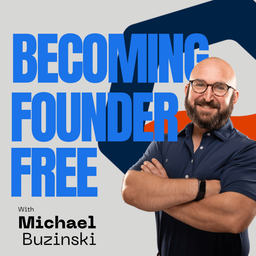
Michael "Buzz" Buzinski, a 36 year award-winning marketing veteran, named a visionary marketer by the American Marketing Association, dives into one of the biggest challenges faced by Business-to-Business (B2B) companies: founder-led dependency. This podcast is dedicated to building Founder-Free Revenue Engines by fixing random acts of marketing with a system that runs across marketing, sales, and client success, without the founder/CEO as the main gear.
Most B2B firms don’t have a marketing problem or a sales problem. They have a system problem. When growth keeps relying on founder heroics, random acts of marketing pile up, and you become the bottleneck, which shows up as
- Low lead volume and/or poor lead quality
- Unpredictable sales pipeline and shaky forecasts
- Inconsistent sales process without founder drive
- Client growth depends on team heroics, not process
What if you had one integrated system that creates demand, converts right-fit clients, and turns wins into retention, expansion, and referrals, without you stuck in the middle? That's what Buzz talks about every week.
This podcast is for seven and eight-figure B2B companies that sell services to other companies with founder-led marketing and/or sales as their main bottleneck, and ready for predictable, profitable growth void of founder or CEO dependency.
Buzz has worked with over 1250 companies across the country and helped countless founders discover entrepreneurial freedom. Using his simple Honeycomb Flywheel framework, he will help you pinpoint your biggest opportunities to become founder-free.
Every weekly episode contains at least one founder-free move you can implement in your business today. He regularly offers free resources and other opportunities to help you finally shed the weight of day-to-day founder heroics.
A prospect can check every box you've written down and still have no business buying from you.
Right industry. Right revenue band. Right headcount. The decision-maker even took the meeting. On paper that's a clean target, and your dashboard will happily count it as a win.
Then the conversation happens and it turns out they want a one-off project while your whole business runs on ongoing relationships. Or their actual problem sits three feet to the left of the thing you're built to solve. Nobody did anything wrong. The targeting was working exactly as designed. The design was just describing what companies look like instead of which engagements are worth having.
That's the gap this episode is about.
When lead quality becomes a recurring fight in your company, the instinct is to go fix a department. Tighten up marketing. Retrain sales. Buy a better list. Sometimes that's the move. Plenty of times the real issue is that marketing, sales and you are each using a different definition of a good opportunity, and yours is the only one that counts because it's the only one anybody can appeal to.
I'll walk through what actually belongs in an ideal customer profile, why a possible sale and a worthwhile sale are two different things, and what the research says about how little of your seller's week is even available for selling.
And then the uncomfortable part. You can be genuinely great at these calls and still be the reason your company can't make them without you.
Key takeaways
A lead quality argument between marketing and sales usually points to a missing shared definition, not a broken department.
Industry, revenue, headcount and job title describe what a company looks like. They don't tell you whether the engagement will be healthy.
Fit lives in the buyer's situation, the problem and the economics. A prospect can match every demographic box and still be wrong for you.
A possible sale and a worthwhile sale aren't the same thing. Qualification is part fit, part resource allocation.
Broad awareness and tight fit can coexist. Stay visible across the category while concentrating sales attention on opportunities that deserve it.
A founder can make excellent calls and still be the bottleneck. The answer helps once. The judgment behind it helps forever.
Every yes is a no to something else. Learning to say no to the wrong clients is one of the bigger steps toward founder-free.
18 Aug 2026
How to Buy Strategy Services Without Guessing
Every proposal looks good in the buying week. That's the problem.
They all promise discovery, analysis, positioning and a roadmap. They're all written by capable people. And none of them tell you what should be happening in week two, what delivery day actually means or what your business should look like on day 60.
In this episode, Michael Buzinski walks a B2B marketing strategy engagement forward on a calendar instead of down a checklist. Where you are now with proposals in hand. What you should hear from a strategist by week two. Why delivery day is the halfway point and not the finish line. How a normal Monday quietly kills good plans. And what should be measurably true at 30, 60 and 90 days.
The reframe underneath all of it: you're not buying a plan. You're buying better decision-making that stays in your company after the smart people leave. That's a much smaller field of providers, and it changes what you ask for before you sign.
The episode closes with a twenty-minute move that works whether you hire anyone or not.
Key takeaways
You are buying decision-making, not a document. Judged as a plan, almost every proposal passes. Judged on whether your team can use it without you, most don't.
Four to thirteen weeks is the normal range, with two failure modes in opposite directions. Discovery that becomes a career, or two days of confident recommendations that were never tested against your pipeline.
By week two you should hear a theory, not an answer. A good strategist forms a hypothesis early and spends the rest of the engagement trying to break it. Silence followed by a big reveal is theater.
Delivery day tells you the least. A good engagement and a good presentation look identical in the room. They diverge the following Monday.
Week one after delivery has one job. Something stops, and one priority gets a name and a first win. If neither happens in seven days, the plan becomes a reference document.
At 30 days you should feel subtraction. If your team is doing everything they were doing before plus new things, the strategy got layered on instead of taken up.
Month two can look like a disaster when the plan is working. Lead volume sometimes drops before quality rises. Have that conversation before you sign, not while it's happening.
Around week three, listen for someone saying "that's not a priority this quarter" without checking with you. That's the baton in somebody else's hand.
12 Aug 2026
Before You Fire the Team, Fix the System
Revenue flattens. The numbers stop moving. And suddenly, everybody starts looking a little less impressive than they did six months ago.
Maybe the marketing director isn’t strategic enough. Maybe sales needs stronger leadership. Maybe the agency has lost its edge. Whatever the theory, the instinct is usually the same: change the people and see if the numbers change with them.
But what if the people aren’t the first thing you should be looking at?
There’s a costly difference between a team that can’t perform and a team that has never been given a system it can perform inside. From the founder’s seat, those two problems can look almost identical.
That’s what this episode of Becoming Founder-Free is about.
Michael “Buzz” Buzinski walks through a client situation where disappointing growth initially pointed toward a personnel problem, but a closer look revealed something more complicated. The team was operating inside a revenue system with its own blind spots, unclear handoffs and hidden dependencies. And once those became visible, the personnel decisions became a whole lot easier to make.
Because sometimes you do need different people.
Sometimes you need a better system.
And sometimes you need both.
The mistake is deciding which one before you have enough clarity to know what you’re actually fixing.
If you’ve been wondering whether someone on your team, an outside agency or your marketing strategy itself is holding growth back, this episode will help you think about the decision in a different order.
Clarity before action. System before judgment. Diagnosis before prescription.
Key Takeaways
A people problem and a system problem can look exactly the same from the outside. Poor results alone don’t tell you which one you’re dealing with.
There are seven possible causes of underperformance: clarity, capacity, ownership, integration, measurement, institutional knowledge and capability.
Capability is only one of those seven. Replacing someone won’t fix unclear priorities, broken handoffs or decisions that still depend on the founder.
Industry experience helps, but diagnostic discipline matters more. The better question is whether an outside strategist understands how your business makes money, earns trust and moves opportunities through the system.
A useful diagnostic looks at the whole revenue path. It follows the buyer from fit and messaging through opportunity, handoffs, operating rules, data and the strategic context behind the decisions.
Starting smaller can sometimes be the smarter move. If you still can’t confidently name the constraint, diagnosis should come before a large execution commitment.
Clarity makes personnel decisions easier. Once the system is visible, genuine skill and capability gaps become much easier to identify.
Sequence is a major part of becoming founder-free. Clarity before action. System before judgment. Diagnosis before prescription.
Because getting the sequence right isn’t only how you make better decisions. It’s part of how you build a business that can eventually make more of those decisions without you.
Contact Becoming Founder Free
Guest appearances
Does not typically book guests
Based on episode analysis; this does not confirm that the show is currently accepting guests.
Host of Becoming Founder Free?
Claim your podcast to manage its listing and keep your show details accurate.
Pod Engine is an independent podcast discovery and analytics service and is not affiliated with or endorsed by this podcast. Artwork and show content belong to their owners. Full legal notice.
Explore this show Podcast research with Pod Engine