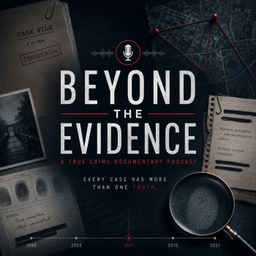
Beyond the Evidence is a true crime podcast that explores the stories behind real criminal cases, shocking investigations, and mysteries that refuse to fade.From chilling disappearances and unsolved murders to complex investigations and unexpected breakthroughs, each episode goes beyond the headlines to uncover the people, decisions, and overlooked details that shaped the case.Through immersive storytelling, careful research, and thoughtful analysis, we examine what investigators discovered, what the evidence actually reveals, and the questions that remain unanswered.Because every crime has a story. And sometimes, the truth lies beyond the evidence.
In nineteen sixty-nine, a killer who called himself the Zodiac mailed the newspapers a cipher and promised it contained his name. A schoolteacher and his wife solved it in eight days. Fifty-one years later, a second cipher that had defeated the FBI, the Navy, and the National Security Agency was finally read by three amateur codebreakers in three countries. Neither message named anyone. This episode follows the Zodiac's four ciphers, the five people he killed and the two who survived, and asks what the most famous codes in criminal history actually proved.
31 Oct 2026
It Is Finished
On the first of December, nineteen forty-eight, a man was found dead on a beach outside Adelaide, Australia. He had no wallet, no name, and the labels had been cut from his clothes. In a hidden pocket was a scrap of paper torn from a book of Persian poetry, printed with two words: Tamam Shud — it is finished. Inside the book, a code nobody has ever read. Seventy-four years later, DNA gave the man a name, Carl Webb — but the law has not confirmed it, the cause of death is still unknown, and the code is still unread. This episode asks what the evidence actually proves, and what it never will.
30 Oct 2026
The Tie He Left Behind
On the twenty-fourth of November, nineteen seventy-one, a man calling himself Dan Cooper hijacked Northwest Orient Flight 305, collected two hundred thousand dollars in ransom, and jumped out of the back of the plane into a storm over southwest Washington. He was never seen again. The only physical trail he left was a cheap clip-on tie, later found to carry more than one hundred thousand microscopic particles, and three bundles of rotting ransom money found on a riverbank nine years later. This episode follows the tie, the money, and the suspects, and asks what the evidence actually proves — and what it never will.
29 Oct 2026
Sixty-Five Years Without a Name
In February 1957, a small boy's body was found in a cardboard box in the woods of northeast Philadelphia. He was four years old, malnourished and beaten, washed and groomed after death - and no one, anywhere, had reported him missing. For sixty-five years he was known only as the Boy in the Box, America's Unknown Child. Then forensic genealogy gave him back his name: Joseph Augustus Zarelli. This episode follows the discovery, the largest investigation in Philadelphia Police history, the dead ends, and the DNA breakthrough that identified him in December 2022 - and asks what the evidence proves, and what it still cannot: who killed him. The case remains an open homicide investigation.
25 Oct 2026
He Said He Shot the Man Who Killed His Wife. The Scene Had Been Built for Police.
On August twenty ninth, nineteen ninety five, Mark Winger called emergency services from his home in Springfield, Illinois.
His wife Donnah had been brutally attacked.
A second man lay dying nearby.
Mark had the gun.
But his explanation appeared simple.
He said the stranger had been attacking Donnah with a hammer, and he had shot him to save her.
Police even knew who the stranger was.
Roger Harrington was the airport shuttle driver who had frightened Donnah only days earlier.
The case appeared almost solved before investigators left the house.
Years later, however, another woman walked into a police station.
And one piece of paper found inside Roger's car suddenly meant something very different.
22 Oct 2026
The Messages Were Fake. One Deleted Photo Wasn't.
For years, investigators believed the messages attributed to Cari Farver were evidence that she was still alive.
Then a cold case team reversed the question.
Instead of asking what Cari was saying, they asked who was actually typing.
IP addresses and device records began connecting the supposed Cari accounts to Liz Golyar.
Then investigators returned to Cari's abandoned Ford Explorer.
They had searched it before.
Twice.
On the third examination, they removed the cloth seat covers.
Underneath was blood.
Cari's blood.
And inside a micro SD card thought to be empty, forensic examiners recovered more than thirteen thousand deleted photographs.
Some of them contained details only someone close to Cari's body should have known.
The digital ghost had finally left fingerprints of its own.
19 Oct 2026
Cari Disappeared. Then Her Phone Kept Texting Everyone.
On the morning of November thirteenth, two thousand twelve, Cari Farver was alive inside the Omaha apartment of a man she had recently started dating.
Hours later, that man received an angry text from Cari ending their relationship.
Cari's mother received another message saying she had found a new job.
Her employer received a resignation.
Her Facebook account remained active.
Then came the harassment.
Dozens of phone numbers.
Dozens of email accounts.
Threats.
Vandalism.
And messages apparently coming from a woman nobody could physically find.
For years, the electronic evidence appeared to answer the most basic question in a missing-person case.
Cari must still be alive.
But investigators were asking the wrong question.
21 Sept 2026
He Said She Fell Down the Stairs. The Blood Told a More Complicated Story.
In the early hours of December ninth, two thousand one, novelist Michael Peterson called emergency services from his home in Durham, North Carolina.
His wife, Kathleen Peterson, was lying at the bottom of a narrow staircase.
Michael said she had fallen.
Investigators saw something else.
There was blood on the walls, the steps, and the floor. Kathleen had multiple scalp injuries. Prosecutors argued that she had been attacked.
A jury convicted Michael of murder.
Years later, one of the prosecution's most important forensic witnesses came under scrutiny, and the conviction was set aside.
The case was no longer only about what happened on the staircase.
It became a question about what happens when the science that helped produce a murder conviction can no longer be trusted in the same way.
12 Sept 2026
His Son's Last Video Put Him Where He Said He Wasn't
On June seventh, two thousand twenty one, prominent South Carolina attorney Alex Murdaugh called emergency services and reported finding his wife Maggie and son Paul shot to death at the family's rural estate.
He repeatedly told investigators he had not been at the dog kennels with them shortly before the murders.
Then investigators unlocked Paul's phone.
At eight forty four that night, Paul had recorded a short video of a friend's dog.
Paul never sent it.
But three voices could be heard in the background.
Paul.
Maggie.
And, according to multiple people who knew him, Alex.
The video changed the entire case.
But years after a jury convicted Alex of both murders, South Carolina's highest court overturned those convictions for an entirely different reason.
The evidence had not disappeared.
The verdict had.
14 Aug 2026
A Knife Sheath, a White Car, and the DNA That Led Police to Him
In November of twenty twenty two, University of Idaho students Madison Mogen, Kaylee Goncalves, Xana Kernodle, and Ethan Chapin were killed inside an off campus house in Moscow, Idaho.
For weeks, investigators had no publicly identified suspect. Then surveillance footage, vehicle records, phone data, and DNA recovered from a knife sheath began converging on a graduate student living just across the state line. Bryan Kohberger later pleaded guilty to four counts of first degree murder and one count of burglary and received four consecutive life sentences without parole.
The guilty plea answered the legal question of responsibility. It did not answer one of the case's most enduring questions.
Why these four people?
14 Aug 2026
He Was Found in the Snow. Two Trials Could Not Prove She Put Him There.
In January of twenty twenty two, Boston police officer John O'Keefe was found unresponsive in the snow outside another police officer's home in Canton, Massachusetts. His girlfriend, Karen Read, was eventually accused of striking him with her SUV and leaving him outside.
The prosecution pointed to a damaged taillight, vehicle evidence, witness testimony, and Read's drinking. The defense argued that the investigation itself was deeply unreliable and that O'Keefe had not been struck by Read's vehicle at all. After a first trial ended without a verdict, a second jury reached its decision in twenty twenty five.
The verdict resolved the criminal charges. But it did not answer every question surrounding how John O'Keefe died.
12 Aug 2026
The DNA Said the Man She Remembered Was Innocent
After more than ten years in prison, DNA testing excluded Ronald Cotton and matched another man, Bobbie Poole, to the crimes for which Cotton had been convicted.
But the DNA result created another question. Jennifer Thompson had sincerely and repeatedly identified Cotton. Understanding how that happened would turn their case into an important lesson about eyewitness memory, certainty, and wrongful conviction.
This is the second part of the Ronald Cotton story.
12 Aug 2026
She Was Certain She Recognized Him
In nineteen eighty four, Jennifer Thompson survived a sexual assault in Burlington, North Carolina. She deliberately studied the attacker's face, believing that remembering him might help police find the man responsible.
She later identified Ronald Cotton from photographs, a live lineup, and in court. Cotton was convicted twice. But more than a decade later, preserved biological evidence would challenge everything the case had been built upon.
This is the first part of the Ronald Cotton story.
12 Aug 2026
The DNA Said He Was Innocent. The Confession Sent Him to Prison.
In nineteen ninety six, eighteen year old Angie Dodge was found murdered in her apartment in Idaho Falls, Idaho. Investigators soon focused on Christopher Tapp, a twenty year old local man who eventually confessed after repeated questioning. But there was a serious problem. DNA recovered from the crime scene did not match him.
Tapp was convicted and spent roughly two decades behind bars. Years later, new DNA analysis and investigative genetic genealogy led investigators to Brian Dripps, a man who had lived across the street from Angie. Dripps confessed, Tapp's murder conviction was vacated, and the case became a striking example of how a confession can overwhelm evidence pointing in another direction.
This is the story of Angie Dodge, the investigation that went wrong, and the evidence that eventually forced the case to be reconsidered.
Contact Beyond the Evidence
Guest appearances
Does not typically book guests
Based on episode analysis; this does not confirm that the show is currently accepting guests.
Host of Beyond the Evidence?
Claim your podcast to manage its listing and keep your show details accurate.
Pod Engine is an independent podcast discovery and analytics service and is not affiliated with or endorsed by this podcast. Artwork and show content belong to their owners. Full legal notice.
Explore this show Podcast research with Pod Engine