- 26
- Episodes
- Weekly
- Cadence
- 2026
- First episode
About Beyond the Standard
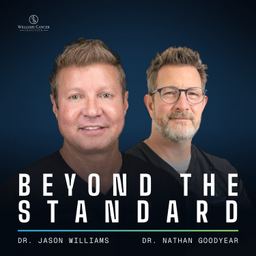
Dr. Jason Williams and Dr. Nathan Goodyear go live every week to break down the cancer research patients are actually reading about. Dr. Williams is an interventional oncologist and the founder of Williams Cancer Institute, where he treats advanced cancers by injecting immunotherapy directly into tumors. Dr. Goodyear is an integrative oncologist focused on metabolism, the microbiome, and the environment a tumor grows in. They take the week's headlines and explain what the study really found, what got left out, and what it means for someone facing a diagnosis today. Not medical advice.
- Publisher
- Williams Cancer Institute
- Category
- health & fitness
- Language
- en
- Explicit
- No
- First episode
- 26 Aug 2026
- Latest episode
- 23 Oct 2026
Latest episodes
26 episodes in the feed.
23 Oct 2026
The Truth About Ultra-Processed Foods & Cancer
Originally recorded October 23, 2026. What does a study really tell us when it finds no overall link between ultra-processed foods and colorectal cancer? This week we revisit that question and why the headline needs context. We also return to our newly released Longevity Primer, with a closer look at GLP-1 medications, tumor-directed treatment, and cellular reprogramming. We begin with the book's first installment. Dr. Goodyear walks through his chapter on Ozempic and GLP-1 drugs, comparing them with another class of diabetes medications and asking what research on metabolic and immune pathways might mean for cancer care. Dr. Williams explains why we study repurposed medicines delivered directly into tumors and how CT and ultrasound help guide injections. We also discuss access, physician training, and questions to ask oncology teams. Next, we return to experimental cellular reprogramming. Could changing a cancer cell's state eventually complement attempts to destroy it? Dr. Williams explains the concept behind reprogramming factors, why he sees a possible role after tumor burden has been reduced, and why he is careful not to overstate current human results. We separate early research from validated therapies. The second half examines a large observational study of ultra-processed foods and colorectal cancer. In the older population discussed, researchers did not find an overall association with the broad ultra-processed food category, while different foods showed different relationships. Processed meats were linked with increased risk, while foods such as whole-grain bread and yogurt were associated with lower risk. Dr. Goodyear focuses on the study's reliance on one dietary questionnaire and explains why that limitation matters when thinking about years of changing diets and risks in younger adults. From there, we unpack the NOVA food categories, discuss why processed meats stand apart from other packaged foods, and look at how diet and the gut microbiome may interact over time. We close with practical questions from viewers: what to keep in the kitchen, how to think about a child's occasional hot dog, and what we know or do not know about sweeteners. A final question on BRCA-related cancer risk brings us back to a central theme: inherited susceptibility, environment, and individual health are more complex than any one headline. What is covered 00:00 We introduce the new book and the research behind today's discussion. 00:47 We revisit the first volume of The Longevity Primer. 03:08 Dr. Goodyear examines GLP-1 drugs, Ozempic, and cancer research. 09:04 We explain repurposed drugs and tumor-directed injections. 12:17 Dr. Williams describes CT- and ultrasound-guided precision. 18:27 We discuss intratumoral care and how patients can ask about it. 28:02 We explore the promise and limits of cellular reprogramming. 36:44 We turn to a major study on processed foods and colorectal cancer. 38:03 Dr. Goodyear examines the study's design and limitations. 41:14 We explain the NOVA categories of food processing. 44:31 We discuss processed meats and colorectal cancer risk. 47:55 Dr. Williams considers the microbiome and younger patients. 51:40 We offer practical ideas for choosing more whole foods. 54:35 We answer a parent's question about occasional hot dogs. 59:48 We discuss sweeteners and the remaining uncertainties. 01:05:16 We examine BRCA-related cancer susceptibility. A weekly livestream from Williams Cancer Institute. Dr. Nathan Goodyear and Dr. Jason Williams take the cancer news dominating your feed and tell you what the underlying science supports. Dr. Williams is an interventional oncologist and the author of The Immunotherapy Revolution. Dr. Goodyear is an integrative oncologist. For educational purposes only. This is not medical advice.
16 Oct 2026
Our New Book on Cancer and Why You Need It
Originally recorded October 16, 2026. We've spent years researching cancer, immunity, and aging, and we're finally getting that work into readers' hands. In this episode, we're introducing our new book and why we're releasing it first as six short Kindle installments, with another planned every six weeks before the complete edition next spring. Our goal is simple. We want patients, families, and anyone interested in their long-term health to have access to the questions, science, and ideas that shape our work. We begin with a question every patient deserves to understand. What is cancer, and what should successful treatment look like? Dr. Jason Williams explains why eliminating a tumor is only part of the goal when treatment can also affect a person's health and quality of life. We talk about the limitations of one-size-fits-all care, the value of precision, and why we believe people should be able to understand the decisions being made about their bodies. Our first mini-book also includes material on GLP-1 medications such as Ozempic and their potential relevance to cancer and aging research. Dr. Nathan Goodyear explores the connections among metabolism, immune signaling, hormones, and the gut microbiome. We explain why we're interested in repurposed medications as part of individualized research and why emerging findings should be distinguished from established cancer treatments. We then explore cellular reprogramming and a central idea behind the book. Cancer and aging share some biological pathways, and the immune system is involved in both. Dr. Williams discusses senescent cells, the signals that surround tumors, and the possibility of changing how damaged cells behave. We look at preliminary animal research alongside the unanswered questions about safety, effectiveness, and what could eventually translate to people. The conversation also considers longer lifespans, affordability, and who might benefit from future advances. Finally, Dr. Williams shares why his mother's spinal problems made his interest in aging research personal. He describes changes he observed after an experimental approach, while acknowledging that more research is needed. We close with the reason we're publishing now. We want you to read, ask questions, and share what you learn, so patients and families can take a more informed role in their care. What is covered 00:29 We introduce the new book and the six-part Kindle release. 01:31 Dr. Williams explains why he wanted to write another cancer book. 03:34 Dr. Goodyear explains why patient education matters. 05:24 We explain why the book begins with the fundamentals of cancer. 06:28 Dr. Williams questions how treatment success should be measured. 08:51 We explain why we're releasing the material before the full book. 10:07 The first installment expands into GLP-1s and cellular reprogramming. 11:20 Dr. Goodyear discusses GLP-1 drugs and precision oncology. 14:41 We examine the shared biology of cancer and aging. 16:49 Dr. Williams compares cancer cells and senescent cells. 20:29 We discuss experimental cellular reprogramming. 25:42 We reveal the book cover and explain the viewer offer. 29:14 The doctors discuss future longevity possibilities and uncertainties. 41:39 We consider who will be able to access emerging treatments. 48:10 Dr. Williams shares his mother's experience with aging research. A weekly livestream from Williams Cancer Institute. Dr. Nathan Goodyear and Dr. Jason Williams take the cancer news dominating your feed and tell you what the underlying science supports. Dr. Williams is an interventional oncologist and the author of The Immunotherapy Revolution. Dr. Goodyear is an integrative oncologist. For educational purposes only. This is not medical advice.
2 Oct 2026
Can infections lead to cancer? | Beyond the Standard
Originally recorded October 2, 2026. Some cancers begin with infection rather than with inherited mutations or lifestyle factors alone. Dr. Jason Williams explains how viruses can insert genetic material into cells, how chronic infections can create persistent inflammation, and why pathogens such as HPV, H. pylori, hepatitis B, and Epstein-Barr virus belong in the cancer conversation. Some infection-linked cancer risks can be reduced or treated before they progress. The discussion first focuses on HPV. Dr. Williams explains how viral proteins can make an HPV-related tumor more visible to the immune system and why those cancers can behave differently from tumors without a viral component. He also discusses the role vaccines can play in prevention and describes how vaccines have been explored as immune stimulants during cancer treatment, including intratumoral approaches intended to increase immune activity at the tumor site. The conversation then turns to H. pylori, the stomach bacterium associated with chronic inflammation and certain gastric cancers. Dr. Williams explains how H. pylori can be detected, why some blood tests can be misleading after a past infection, and why treatment usually requires antibiotics. That creates a second problem because antibiotics can disrupt the gut microbiome, sometimes removing bacterial species that may not fully recover. Dr. Williams then looks at ways medicine may become more precise. He discusses bacteriophage therapy, which uses viruses that attack bacteria, as a potential strategy for targeting infections without the broad collateral damage of conventional antibiotics. He also explains why antibiotic sensitivity testing and more localized treatment may reduce unnecessary exposure. Natural compounds may sometimes support treatment, he says, but they should not be treated as substitutes for appropriate care when an infection is serious. The episode closes on prevention and timing. Dr. Williams discusses HPV and hepatitis B vaccination, H. pylori testing when symptoms warrant evaluation, and why infection-related cancers can look very different when caught early versus after they become advanced. The larger theme is that infection, immunity, inflammation, and cancer are connected. What is covered 00:10 The episode introduces the link between infection and cancer. 01:29 Dr. Williams explains how viruses can alter healthy cells and drive cancer. 02:24 Dr. Williams discusses HPV-related cancers and changing patterns in his practice. 03:20 Dr. Williams explains why HPV-related tumors can respond differently to immunotherapy. 04:18 Dr. Williams discusses why vaccines may stimulate immunity near a tumor. 06:44 Dr. Williams explains how vaccines have been studied alongside cancer treatment. 07:41 The conversation turns to H. pylori and its connection to stomach cancer. 08:30 Dr. Williams explains how H. pylori can be detected and why testing has limitations. 09:23 Dr. Williams describes why treatment can be hard on the gut microbiome. 12:41 Dr. Williams explains how antibiotics can alter some gut bacteria long term. 14:18 Dr. Williams discusses choosing antibiotics more precisely when sensitivity data are available. 15:35 Dr. Williams introduces bacteriophage therapy as a more targeted way to attack bacteria. 17:01 Dr. Williams explains why natural antibacterial approaches still require caution. 19:34 Dr. Williams compares localized infection treatment with localized cancer treatment. 21:13 Dr. Williams closes with practical prevention and screening considerations. A weekly livestream from Williams Cancer Institute. Dr. Nathan Goodyear and Dr. Jason Williams take the cancer news dominating your feed and tell you what the underlying science supports. Dr. Williams is an interventional oncologist and the author of The Immunotherapy Revolution. Dr. Goodyear is an integrative oncologist. For educational purposes only. This is not medical advice.
Contact Beyond the Standard
- Guest appearances
- Books guests
Based on episode analysis; this does not confirm that the show is currently accepting guests.
Host of Beyond the Standard?
Claim your podcast to manage its listing and keep your show details accurate.
Pod Engine is an independent podcast discovery and analytics service and is not affiliated with or endorsed by this podcast. Artwork and show content belong to their owners. Full legal notice.
Explore this show
Podcast research with Pod Engine