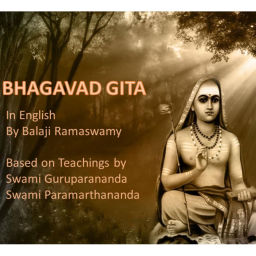
About Bhagavad Gita | Advaita Vedanta | English | Balaji Ramaswamy | vedantabalaji@gmail.com
Bhagavad Gita Explanation in English by Balaji Ramaswamy, Singapore based on the teachings of Swami Guruparananda and Swami Paramarthananda
For Any Feedback or to Attend Live Classes - WhatsApp +65-98323176
Bhagavad Gita - Class 128 - Chapter 04 Slokas 07-09 - Cause & Purpose of Avatāra & the benefit of Ishvara jnanam - Class taken on 08 Jun 2025
Chapter 04 - Jnana Karma Sannyasa YogaSloka 07 - Indicator of the Time of AvatāraWhat are the two triggers that prompt Bhagavan to take an avatāra?What does the word “sṛijāmi” indicate about the nature of Bhagavan’s avatāra?How is the avatāra of Bhagavan different from the birth of a jīva?Why can we not predict when or how Bhagavan should take an avatāra?What is the deeper meaning of the word "Dharma" in this context? Is it only about human ethics or does it include cosmic harmony?How do the verses from Mahābhārata and Mahānārāyaṇa Upaniṣad help in understanding the role of Dharma in creation?Can the concept of avatāra be limited to just human forms like Rāma or Kṛṣṇa, or does it include other forms too? What is the criterion for recognizing avatāras?How should we interpret situations when it seems that adharma is rising, but no avatāra seems to appear?Does Bhagavan take avatāra to reward devotees or to restore balance for all beings?Is the knowledge about all the avatāras important for moksha?Sloka 08 - Purpose of Avatāra - Protection of DharmaWhat is Dharma? Is it a physical object?How does Bhagavan protect Dharma?Why is protecting sādhus considered equal to protecting Dharma itself?Is destruction (vināśa) compatible with Bhagavan’s compassion? Why would He destroy anyone?Why is the destruction of the duṣkṛtās actually for their own good?What is the deeper meaning of “yuge yuge”? Does it refer to once every yuga only?How does the destruction of a physical body help a jiva in spiritual growth?What is the role of varṇāśrama dharma in the establishment of Dharma mentioned here?What is the real intent of Bhagavan’s avathāra?Why does Bhagavan emphasize the destruction of duṣkṛtās instead of their transformation?How is this sloka the answer to Arjuna’s original question in 4.4?Sloka 09 - Moksha through Jiva-Ishvara AikyamWhat kind of knowledge leads to Moksha according to this śloka?What is meant by “divyam janma” and “divyam karma” of Bhagavan?Why does Bhagavan use the word tattvataḥ to describe the kind of knowledge required?How does tattvataḥ-jñānam differ from ordinary or superficial knowledge?Why is fear of Bhagavan a sign of incomplete understanding of His true nature?What is the link between Īśvara-jñānam and Ātma-jñānam? Are they different?How does the rope-snake analogy help us understand tattvataḥ-jñānam?What does Bhagavan mean when He says, “mām eti”? Does a jiva go to a place called Ishvara?How does this śloka connect to the earlier discussion of Avatāra-tattva in verses 5 to 8?What is the difference between Jīvan Mukti and Videha Mukti as implied here?Why is punarjanma (rebirth) avoided by one who knows Bhagavan correctly?How can one know the divyam janma and karma of Bhagavan in tattva? What is the sādhana for this?
23 Oct 2026
Bhagavad Gita - Class 127 - Chapter 04 Slokas 05-06 - Avatāra Tattvaḥ & Rahasya - Class taken on 01 Jun 2025
Chapter 04 - Jnana Karma Sannyasa YogaSloka 05 - Avatāra Tattvaḥ - Secret Behind the AvatārāsWhat prompts Bhagavan to talk about his previous births in this sloka?What is the core ignorance in Arjuna’s question that Bhagavan seeks to address here?How does a teacher decide whether to answer a question directly or address the intent behind it?What does Bhagavan reveal about His own past births?What does Bhagavan say about Arjuna’s previous births?Why does Arjuna not remember his previous janmas while Bhagavan remembers all?What does this sloka tell us about the difference between a Jiva’s janma and Ishvara’s avatāra?What is meant by saying "Ishvara has no paapa-puṇya but has Samashti Karma"?How do Dharma Drishti and Karma Drishti help us understand avatāra?Why is it said that the jiva’s memory of past lives is deliberately hidden by Ishvara?Is knowing about one’s past lives spiritually helpful? Why or why not?How does this sloka help both types of people: those who deny rebirth and those obsessed with knowing their past lives?What is the key difference between a siddha purusha and an avatāra?Why can we not conclusively recognize an avatāra when He is present?How does this sloka set the stage for the next teachings on avatāra in slokas 6 to 8?Sloka 06 - Māyā Binds the Jīva; Māyā is Subservient to ĪshvaraHow does a jīva take birth?What is the key difference between jīva janma and Ishvara’s avatāra?What does Bhagavan mean when He says "ajo’pi sann" (even though I am birthless)?How does the Shastra define birth (janma)?Why does Ishvara not need to unite with matter (inert prakṛti) to be born?What is meant by "avyayātmā" — the changeless nature of Ishvara?What are the two powers of Māyā?How do Avaraṇa and Vikṣhepa Śakti operate differently on jīvas and Ishvara?Why does Māyā bind the jīva but not Bhagavan?What does Bhagavan mean when He says "prakṛitiṁ svām adhiṣhṭhāya"?What is the meaning of "ātmamāyayā sambhavāmi"?How does Bhagavan’s body manifest in an avatāra without undergoing garbhavāsa or natural birth?Why does Ishvara remain the master of Māyā, while jīva remains its slave?What is the deeper implication when Bhagavan says "I appear through My own Māyā"?Why is the avatāra process called "Rahasya" (a secret)?Can human beings definitively recognize who is an avatāra? Why or why not?How does understanding this sloka help build bhakti and śraddhā towards the Guru and Ishvara?Does one need to recognize an avatāra for moksha? Why or why not?
16 Oct 2026
Bhagavad Gita - Class 126 - Chapter 04 Slokas 01-04 - Bhagavan's Claim and Arjuna's Doubt - Class taken on 25 May 2025
Chapter 04 - Jnana Karma Sannyasa YogaSloka 01 - Ādi-Guru Bhagavān – The Original Teacher of Timeless YogaWhat is the meaning of "Jñāna Karma Sannyāsa Yōga" and how is renunciation through knowledge described?Why does Bhagavan begin by glorifying Yōga?What does Bhagavan mean when He says He taught this Yōga to Vivasvān?What are the two reasons this Yōga is considered avyaya (eternal)?How does Karma Yōga and Jñāna Yōga together form the foundation for spiritual living?How was this teaching passed from Vivasvān to Manu, and then to Ikṣvāku?What significance does the Surya Vaṁsa lineage hold in preserving spiritual teachings?What are the two paramparas mentioned in our tradition, and whom do they represent?Why is the Kṣatriya paramparā emphasized in this context?What is the broader implication of having both Brāhmaṇas and Kṣatriyas uphold Dharma?How does mentioning this ancient lineage help inspire Arjuna to receive this knowledge?Sloka 02 - The Lost Legacy of Raja Rishis: How Dharma Faded Over TimeHow was the wisdom of Karma Yōga and Jñāna Yōga preserved and transmitted in earlier times?Who were the Raja Rishis, and what qualities made them ideal preservers of this sacred knowledge?What is the deeper meaning of the terms "Raja" and "Rishi" as described by our traditional teachers?How did kings like Janaka and Ashwapati embody both worldly prosperity and spiritual insight?Why is the combination of Ishwaryam and Sukshmaartha Nireekshana Kshamatvam considered powerful in a ruler?What role did stories from Mahabharata, as narrated by Bhishma, play in preserving Dharma?What unfortunate change does Bhagavan reveal in the second half of this sloka?How did the passage of time affect the continuity of this Yōga?What societal shifts led to the gradual decline in interest toward this knowledge?What reason does Adi Shankaracharya give for the disappearance of this wisdom from mainstream life?How does sensory discipline, or the lack thereof, influence the presence or absence of higher knowledge in society?Sloka 03 - The Ancient Secret Revealed Again: Why Arjuna Was ChosenWhat is the nature of the Yōga that Bhagavan refers to as purātanaḥ — the most ancient?Why does Bhagavan say the Yōga taught to Arjuna now is the same as what was taught to Vivasvan?How does this statement highlight the eternal relevance and origin of this Yōga?What are the two divisions of the Vedas, and how do they relate to Karma Yōga and Jñāna Yōga?Why is it said that even the ṛṣīs didn’t invent this wisdom but received it through tradition?What makes this ancient knowledge rahasyam — the highest secret?Why did Bhagavan choose Arjuna as the recipient of this sacred teaching? What made Arjuna eligible?What does Arjuna's declaration in 2.7 tell us about the qualifications of a true spiritual seeker?Why is Sharanagati — the attitude of surrender — considered a higher form of Bhakti?What are the six qualities of a satmitra (true friend) described through the Hitopadeśa verse?How does Bhagavan demonstrate these six qualities in His relationship with Arjuna?Sloka 04 - Arjuna's Question on AvatāraWhat is Arjuna’s exact doubt in this sloka?Why does Arjuna find it difficult to accept that Krishna taught Surya Bhagavān at the beginning of creation?What does the word param signify in describing the birth of Surya Bhagavān?Does Arjuna disrespect Krishna while asking this question? What quality of a true disciple does he display?What is the difference between doubt (saṁśaya) and disbelief (apavāda)? Which one does Arjuna show here?How does Arjuna’s śraddhā (faith) shine through in the way he asks his question?How does this sloka highlight the subtle characteristics of a sincere seeker or bhakta?Why is it said that Arjuna lacked the knowledge of avatāra tattva at this point?How does Adi Shankaracharya interpret Arjuna’s question differently in his bhāṣhya?
Reach and audience
Public platform figures. Ratings count people who left a rating, not total listeners.
Spotify
5.0 / 5
2 ratings
Host of Bhagavad Gita | Advaita Vedanta | English | Balaji Ramaswamy | vedantabalaji@gmail.com?
Claim your podcast to manage its listing and keep your show details accurate.
Pod Engine is an independent podcast discovery and analytics service and is not affiliated with or endorsed by this podcast. Artwork and show content belong to their owners. Full legal notice.
Explore this show Podcast research with Pod Engine