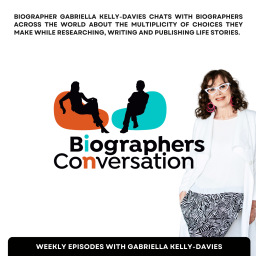
Biographer Gabriella Kelly-Davies chats with biographers across the world about the myriad of choices they make while researching, writing and publishing life stories. In every episode, she explores elements of narrative strategy such as structure, use of fiction techniques, facts and truth, beginnings and endings and to what extent the writer interpreted the evidence rather than providing clues and leaving it to readers to do the interpreting themselves. She also asks how they researched their books; how they balanced a subject’s public, personal and inner lives; and ethical issues, such as privacy and revealing secrets.
In this episode of Biographers in Conversation, Sonia Orchard chats with Dr Gabriella Kelly-Davies about Groomed.
Here’s what you’ll discover in this episode:
How Sonia’s daughter approaching the age Sonia was when the abuse occurred, prompted her to reconsider the relationship and pursue justice for herself and the next generation.
Why Sonia used the police investigation and court case as the memoir’s narrative spine, beginning with the question: ‘Had a crime been committed?’
How writing the unfolding legal process in real time without knowing its outcome created immediacy, uncertainty and suspense.
Why Sonia interwove memoir with neuroscience, psychology, cultural history and legal research, using research as both a means of understanding and a source of emotional distance.
How Sonia’s teenage diaries and adult perspective reveal competing narratives of love and abuse—and helped her reclaim her story through narrative justice.
What Groomed reveals about grooming, gaslighting and coercive control, and the cultural narratives that allow child abuse to be mistaken for romance.
Why Sonia’s search for accountability became a wider critique of a legal system that can retraumatise survivors while failing to provide recognition, care and communal healing.
How her cancer diagnosis illuminated society’s contrasting responses to physical and emotional trauma, and why she advises trauma writers to seek support, trust their instincts and write only when ready.
29 Oct 2026
A Vast Horizon: Artists and Lovers, Freedom and War
In this latest episode of Biographers in Conversation, Anna Thomasson chats with Dr Gabriella Kelly-Davies about A Vast Horizon: Artists and Lovers, Freedom and War.
Here’s what you’ll discover in this episode:
Why Anna Thomasson chose a collective biography to reveal the chemistry and interconnected lives of nine surrealists.
How a 1937 summer at the Hôtel Vaste Horizon became the book’s narrative and symbolic starting point.
What photographs reveal about historical lives and why their apparent intimacy can never yield the whole truth.
How letters, diaries, poems and artworks became ‘wormholes’ into her subjects’ experiences.
Why Anna Thomasson preserves archival silences and honours Ady Fidelin’s right to opacity rather than speculating.
How short chapters, juxtaposition and a collage of fragments sustain momentum across nine intersecting lives.
Why contradictions, omissions and self-mythologising belong inside biography instead of being smoothed into certainty.
Thomasson’s advice to biographers: set research boundaries, trust your instincts and accept that every life remains provisional.
22 Oct 2026
Black, White + Colour
In this latest episode of Biographers in Conversation, Tim Dobbyn chats with Dr Gabriella Kelly-Davies about Black, White + Colour: A Biography of Mervyn Bishop Australia's First Indigenous Professional Photographer
Here’s what you’ll discover in this episode:
Mervyn Bishop joined the Sydney Morning Herald at 17, becoming Australia’s first Indigenous press photographer and, soon after, the first Indigenous journalist on a metropolitan daily newspaper.
Tim Dobbyn’s family has known Mervyn since 1962; their friendship deepened over decades before evolving into a nine-year biography project, completed largely during pandemic lockdowns.
Dobbyn discusses the unusual position of writing about a living, close friend, using journalistic standards, corroborating witnesses and news archives to keep the account truthful rather than reverential.
Mervyn’s mother, Marjorie, was a talented amateur photographer whose influence sparked his early interest, reflecting a broader, lesser-known tradition of photography within First Nations families as a way of preserving connection.
The death of Mervyn’s wife Elizabeth on the day of his first solo exhibition profoundly altered Mervyn’s life and parenting, with Dobbyn noting she had been his crucial organising force.
Mervyn developed a distinctive ethical practice around photographing people in dire circumstances, using humour, empathy and consent to disarm subjects rather than exploit them.
Dobbyn faced years of publishing rejection as a first-time author before Ginninderra Press took on the richly illustrated book, timed serendipitously with a State Library exhibition of Mervyn’s photographs.
Who has been a guest on Biographers in Conversation
Names identified in recent episode analyses. Showing up to five guests.
Patricia Meisol
Jacqueline Kent
Robert Zaretsky
Dr Kiera Lindsey
Sally Bayley
Reach and audience
Public platform figures. Ratings count people who left a rating, not total listeners.
YouTube views
1,985
Score snapshot 15 Sept 2025
Apple Podcasts (US)
5.0 / 5
4 ratings
Spotify
4.5 / 5
2 ratings
Podcast Authority Score: 59 / 100
A composite of feed quality, social presence, YouTube performance and engagement. Read the methodology.
Quality
66
Social presence
0
YouTube
68
Engagement
60
Contact Biographers in Conversation
Guest appearances
Books guests
Based on episode analysis; this does not confirm that the show is currently accepting guests.
Pod Engine is an independent podcast discovery and analytics service and is not affiliated with or endorsed by this podcast. Artwork and show content belong to their owners. Full legal notice.
Explore this show Podcast research with Pod Engine