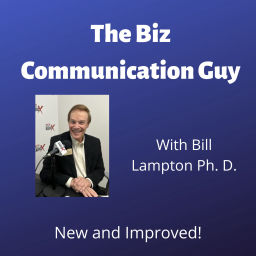
Biz Communication Guy Podcast II
Hosted by Bill Lampton · Dr. Bill Lampton Ph. D.
5.0from 3 ratings
- 44
- Episodes
- 3
- Ratings
- Bi-weekly
- Cadence
- 2023
- First episode
About Biz Communication Guy Podcast II
Every week Bill Lampton, Ph.D.–the “Biz Communication Guy”–interviews renowned communication experts about their areas of expertise. Listeners learn tips, strategies, and guidelines for sales, management, customer service, presentation skills, technology, and persuasion. Catch every lively episode, so you will jet-propel your business communication skills–and profits!
- Publisher
- Dr. Bill Lampton Ph. D.
- Category
- business · business · business
- Language
- en
- Explicit
- No
- First episode
- 22 Oct 2023
- Latest episode
- 23 Oct 2026
Latest episodes
44 episodes in the feed.
23 Oct 2026
Diana Damron’s Guidelines For Podcast And Media Guests
Bill Lampton: Hi there. Welcome to the Biz Communication Show. I’m your host, Bill Lampton, the Biz Communication Guy, hosting the Biz Communication Show for the eighth year. And I don’t just share with you my own experiences about communication. Instead, I bring on a highly qualified guest who gives us guidelines and strategies that will boost our business. Today, it’s a great privilege to welcome from Montana, Diana Damron. Diana Damron is a keynote speaker, writer, and consultant who helps organizations build their own unique cultures of trust. Diana knows firsthand that the financial, physical, mental, and emotional costs of no trust are tremendous, as she was the target in a toxic workplace. And I can stop here and say, I can relate to that, and I’m sure you can as well. Because of her experiences in a toxic workplace, Diana’s made it her mission to help organizations and their teams grow trust through the vehicle of civility, which Diana defines as the consistent communication of respect. Diana’s clients describe her as the “human whisperer” because of her success in helping them unleash civility throughout their organization, thereby growing their own unique cultures of trust. Diana’s a former television anchor. She’s the author of two books: Civility Unleashed: Using Civility to Survive and Thrive in the Workplace and The Civility Workout: Your Personal Guide to Unleashing Civility in the Workplace. So join me as we welcome Diana Damron. Hello, Diana. Diana Damron: Hello, Bill. How are you? Bill Lampton: It’s just great to have you return for a second appearance on the Biz Communication Show. And who’s counting, really, because I’m sure that I will call on you frequently with your expertise in business communication that you can share with us. Diana Damron: Oh, well, I love being here. Thank you so much for the invitation, Bill. This is just—I mean, you’re the pro, so this is just such a treat. Bill Lampton: It’s delightful to host you, as I said. And let’s get back to this business of civility and what we need to do for trust. If you can capsule for us what the problem is and how we go about solving that problem, that’ll be very helpful. Diana Damron: Well [laughter]—I think it’s a variety of problems, Bill, but let’s focus on a couple of them. I think, number one, one of the easiest things that we could re-establish is this concept of manners. You know, manners were really redefined beginning in the ’60s and ’70s, and they were kind of tossed out because we had been in an anti-establishment period. And manners were considered, certainly, a signal of an establishment as such. And so manners were kind of tossed to the side: “We really don’t need them; they’re too formal; they’re antiquated”. And yet, manners—and I’m not talking about forks, knives, and spoons. I’m talking about how we treat one another. And the best definition I ever heard of manners is from Emily Post, and it’s “the sensitive awareness of the feelings of others”. And I think that if you were to ask me what the problem these days and how to solve that problem in a quick way would be, the fact is our sensitive awareness these days seems, more often than not, on ourselves, our feelings, as opposed to the feelings of others. And that makes all the difference in the world. When we’re focused on our own feelings, you know, we’re looking almost to be offended and to have an issue. When we are looking at the other person, we’re paying attention to the other person, we’re more aware, we’re more in tune with them, we get out of ourselves, and we start looking at some way to make their life a little bit easier. Bill Lampton: I think of manners, and I think of what you just said about looking out for our own interests and being self-protecting. And yet, in doing that, we set up a barrier; we set up a distance with others. And I also want to get back to you’re saying that there were times in your career that somebody broke trust with you, and that that got you started thinking about, “How can I, Diana Damron, help people understand the need for civility and move towards it?” It brought to mind a situation—and everybody can think of them, I’m sure—but it brought to mind a situation where—I’ll speak personally—I was in higher management in education and in healthcare prior to becoming a professional speaker and communication consultant. And I remember so well, one institution hired me, and they promised me after I’d been there two or three months that there would be an automatic boost in my compensation. And guess what? That didn’t happen. And so that had been promised; it had not been carried through. And you can imagine how—and our viewers and listeners can imagine how—my morale dropped because of that. Of course, I brought it to the organization’s leader, brought it to attention, showed in writing where I’d had that. And I’ll have to admit that there was no time after that that those leaders would have credibility with me. That’s—you must have hundreds of examples like that that you’ve heard from your clients. Diana Damron: I think there’s that type of example, Bill, where something has been spelled out, and it’s very specific, and then this is something that we owe you, and then it doesn’t transpire. So the trust is really black-and-white and broken there. The lack of trust that I ran into—and it’s funny, because when I came from a television background, which is a really high-stress environment, and yet the trust in that environment of working with those men and women was never broken. Even though we were trying to—I mean, there’s yelling in a newsroom; you’re trying to get something done; you don’t have time for “please” and “thank you”; you don’t have time to, “Do you mind doing it this way?” You’re yelling. I mean, you’re very short. And yet, because we were focused on getting the story on the air, the show on the air, we had to work together. We had to communicate well. It may not have been pretty, but it was effective. I think where—and what I ran into was not in the broadcasting world; it was in a different environment—but is when you suddenly find yourself where you’re not exactly sure what is expected any longer, or where the expectations change from moment to moment, and where suddenly you feel that it’s not a cohesive team, but that we’ve now broken up into little niches and little cliques as such, and people are trying to move ahead, or that because you don’t agree 100% with the boss or with a colleague, then all of a sudden, instead of working together, trying to iron things out as I had seen in broadcasting—because believe me, directors, producers, you’ve got a lot of people there: editors, photographers, talent, the people in front of the camera, they’re not always on the same page, and they have to hammer things out. But as I said, and I worked on both coasts, so different environments, I never saw that trust broken. But when there’s a jockeying for position, when it’s almost like behind the scenes, it’s not out in the open, that’s when you begin to look around. That’s when you begin to lose that sense of trust. Bill Lampton: You, having been a television anchor, I’m sure that you, during that phase of your career, interviewed many people on camera from a great variety of backgrounds. Now, there are many of us, as we know Diana in the business and professional world, who are going to be interviewed on camera, whether it’s a podcast, such as this one, or whether it’s a television station. Many of us are going to get interviewed. And we all know when we’re going to be interviewed that, potentially, there could be people we want to influence; there also can be a large number of people. So what three or four tips would you give us who are not television people and will not be employed as TV reporters or anchors, but we’re business people and we get an invitation to a video podcast like this or even to a television station interview? What are three or four tips you would give us on how to prepare for that? Diana Damron: First of all, you’re not the star. There’s a tendency very often for people to think they’re the star because they’re being interviewed. The fact is, the host and the show are the star. You’re trying to make—as a guest, you are trying to make their job easy, which means you know your stuff. I mean, if you say you’re an expert in a certain arena, be sure that you’re prepared. Be sure that you come early. Be sure that you look like you care about making an impression, that you have enough respect for that host, the program, or the multiple hosts, to show up in—you’re presentable. Your hair, makeup, what you have on—it’s also a great opportunity if you have a brand. I mean, you’re talking about business people, Bill. So often we have brand colors. You’ll see me lots of times in red, because that’s one of my brand colors, so it’s an opportunity to connect and make people aware of your brand just by what you wear. Do your homework. In other words, there are so many ways of being interviewed these days. If you’re going onto a television interview, more often than not, it’s a short, tight interview. It’s about 1½, 3 minutes, maybe 5 minutes; it’s very short. In the world of podcasting, like you and I, Bill, have much more time here, and now we have really long-form interviews, and that generates a whole different type of atmosphere. So do your homework, know: What am I walking into? Are they going to be looking for tight answers? In news, we want something really tight, or we’re going to edit you, and we may not edit you the way that you want to be edited, unintentionally. If you’re going into a long-form interview, in an interview like here, you have an opportunity to speak a little bit more. Get a sense of the host’s personality, and again, show up on time and be prepared. And look at it as fun, an opportunity, and know that things will go wrong. And just be flexible. Lights will go out, tech will break, the host will have an issue or some kind of problem that they might be a little bit behind the schedule, so be flexible and enjoy yourself. It’s fun. Bill Lampton: I think all those are so valuable, and I go back to your bit about don’t try to be the star of the show. The television host and the station and the network possibly are the stars. And the person who tries to just take over—it’s one thing to be prepared, we both know that. You should not come in unprepared. But remembering that short time span. And of course, television has changed so much in the past two or three decades, where a person before might have been interviewed for 25 minutes. That’s just—unless it’s a national calamity or something of almost universal significance, the average interview has to be much shorter than that because you’ve got a full schedule of other items of interest to viewers and listeners. Thank you very much for those tips. And we’re going to come back in just a minute or so, and I’m going to talk with you about a particular guest that you once interviewed. She’s very much in our minds today, and I want to hear what your interview with Dolly Parton went like. Be back in just a few seconds. Announcer: Do you wish you felt confident about giving speeches? Do you want to deal with difficult people constructively? And what about becoming more persuasive in sales? Then keep listening now to Dr. Bill Lampton. He spent 20 years in management, so he knows the communication skills you need for success. I urge you to call the Biz Communication Guy today for a no-cost, but very valuable, 30-minute discussion about your communication challenges. Call now: 678-316-4300. Again, that’s 678-316-4300. Bill Lampton: Hi again. I’m Bill Lampton, the host of the Biz Communication Show, and our guest today is Diana Damron. Diana, many of us have had the opportunities to watch celebrities on television, in the movies, and other media. And practically every time we watch somebody who’s on camera and they absolutely glow and they shine and they’re so friendly and we just feel connection and camaraderie with them, but we’re probably always wondering: What is this person like in other situations, when the camera isn’t on, when the mic isn’t there, when they’re not on stage? And very recently, there has been worldwide recognition of the loss of Dolly Parton. And I know in your book that I read, you talked about interviewing her one time, so give us a picture, please, of what that was like. Diana Damron: Probably my favorite professional interview ever. You know, I had interviewed a lot of people, and as you say, Bill, they’re one person in front of the camera—many of them are one person in front of the camera, and as soon as the lights go off, as soon as the camera is off, they’re indifferent, kind of condescending, kind of self-absorbed. And it was disappointing. It’s very disappointing to see, but you begin to see it so often that you just—you know that when you walk into the interview, that could happen. However, with Dolly Parton, I was assigned years ago, when I was anchoring in Sacramento, California, to cover her. She was in Sacramento in order to be the grand marshal of a 4th of July parade, and I was sent down and I interviewed her. Now, mind you, this is Sacramento, this is July, it’s hot. It’s super hot, and a lot of people don’t like that weather. And you know Dolly, I mean, she’s always glammed up. She just had a lot—you know, lots of weight, lots of—it’s got to be a lot hotter for her, for what she was wearing and everything. She was such a delight. She was smiling the entire time, and at the end of the interview, when fun and giggly, she asked if I wanted to join her and her band for lunch, and of course I jumped on it. And this was in Old Sacramento, and there was a hamburger dive, like a bar there, that that’s where she decided to go, you know, the peanuts-on-the-floor type of place. We sat down, so there’s the band, and there’s Dolly, and there’s myself, and she was the same person throughout the entire time. There was nothing about her that said, “Look at me; I should be the center of attention; I want anything special; I want my food handed to me specially; I expect to be served right away”. There was none of that. And you know, it’s not always convenient to be eating or to be speaking with people and all of a sudden strangers come up and ask you for an autograph, and obviously that happened over and over and over again with Dolly. And she was so charming. I learned so much about just the fact of no matter what this person looked like, what they handed her to sign—it could have been kind of a damp napkin, anything, they were just so excited to get her signature—and she’d look up at them and her focus was entirely on that person. There was absolutely nothing about her that was condescending, and she just made that person feel like a million dollars. And there was nothing condescending, nothing “treat me like a queen,” and she sure was a queen. But there was nothing in her that demanded that. She just—she was Dolly. She was so special. And so, yes, I always—whether writing, and I did a tribute to her on Facebook and I think on LinkedIn after she passed away, because she made such an impression. And by the way, she was even prettier in person than on camera. Bill Lampton: I had a similar experience with an internationally known—happened to be a media mogul—during my previous career, there was a time that I hosted Charles Kuralt for the evening. And of course, Charles Kuralt, beloved for so many years by viewers, known so well for his On the Road series. And the main thing I noticed about Charles Kuralt was that when he came in, he immediately was one of us. And after meeting a few of us, he said, “I’ve got to walk out for a cigarette”. [Laughter] And so I walked out with him and we chatted. He greeted the people who were coming in for the program. When he stood to give the address that we had hired him for, nothing about him changed, and then there was a reception afterwards and I think many people stayed until midnight. It’s so refreshing. And on the contrary, I’ll tell you an interesting quip that I know of, that my brother has been a commercial airline pilot. And he said now and then a celebrity would come on and would want special treatment, and they would make that offensive statement, “Well, do you know who I am?” [Laughter] And my brother said there was one flight attendant who had to correct or instruct a celebrity passenger, and the passenger looked and said, “Do you know who I am?” And so the flight attendant went on the microphone and spoke to the entire passenger group and said, “I wonder if somebody can help us. We have somebody up here who doesn’t know who she is”. [Laughter] And that is—that is well— Diana Damron: That’s great! That is marvelous! I love that. Bill Lampton: Well-deserved feedback. Before we end this dynamic discussion—and it always is, I could call you “Dynamic Diana,” and I will—before we end it, all of us who are in the communication business have had some people along the way who we have relied on as role models, some we hired as coaches, some we have had as long-time mentors. And it doesn’t matter if we know the names you would mention, but are there two or three people who have been especially influential in your early television career, and in your professional speaking, and your writing career? Diana Damron: To start off with, yes, my mom and dad. Bill Lampton: God bless them. Diana Damron: My dad was an engineer; my mom was an actress. So, you know, you have these two sides. And my mother, who had gone to the American Academy of Dramatic Arts—she had graduated from there before she went on stage—and she said one of the lessons that they really tried to drill into them was the importance of listening. And that was such an important skill. And I would see both with my dad and with her—I’m an only child, but I’d have friends who would come and they would spend—it was kind of like I was an afterthought, but they wanted to spend time with my mom and dad because my mom and dad would listen to them. And obviously, you’ve got an actress, you’ve got an engineer, they have totally different approaches, but they cared about that person and they spent the time, again, making them the star, listening to them. So I would say that they’re my primary mentors. I had a wonderful opportunity: I went up to New York to compete in a national modeling competition and started off doing some modeling, and it was not for me. [Laughter] It was a world that was just not for me. And I ended up working with a woman by the name of Dorothy Sarnoff, who at the time was considered the premiere speech coach in the country. And executives would go and talk to them, and then send their wives to talk to them—and this is at a time where so many the executives were men, not nearly so blended with men and women as today. But she gave me so many exercises, so much understanding of the power of our voice and the importance of our voice as an instrument. And I don’t think we realize that, and we miss so many opportunities, and we create problems for ourselves, and we create opportunities when we understand the power of the voice. Bill Lampton: One of the phrases that I came up with a while back, Diana, to echo what you’re saying, and I use it quite often: We know many people who think that you network your way to the top or you speak your way to the top, and those do play a part. But I often say, and I often post, “Listen your way to the top”. And it brings me back to something that Larry King said. Larry King hosted over 7,000 shows, and Larry King said that the best advice that he could give was that let the guest be the one who does the most talking. And it’s fascinating how great listeners—and I remember my father, you mentioned your parents, I remember my father was incredibly keen on listening, and so I thank you for that. Diana, this has been so fascinating. We’ve got, let’s say, a minute and a half or so. How would you pull together what you’d like to leave with our podcast viewers and listeners? Diana Damron: You know, Bill, I have found that if I have a goal of leaving a person in a better place than where I found them, I have found that’s made such a difference in their lives, which in turn affects my life. So, and I learned this on a trip that was supposed to take two days, and it was a flight that took five days. And it was one thing right after another, and I’ve got a short temper [laughter], I’m kind of an impatient person, and I started thinking about that, and that just changes behavior and that changes your experience and it helps so much that other person. Bill Lampton: That delay certainly did test your patience, I’m sure. Please give us your contact information. I know there are those who would like to follow up with you. Diana Damron: Absolutely. Obviously, I have a website, dianadamron.com. And I’m new to the YouTube world. It’s kind of like television, except that I don’t have my producer, director, and I’m having to figure it out all by myself, and the tech is interesting. So I would love to ask your viewers to join me over at YouTube. It’s Diana Damron over there, and it’s “Stand Out, Speak Up, and Step Into Your Brilliant Self”. Thank you so much, Bill, for giving me that opportunity to share that information. Bill Lampton: I will be checking in on that and subscribing myself. Diana Damron: Thank you! Bill Lampton: Thank you for your contact information. I want to share mine as well, starting in fact with my YouTube channel, which is Bill Lampton, Ph.D. I noticed recently, Diana, that while you were on television all these years, I’ve been on YouTube; I started in 2007. Now, I do not want people to look at those early YouTube videos. [Laughter] So I encourage you to subscribe to my YouTube channel, and you will find that every episode of the Biz Communication Show is on there, which means, of course, that you have many tips and strategies on communication from experts and leaders that I have been privileged to be with. So I encourage you to subscribe. And my website, since my tagline is Biz Communication Guy, my website is bizcommunicationguy.com. And while you’re on the website, you can subscribe to my podcast, which I encourage you to do. Also would welcome phone calls from those of you who want to expand your expertise in communication: initial call, just a conversation with no investment on your part, and that number is 678-316-4300. I don’t want to close without giving attention and credit to my longtime mentor, Mike Stewart. Mike and I began working together in 1996, when all this stuff about the internet was new. And Mike Stewart, based in Nashville, has kept up and stayed ahead of every item that you and I can benefit from. And his website: localinternetpresence.com. Diana Damron, again, it has been such a privilege to host you— Diana Damron: Thank you, Bill. This has been wonderful. Thank you. Bill Lampton: Thank you so much for sharing your communication expertise, and we look forward to when you’re going to be with us again. So keep that calendar handy, please. Diana Damron: Thank you! Thank you so much! Bill Lampton: Have a good day, and we invite those of you who have benefited from this show to be with us next week for another edition of the Biz Communication Show. I’m your host, Bill Lampton, the Biz Communication Guy.
15 Sept 2026
Internet and Marketing Pioneer Mike Stewart Shares Strategies
Bill Lampton: Hi there, welcome to The Biz Communication Show. I’m your host, Bill Lampton, the Biz Communication Guy, in our eighth year of hosting The Biz Communication Show. It’s not just my communication tips and strategies that I share with you, but I bring on expert guests who will give us their tips and strategies. And today, coming to us from Nashville, Tennessee, Mike Stewart. Mike and I met at the Georgia Chapter of the National Speakers Association in 1996, and I’ve been a client of his marketing and internet skills ever since. Mike is a songwriter, publisher, and film composer who has played on hit records as a session musician, owned a successful recording studio, played keyboards, guitar, and bass, and written music all his adult life. In fact, he’s a full-time music biz songwriter. I guess we’ll have to say that Mike got a lot of talent that I didn’t music-wise. In 1996, Mike Stewart discovered the power of audio and video marketing with the internet and proceeded to become known worldwide as the “Internet Audio and Video Guy,” making success selling trainings, music, and production hardware. And there’s so much more I could say about him, but I will say that he’s helped many hundreds of clients, including me, learn tools like YouTube, blogging, Facebook, PPC, podcasting, and a whole lot more. Mike’s own statement about his service is: “I want to help those willing to have an open mind about the music biz internet that I passionately love and embrace.” So it’s both a personal and professional privilege to welcome Mike Stewart to The Biz Communication Show. Hello, Mike. Mike Stewart: Hello, Bill. It’s an honor always, and I just want to deliver some good information that’ll help your audience. Bill Lampton: I know that you do that, and you’ve been doing it since the late mid or middle 1990s when I met you. And you’ve done that globally. I’ve been the beneficiary of your marketing and internet strategies. One major question I believe that people would want to have you respond to: let’s take a business professional who wants to market his or her services and do it via the internet, because that’s the way we are going to get to the most people and do it effectively. What would you say are some of the major guidelines and tips? What do you say to a client who comes to you and tells you, “Mike, I need to get a much wider audience, and I need to get more clients, and I need to get more income, and I’ve heard you’re the guy who can do that.” So, what are the next steps, Mike? Mike Stewart: Well, I think one of the things that a lot of people get confused about the internet and the principles of the internet is they don’t break it down into the really bottom-line basics. There’s two things that marketers know matter, and it’s called traffic and conversion. You’d be surprised how many people are confused by those two terms, but traffic is the people, your targeted audience, finding you. If somebody finds you and they’re not interested in you, that’s still traffic. But what you want is targeted traffic—people who would have an interest in the services and products that you provide that solve problems for them. And then conversion is when they find content that you’ve created, whether it be a website, a website page, or what I’m an advocate of: blogging and podcasting. Because what do those pieces of content do? They build relationships that prove to people that you’re the authority and that you have the solution to their problem. So, you have to learn to get traffic, and you have to learn to make conversion information. What is conversion information? That’s somebody that watches, listens, reads something from you, and then they’re convinced beyond a shadow of a doubt that you have a product or service that will solve their problem. If that ever doesn’t get connected, I call it cognitive dissonance. They don’t understand why they need you, so they don’t want you. And you’ve got to dumb it down and make it so simple. A lot of websites out there talk about themselves, but they don’t talk about what’s in it for the end user. So you always have to think about your marketing: “What problems do I solve, and what’s in it for my customer if they hire me?” And so, there’s only three ways to get found or three ways to get traffic. I call it get found on the internet—that’s traffic. In fact, I love the story: my friend Ray Stevens up here in Nashville, he was the inspiration why I moved to Nashville, he said, “Mike, why in God’s name would I put my music on YouTube?” And I said, “Ray, for traffic.” And he says, “Oh, I don’t want traffic. Have you ever driven around here?” And I said, “No, Ray, it’s not cars on the highway. It’s people on the internet who find your content and respond to it.” And he went, “Oh.” And then, of course, after my consulting, he built a whole new audience on YouTube with videos that people watched all over the world and listened to music that he would have never gotten on radio in the past. So, traffic and conversion. The only three ways to get traffic: number one way is earn it with great content, content that people want to see and hear. Bill Lampton: I’ve heard, Mike, that maybe the saying is pretty widespread: “Content is king.” Mike Stewart: That was a kind of a saying right early on in the internet that if your content is not king-worthy, then nobody cares. Content is king, but poor content is not king. Lots of times—and I look at hundreds of websites over the year—they’re all about, “We’re number one.” Especially in the local service businesses, but independent entrepreneurs, small local businesses, consultants, lawyers—it doesn’t matter what your business is. If it’s all about you—”I’m number one, I’m the best, voted best in the county”—people go, “Whoop-dee-doo, can you fix my problem?” And lots of times when websites use stock photos—it should be you. People want to build a relationship of know, like, and trust with you. So I’ve been an advocate for years that when people find you, they have the opportunity to hear you, meet you, see you in a video format. That builds a relationship. I don’t know how many times I’ve heard people say, “I met you on your website.” There’s no way to meet me on my website unless I’m willing to talk to a webcam. It used to be difficult. I went through video cameras to webcams, to iPads. Now an iPhone or an Android or a webcam makes television. In fact, the television quality of the webcams today are broadcast on news channels. When you see a news channel today interview somebody, they’re on the same exact equipment you and I are on right now. Bill Lampton: Yes, I just recently found out that there was a place here in town where I could dispose of video and audio equipment that was not useful any longer. It was amazing to me when I went through my closet, my office, and even downstairs. I took a couple of bags of items out there. At the time, they were it; that was what we had to have. Of course, where we’re very fortunate is that that equipment has become far better, and it’s much more cost-effective, and there are people like you who can train us on how to use it. I’d like to go back to something that you said a couple of minutes ago about visibility and about problem-solving. I know that you’re familiar with the National Speakers Association, and you’re probably familiar with Lois Creamer. Lois has been a consultant for the National Speakers Association for as long as I can remember, and I became a member in 1996. Lois has pretty well echoed what you just said: that our features may be nice, our photos, stock photos, or whatever, but what people really want to know is what problems can you solve. I go back, Mike, to the first time I got a website—and this was before I knew you, I believe. I went to someone who was a veteran speaker and had lunch with him, and I took along my outline of what my website was going to say. He looked at me, and he said, “Well, this is all as good, but it’s all about you. What will people benefit from? What will they get? How will they change? How will they improve? How will they make more money?” And so, the term I keep hearing, and I keep making my own effort to target, is not features, but benefits. That’s what people really want, and you’ve already alluded to that. It’s not, “Yes, you could have all the credentials and initials after your name and everything else, but if you can’t help me, I’m not going to hire you.” And that’s pretty well underscoring what you’re saying, right? Mike Stewart: Absolutely. My whole life, when I created something for sale to make a profit, I always talked about—there’s a gentleman who I spoke on his stages as a speaker, and he is an expert at what’s called direct response marketing. I’ll mention his name, because people, if you don’t know him, you should research him. His name is Dan Kennedy. Bill Lampton: Oh yes, oh yes. Mike Stewart: Dan is all about—there’s agencies, there’s advertising entities that will tell small people, “You need to build your brand.” But Dan says, “You don’t have enough money to be a brand.” What is a brand? A brand is repetition of a marketing message that doesn’t ask for a direct response, but it lets people, when they hear that brand name, associate your business with it. It’s an image. Dan says small businesses, independent entrepreneurs—to become a brand is so expensive in repetition of advertising that you can’t afford it. What you need is enough people to find you and respond to the solutions to their problems. Website designers, digital marketing agencies—they’re probably not going to like this information, and quite honestly, I don’t care if they don’t like it. They build branding websites for people because they think that’s what they need. What they need is to address the problems of their market or their customers and assure them through a lot of different ways that they’re the best solution to the problem. You’ve got to remember, when we started, the internet was just Yahoo and Bing—not Bing, Google didn’t even exist when I started. Bill Lampton: Yes. Mike Stewart: Yahoo was kind of like the equivalent of the Yellow Pages back when I was a kid. You think about it. Let’s take a problem: your toilet is leaking. What did Mom and Dad do? They went and got the Yellow Pages, looked in the P’s under plumbers, and they generally called the first one. I knew people that used to name their business AAA Plumbing. You know why? To be the first plumber in the Yellow Pages. And then they’d get a phone call, and if they called and somebody says, “Hey, we’re so slammed with business, we can’t see you till next week.” “Well, my toilet has a problem right now. I need it fixed right now.” So you’d just go down the list till you finally got somebody who’d come out and fix the problem. And if they did a great job, sometimes they became a customer for life. That was the way you did it back in the old days. Now, people didn’t go to the Yellow Pages and go, “Who is a communication expert?” Because you have to educate your market why they need you. The internet was primitive in the ’90s; it came to fruition through e-commerce. In the ’90s, Jeff Bezos said, “I want to build the world’s largest bookstore.” And he was going to name it Abracadabra.com. Bill Lampton: Was he really? I didn’t know that. Mike Stewart: Yes. A friend of mine said success leaves traces. I love reading about successful people and what they did. He was driving across America with his wife at the time, moving to Seattle, and he wanted to start an online bookstore. He thought the domain name Abracadabra—the book will show up at your house like magic. His lawyer said, “Sounds like cadaver. That’s a terrible name.” This will kind of give an illustration about branding. He turns to his wife and says, “You know what the biggest river in the world is? The Amazon. I want to be the biggest bookstore in the world.” That was his first goal. And he said, “So, I’m going to name it Amazon.” Bill Lampton: Well, you just clued me and our viewers and listeners into something that I’ve been wondering about for quite a while: why was the name chosen Amazon? I thank you for that, and our viewers and listeners thank you for that. You solved the puzzle. Mike Stewart: Okay. So now, if you think about it, when you and I were in school, if I said, “Do you know anything about Amazon?” you would have said, “It’s the world’s biggest river. It’s in South America, in the rainforest.” That’s what Amazon was: the Amazon rainforest. If you ask a Gen Z-er or a millennial, “What’s Amazon?” “Oh, it’s an online store where you can get anything in the world delivered overnight.” He built a brand from repetition. He made an unrelated word be associated with something that it originally wasn’t. I can give you another great example. When I was in school, Liberty was Patrick—you’re an educator, my history’s—the guy who said, “Give me liberty or give me death.” Bill Lampton: Patrick Henry. Mike Stewart: Patrick Henry. That’s what Liberty meant to me. When somebody said, “Do you know anything about Liberty?” Well, if you Google Liberty right now, it’s an insurance company. They have rebranded words through the repetition advertising. You don’t have the resources to do that. You have to get targeted traffic and convert them. Here’s what’s happened that is so exciting today, and one of the things that I’m studying, and it keeps me going: I’m supposed to be retired. Well, let me tell you something: nowhere in the Bible does it say you need to be retired. Retirement to me is if I hate it, I can say no; if I love it, it’s not work. In fact, I talk on baby boomer side hustles these days. What is a baby boomer side hustle? When I was a kid, we used to call it a part-time job. Younger people call it a side hustle. A baby boomer side hustle keeps you in air conditioning, out of the heat and out of the cold, and you don’t have to lift anything heavy, and you don’t have to stand on your feet. Bill Lampton: Sounds pretty good to me. Mike Stewart: You’d be surprised how many baby boomers I have met driving Uber. Why do they drive Uber? I had a guy one time say, “You know, I don’t really need the money, but I just want something to do.” And he says, “Every time the wife wants to take a cruise, I drive for 10 days, make enough money for the cruise, turn it off, and we go on the cruise.” That’s a baby boomer hustle. That’s really anybody’s hustle, if you want to know the truth. Bill Lampton: And let’s face it, Mike, in doing that, they’re solving somebody’s problem. They’re solving the problem of somebody who wants to get somewhere, but maybe doesn’t have a car, or possibly they have a physical limitation and can’t drive anymore. So this gets back to our start of the conversation: that the Uber people are solving problems. Mike Stewart: Right, and they’re generating income from an app. Here’s my problem: I don’t want to park at the airport. I fly playing music all over America. Got a flight this Friday, I’m flying to LA. When my personal Uber driver, my wife Susan, is out of town doing something, I can book Uber to take me to the airport cheaper than I can park at the airport all week. So my problem is I don’t want to park my car at the airport for $25 a day. I’d rather give some entrepreneur the ability to drive me to the airport, drop me off, and he makes 20, 25 bucks. And if I’m gone 5 days, I’m saving money. Bill Lampton: And you also did not have to fight the traffic, and you did not have to try to find a parking place, which at any airport, especially the Atlanta or the Nashville airport or any major city, is tough. Mike, I’m going to ask you about the impact of AI. We do need to know that. We’ll be back right after this message. Voiceover: Do you wish you felt confident about giving speeches? Do you want to deal with difficult people constructively? And what about becoming more persuasive in sales? Then keep listening now to Dr. Bill Lampton. He spent 20 years in management, so he knows the communication skills you need for success. I urge you to call the Biz Communication Guy today for a no-cost but very valuable 30-minute discussion about your communication challenges. Call now: 678-316-4300. Again, that’s 678-316-4300. Bill Lampton: We’re with Mike Stewart on The Biz Communication Show. Mike, a few years back, if somebody had told me about artificial intelligence, I probably would whimsically say that I knew some people who exhibited artificial intelligence. But I can’t say that now. It has become—very much I would go back to when I met you in 1996, and there were certain things if you were going to succeed in business you had to learn. And you, Mike Stewart, had the vision and the talent and the dedication to learn those things, and to help those of us who hadn’t seen the vision and didn’t know how to use it. So let’s talk about artificial intelligence. In what ways can it be beneficial for the business person who wants more business, get the message across more, and increase profits? Mike Stewart: Well, there’s so many aspects of the technology, and I don’t understand the technical side of it, how it works. I do understand that because of the speed of computations, and the fact that it is a protocol of code that can rewrite itself and can learn from user’s input—so they call them modeling languages. A lot of people are concerned about AI taking over the world. Hopefully, they can put preemptive protocols into the software. What AI will do when you learn the art of the prompt: how to talk as a human being to the code to get the results you want. And now there are phenomenal systems in place, and learning the systems that improve your business. The number one AI tool I started using because I’m in an audio world is the ability to transfer a script, a written document, into my voice. That’s done with an AI program called ElevenLabs. The world is using ElevenLabs. In fact, I heard your voiceover guy on your commercial. I could have put that script in ElevenLabs and it spit out my voice saying it in seconds. AI tools are continually combining systems. Right now, there’s a new tool that I’m looking at called GoHighLevel. GoHighLevel has multiple abilities to write content based on your input: the better your prompt, the better your output. It has the ability to build websites based on—it can design logos, it can create video, it can create a virtual attendant that answers the phone and can take orders and answer questions, and it just basically can speed up the whole process. In fact, Nashville, I’m here in a songwriting town, and there’s an AI program called Suno.ai. Most of the AI programs are .ai, not .com. And I’m using Suno to write jingles for businesses. I can sing a melody and lyrics into Suno, and it spits out a master recording. Bill Lampton: Tell us, Mike, those URLs, how do we find these? Mike Stewart: I’ll tell you what, let me go to Google here and let me pull them up on the screen so people have a visual as I talk about them. Bill Lampton: Excellent. Mike Stewart: Here we go. I’m going to put that up on the—I’m sharing my screen, but I don’t know that people are seeing it. There we go. All right, well, there’s the email from Bill saying I’ve got to join StreamYard. Every technology is adding AI. For instance, I don’t know if StreamYard’s doing it yet, but there’s a lot of note-taking AI programs that can listen to your script and turn it into amazing summaries and outlines. The whole thing about AI is it speeds up the process and it automates a lot of things. The number one AI thing that I use is Gemini. Gemini, I can go in and say, “Write a bio on Dr. Bill Lampton of Biz Communication Guy.” And in 15 seconds, it searches everything that exists online, and there you go. I’ve got two different bios to look at. Bill Lampton: It’s amazing. I have—and I imagine some other professionals have done this—I’ve used AI to find out what the description of me online was, and it’s educational. Are they seeing your product, your service like you want it seen? It’s great. And as you’re saying, Mike, how would you like to be an encyclopedia salesman these days? Mike Stewart: AI listens to everything, and hence why writing blogs—AI learns from the information out there. If there’s negative information out there or incorrect information, it’s not smart enough to know the difference between the truth and reality. That’s why I tell my clients blogging and podcasting with your information is going to teach Gemini, Claude—there’s four platforms that are huge: Gemini, Claude, ChatGPT, and Elon Musk’s Grok. At the end of the day, they’re all moving at lightning speed. But anyway, Gemini is my first AI tool that I use on a regular basis. Bill Lampton: That’s spelled G-E-M-I-N-I, right? Mike Stewart: It’s Google’s Gemini. If I take a script like—here’s a script I did for my wife’s blog. It’s great to just—well, here’s another one. This is the prompt that I use: “Write an article based on what somebody should know in the voice of the person, the client, and their location.” And it spits out a script, and it’s amazing how accurate it is, because Gemini is learning what I need and gets better at it. Bill Lampton: Okay, I’m making a note to go to Gemini myself, because I’ve used ChatGPT, Perplexity, and some others, but I haven’t used Gemini. Mike Stewart: Gemini is a Google product. You can actually go to ChatGPT and say, “Compare all the platforms,” and it’ll tell you the benefits and the features of each. ElevenLabs.io is what the world is using to take scripts, and I go into the studio for my clients. Like, this is the ones I did yesterday, and I just upload the Word document. I don’t know if you can hear this, but I sample the client’s voice. This is Kelly McHugh. (Audio sample plays briefly) That’s her voice. We’re producing her podcast purely without her doing anything. So anyway, I use ElevenLabs. The other one I do is Suno. A lot of these accounts will give you three trials so you can understand how it works. Bill Lampton: What’s the spelling on that one, Mike? Mike Stewart: S-U-N-O.com, or .ai. Bill Lampton: Thank you. Mike Stewart: For instance, if I wanted to write a song, I could go in here and I could sing into it, which I’m not going to do right now, but I’m going to say: “Bill Lampton is my friend. Wanna learn communication, learn from him. That’s Bill Lampton, the Communication Guy.” Okay, I’ve spent 10 seconds on lyrics. I’m going to let the AI discover what it thinks is a good idea to make that piece of music. Now, you have the ability to tell it exactly what you want. That’s the power of AI. And I have been helping businesses create jingles for their business. So let’s see. (AI music plays briefly) Now, I didn’t like the prompt, so I’m going to change it prompt-wise. See, you never let AI think on its own; you have to prompt it. So I’m going to create what’s called a redo. And I’m going to keep the lyrics, but I’m going to go in here and I’m going to say style: I don’t want that style. What kind of music do you like, Bill? Bill Lampton: Country. Mike Stewart: Country, rock, husky male vocal. What instruments do you like? Bill Lampton: Piano. Mike Stewart: Piano, fills, and a fiddle, what the heck. Bill Lampton: I know you took piano for 13 years, you told me. Mike Stewart: So AI can create music. Video, it can create amazing content. (AI music plays briefly) Could you hear that? Bill Lampton: No, I didn’t. And I tell you, Mike, I know you told me you got another appointment coming up. Time flies so quickly when I host you on The Biz Communication Show, and I know that there are people who want to get in contact with you. So please give us your contact information. Mike Stewart: Well, since I help you produce your podcast, I’ll edit in those audios so people can hear them, and I’ll send them to you so you can have a laugh. Let me tell you the opportunities that have been a blessing to me, and if you want to know more information, I’ve got a lot of information that you can look at your leisure. I discovered probably in 2010 that the biggest underserved market with what I do, which is helping small businesses get traffic and conversion, was that local service business: like lawyers, like roofers. A service business is something that pretty much their local community is who they serve. A franchise is a local business that’s been replicated in other markets. But there’s a lot of small businesses that aren’t franchises. The local business is just the low-hanging fruit who spends money on the internet and gets poor results for whatever reason. So I started selling local business services to help them improve their presence. Meaning a local internet presence is people in your local market finding you. That business has served me well for many, many years. We did it in the pest control vertical; I still have Gainesville, Georgia customers. Because of the AI tools, what I learned to do manually and at an expense, AI has made it free almost. And I am teaching and helping small businesses at LocalInternetPresence.com. Bill Lampton: In fact, Mike, I have that on the screen now: LocalInternetPresence.com. Mike Stewart: Yes, in fact, if you were to type the words “local internet presence” in Google, I’m the number one website in the world. And why is that? Because nobody knows they need this. I have been doing interviews and sharing this concept, and every bit of it is for free archived at LocalInternetPresence.com. So if you have a curiosity of what I’m doing, I invite you to go there and look at all the free information. And actually, I book a one-hour consult when people really have an interest. So I offer that to your audience if they want to connect with me. I’m very grateful that so many people have really resonated with this, and I’m just looking for that person, whether you’re a baby boomer or you’re—I’ve actually had people who just graduated from college and they want to build their own business. They learned to do something they’re passionate about, and the job market is fickle. Sometimes they come out with an education and they can’t get a job. Well, I’ve never had a job. I’ve always started businesses. You’ll laugh at this: I’ve never written a resume in my life. Bill Lampton: You are an incredible pioneer, no doubt about it. Mike Stewart: I wouldn’t know how to go on a job interview if my life depended on it, but I tell you what, I have been interviewed by customers for years, and my passion is making sure that customer is confident I can solve their problem. Bill Lampton: Mike, I think that’s a great note to wind up on. You work directly with customers, you help people build businesses, you help them take what they have in the way of services or products and you help them have the right language. But even more importantly, you take these ever-changing, somewhat complex internet opportunities we have, and you teach them how to use them and you help them. That’s a great value. As you know, and as people who have heard me interview you before know, I have relied on you so heavily for decades, and I will continue to do it. So Mike, the contact information for you is at LocalInternetPresence.com, correct? Mike Stewart: If you go there, you can get in touch with me, that’s guaranteed. Bill Lampton: Okay, and I’ll mention my website: BizCommunicationGuy.com. And also my YouTube channel, Bill Lampton, Ph.D. There you will find all the previous segments of The Biz Communication Show. If you would like a phone call at no obligation: 678-316-4300. Mike, before we sign off, any closing word from you? Mike Stewart: You know, if you love what you do, you never work a day in your life. Bill Lampton: It’s an old saying, and it’s true. Mike Stewart: And one of the things that broke my heart is I see people my age standing on their feet all day at fast food. I’ve got to tell you a funny true story. There was a fellow in Georgia who became a Walmart greeter. Walmart greeters are usually baby boomers who are bored. And so, you know Highway 400 like I do in Atlanta. Sometimes it can be a mess. And the gentleman was late, 15 minutes late for his Walmart greeter job that he didn’t need the money, he just wanted something to do, and he enjoyed talking to people. But he’s on his feet all day, and he was 15 minutes late. So some young manager came up to him and he said, “You’re late.” He says, “I tried to call to let you know that I left in plenty of time, but 400 was a parking lot. I’m sorry, I didn’t mean to be, but I did call and nobody answers.” He said, “I’d like to know at your previous job, if you were late, what did your administrator say to you?” “Can I get you another cup of coffee, General?” You never know who that person is, but I can’t stand on my feet all day. My knees are too shot. And most people who are baby boomers and are retired, some of them need extra money, and some of them don’t. They just want to have a reason to get up in the morning. I mean, I look at you. You’re still constantly trying to learn things, and you’re trying to live life. Bill Lampton: It makes life interesting, Mike. It makes it interesting. Mike Stewart: So I encourage young people to learn all you can, respect your elders. One of the comments on a previous podcast I did, they said, “You know what? That old fellow had a lot of gems that I didn’t know.” Guess what? Our whole generation, Bill, has a lot of gems that young people and our peers don’t know. And the right thing to do is share what you know to make it a better world. That’s what I want to leave you with. Bill Lampton: Wonderful way to sign it off. Thank you so much, Mike Stewart, a man of many talents and a man who wants to help us maximize our own talents, expand our knowledge, build our business, and enjoy life more. Mike, it’s such a privilege to have you here. And many thanks to those of you who joined us on video and on the audio portion. We invite you to be with us again next week for another version of The Biz Communication Show. I’m your host, Bill Lampton, the Biz Communication Guy.
30 Aug 2026
Dr. Bev Smallwood Gives Solutions to The Comparison Trap
Host Bill Lampton interviews psychologist Dr. Beverly Smallwood about navigating the comparison trap and finding self-worth.
Who has been a guest on Biz Communication Guy Podcast II
Names identified in recent episode analyses. Showing up to five guests.
- Dr Beverly Smallwood
- Terry Brock
- John Ray
- Keith Nabb
- Gina Carr
Reach and audience
Public platform figures. Ratings count people who left a rating, not total listeners.
- Apple Podcasts (US)
- 5.0 / 5
- 3 ratings
Podcast Authority Score: 33 / 100
A composite of feed quality, social presence, YouTube performance and engagement. Read the methodology.
- Quality
- 43
- Social presence
- 0
- YouTube
- 0
- Engagement
- 60
Contact Biz Communication Guy Podcast II
- Guest appearances
- Books guests
Based on episode analysis; this does not confirm that the show is currently accepting guests.
Questions about Biz Communication Guy Podcast II
Who hosts Biz Communication Guy Podcast II?
Bill Lampton host the show. Published by Dr. Bill Lampton Ph. D..
How often do new episodes come out?
The show publishes bi-weekly, based on its RSS feed.
Does Biz Communication Guy Podcast II take guests?
Yes. Guests have been identified in episode analyses.
Host of Biz Communication Guy Podcast II?
Claim your podcast to manage its listing and keep your show details accurate.
Pod Engine is an independent podcast discovery and analytics service and is not affiliated with or endorsed by this podcast. Artwork and show content belong to their owners. Full legal notice.
Explore this show
Podcast research with Pod Engine