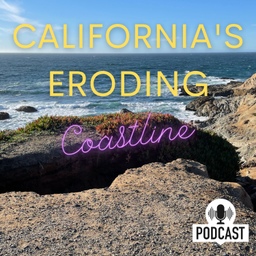
Podcast thumbnail for California's Eroding Coastline

California's Eroding Coastline

Claim This Podcast

by Alison Maas

7 episodes
Updated Daily
Accepts GuestsHas SponsorsLocation 🇺🇸

Podcast Overview

On this podcast series "California's Eroding Coastline," UC Davis Literature PhD Candidate Alison Maas explores California's coastal erosion crisis. In each episode, Alison interviews a different scholar, practitioner, or ocean enthusiast currently studying coastal issues to paint a larger portrait of the different perspectives/approaches to coastal erosion and our planetary climate crisis. Join as we ponder—with some love, a lot of passion, and ongoing concern—what it means to live with/on California’s eroding coastline. Thank you to the Bilinski foundation and the Bilinski fellowship at Bodega Bay Marine Lab for the funding that made this series possible.

Language

🇺🇲

Publishing Since

4/4/2022

1 verified contact email on file for California's Eroding Coastline

Pitch yourself as a guest, propose sponsorships, or reach out directly to the host.

Recent Episodes

Episode thumbnail for 7. “All Things California Coastal Erosion” with Dr. Gary Griggs

April 4, 2022

7. “All Things California Coastal Erosion” with Dr. Gary Griggs

On this final episode, I talk with Dr. Gary Griggs. A foremost figure in research and policy on California’s coastal erosion crisis, Dr. Griggs discusses with me all things California coastal erosion. We discuss what has exacerbated the current coastal erosion crisis, what is being done to address it, what has worked and what has failed, and where we go from here. Linked below are select texts from Dr. Griggs’ capacious body of work on the subject and provide a wonderful jumping off point to learning about our coastal crisis. Dr. Griggs is Distinguished Professor of Earth Sciences at UC Santa Cruz. His research is focused on the coastal zone and ranges from coastal evolution and development, through shoreline processes, coastal hazards and coastal engineering, and sea level rise. Recent research projects have focused on documenting and understanding coastal erosion processes including temporal and spatial variations in rates of retreat; evaluating the effectiveness of coastal protection structures and the impacts of coastal engineering projects (seawalls, jetties, breakwaters) on coastal processes and beaches; evaluating beach processes and quantifying littoral cell budgets and human impacts on these budgets; impacts of extreme events such as El Ninos) on coastlines; the impacts of sea level rise on California's beaches and coastline; and coastal policies to reduce the impacts of hazards and sea level rise. Many thanks to the Bilinski foundation and the Bilinski fellowship at Bodega Bay Marine Lab for providing the funding that made this series possible. Links: department website for Dr. Griggs https://eps.ucsc.edu/faculty/Profiles/fac-only.php?uid=griggs ; link to his LA times article https://www.latimes.com/opinion/story/2021-05-06/california-coast-sea-level-rise-climate-solutions ; link to Coasts In Crisis: A Global Challenge https://www.ucpress.edu/book/9780520293625/coasts-in-crisis ; link to Dr. Griggs’ numerous other published books https://www.ucpress.edu/search.php?q=Gary+Griggs ; Santa Cruz Coast https://www.santacruz.org/things-to-do/beaches/

Episode thumbnail for 6. “Knee Deep:” Foregrounding Indigenous Authors” with Dr. Bonnie Etherington

April 4, 2022

6. “Knee Deep:” Foregrounding Indigenous Authors” with Dr. Bonnie Etherington

On this episode, I talk to Dr. Bonnie Etherington. Dr. Etherington and I discuss the role of environmental activism and literature in countering the settler violence at the root of contemporary coastal and oceanic crises. We also discuss US militarization and imperial mapping in the Pacific, re-imagining mapping through poetry as a decolonial practice, and how narratives are integral to confronting issues that face our oceans and our relationships with the ocean today. And Dr. Etherington reminds us that most importantly, reading, citing, and foregrounding indigenous authors, activists, and thinkers is essential to any approach combatting climate change. Bonnie Etherington earned her PhD in English from Northwestern University, and was the CU Boulder Environmental Futures Postdoctoral Fellow from 2020-2021. After teaching literature for the University of the South Pacific in Suva, Fiji, Bonnie is now a Lecturer in Literary and Creative Communication at Te Herenga Waka – Victoria University of Wellington. Bonnie is at work on a book manuscript entitled One Salt Water: Writing the Pacific Ocean in Contemporary Indigenous Protest Literatures, and her scholarly work is forthcoming in The Contemporary Pacific, and recently published in New Oceania: Modernisms and Modernities in the Pacific (Routledge, 2019). Her first novel, The Earth Cries Out (Vintage NZ, 2017), was shortlisted for the William Saroyan International Prize for Writing and long-listed for the Ockham New Zealand Book Awards. Bonnie was born in Aotearoa New Zealand and raised in West Papua. Many thanks to the Bilinski foundation and the Bilinski fellowship at Bodega Bay Marine Lab for providing the funding that made this series possible. Links: Dr. Etherington’s website/ link to her novel https://www.bonnieetherington.com/book ; selected works of Epeli Hau‘ofa https://uhpress.hawaii.edu/title/we-are-the-ocean-selected-works/ ; writer Bio and link to book for John Waromi https://idwriters.com/writers/john-waromi/ ; poetry Collection/ website for poet Craig Santos Perez http://craigsantosperez.com/books/hacha/ ; website for author Kathy Jetnil-Kijiner (phrase “knee deep” taken from her post quoted by Dr. Etherington) https://www.kathyjetnilkijiner.com/

Episode thumbnail for 5. “Connecting to your Coastal Cable Network” with Hayley Brazier

April 4, 2022

5. “Connecting to your Coastal Cable Network” with Hayley Brazier

On this episode, I talk with Hayley Brazier. Hayley and I embark offshore as we discuss the coastal sea and how underwater cables, and undersea constructions, destabilize coastal environments. We discuss the history of the ocean floor the place where many of our most valuable technologies sit yet where we do not live. Hayley reminds us that the seas, rivers, and land are not as separate, distinct, and disconnected environments as we have come to believe. Hayley is a PhD Candidate in the Department of History at the University of Oregon and the Curator of Natural History at the High Desert Museum. Her research is situated at the nexus of environmental history and public history, the study of water resources, public lands, and the build environment. Her dissertation examines the historical development of ocean-bottom technologies along the northeast Pacific seafloor. Many thanks to the Bilinski foundation and the Bilinski fellowship at Bodega Bay Marine Lab for providing the funding that made this series possible. Links: Hayley’s author website https://hayleybrazier.com/ ; Coos Bay Oregon Coast https://visittheoregoncoast.com/cities/coos-bay/ ; Article on Facebook’s abandoned drilling equipment off the Oregon coast https://www.oregonlive.com/environment/2020/08/facebook-abandons-broken-drilling-equipment-under-oregon-coast-seafloor.html

7 total episodes available

Deep-dive analytics for California's Eroding Coastline

Frequently asked questions

Have a different question and can't find the answer you're looking for? Reach out to our support team by sending us an email and we'll get back to you as soon as we can.

What is California's Eroding Coastline?

On this podcast series "California's Eroding Coastline," UC Davis Literature PhD Candidate Alison Maas explores California's coastal erosion crisis. In each episode, Alison interviews a different scholar, practitioner, or ocean enthusiast currently studying coastal issues to paint a larger portrait of the different perspectives/approaches to coastal erosion and our planetary climate crisis. Join as we ponder—with some love, a lot of passion, and ongoing concern—what it means to live with/on California’s eroding coastline.

Thank you to the Bilinski foundation and the Bilinski fellowship at Bodega Bay Marine Lab for the funding that made this series possible.

How often does this podcast release new episodes?

This podcast updates daily.

Where can I listen to this podcast?

This podcast is available on 4 platforms including Apple Podcasts, Spotify, and more. You can also use the RSS feed directly.

Does this podcast accept guests?

Yes, this podcast regularly features guests.

Legal Disclaimer

Pod Engine is not affiliated with, endorsed by, or officially connected with any of the podcasts displayed on this platform. We operate independently as a podcast discovery and analytics service.

All podcast artwork, thumbnails, and content displayed on this page are the property of their respective owners and are protected by applicable copyright laws. This includes, but is not limited to, podcast cover art, episode artwork, show descriptions, episode titles, transcripts, audio snippets, and any other content originating from the podcast creators or their licensors.

We display this content under fair use principles and/or implied license for the purpose of podcast discovery, information, and commentary. We make no claim of ownership over any podcast content, artwork, or related materials shown on this platform. All trademarks, service marks, and trade names are the property of their respective owners.

While we strive to ensure all content usage is properly authorized, if you are a rights holder and believe your content is being used inappropriately or without proper authorization, please contact us immediately at hey@podengine.ai for prompt review and appropriate action, which may include content removal or proper attribution.

By accessing and using this platform, you acknowledge and agree to respect all applicable copyright laws and intellectual property rights of content owners. Any unauthorized reproduction, distribution, or commercial use of the content displayed on this platform is strictly prohibited.