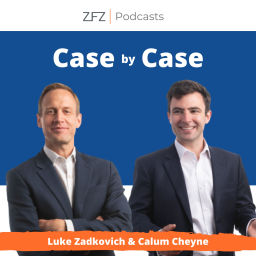
Luke Zadkovich and Calum Cheyne of Floyd Zadkovich discuss a new case each week, focused on shipping, international trade and commercial law.
We each read the case, then jump straight on the podcast and hit record. All you hear is our organic conversation and our thoughts on what the case is about, what the Court decided, and how the decision may affect the industry.
*any guidance or suggestions given in any podcast episode is generic in nature and not to be considered as legal advice. Please contact lawyers for specific, legal advice.
www.floydzad.com / marketing@floydzad.com
Calum and Luke discuss the recent High Court decision in FinCo International AG v Integra Petrochemicals Europe AG, which considers the impact of a post-contractual agreement to change delivery terms under a contract governed by the BP Oil General T&Cs (“BP GTCs”) from DES Incoterms to CIF.
The Judgment provides an interesting and accessible snapshot of the risks of post-contractual amendments to commodities sale and purchase contracts which, against the current uncertain geopolitical backdrop, should give commercial counterparties pause to consider the unforeseen impacts of “on the fly” adjustments to contractual arrangements.
The dispute concerned a c.US$3 million claim by FinCo for damages and restitution arising out of a contract for the sale of MTBE (a petrochemical) concluded on the “BP GTCs” and the Incoterms 2010.
The contract terms as initially agreed included "Delivery dates: 10 - 24 November 2023" and provided for a DES Delivery in the ARA (Amsterdam, Rotterdam, Antwerp) range. On 6 October 2023 the delivery term was amended by agreement so as to provide for CIF ARA delivery terms. However, crucially this subsequent agreement made no amendment to the fixed window of delivery dates agreed under the original contract.
On 5 October 2023, Integra sent notice by email nominating the M/T Aramon as the performing vessel under the contract. FinCo responded to that notice in terms indicating a concern that the vessel would not 'fit' at the jetties at the discharge terminal that FinCo (or rather its onward customer) wished to use. Integra responded by agreeing to check whether a smaller vessel was available but on 9 October 2023 confirmed that that was not the case. The dispute between the parties arose as to whether FinCo's responses to the nomination of the Aramon amounted to a valid rejection of the nomination.
One of the key questions before the Court was, in circumstances where time is usually of the essence under a sale contract, whether the fixed delivery window agreed in the context of the original DES sale was altered from absolute to indicative as a result of the Parties’ subsequent agreement to change the Incoterms from DES to CIF (as it would otherwise have been if the Parties had originally agreed CIF Incoterms).
The Court held that, even though the Parties agreed at the time of Contract formation to a firm and binding delivery window, the subsequent agreement to change the Incoterms to CIF was enough to supervene the original agreement, such that the previously binding DES delivery window was to be interpreted as being indicative “delivery dates” following the amendment to CIF terms as a result of other (newly) applicable terms in the BP GTCs, regardless of what the intentions of the Parties might have been in actuality.
The Judgment exposes the risks of tension arising between what Parties realistically are likely to have intended to agreed and the logical reading of the actual agreement that has been reached, especially in circumstances where the basis of the underlying agreement incorporates standard terms and conditions that incorporate competing regimes which are identified by reference to relevant terms (in these case, the election of specific INCOTERMS).
The Judgment also considers the proper construction of vessel nomination obligations in the BP GTCs, in particular under section 14 (within the CIF terms section). The judgment provides that under the section 14 regime, a buyer is obliged to give notice accepting or rejecting the nomination of a vessel within 1 business day of receipt. If it does not, the buyer is assumed to have accepted the vessel.
The case raises interesting commentary as to the respective weights given by the Court to likely contractual intention versus the objective reading and effect of clearly agreed amendments to contracts, especially in circumstances where standard form terms and conditions and conditions form part of such contract.
4 Jun 2026
Ep #100 Palletizing Packages - Carrier wins on limitation in CoAs with Ed Floyd and Eva-Maria Mayer
Case: HDI Global Insurance Co. v. Kuehne + Nagel, Inc., trading as Blue Anchor America Line (2026)Guests: Edward Floyd, Eva-Maria Mayer, both Partners at Floyd Zadkovich.
In this episode, Luke is joined by Edward Floyd and Eva-Maria Mayer of Floyd Zadkovich to discuss their recent victory for Kuehne + Nagel, Inc. (K+N) before the U.S. Court of Appeals for the Second Circuit in a significant Carriage of Goods by Sea Act (COGSA) limitation of liability case.
The discussion explores the dispute at the heart of the case: how the term "package" should be interpreted for purposes of COGSA's USD 500 per package liability limitation. Ed and Eva-Maria explain the facts surrounding the shipment of electrical wire harnesses, the damage that occurred during loading, and the competing arguments over whether the relevant packages were the individual cartons or the pallets on which they were consolidated.
The episode also examines the courts' application of established Second Circuit precedent, the importance of contractual package definitions in sea waybills, and why both the District Court and the Second Circuit concluded that the parties had clearly agreed that the pallets—not the cartons—would constitute the relevant packages for limitation purposes.
Listeners will gain practical insight into COGSA limitation provisions, drafting considerations for carriers and cargo interests, and the broader implications of the Second Circuit's decision for the maritime and logistics industries.
16 Apr 2026
#Ep 99 Clause Chaos: When Arbitration Agreements Collide with Dr Benjamin Hayward
Luke zadkovich and calum cheyne are joined this week by dr ben hayward (monash university, melbourne) to discuss the supreme court of victoria’s decision in downer utilities australia pty ltd v murra warra asset co pty ltd [2026] vsc 48 — a case that shines a spotlight on the practical and legal difficulties posed by hybrid arbitration clauses.
Arising out of the murra warra wind farm project, this case concerned an arbitration clause providing for arbitration to be conducted by the resolution institute in accordance with the icc rules — a classic “hybrid” clause. When the dispute crystallised, competing arbitrations were commenced within a day of each other: one before the resolution institute, and another before the icc. This gave rise to a fundamental question — which, if either, of these arbitrations had been validly commenced?
Before croft j, the parties advanced competing constructions of the arbitration agreement, alongside arguments as to the applicable statutory regime and whether the court should intervene at all. Central to the dispute was whether the hybrid clause was workable, and how it should be given effect in light of well-established principles favouring party autonomy in arbitration.
The court ultimately emphasised that, where possible, arbitration agreements should be construed in a manner that gives effect to the parties’ intention to arbitrate, even where the drafting is less than ideal. In doing so, croft j engaged in a detailed analysis of international authorities on hybrid arbitration clauses, recognising both their enforceability and the practical difficulties they present.
The decision also highlights the continuing importance of the kompetenz-kompetenz principle, with the court exercising restraint in circumstances where questions of jurisdiction were properly capable of determination by the arbitral tribunal itself.
Luke, calum and ben draw on both the judgment and broader arbitral practice to explore the risks inherent in hybrid clauses, the limits of judicial intervention, and the drafting lessons for commercial parties navigating complex dispute resolution frameworks.
This is a case that underscores a simple but critical point: when it comes to dispute resolution clauses, clarity is everything.
Who has been a guest on Case by Case
Names identified in recent episode analyses. Showing up to five guests.
David Walsh KC
Jakob Reckhenrich
Oliver Caplin KC
Reach and audience
Public platform figures. Ratings count people who left a rating, not total listeners.
YouTube views
3,941
Score snapshot 15 Sept 2025
Apple Podcasts (US)
5.0 / 5
1 ratings
Spotify
4.9 / 5
22 ratings
Podcast Authority Score: 71 / 100
A composite of feed quality, social presence, YouTube performance and engagement. Read the methodology.
Quality
82
Social presence
0
YouTube
74
Engagement
77
Contact Case by Case
Guest appearances
Books guests
Based on episode analysis; this does not confirm that the show is currently accepting guests.
Questions about Case by Case
Who hosts Case by Case?
Calum Cheyne and Luke Zadkovich host the show. Published by Floyd Zadkovich.
How often do new episodes come out?
The show publishes monthly, based on its RSS feed.
Does Case by Case take guests?
Yes. Guests have been identified in episode analyses.
Host of Case by Case?
Claim your podcast to manage its listing and keep your show details accurate.
Pod Engine is an independent podcast discovery and analytics service and is not affiliated with or endorsed by this podcast. Artwork and show content belong to their owners. Full legal notice.
Explore this show Podcast research with Pod Engine