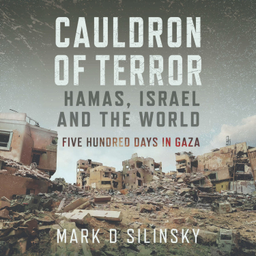
Cauldron of Terror Hamas, Israel and the World - Five Hundred Days in Gaza Podcast
Claim This Podcastby silinsky
Podcast Overview
<p>Hamas, an acronym for Harakat al-Muqawama al-Islamiya or Islamic Resistance Movement, has been cast as a terrorist organization, a national liberation group, a religious-social movement, an Islamo-fascist or neo-Hitlerian force, and<br />a counter-colonial group. The group itself is an outgrowth of the Muslim Brotherhood, an international organization that propounds radical Islam.<br />On October 7, 2023, Hamas launched a day-long slaughter-fest against multiple sites near Gaza. Hamas operatives fired on anything that moved – men, women, children, infants, and house pets. Militants also abducted over two hundred soldiers and civilians to be used as bargaining fodder. The carnival-like atmosphere surrounding the killing harkened to the Nazi death squads of World War Two. In response, Israel launched Operation Swords of Iron against Hamas in Gaza, which has lasted over one year, pulverized many Gazan towns and homes, and killed many Gazans. Silinsky, a career<br />military intelligence analyst, explains the strategy and tactics of both Hamas and Israeli forces used in the war. But this battlefield extended well beyond the streets of Gaza. It was, and remains, a battle of ideas fought to win international public opinion. Silinsky examines the information operations employed by both sides to secure global sympathy. International organizations have taken sides in the war, and Silinsky examines the global diplomatic maneuvering. Agencies of the United Nations are examined, particularly the United Nations Relief and Works Agency and the<br />International Court of Justice. Cauldron also examines some pro-Israel- and anti-Israel-leaning non-governmental organizations and the heated activism that erupted on college campuses and in the streets of Western cities. The war is, at its core, a tragedy. Silinsky brings to light the human dimension to people on both sides of the war / </p>
Language
🇺🇲
Publishing Since
2/11/2026
Reach the team behind Cauldron of Terror Hamas, Israel and the World - Five Hundred Days in Gaza Podcast
Verified contact details for this show aren't on file yet — sign up to get notified when they land.
Recent Episodes

July 17, 2026
Cauldron of Terror - Policing the English Language and the King's New Faiths
Hello and welcome to Cauldron of Terror, a podcast that explores the effects of Islamic terrorism on the West. The book, Cauldron of Terror – Hamas, Israel, and the World, will be available sometime next month, as planned. I am Mark Silinsky, president of Kensington Security Consulting, where we bring education to national security. In this episode, we will drill down on Britain. In Cauldron, I discuss in some detail how the partnership between Islam and leftism drives British Middle East policy and shapes domestic opinion and activism. Daniel Pipes has coined the term the six Ps. These are (what I call the 6Ps – police, politicians, press, priests, professors, and prosecutors) that enable the expansion and entrenchment of Islamic law in Europe. Let’s look at the police in a story featured in the Middle East Forum, which was written by Jules Gomes. I have argued many times that a neglected front in the West’s war against Islamic law, or Sharia, is the battle for ideas. This war has been well underway in Britain for decades. To control words about Islam is to control the debate about Islam. To control the debate about Islam is to allow the insertion of Sharia into Britain without a fight. Often, this insulation of Sharia comes stealthily and without widespread public notice. I have offered a number of podcasts of Britons being arrested for making cavalier comments about Islam and Muslims. Upon arrest, they protested that they didn’t know it was illegal to criticize Islam. Well, one of Britain’s police forces has been grappling with this war of words for decades. Now, Britain’s official representative body for Muslim police officers has officially demanded that a policy paper published on its website propose scrapping terms like “Islamist” and “jihadist” to label “terrorists with Islamic affiliations.” As of July 2026, this policy paper has been shelved. So why bring it up? It is an example of the unrelenting demands that Muslim society makes on European states. The general strategy is to cast themselves as victims of Islamophobia and demand that host states bow to their demands to eliminate any word, image, policy, or law to which they object. This was the case with the National Association of Muslim Police (NAMP), which first posted and then removed the 39-page paper titled “From Past Prejudices to Present Policies: Confronting anti-Muslim hatred and Promoting Human Rights.” This paper also casts Zionism as “one of the manifestations of anti-Muslim hatred.” It describes Zionism “a narrow, nationalist, and colonialist viewpoint that fosters anti-Muslim hatred.” It was drafted by Khaldoun Kabbani, former vice president of the NAMP, and promulgated last year. So, what did the paper demand? First, the paper concludes with proposals “to remove the direct association of terrorism with Islam” and instead use terms like “Irhabi/Irhabism/Irhabist”— words derived from the Arabic word for “fear” or “dread” and used to refer to terrorism and terrorists in modern Arabic —as well as “anti-Western Terrorism” and “right-wing terrorism.” Now, there would be no Islamic terrorism. It would be Irhabism. What would this achieve? It would rhetorically decouple Islam from terrorism. But then what is Irhabism? Well, it doesn’t contain the word Islam. A second goal of the paper is to criminalize Zionism. Kabbani, who struggles to obscure the connection between Islamism and political violence, is, however, quick to demonize Zionism, which he claims strips Muslims of their humanity and portrays them as “human animals,” “monsters,” and “Amalekites.” This is my take on the paper. First, though the NAMP pulled the paper from its website, it did not renounce it or toss it in the electronic trash can. So, I do not see it as a loss for NAMP. It was likely a part of a pattern of prodding and testing. The NAMP met resistance and backed off a bit. Did it back down? By that, I mean, did it acknowledge that it was defeated?

June 30, 2026
Cauldron of Terror - Students for Justice in Palestine - A Friend of Hamas?
Hello and welcome to Cauldron of Terror, a podcast that explores the effects of Islamic terrorism on the West. The book, Cauldron of Terror – Hamas, Israel, and the World, will be available in summer 2026. I am Mark Silinsky, president of Kensington Security Consulting, where we bring education to national security. In this episode, we will bring education to education. By that, I mean we will look at a prominent and very influential student group that, among other things, advances HAMAS. First, what is Students for Justice in Palestine? According to its website, “we promote an agenda grounded in freedom, solidarity, equality, safety, and historical justice, and we seek to elevate the student movement to a higher level of political engagement.” I am not exactly sure what that means. I see it as a thread of leftist cliques. Freedom, solidarity, equality, and similar terms tell me very little. So, let’s drill down on one proclamation on the website. It condemns universities for, in the SJP’s words, “The reproduction of capitalist, imperialist, and settler colonial power, situating campus organizing for Palestine within the context of previous divestment movements and struggles against empire.” Notice, once again, the terminology – capitalist, imperialist, and colonial babble. This is clearly the rhetoric of the hard left. I have made podcasts about the Green-Red alliance. The green is for Islam, and the red is for the left. This is intersectionality. It builds a bridge between groups deemed oppressed in a white, patriarchal, capitalist West. So this is the general statement of principles. And here is an interesting point. “Building on the legacy and impact of previous student movements on occupied Turtle Island (so-called US and Canada), National SJP seeks to empower, unify, and support the Student Movement for Palestinian liberation. We aim to build a connected, disciplined movement equipped with the tools to contribute to the fight for Palestinian liberation.” If you know what Turtle Island is, you have one on me. According to Wikipedia, Turtle Island" is a name used by some Indigenous peoples of the Americas to refer to Earth[1] or North America.” So, the United States is “so-called.” The North American landmass is really Turtle Island. Now, these claims and objectives seem outrageous to most of us. When SJP was created in 1992, it was dismissed as a campus outlier of Islamic extremism. It began at UC Berkeley with a small table and a handful of students handing out boycott leaflets. Interestingly, at the time, SJP's rhetoric was far more civil. As a spokesman described in 1995, “We believe in peace coupled with justice,” the unnamed student added. “We oppose illegal settlements, not the peace process.” It quickly gained traction and grew emboldened. It took off and established branches on 350 campuses. The SJP expanded into a vast network of campus chapters that advance anti-Israel, anti-Semitic, anti-capitalist, and anti-American agendas. At least four of its chapters have been suspended since the Oct. 7 terror attack on Israel. Many SJP leaders celebrated the attacks as, in their words, “a historic win for the Palestinian resistance.” Soon after the attack, the SJP began to attack Israel’s response as genocide. The group’s chapters across the U.S. and Canada, not all of which are active at any given time, are loosely connected by a coordinating body called National SJP. I couldn’t find evidence of a professional staff or national headquarters. This, along with its opaque funding. Some SJP alumni have helped organize mass demonstrations, including those that shut down bridges and public transit in New York City and other major cities in the weeks after the war began. However, those protests were primarily organized by other organizations, such as Within Our Lifetime and Jewish Voice for Peace. SJP chapters remain focused on campus, where even a relatively small number of students can draw national attention.

June 5, 2026
Cauldron of Terror - Videocast Four - Eurovision, Nicholas Kristoff, Randy Dogs
Hello from Kensington Security Consulting, where we bring education to national security. This is Mark Silinsky, welcoming you to an audio cast that supplements a video cast. Today, we will provide updates on some issues we discussed in my upcoming book, “Cauldron of Terror – Hamas, Israel and the World.” We will start with Kensington Updates, which cover issues we discussed earlier. Update - Eurovision Let’s begin with the Eurovision contest. Once again, Israel placed second, for the second consecutive year. Not bad. There are usually more than two dozen countries. This year, five countries boycotted the contest because Israel took part. Spain’s leader, Prime Minister Pedro Sanchez, said, “Our position is clear and unequivocal: until the barbarity ceases, neither Russia nor Israel should participate in any international competition.” Ireland neither participated in nor broadcast the contest, blaming Israel for killing too many Palestinians and targeting journalists in Gaza. It was much the same for Iceland with the curious explanation that, “The Song Contest and Eurovision have always had the aim of uniting the Icelandic nation, but it is now clear that this aim cannot be achieved and it is on these program-related grounds that this decision is taken." If you understand this, I envy you. How does Eurovision unite the Icelandic nation? I didn’t know that the Icelandic nation was divided. Is there a large Palestinian population there? I read the communique a few times, and I think that something was lost in translation. The Dutch kept away, too. They cited "severe humanitarian suffering in Gaza, the suppression of press freedom, and the political interference during the last Eurovision Song Contest." The severe humanitarian suffering in Gaza. Yes, Gazans suffer, though reasonable people could debate whose fault it is. Press freedom. Well, the press is not free to partner with Hamas operatives in terrorist attacks or to provide them with shelter or intelligence operations. That is too. Yes, yes. On the last point, political interference during the last Eurovision contest, presumably in 2025, is new to me. The Dutch did not explain what that interference was. Slovenia boycotted the program in a rage and would not air it on its television. Instead, they offered a program on Palestinian suffering. Well, these were the stated reasons. Was there more to the decisions? I don’t know if Israel cheated in Eurovision, as the Dutch claimed. But who cheated? Israeli leaders or a few low-level operatives? Israel's national broadcaster received a formal warning from Eurovision for encouraging viewers to cast 10 votes for their act, a move deemed a breach of competition rules designed to prevent voting manipulation. Is there something to this? I don’t know. Are other participating countries held to the same standards? Also, Turkey occupies Cyprus and has dislodged the Greek populations. Does that ever come up? What is important here? These are my thoughts. OK, the boycotters lost one this year. Israel participated and did very well. But there is next year and the year after. Each year, the continent becomes increasingly Islamic and restive. There are few Jews left in Europe, and many are leaving. So politicians have good reason to partner with the growing constituencies. The new left of the 1960s and 1970s has been reborn in Europe and the United States. Its adherents despise Israel, too. This is the green-red alliance, about which we have spoken many times on other podcast channels. So efforts to boycott and ostracize Israel in Europe are likely to accelerate. But Israel placed second two years in a row, largely through popular voting. Did Israel cheat, as some Europeans claimed? I don’t know. Where is the proof? Those Eurovisonistas who boycott or despise Israel were certainly on the lookout for cheating. There have been Eurovision contests for 70 years, and guardrails against cheating have evolved over time. If you have evidence
20 total episodes available
Similar Podcasts
Discover related shows you might enjoy
Deep-dive analytics for Cauldron of Terror Hamas, Israel and the World - Five Hundred Days in Gaza Podcast
Frequently asked questions
Have a different question and can't find the answer you're looking for? Reach out to our support team by sending us an email and we'll get back to you as soon as we can.
- What is Cauldron of Terror Hamas, Israel and the World - Five Hundred Days in Gaza Podcast?
<p>Hamas, an acronym for Harakat al-Muqawama al-Islamiya or Islamic Resistance Movement, has been cast as a terrorist organization, a national liberation group, a religious-social movement, an Islamo-fascist or neo-Hitlerian force, and<br />a counter-colonial group. The group itself is an outgrowth of the Muslim Brotherhood, an international organization that propounds radical Islam.<br />On October 7, 2023, Hamas launched a day-long slaughter-fest against multiple sites near Gaza. Hamas operatives fired on anything that moved – men, women, children, infants, and house pets. Militants also abducted over two hundred soldiers and civilians to be used as bargaining fodder. The carnival-like atmosphere surrounding the killing harkened to the Nazi death squads of World War Two. In response, Israel launched Operation Swords of Iron against Hamas in Gaza, which has lasted over one year, pulverized many Gazan towns and homes, and killed many Gazans. Silinsky, a career<br />military intelligence analyst, explains the strategy and tactics of both Hamas and Israeli forces used in the war. But this battlefield extended well beyond the streets of Gaza. It was, and remains, a battle of ideas fought to win international public opinion. Silinsky examines the information operations employed by both sides to secure global sympathy. International organizations have taken sides in the war, and Silinsky examines the global diplomatic maneuvering. Agencies of the United Nations are examined, particularly the United Nations Relief and Works Agency and the<br />International Court of Justice. Cauldron also examines some pro-Israel- and anti-Israel-leaning non-governmental organizations and the heated activism that erupted on college campuses and in the streets of Western cities. The war is, at its core, a tragedy. Silinsky brings to light the human dimension to people on both sides of the war / </p> - How often does this podcast release new episodes?
This podcast updates daily.
- Where can I listen to this podcast?
This podcast is available on 4 platforms including Apple Podcasts, Spotify, and more. You can also use the RSS feed directly.
- Does this podcast accept guests?
No, this podcast does not typically feature guests.
Legal Disclaimer
Pod Engine is not affiliated with, endorsed by, or officially connected with any of the podcasts displayed on this platform. We operate independently as a podcast discovery and analytics service.
All podcast artwork, thumbnails, and content displayed on this page are the property of their respective owners and are protected by applicable copyright laws. This includes, but is not limited to, podcast cover art, episode artwork, show descriptions, episode titles, transcripts, audio snippets, and any other content originating from the podcast creators or their licensors.
We display this content under fair use principles and/or implied license for the purpose of podcast discovery, information, and commentary. We make no claim of ownership over any podcast content, artwork, or related materials shown on this platform. All trademarks, service marks, and trade names are the property of their respective owners.
While we strive to ensure all content usage is properly authorized, if you are a rights holder and believe your content is being used inappropriately or without proper authorization, please contact us immediately at hey@podengine.ai for prompt review and appropriate action, which may include content removal or proper attribution.
By accessing and using this platform, you acknowledge and agree to respect all applicable copyright laws and intellectual property rights of content owners. Any unauthorized reproduction, distribution, or commercial use of the content displayed on this platform is strictly prohibited.


