- 17
- Episodes
- 6
- Ratings
- Weekly
- Cadence
- 2025
- First episode
About CEO Pajama Time
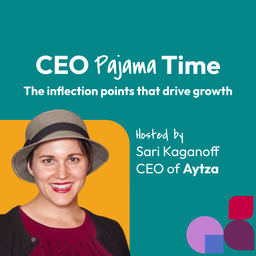
CEO Pajama Time takes you inside the after-hour decisions and toughest strategic choices made by founders as they scale. Hosted by Sari Kaganoff, CEO and Founder of Aytza, these conversations are grounded in real-world experience, navigating the key inflection points every CEO faces.
- Publisher
- Sari Kaganoff
- Category
- business
- Language
- en
- Explicit
- Yes
- First episode
- 24 Dec 2025
- Latest episode
- 5 Oct 2026
Latest episodes
17 episodes in the feed.
5 Oct 2026
Not for Tourists: Building for the long haul
What do you do when the prevailing business model doesn’t align your incentives with those of your customers? Ali Diab co-founded Collective Health after a medical emergency left him fighting his insurer over denied coverage. He set out to build a better way for self-insured employers to administer health benefits, entering an industry he knew almost nothing about at the time. In this conversation, Ali talks about the early years of “breaking glass” when benefits consultants wouldn’t return his calls, and how Collective Health found its first believers found its earliest customers among other iconoclastic companies trying to challenge entrenched, highly regulated industries, including Uber, SpaceX and Palantir. Ali also gets into the economics of competing against insurers that can subsidize administration with other parts of their businesses, and why Collective Health has deliberately stuck with a model that aligns how it makes money with the employers it serves. He talks about maintaining conviction through periods when the economics looked challenging, resisting attractive adjacent markets. Finally, Ali reflects on how his role has changed as Collective Health has grown to roughly 1,200 people: learning to delegate, building a low-ego culture, staying grounded in facts even when the data challenges your beliefs, and why being CEO means making even the smallest problems your responsibility. About Ali Diab Ali Diab is the Co-Founder and CEO of Collective Health, a leading independent health benefits platform serving self-funded employers. Inspired by his own experience navigating insurance denials following a life-threatening medical emergency, Ali founded Collective Health to simplify the healthcare experience for employers and their employees. Prior to Collective Health, he held leadership roles at Google, Goldman Sachs, Microsoft, and Yahoo!, and studied economics at Stanford and Oxford. He currently serves on the Board of Advisers for the Stanford Institute for Economic Policy Research. Presented by Aytza
10 Sept 2026
In the Business of Reinvention
What do you do when you’ve built a product that works, solved the technical hurdles, landed major customers, and then realize you’ve built it for the wrong decision maker? Oron Afek is the co-founder and CEO of Vim, a collaborative healthcare system that brings innovation directly into clinical workflows In this conversation, Oron walks through Vim’s eleven-year journey, starting with its first incarnation as BookMD, a marketplace designed to steer patients toward more cost-effective healthcare services. After more than a year navigating enterprise relationships and building around entrenched infrastructure, the team discovered that patients weren’t actually making the decisions they had designed the product around. Oron shares how that failure pushed Vim from patient-facing to provider-facing, and eventually from a point solution into the platform it is today. He talks about using design partners without becoming a custom dev shop, what it takes to keep reinventing a company over more than a decade, and the difficult process of rebuilding Vim to become AI-native while still supporting a large existing business. He also makes the case that AI is changing an old startup assumption: building something bespoke for one customer may no longer be a bad thing. About Oron Oron Afek is the co-founder and CEO of Vim, a collaborative healthcare system that brings innovation directly into clinical workflows. Vim's proprietary integration layer sits securely on top of the electronic health record and, through a single JavaScript SDK (VimOS.js), standardizes clinical workflow events and data across otherwise incompatible EHRs — so any developer can build once and deploy everywhere, in-workflow, with bi-directional data exchange and no new logins or systems. On that foundation, partners deliver point-of-care experiences like insights, referrals, and documentation directly to care teams. Presented by Aytza
31 Aug 2026
The Morning After the Exit
What does it take to sell the company you spent 16 years building, and how does it feel the morning after? Drew Schiller returns to CEO Pajama Time, this time from the other side of an exit. In June 2026, Validic, the platform he co-founded in 2010 to connect data from wearables and in-home medical devices into the healthcare system, was acquired by ChartSpan. In this conversation, Drew walks through the full arc of the sale, from the work his leadership team did to map the acquirer landscape 18 months prior, to the inbound offer that set things in motion, and the nitty gritty of managing an exit. Drew talks about both the mechanics and the emotional reality of a strategic sale and shares advice for other founders. He explains why you can never tip your hand that you're a seller without losing all your leverage, why the conversations that went furthest came from prior relationships, and why lining up the right value proposition with the right executive at the right time is the hardest part. Drew talks through surviving an earlier near-exit that didn't close, and the roughly 75/25 split between running the sale and running the company, and how to successfully get through a diligence. Then there's the morning after the close, when Drew says he felt 5,000 pounds lighter and realized just how much weight founders carry the whole way through. About Drew Drew Schiller is the Chief Development Officer & Board Director at ChartSpan. Prior to that he was the CEO and co-founder of Validic (founded in 2010 with his co-founder Ryan), a platform that connects data from wearables, in-home medical devices, and health apps into the healthcare system, which was acquired by ChartSpan in 2026. Presented by Aytza
17 Aug 2026
Beware the Red Herring: A Founder’s Balancing Act
What do you do when you've built the ideal care model and realize it won't scale? Tara Raffi is the founder and CEO of Almond OB-GYN, a functional OB-GYN practice built on the belief that women should be living more healthy years, and that much of the solution to our health problems is found in lifestyle: sleep, stress, diet, exercise, metabolism, gut, and pelvic and vaginal health. Tara’s mission was to build a hybrid in person and virtual functional clinic for the $200 billion OB-GYN market in the United States. In this conversation, Tara talks about running clinical operations with a ruthless focus on profitability, reaching sustainable margins on a hybrid insurance-plus-membership model, and why she believes you need both a strategic vision and the discipline to watch every dollar. She opens up about the brick-and-mortar "red herring" that distracted her: she was crushing build-out efficiency, but the real problems were inefficiency of marketing dollars and the partnerships a single location couldn't unlock. She walks through the excruciating decision to shut the clinic, the early-2025 shift to a telehealth-only subscription that opened new horizons, and what she'd do differently. She digs into building a better filter as a founder, reading a venture-funded market where growth can mask what's really happening under the hood, and building the muscle to absorb the constant sting of setbacks without buying into the "die trying" mythology. Finally, she shares where Almond is headed: unlocking one of the largest functional women's health data sets. About Tara Tara Raffi is the Founder & CEO of Almond OB-GYN, reimagining women's health as proactive and personalized. A UC Berkeley, McKinsey, and Y Combinator alum, Tara believes in a world where women's bodies are studied and understood, and where they get true healthcare before cues become crises. Presented by Aytza
23 Jul 2026
Pivoting in public: Building a business that sustains the mission
What do you do when the model you spent years building isn’t working economically, and the only way forward is to drastically change the shape of the business? Naomi Allen is the co-founder of Brightline, a pediatric mental health company. She previously held leadership positions at Castlight and Livongo. In this conversation, Naomi talks about leading through profound uncertainty as both a parent and a CEO, especially in the early days of building Brightline during COVID. She shares the "art and science" of making big calls from incomplete data. Naomi walks through the hardest chapter at Brightline: after building out a 50 state virtual model to support employers and scaling from nine customers to over 430 in under two years, she realized that the unit economics didn’t work. She got her team into gear, first running experiments and measuring impact week over week and then decided to drastically shift the model to focus on key locations, which led to a rapid four-week wind-down process. She opens up about the deeply personal side of a public pivot, and realizing that even while running a mission driven company you need to be financially viable to continue serving the mission. About Naomi Allen Naomi Allen is an entrepreneur and health care executive with more than 20 years of experience building high-growth health technology companies. She is the co-founder and executive chair of Brightline, an award-winning therapy and psychiatry practice that provides pediatric, teen, and parental mental health care to families and children up to age 18. A mother of three, Naomi co-founded Brightline in 2019 after experiencing firsthand how difficult it can be for families to access timely, high-quality mental health care for children. Since then, Brightline has served hundreds of thousands of families with evidence-based mental health care and support. Today, Brightline serves families through virtual and in-person care across New York, New Jersey, Connecticut, Massachusetts, and Washington. In addition to Brightline’s clinical services, the company offers BrightLife Kids, a CalHOPE program delivered in partnership with the California Department of Health Care Services. BrightLife Kids provides free online coaching, resources, and support for California families with children up to age 12. Before Brightline, Naomi served as chief growth officer at Livongo, where she led strategic growth initiatives, including market expansions, acquisitions, and IPO preparation. She was a founding team member at Castlight Health, helping guide the company from startup through its public offering, and worked at McKinsey & Company’s Silicon Valley office, where she helped build the firm’s health care technology practice. Naomi earned an MBA from Stanford Graduate School of Business and a bachelor’s degree from the University of North Carolina at Chapel Hill. Presented by Aytza
9 Jul 2026
Built on trust: Category creation in women’s health
How do you convince investors, patients, and the healthcare system that a new category in women's health needs to exist? Joanna Strober is the founder and CEO of Midi Health, the telehealth company providing insurance-covered primary care for women navigating perimenopause, menopause, and beyond. Joanna started Midi in 2021 after her own frustrating search for menopause care, following an earlier career as a venture capitalist and as health tech founder. In this conversation, Joanna talks about the early development of Midi, and how the model expanded based on patient need to offer the full scope of what Midi does today. She digs into how she raised venture capital for a category that didn't yet exist, and the economics of building an insurance-covered, clinician-led virtual specialty care model. Joanna also shares how she manages the business today, building a strong, trusted team so she can dive deep ("like a falcon") into new challenges as they emerge, and standing up the New Product Committee, which helps her turn her constant stream of ideas into disciplined, prioritized bets. Joanna also opens up about deliberately becoming a public figure, how she holds her confidence steady against critics, and how intertwined her personal life is with the business. About Joanna Strober Joanna Strober (https://www.linkedin.com/in/joannastrober) is the CEO and Co-founder of Midi Health (https://www.joinmidi.com/), a virtual healthcare platform for women with a focus on perimenopause and menopause. Midi brings expert care, covered by insurance, to women nationwide. Previously, Joanna founded Kurbo, the first digital therapeutic for childhood obesity, which was acquired by Weight Watchers. Joanna also spent 20+ years in direct private equity and venture capital investing in health and consumer companies. She is also the author of the book Getting to 50/50, a primer on how women can succeed and thrive at work and home, and she was named to Forbes' 50 over 50 list of top Innovators, the CNBC Changemaker 2025, and Time 100 Healthcare Leaders. Read up on Joanna & Midi here: Midi Instagram (https://www.instagram.com/midihealth/?hl=en) Midi Health TikTok (https://www.tiktok.com/@midihealth) Jonna’s Linkedin (https://www.linkedin.com/in/joannastrober/) Joanna’s Instagram (https://www.instagram.com/joannastrober/?hl=en) Presented by Aytza
25 Jun 2026
From Basements to Boardrooms: building a new care modality and passing the torch
What do you do when you haven’t yet reached scale, but market conditions have changed and runway is running out? Tori Lecomte founded Sesh in 2019 to bring the power of therapist-led group therapy to consumers. Not coming from a healthcare or CEO background, but convinced the modality was dramatically underutilized, she focused on making sure she had market validation, launching a revenue generating in person direct to consumer marketplace, before adding virtual services, expanding to b2b sales, and then ultimately selling the company in 2023. In this conversation, Tori talks about the strategic choices and challenges of building Sesh, the marketplace conundrum at the start, the strategic pivot from consumer to employer sales, navigating a crowded mental health market, and being painted as a point solution. Tori shares the challenges she faced raising her next round of funding, how partnership conversations shifted to become acquisitions discussions, and what it felt like to exit before Sesh had hit the scale and impact she had hoped for. She shares what she'd do differently with hindsight and practical tips for founders who find themselves considering their options. Tori also gets candid about myth-busting one of the most pervasive startup tropes, the idea that your business is your baby, and how she navigated having her first child at a pivotal time for the company. About Tori Vittoria (Tori) Lecomte is the founder of Domestic Futures, a project exploring how technology, markets, and institutions are changing the way we form families. Previously, she founded Sesh, a mental health company acquired by Caraway. She began her career as a technology investment banker at Barclays and later joined Blockchain.com (http://Blockchain.com) as an early employee. She was named to Forbes 30 Under 30 for Social Impact. Presented by Aytza
18 Jun 2026
Building the impossible, the story behind one of the earliest DTC telemedicine companies
What do you do when lawyers tell you the thing you're building probably isn't possible? Demetri Karagas co-founded Thirty Madison in 2017 with no healthcare background, a consumer business playbook, and a conviction that a one-stop shop for telemedicine and prescriptions was obviously better for patients, even if the lawyers weren't sure it was possible. He and his cofounder had a vision for a platform of multiple deeply specialized brands of which “Project Samson” (the early working name for their flagship brand Keeps) was the first. In this conversation, Demetri talks about early structural decisions, like which pieces of the value chain to own vs partner, why controlling that first patient touchpoint was worth a slower launch, and how Thirty Madison pioneered asynchronous telemedicine. Demetri opens up about the hubris trap after Keeps hit big, adding 20-30 people a week in early scaling days, and how they lost (and then regained) some of the rigor that made the first brand work. Finally, he dives into being on both sides of M&A - acquiring two companies and then exiting via acquisition to get to scale. M&A can leapfrog years of organic growth, but integration is hard. Demetri shares how the team kept multiple paths open until the very end, including seriously considering another acquisition before deciding that selling was the right move. About Demetri Demetri Karagas is a New York City–based entrepreneur. He co-founded and led Thirty Madison, a digital health company that grew into one of the leading specialty care platforms in the United States. Founded in 2017, Thirty Madison served millions of patients through brands including Keeps, Nurx, and Cove before being acquired by Remedy Meds in 2025. Prior to Thirty Madison, Demetri founded Get Maid, an on-demand home services marketplace that was acquired by Homejoy. After Google acquired Homejoy, he spent a brief stint working on Search Ads before returning to startup life. Today, he's experimenting with new ideas across healthcare and consumer technology while trying to keep up with his 10-month-old son. Presented by Aytza
4 Jun 2026
The Founder who won't stop
Most founders get one shot at building something that matters. Glen Tullman has taken several, and he keeps going back for more. In this conversation, Glen traces the through-line of a career spent trying to fix a healthcare system that, in his words, still runs 50 years behind every other industry. From the early days of building Livongo into a category-defining chronic care company, to reentering the startup space, the arc of his journey is less about any one company and more about making the healthcare system more affordable and accessible for all Americans. Glen talks about what it looks like to lead at every stage, from building office furniture, rapid scaling, to IPO and beyond. He also shares the frameworks that have held across every chapter: make lists, measure what matters, attack ideas not people, and why not to invest in someone who has an exit strategy. He talks about why he doesn't believe in work-life balance, instead focusing on working on things that matter and prioritizing family. And because Glen is Glen, he also built a 40,000-square-foot magic experience in Chicago to fulfill a childhood dream and bring people together. About Glen Tullman Glen Tullman is the Chief Executive Officer of Transcarent, the first comprehensive, consumer-directed health and care platform that makes it easy for people to access high-quality, affordable health and care. He is the former Executive Chairman, Chief Executive Officer, and Founder of Livongo Health. Glen led Livongo through the largest consumer digital health Initial Public Offering in history and the industry’s largest merger to date between Livongo and Teladoc Health. A visionary leader and entrepreneur, Tullman previously ran two other public companies that changed the way health care is delivered: Allscripts, the leading provider of electronic prescribing, practice management, and electronic health records for physician practices and Enterprise Systems, the leading resource management systems for hospitals, which he also took public and then sold to McKesson/HBOC. Glen is also one of two Founding Partners at 7wireVentures, a leading healthtech venture fund. He is the author of On Our Terms: Empowering the New Health Consumer, in which he proposes new solutions to address the chronic condition epidemic facing our country. Presented by Aytza
29 May 2026
Surviving long enough to win
What happens when a founder is offered $100 million and takes half on purpose? Deepak Thomas started PHILl in 2015 after his own experience with chronic Lyme disease highlighted the gap between consumer-grade technology and how patients access medication. Phil now works with patients, prescribers, manufacturers, and pharmacies to make high-cost therapies accessible by solving for the two things that matter most: price and convenience. In this conversation, Deepak talks about the capital discipline behind turning down $100m in funding in favor of taking half that amount, why character eats resume for lunch in early-stage hiring, how PHIL survived three distribution pivots before landing on enterprise sales, and why startups succeed through hermetic stress rather than hedging. This one is for founders optimizing for unit economics, not just the next financing round. About Deepak Deepak Thomas is the Founder and CEO of PHIL, a healthcare technology company modernizing how patients access prescription therapies. He founded PHIL more than a decade ago after seeing how fragmented, manual, and outdated the medication access experience remained for patients, providers, and pharmaceutical manufacturers. Today, PHIL partners with leading life sciences manufacturers to help millions of patients start and stay on therapy through a technology-driven, outcomes-based platform. Under Deepak’s leadership, the company has grown into a late-stage, fast-growing, profitable business in one of healthcare’s most complex categories. On CEO Pajama Time, Deepak shares lessons from building PHIL, navigating strategic inflection points, and turning long-held conviction into a scaled company. Presented by Aytza
13 May 2026
The Midnight Pivot That Became Validic
Episode Description Most digital health companies of Validic's vintage have raised $100 million or more. Drew Schiller raised $35 million over 12 years, on purpose. Validic connects data from over 700 wearables, in-home medical devices, and health apps into the healthcare system. Drew started the company in 2010 with his college best friend Ryan, pivoted from corporate wellness into a data infrastructure play, then later expanded into health systems and acquired a logistics business to own the full stack. Drew talks about the midnight conversation with Ryan where they realized they couldn't out-build Fitbit or MyFitnessPal and decided to solve a different burning market need of integrating data into them instead. He also talks about why he devotes a full day every month with his leadership team to talk about nothing but strategy, and how the Validic team rewrote the company's core values in 2018 without him in the room. This one is for founders building infrastructure businesses, navigating pivots, or trying to figure out when slower growth is the right call. About Drew Schiller Drew Schiller is the CEO and co-founder of Validic, the platform that connects data from wearables, in-home medical devices, and health apps into the healthcare system. He started the company in 2010 with his college best friend Ryan, and launched Validic in 2013 after a midnight pivot away from corporate wellness software. Today the platform normalizes data from over 700 sources into a single API used by health systems, health plans, and digital health companies. Presented by Aytza
23 Apr 2026
Killing Growth to Build a Lasting Company: with Michelle Davey, CEO of Wheel
Michelle Davey built Wheel from a bootstrapped clinician-matching service into the infrastructure behind virtual-first care for some of the largest healthcare enterprises in the country like Amazon Clinic. In this conversation, she gets honest about what that evolution actually looked like. She talks about walking into a board meeting with the investor hockey stick chart and telling them they needed to change course despite it. About pivoting from SMBs to enterprise when every instinct said keep the revenue coming. About acquiring GoodRx's care platform and integrating it in only nine months. About over-hiring in 2021 and the dark days that followed when she had to unwind it. She also talks about her actual pajama time: blocking mornings for reading, then picking back up after the kids go to bed to catch up on what's happening in the market. As Michelle puts it: "A lot of people get into being a founder because it seems glamorous. It is not." In this episode: From Enzyme to Wheel: the three horizons of building virtual-first care infrastructure The board meeting where she stopped chasing SMB growth Acquiring GoodRx's care platform and building an EMR she said she'd never build Horizon 3: An AI-native platform powering programs like weight management, menopause, and longevity Her biggest mistake: over-hiring in 2021 and the layoffs that followed Hot take: "GLP-1s are going to be more disruptive to healthcare than AI" The signal she's watching: stagnation in large payer market values About Michelle Davey Michelle Davey is the CEO and founder of Wheel, the infrastructure platform powering virtual-first care for enterprise healthcare companies. She started the company in 2018 after spending 15 years undiagnosed with an autoimmune condition in rural Texas. That experience drove her into healthcare, but the perverse incentives drove her out and into tech, where she built her career across startups and gig economy marketplaces before finding her way back to telehealth in 2016. Today, Wheel’s AI-native Horizon platform is on track to power 3 to 4 million patient visits this year for enterprises including retailers, pharmaceutical companies, and digital health brands. Presented by Aytza
13 Apr 2026
Two Acquisitions in 60 Days: What Scaling That Fast Actually Looks Like with Taylor Justice
Taylor Justice spent 13 years building Unite Us from a veteran services startup into the infrastructure connecting healthcare, government, and community organizations across the country. In this conversation, he gets honest about what that actually looked like. He talks about the first thing they built being wrong. The investor who told him healthcare was a mistake, then wrote back a year later to say he was wrong. He also talks about the reality of scaling fast. Tripling headcount. Two acquisitions in 60 days. And what it took to stay the course when everything is moving at once. As Justice puts it: “This sh*t is hard. And you definitely cry sometimes." In this episode: Building for veterans, then pivoting into healthcare before knowing the landscape The first product they built (and why it was wrong) Realities of scaling fast: 300 to 900 people, two acquisitions, and trying to stay focused 12 years with a co-founder, and what it's like now that he's gone Myth bust: "Stealth mode is the biggest waste of time" Taylor Justice Taylor Justice is the CEO and co-founder of Unite Us, a software company connecting healthcare, government, and community organizations to coordinate care around health-related non-medical needs like food, housing, and transportation. A former U.S. Army infantry officer, Taylor was medically discharged and built Unite Us out of his own experience navigating the VA system and the gaps he saw for veterans without a network. Thirteen years later, Unite Us operates throughout the United States and has raised over $250 million to transform how human services are delivered.
19 Mar 2026
Jen Goldsack’s Journey from Olympian to CEO, Declining a 20x Offer to Stay True to the Mission, and Leading Through Cancer
Jen Goldsack has spent six and a half years building the Digital Medicine Society (DiMe) into a trusted voice for healthcare's digital transformation. In this conversation, she shares the inflection points that shaped the organization. And the real story behind them. Like the time a family office offered $4 million if DiMe would pivot to focus only on cancer. She said no. Then sat on the floor crying with her dog, knowing she'd just made everything harder. Or the org structure she championed for two years that wasn't working. And the courage it took to acknowledge it and rebuild. This year, she's been navigating all of it while fighting late-stage colon cancer. She talks about the brutal self-talk that preceded her diagnosis, what being a patient has taught her about the system she's trying to fix, and why the work feels more urgent than ever. In this episode: Turning down $4M to protect DiMe's positioning as "expert generalists" The org structure shortcomings she wishes she'd caught sooner What it's like to navigate the healthcare system as a patient after 20 years working in it Hot take: Why longevity tech investment is "incredibly gratuitous" The signal she's watching: direct-to-patient pharma pathways About Jen: Jen Goldsack founded and leads DiMe, a nonprofit working to ensure digital technologies actually improve health, healthcare, and research. Her path to healthcare leadership started unexpectedly. She landed in the field during the 2008 financial crisis after competing in the Beijing Olympics as an elite athlete. Before DiMe, she built experience across two digital health startups (one successful exit), led digital initiatives at a Duke-FDA partnership, and conducted research at Penn. Today she sits on the boards of the Coalition for Health AI and Sage Bionetworks, and contributes to the National Academies' Roundtable on Genomics and Precision Health. She holds three graduate degrees: chemistry from Oxford, history and sociology of medicine from Penn, and an MBA from George Washington. Beyond her professional credentials, Jen is a Pan American Games champion, former world record holder, and World Championship silver medalist. Resources & Links: Digital Medicine Society (DiMe) - https://dimesociety.org/ (https://dimesociety.org/) Follow Jen Goldstack - https://www.linkedin.com/in/jgoldsack (https://www.linkedin.com/in/jgoldsack) Presented by Aytza https://www.aytza.com/ (https://www.aytza.com/)
5 Mar 2026
The Decisions Behind Huma: The Platform Approach to Healthcare Innovation with Dan Vahdat
How Dan Vahdat Built Huma: The Platform Approach to Healthcare Innovation Enjoy this behind-the-scenes look at how bold vision, stubborn persistence, and platform thinking are revolutionizing healthcare, one disease, one regulation, one market at a time. Dan Vahdat, CEO of Huma, shares the story behind creating a platform that scales across diseases, regulations, and markets without losing sight of the big vision. In this episode: The origin story: From Johns Hopkins lab nerd to healthcare disruptor Why building a platform beats focusing on single-use cases The regulatory secret sauce: Configurable software as a medical device Common pitfalls: Do's and don’ts of vision, team-building, and acquisitions The future of healthcare workforce with AI: Reinvented doctors and vibing clinicians Practical advice for founders: Gut feeling, stubbornness, and when to listen Why AI hype is just noise, even at the biggest tech firms Timestamps: 00:00: Welcome and introducing Dan Vahdat 03:30: From disease-specific apps to a scalable platform 06:51: Why Dan was driven to start a company 10:34: How Dan convinced investors 15:28: The risk of chasing one disease versus the platform play 20:06: Biggest mistake: Building in uncharted healthcare waters 36:49: Hot take: Healthcare workforce will be transformed by AI Resources & Links: Huma (https://www.huma.com/) Dan Vahdat (https://linkedin.com/in/danvahdat) Connect with Dan Vahdat: LinkedIn (https://linkedin.com/in/danvahdat) Twitter (https://twitter.com/danvahdat) Presented by Aytza (https://www.aytza.com/).
5 Mar 2026
The Decisions That Built Maven with Kate Ryder
Most healthcare startups fail because founders chase every opportunity without knowing what to say no to. Kate Ryder built Maven into the first women's and family health unicorn by doing the opposite. In this conversation, Kate walks through the inflection points that shaped Maven: strong early signals, the decision to wind down Maven Campus when demand did not translate into a sustainable business model, a strategic shift to B2B, and the path to building a virtual care platform that now covers over 28 million lives. She talks about what was actually going through her head when she made those calls, and what she wishes she'd known earlier. We get into how customer signals shaped Maven's direction, the tension between product-market fit and strategic pivots, and why agility matters more than funding in healthcare. Kate also shares the mental model she used to keep investors confident during the moments when scaling felt impossible, and why she focuses on ROI per customer over headcount metrics. This is a conversation about the decisions founders make when no one's watching. If you're navigating a pivot or trying to figure out what to protect and what to let go, Kate's perspective will stay with you. In this episode you will learn about: 00:00- Kate Ryder and Maven's mission 02:07 - The evolution of Maven's business model 04:35 - Challenges and decisions in the early stages 06:10 - The strategic pivot to enterprise clients 12:01 - Building trust and resilience in healthcare innovation 17:23 - Lessons learned from shutting down the campus health product 20:21 - The future of virtual healthcare and Maven's role Resources & Links: Maven Clinic (https://www.mavenclinic.com/) Follow Kate Ryder: Twitter (https://x.com/_kateryder) Presented by Aytza. (https://www.aytza.com/)
24 Dec 2025
Introduction to CEO Pajama Time with Sari Kaganoff
Welcome to CEO Pajama Time, the podcast that offers a candid look at the behind the scenes decisions and strategic turning points every founder faces. Host Sari Kaganoff, CEO and Founder of Aytza, sits down with healthtech leaders to explore the most difficult choices they made while scaling and the key inflection points that defined their journey.
Reach and audience
Public platform figures. Ratings count people who left a rating, not total listeners.
- Apple Podcasts (US)
- 5.0 / 5
- 6 ratings
Contact CEO Pajama Time
- Guest appearances
- Books guests
Based on episode analysis; this does not confirm that the show is currently accepting guests.


Host of CEO Pajama Time?
Claim your podcast to manage its listing and keep your show details accurate.
Pod Engine is an independent podcast discovery and analytics service and is not affiliated with or endorsed by this podcast. Artwork and show content belong to their owners. Full legal notice.
Explore this show
Podcast research with Pod Engine