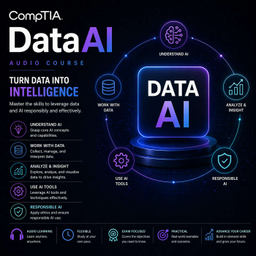
Podcast thumbnail for Certified: The CompTIA DataAI Audio Course

Certified: The CompTIA DataAI Audio Course

Claim This Podcast

by Jason Edwards

71 episodes
Updated Daily
Accepts GuestsHas Sponsors

Podcast Overview

Certified: The CompTIA DataAI Certification Audio Course is an audio-first study companion built for busy professionals who want a clear path into data and AI work without getting lost in jargon. It’s designed for analysts, early-career data practitioners, IT and cybersecurity pros expanding into AI, and managers who need enough technical fluency to lead data projects confidently. If you’ve worked with dashboards, spreadsheets, or basic scripting and you’re ready to understand how data becomes models and decisions, this course meets you where you are. You don’t need an advanced math background to start. You do need curiosity, consistency, and a willingness to think in systems. In Certified: The CompTIA DataAI Certification Audio Course, you’ll learn the practical building blocks behind modern data and AI work: how data is collected and prepared, what makes data trustworthy, how features and models are developed, how evaluation works, and what it takes to move from a prototype to something that can run in the real world. The teaching style is built for audio, so concepts are explained in plain English, then reinforced through repetition and real-world framing. You can listen during commutes, workouts, or downtime and still make meaningful progress because each episode is organized around one core idea and one set of takeaways. What makes Certified: The CompTIA DataAI Certification Audio Course different is that it treats “learning AI” as a workflow, not a vocabulary test. You’ll hear how decisions get made at each step, what can go wrong, and how to choose sensible options when you don’t have perfect data or perfect time. Success looks like being able to explain the full lifecycle—from raw data to deployed capability—in your own words, spot common pitfalls, and make better calls about quality, risk, and value. If your goal is to earn the credential and also become useful on real projects, this course is built to do both.

Language

🇺🇲

Publishing Since

2/22/2026

1 verified contact email on file for Certified: The CompTIA DataAI Audio Course

Pitch yourself as a guest, propose sponsorships, or reach out directly to the host.

Recent Episodes

Episode thumbnail for Welcome to the CompTIA DataAI Course!

March 14, 2026

Welcome to the CompTIA DataAI Course!

<p> Welcome to The Bare Metal Cyber CompTIA DataAI Audio Course—your practical companion for preparing for the DataAI certification. Built for busy professionals who need a strong, usable foundation in data engineering, AI model implementation, and ethical governance fundamentals, this audio course turns the major DataAI topics into clear, structured lessons you can follow anytime, anywhere. Each episode stays grounded in real-world machine learning lifecycle decisions and exam-aligned thinking, helping you understand not just what to study, but how to reason through data pipeline orchestration, model evaluation, AI security, and responsible AI implementation with confidence. Whether you’re commuting, exercising, or fitting in study time after work, this series is designed to keep you consistent, focused, and moving forward. </p>

Episode thumbnail for Episode 70 — Specialized applications survey: graphs, heuristics, greedy methods, and reinforcement learning

February 22, 2026

Episode 70 — Specialized applications survey: graphs, heuristics, greedy methods, and reinforcement learning

<p>This episode surveys specialized application areas that show up on DY0-001 as evidence you can recognize when standard supervised learning is not the best tool for the job. You will explore graph problems where relationships between entities matter, such as fraud rings or network influence, and learn why graph representations and graph algorithms can reveal structure that tabular features miss. We’ll discuss heuristics and greedy methods as practical approaches when exact optimization is too expensive, including how to evaluate them using constraints, approximation quality, and failure modes rather than pretending they are always optimal. Reinforcement learning will be introduced as learning through interaction where actions affect future states, and you’ll connect it to concepts like reward design, exploration, and the risk of unintended behavior when objectives are poorly defined. Best practices will include choosing the simplest method that meets the requirements, validating in safe environments, and documenting assumptions and risks when methods are complex or opaque. Troubleshooting will include detecting objective misalignment, preventing feedback loops that amplify harm, and recognizing when the right exam answer is to select a less exotic method because the organization cannot support the data, monitoring, and governance demands of the specialized approach. Produced by BareMetalCyber.com, where you’ll find more cyber audio courses, books, and information to strengthen your educational path. Also, if you want to stay up to date with the latest news, visit DailyCyber.News for a newsletter you can use, and a daily podcast you can commute with.</p>

Episode thumbnail for Episode 69 — Computer vision essentials: augmentation, detection, segmentation, and tracking basics

February 22, 2026

Episode 69 — Computer vision essentials: augmentation, detection, segmentation, and tracking basics

<p>This episode introduces computer vision essentials that DY0-001 expects you to understand at a conceptual and workflow level, especially how data preparation and evaluation choices shape outcomes. You will learn augmentation as controlled transformations that expand training variety, helping models generalize across lighting, orientation, and minor noise, while also learning when augmentation becomes unrealistic and harms performance. We’ll cover detection as locating objects with bounding boxes, segmentation as labeling pixels or regions, and tracking as maintaining identity across frames, clarifying how each task differs in outputs, complexity, and evaluation methods. You’ll connect these tasks to practical applications like quality inspection, safety monitoring, and asset tracking, where false positives and false negatives carry different costs. Best practices will include labeling consistency, managing class imbalance for rare objects, and validating across different camera conditions to avoid brittle models. Troubleshooting will include diagnosing poor performance caused by domain shift, annotation noise, occlusion, and mismatched training and deployment resolutions, as well as recognizing when the correct answer is to improve data and labeling before changing architectures. Produced by BareMetalCyber.com, where you’ll find more cyber audio courses, books, and information to strengthen your educational path. Also, if you want to stay up to date with the latest news, visit DailyCyber.News for a newsletter you can use, and a daily podcast you can commute with.</p>

71 total episodes available

Deep-dive analytics for Certified: The CompTIA DataAI Audio Course

Frequently asked questions

Have a different question and can't find the answer you're looking for? Reach out to our support team by sending us an email and we'll get back to you as soon as we can.

What is Certified: The CompTIA DataAI Audio Course?

Certified: The CompTIA DataAI Certification Audio Course is an audio-first study companion built for busy professionals who want a clear path into data and AI work without getting lost in jargon. It’s designed for analysts, early-career data practitioners, IT and cybersecurity pros expanding into AI, and managers who need enough technical fluency to lead data projects confidently. If you’ve worked with dashboards, spreadsheets, or basic scripting and you’re ready to understand how data becomes models and decisions, this course meets you where you are. You don’t need an advanced math background to start. You do need curiosity, consistency, and a willingness to think in systems.

In Certified: The CompTIA DataAI Certification Audio Course, you’ll learn the practical building blocks behind modern data and AI work: how data is collected and prepared, what makes data trustworthy, how features and models are developed, how evaluation works, and what it takes to move from a prototype to something that can run in the real world. The teaching style is built for audio, so concepts are explained in plain English, then reinforced through repetition and real-world framing. You can listen during commutes, workouts, or downtime and still make meaningful progress because each episode is organized around one core idea and one set of takeaways.

What makes Certified: The CompTIA DataAI Certification Audio Course different is that it treats “learning AI” as a workflow, not a vocabulary test. You’ll hear how decisions get made at each step, what can go wrong, and how to choose sensible options when you don’t have perfect data or perfect time. Success looks like being able to explain the full lifecycle—from raw data to deployed capability—in your own words, spot common pitfalls, and make better calls about quality, risk, and value. If your goal is to earn the credential and also become useful on real projects, this course is built to do both.

How often does this podcast release new episodes?

This podcast updates daily.

Where can I listen to this podcast?

This podcast is available on 4 platforms including Apple Podcasts, Spotify, and more. You can also use the RSS feed directly.

Does this podcast accept guests?

No, this podcast does not typically feature guests.

Legal Disclaimer

Pod Engine is not affiliated with, endorsed by, or officially connected with any of the podcasts displayed on this platform. We operate independently as a podcast discovery and analytics service.

All podcast artwork, thumbnails, and content displayed on this page are the property of their respective owners and are protected by applicable copyright laws. This includes, but is not limited to, podcast cover art, episode artwork, show descriptions, episode titles, transcripts, audio snippets, and any other content originating from the podcast creators or their licensors.

We display this content under fair use principles and/or implied license for the purpose of podcast discovery, information, and commentary. We make no claim of ownership over any podcast content, artwork, or related materials shown on this platform. All trademarks, service marks, and trade names are the property of their respective owners.

While we strive to ensure all content usage is properly authorized, if you are a rights holder and believe your content is being used inappropriately or without proper authorization, please contact us immediately at hey@podengine.ai for prompt review and appropriate action, which may include content removal or proper attribution.

By accessing and using this platform, you acknowledge and agree to respect all applicable copyright laws and intellectual property rights of content owners. Any unauthorized reproduction, distribution, or commercial use of the content displayed on this platform is strictly prohibited.