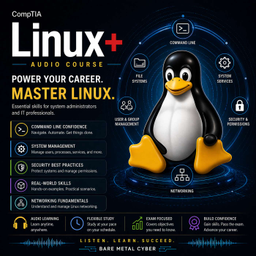
Linux+ for People With Jobs is a practical, audio-first course that teaches you to think and work like a real Linux administrator—without burying you in theory or trivia. You’ll learn the commands, concepts, and workflows the exam expects, but more importantly, you’ll build the habits that keep systems stable in production: verifying assumptions, making safe changes, and troubleshooting with a calm, repeatable process. Every episode is designed to help you study efficiently, retain what matters, and walk into the exam with confidence that actually transfers to the job.
Linux+ for People With Jobs is a practical, audio-first course that teaches you to think and work like a real Linux administrator. You’ll learn the commands, concepts, and workflows the exam expects—plus the habits that keep systems stable in production—so you can study efficiently and build confidence that transfers to the job.
This course is built for busy professionals who want clear explanations without the fluff. Each lesson is focused, hands-on in mindset, and designed to help you recognize what Linux+ is really testing—how you troubleshoot, validate, and choose the safest next step under time pressure.
You’ll move from fundamentals into daily admin skills like users and permissions, storage, networking, services, process control, scripting, and automation. Along the way, you’ll reinforce “how to think” patterns: verify before you change, read the system’s signals, reduce risk, and document repeatable steps.
By the end, you’ll have a solid mental map of the Linux+ objectives and a study rhythm that actually fits real life. Whether you’re leveling up for the exam, your current role, or your next one, you’ll come away with practical competence—not just memorized facts.
Linux+ includes memory pressure because it produces symptoms that mimic application bugs, random crashes, and performance degradation, and administrators must recognize the pattern quickly. This episode explains swapping as the system’s way of extending memory using disk-backed pages, and why heavy swapping often indicates that the workload exceeds available RAM or that memory is fragmented by competing processes. You’ll learn how the Out-Of-Memory (OOM) mechanism protects system stability by terminating processes when memory cannot be reclaimed, and how exam prompts may describe “killed” processes or sudden service exits as evidence of OOM conditions. We also introduce memory leaks as a behavior pattern where a process’s memory use grows over time without being released, creating gradual degradation that can culminate in swapping storms or OOM events.
we apply memory pressure concepts to troubleshooting and best practices. You’ll practice distinguishing transient spikes from sustained leaks by looking at trends and correlating events with workload changes, not just reading one snapshot metric. We also cover operational decisions: when to restart a leaking service, when to tune limits and resource allocations, and when to investigate deeper root causes like misbehaving dependencies or runaway caching behavior. Finally, you’ll learn exam-aligned safety habits: avoid “fixing” by disabling swap without understanding impact, confirm which process was killed and why, and validate recovery by observing that swap usage and memory pressure stabilize after remediation, so your system returns to predictable performance rather than repeating the same failure cycle. Produced by BareMetalCyber.com, where you’ll find more cyber audio courses, books, and information to strengthen your educational path. Also, if you want to stay up to date with the latest news, visit DailyCyber.News for a newsletter you can use, and a daily podcast you can commute with.
7 Feb 2026
Episode 104 — CPU and load: high CPU, load average, context switching, slow startup
Linux+ tests performance diagnosis because “system is slow” demands you identify which resource is constrained and which metric actually indicates the bottleneck. This episode explains high CPU usage versus high load average as different signals: CPU usage shows active computation, while load reflects runnable and uninterruptible tasks waiting for CPU or I/O. You’ll learn why context switching matters: excessive switching can indicate too many runnable tasks, poor scheduling conditions, or contention that wastes CPU time. We also cover slow startup as a symptom that can be driven by CPU contention, dependency ordering, storage latency, or service retries. The goal is to build a performance reasoning model where you interpret metrics as evidence, not as isolated numbers, and choose next steps that prove the cause quickly.
we apply performance reasoning to exam-style scenarios and practical operational decisions. You’ll practice distinguishing a truly CPU-bound workload from one that is I/O-bound but reported as “high load,” and learning how to spot when many processes compete for CPU in a way that degrades responsiveness even if no single process looks extreme. We also cover best practices: establish baselines, correlate spikes with changes or scheduled jobs, and avoid killing processes blindly when reprioritization or throttling might preserve service health. Finally, you’ll learn exam-aligned troubleshooting: identify the top consumers, check whether tasks are blocked or runnable, validate whether startup delays come from service dependencies or resource constraints, and apply the smallest corrective action that restores stability without masking the underlying performance issue. Produced by BareMetalCyber.com, where you’ll find more cyber audio courses, books, and information to strengthen your educational path. Also, if you want to stay up to date with the latest news, visit DailyCyber.News for a newsletter you can use, and a daily podcast you can commute with.
Contact Certified: The CompTIA Linux+ Audio Course
Guest appearances
Does not typically book guests
Based on episode analysis; this does not confirm that the show is currently accepting guests.
Host of Certified: The CompTIA Linux+ Audio Course?
Claim your podcast to manage its listing and keep your show details accurate.
Pod Engine is an independent podcast discovery and analytics service and is not affiliated with or endorsed by this podcast. Artwork and show content belong to their owners. Full legal notice.
Explore this show Podcast research with Pod Engine