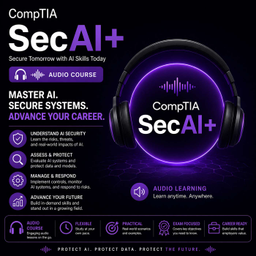
Podcast thumbnail for Certified: The CompTIA SecAI+ Audio Course

Certified: The CompTIA SecAI+ Audio Course

Claim This Podcast

by Jason Edwards

91 episodes
Updated Daily
Accepts GuestsHas Sponsors

Podcast Overview

Certified: The CompTIA SecAI Certification Audio Course is an audio-first training program built for busy IT and security professionals who want to understand how AI changes cybersecurity work—and how security changes when AI is part of the environment. It’s designed for early- to mid-career practitioners, analysts, administrators, and technically curious managers who need a practical foundation without wading through research papers or hype. If you already speak basic security—identity, logging, vulnerability management, incident response—this course helps you connect those skills to modern AI systems in a way that makes sense on the job. You can use it as preparation for a CompTIA SecAI certification path, or as a focused upskilling track if your organization is adopting AI tools and you need to stay credible in the room. Inside Certified: The CompTIA SecAI Certification Audio Course, you’ll learn how AI systems work at a level that matters for defense, governance, and risk decisions. We cover the security concerns that show up in real environments: data exposure, model misuse, prompt injection, supply-chain risk in AI components, access control for AI tools, and the operational controls that make AI safer in production. You’ll also build a working vocabulary for the space—models, training data, inference, embeddings, retrieval, and guardrails—so you can read vendor claims with a sharper eye and communicate clearly with engineers and leadership. The teaching approach is built for audio: short, focused explanations, plain-English definitions, and repeated reinforcement of the concepts you actually need to recall under pressure. What makes Certified: The CompTIA SecAI Certification Audio Course different is that it treats AI security as security—not as magic and not as fear. You’ll get clear mental models, practical decision points, and the “why this matters” context that helps you choose controls instead of collecting buzzwords. Success looks like being able to walk into an architecture review and ask the right questions, map AI risks to familiar security practices, and recognize what good governance and monitoring should look like. It also looks like confidence: you can explain the difference between a data problem and a model problem, spot common failure modes, and recommend safeguards that are proportionate to the business use case. If you finish this course and feel calmer, sharper, and harder to mislead about AI security, it did its job.

Language

🇺🇲

Publishing Since

2/23/2026

1 verified contact email on file for Certified: The CompTIA SecAI+ Audio Course

Pitch yourself as a guest, propose sponsorships, or reach out directly to the host.

Recent Episodes

Episode thumbnail for Episode 90 — Prevent Shadow AI: Sanctioned Tools, Usage Rules, and Enforcement Patterns

February 23, 2026

Episode 90 — Prevent Shadow AI: Sanctioned Tools, Usage Rules, and Enforcement Patterns

<p> This episode focuses on preventing shadow AI as a governance and data protection requirement, because SecAI+ expects you to control unapproved tools that employees adopt for convenience, often without understanding how prompts, files, and proprietary data may be retained, reused, or exposed. You will learn why shadow AI emerges, including friction in approved tooling, unclear policies, and rapid feature availability, then connect that to practical risks like confidential data leaving the organization, licensing and IP exposure, inconsistent security logging, and uncontrolled model behaviors influencing decisions. We will cover prevention patterns such as providing sanctioned tools that meet real user needs, defining clear usage rules tied to data classification, implementing technical controls like access restrictions and DLP where appropriate, and creating training that explains what is allowed with concrete examples rather than vague warnings. You will also learn enforcement patterns that are realistic, including monitoring for risky data flows, investigating repeated violations, and adjusting policies and tooling to reduce incentives for workarounds, while keeping governance credible and auditable. Produced by BareMetalCyber.com, where you’ll find more cyber audio courses, books, and information to strengthen your educational path. Also, if you want to stay up to date with the latest news, visit DailyCyber.News for a newsletter you can use, and a daily podcast you can commute with.</p>

Episode thumbnail for Episode 89 — Apply Responsible AI Principles: Fairness, Transparency, and Explainability Choices

February 23, 2026

Episode 89 — Apply Responsible AI Principles: Fairness, Transparency, and Explainability Choices

<p> This episode teaches responsible AI principles in an exam-ready, security-relevant way, because SecAI+ expects you to translate fairness, transparency, and explainability into practical choices that reduce harm, improve trust, and support governance rather than treating them as abstract ideals. You will learn how fairness concerns arise from biased data, uneven error rates across groups, and feedback loops that reinforce historical patterns, then connect those concerns to security outcomes like discriminatory access decisions, inconsistent fraud controls, or reputational risk after a public incident. We will cover transparency expectations such as clearly communicating system purpose, limitations, and data usage, and why transparency must be balanced against security needs so you do not reveal internal defenses or sensitive sources. You will also learn how to choose explainability methods that fit the model and the decision, including when simple interpretable models are preferable, when post-hoc explanations are acceptable with caveats, and how to validate that explanations are stable and not misleading. Troubleshooting considerations include detecting fairness regressions after retraining, documenting tradeoffs for auditors, and designing escalation rules so high-impact decisions always have human review and clear evidence trails. Produced by BareMetalCyber.com, where you’ll find more cyber audio courses, books, and information to strengthen your educational path. Also, if you want to stay up to date with the latest news, visit DailyCyber.News for a newsletter you can use, and a daily podcast you can commute with.</p>

Episode thumbnail for Episode 88 — Define AI Security Responsibilities: Owners, Approvers, Builders, and Auditors

February 23, 2026

Episode 88 — Define AI Security Responsibilities: Owners, Approvers, Builders, and Auditors

<p>This episode focuses on defining responsibilities clearly, because SecAI+ scenarios often reveal failures caused by vague ownership, where everyone assumes someone else handled security review, data permissions, or monitoring, and the exam expects you to fix that with explicit accountability. You will learn how to separate responsibilities across owners who define outcomes and accept risk, approvers who validate security and compliance requirements, builders who implement controls and document evidence, and auditors who verify performance and investigate gaps independently. We will connect these roles to concrete artifacts like model cards and evaluation reports, data lineage documentation, access control decisions for retrieval and tools, change logs for prompts and model versions, and incident response playbooks for abuse, leakage, or drift. You will also learn how to avoid common pitfalls such as letting builders approve their own changes, leaving service accounts unmanaged, or assuming vendor attestations replace internal validation. Troubleshooting considerations include handling shared services across multiple business units, aligning responsibilities with existing security and compliance structures, and ensuring responsibilities remain valid as systems evolve from pilots to production services with real business impact. Produced by BareMetalCyber.com, where you’ll find more cyber audio courses, books, and information to strengthen your educational path. Also, if you want to stay up to date with the latest news, visit DailyCyber.News for a newsletter you can use, and a daily podcast you can commute with.</p>

91 total episodes available

Deep-dive analytics for Certified: The CompTIA SecAI+ Audio Course

Frequently asked questions

Have a different question and can't find the answer you're looking for? Reach out to our support team by sending us an email and we'll get back to you as soon as we can.

What is Certified: The CompTIA SecAI+ Audio Course?

Certified: The CompTIA SecAI Certification Audio Course is an audio-first training program built for busy IT and security professionals who want to understand how AI changes cybersecurity work—and how security changes when AI is part of the environment. It’s designed for early- to mid-career practitioners, analysts, administrators, and technically curious managers who need a practical foundation without wading through research papers or hype. If you already speak basic security—identity, logging, vulnerability management, incident response—this course helps you connect those skills to modern AI systems in a way that makes sense on the job. You can use it as preparation for a CompTIA SecAI certification path, or as a focused upskilling track if your organization is adopting AI tools and you need to stay credible in the room.

Inside Certified: The CompTIA SecAI Certification Audio Course, you’ll learn how AI systems work at a level that matters for defense, governance, and risk decisions. We cover the security concerns that show up in real environments: data exposure, model misuse, prompt injection, supply-chain risk in AI components, access control for AI tools, and the operational controls that make AI safer in production. You’ll also build a working vocabulary for the space—models, training data, inference, embeddings, retrieval, and guardrails—so you can read vendor claims with a sharper eye and communicate clearly with engineers and leadership. The teaching approach is built for audio: short, focused explanations, plain-English definitions, and repeated reinforcement of the concepts you actually need to recall under pressure.

What makes Certified: The CompTIA SecAI Certification Audio Course different is that it treats AI security as security—not as magic and not as fear. You’ll get clear mental models, practical decision points, and the “why this matters” context that helps you choose controls instead of collecting buzzwords. Success looks like being able to walk into an architecture review and ask the right questions, map AI risks to familiar security practices, and recognize what good governance and monitoring should look like. It also looks like confidence: you can explain the difference between a data problem and a model problem, spot common failure modes, and recommend safeguards that are proportionate to the business use case. If you finish this course and feel calmer, sharper, and harder to mislead about AI security, it did its job.

How often does this podcast release new episodes?

This podcast updates daily.

Where can I listen to this podcast?

This podcast is available on 4 platforms including Apple Podcasts, Spotify, and more. You can also use the RSS feed directly.

Does this podcast accept guests?

No, this podcast does not typically feature guests.

Legal Disclaimer

Pod Engine is not affiliated with, endorsed by, or officially connected with any of the podcasts displayed on this platform. We operate independently as a podcast discovery and analytics service.

All podcast artwork, thumbnails, and content displayed on this page are the property of their respective owners and are protected by applicable copyright laws. This includes, but is not limited to, podcast cover art, episode artwork, show descriptions, episode titles, transcripts, audio snippets, and any other content originating from the podcast creators or their licensors.

We display this content under fair use principles and/or implied license for the purpose of podcast discovery, information, and commentary. We make no claim of ownership over any podcast content, artwork, or related materials shown on this platform. All trademarks, service marks, and trade names are the property of their respective owners.

While we strive to ensure all content usage is properly authorized, if you are a rights holder and believe your content is being used inappropriately or without proper authorization, please contact us immediately at hey@podengine.ai for prompt review and appropriate action, which may include content removal or proper attribution.

By accessing and using this platform, you acknowledge and agree to respect all applicable copyright laws and intellectual property rights of content owners. Any unauthorized reproduction, distribution, or commercial use of the content displayed on this platform is strictly prohibited.