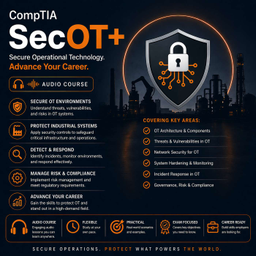
Podcast thumbnail for Certified: The CompTIA SecOT+ Audio Course

Certified: The CompTIA SecOT+ Audio Course

Claim This Podcast

by Jason Edwards

89 episodes
Updated Daily
Accepts GuestsHas Sponsors

Podcast Overview

Certified: The CompTIA SecOT Certification Audio Course is built for security practitioners and aspiring operators who need a practical, audio-first path into day-to-day security work. If you’re early career in cybersecurity, moving from IT into security operations, or stepping into a SOC-adjacent role, this course is designed to meet you where you are. You don’t need a lab rack or a perfect study schedule. You need clear explanations, realistic context, and a steady cadence that fits commutes, workouts, and the hours in between meetings. In Certified: The CompTIA SecOT Certification Audio Course, you’ll learn how modern security operations actually runs: what to monitor, how to interpret signals, and how to respond with calm precision. We’ll cover the flow from detection to triage to containment, with plain-English breakdowns of the tools and concepts you’re expected to understand. Because it’s audio-first, the teaching style is deliberate: short mental models, repeatable decision steps, and simple language that sticks. You can listen straight through or replay sections until the ideas feel automatic. What sets Certified: The CompTIA SecOT Certification Audio Course apart is that it treats “operations” as a craft, not a pile of terms to memorize. You’ll practice thinking like an analyst: separating noise from risk, asking better questions, and documenting what matters so others can act quickly. Success here looks like confidence under pressure—knowing what good triage sounds like, how to escalate cleanly, and how to keep your work defensible. Whether you’re preparing for the certification or building real-world readiness, you’ll finish with a stronger operational mindset and a clearer path forward.

Language

🇺🇲

Publishing Since

2/23/2026

1 verified contact email on file for Certified: The CompTIA SecOT+ Audio Course

Pitch yourself as a guest, propose sponsorships, or reach out directly to the host.

Recent Episodes

Episode thumbnail for Episode 88 — Prepare for Incidents: Draft and Update IR Documentation That OT Can Use

February 23, 2026

Episode 88 — Prepare for Incidents: Draft and Update IR Documentation That OT Can Use

<p>This episode teaches how to prepare for incidents by drafting and maintaining IR documentation that OT teams can actually use during real events, where time pressure and safety constraints punish vague plans. You’ll learn what documentation must exist before an incident, including role assignments, contact trees, escalation criteria, safe containment principles, evidence handling procedures, communications templates, and site-specific constraints like maintenance windows and vendor-only change authority. We discuss why OT IR documentation should be practical and localized, with clear language, explicit decision pathways, and references to validated diagrams and inventories, so responders are not forced to invent structure mid-incident. Updating is framed as a continuous improvement loop, using lessons learned from exercises, near misses, vendor changes, and architecture updates to keep documentation aligned with reality instead of letting it drift into irrelevance. The episode also reinforces exam-ready thinking by showing how “prepare” often means building checklists, approvals, and evidence packages that enable safe action, fast coordination, and defensible decisions when the next incident arrives. Produced by BareMetalCyber.com, where you’ll find more cyber audio courses, books, and information to strengthen your educational path. Also, if you want to stay up to date with the latest news, visit DailyCyber.News for a newsletter you can use, and a daily podcast you can commute with.</p>

Episode thumbnail for Episode 87 — Execute Escalation and Notification: Internal, Government, and Regulator Expectations

February 23, 2026

Episode 87 — Execute Escalation and Notification: Internal, Government, and Regulator Expectations

<p>This episode explains escalation and notification as disciplined processes that protect safety, preserve credibility, and reduce legal and regulatory risk, because delayed or inconsistent notifications can create consequences that outlast the technical incident. You’ll learn how internal escalation should work across operations, engineering, safety, IT, security leadership, legal, and communications, with clear triggers that avoid both panic escalation and dangerous delays. We cover external notification considerations, including when government coordination may be appropriate, how sector expectations influence timelines, and how regulator expectations tend to focus on accuracy, timeliness, and evidence of control rather than perfect certainty in early hours. The episode emphasizes that notification content must be grounded in what is known, what is unknown, and what actions are being taken, so teams avoid speculative statements that damage trust or create liability. Troubleshooting considerations include handling conflicting reports, ensuring time synchronization and decision logging, and maintaining a single authoritative narrative while technical teams continue investigation and containment under safety constraints. Produced by BareMetalCyber.com, where you’ll find more cyber audio courses, books, and information to strengthen your educational path. Also, if you want to stay up to date with the latest news, visit DailyCyber.News for a newsletter you can use, and a daily podcast you can commute with.</p>

Episode thumbnail for Episode 86 — Plan Mutual Aid and Retainers: ISACs, Peer Support, and IRR Readiness

February 23, 2026

Episode 86 — Plan Mutual Aid and Retainers: ISACs, Peer Support, and IRR Readiness

<p>This episode teaches how to plan mutual aid and retainers so OT incident response readiness is real, not theoretical, especially when specialized expertise and vendor knowledge may be required quickly. You’ll learn how mutual aid works in practice through sector communities and peer support, and why relationships and pre-defined trust are often more valuable than scrambling for contacts during a crisis. ISAC participation is discussed as a practical channel for timely intelligence, peer lessons learned, and coordinated response support, with an emphasis on how to consume and act on shared information safely in OT environments. Retainers are covered as contractual readiness tools, including defining scope, response timelines, access requirements, evidence handling expectations, and how retained responders coordinate with operations and safety leadership rather than operating like an external IT incident team. IRR readiness is framed as having the right people, contracts, procedures, and approvals in place so help can be activated without delay, while still maintaining governance and safe operational behavior. Produced by BareMetalCyber.com, where you’ll find more cyber audio courses, books, and information to strengthen your educational path. Also, if you want to stay up to date with the latest news, visit DailyCyber.News for a newsletter you can use, and a daily podcast you can commute with.</p>

89 total episodes available

Deep-dive analytics for Certified: The CompTIA SecOT+ Audio Course

Frequently asked questions

Have a different question and can't find the answer you're looking for? Reach out to our support team by sending us an email and we'll get back to you as soon as we can.

What is Certified: The CompTIA SecOT+ Audio Course?

Certified: The CompTIA SecOT Certification Audio Course is built for security practitioners and aspiring operators who need a practical, audio-first path into day-to-day security work. If you’re early career in cybersecurity, moving from IT into security operations, or stepping into a SOC-adjacent role, this course is designed to meet you where you are. You don’t need a lab rack or a perfect study schedule. You need clear explanations, realistic context, and a steady cadence that fits commutes, workouts, and the hours in between meetings.

In Certified: The CompTIA SecOT Certification Audio Course, you’ll learn how modern security operations actually runs: what to monitor, how to interpret signals, and how to respond with calm precision. We’ll cover the flow from detection to triage to containment, with plain-English breakdowns of the tools and concepts you’re expected to understand. Because it’s audio-first, the teaching style is deliberate: short mental models, repeatable decision steps, and simple language that sticks. You can listen straight through or replay sections until the ideas feel automatic.

What sets Certified: The CompTIA SecOT Certification Audio Course apart is that it treats “operations” as a craft, not a pile of terms to memorize. You’ll practice thinking like an analyst: separating noise from risk, asking better questions, and documenting what matters so others can act quickly. Success here looks like confidence under pressure—knowing what good triage sounds like, how to escalate cleanly, and how to keep your work defensible. Whether you’re preparing for the certification or building real-world readiness, you’ll finish with a stronger operational mindset and a clearer path forward.

How often does this podcast release new episodes?

This podcast updates daily.

Where can I listen to this podcast?

This podcast is available on 4 platforms including Apple Podcasts, Spotify, and more. You can also use the RSS feed directly.

Does this podcast accept guests?

No, this podcast does not typically feature guests.

Legal Disclaimer

Pod Engine is not affiliated with, endorsed by, or officially connected with any of the podcasts displayed on this platform. We operate independently as a podcast discovery and analytics service.

All podcast artwork, thumbnails, and content displayed on this page are the property of their respective owners and are protected by applicable copyright laws. This includes, but is not limited to, podcast cover art, episode artwork, show descriptions, episode titles, transcripts, audio snippets, and any other content originating from the podcast creators or their licensors.

We display this content under fair use principles and/or implied license for the purpose of podcast discovery, information, and commentary. We make no claim of ownership over any podcast content, artwork, or related materials shown on this platform. All trademarks, service marks, and trade names are the property of their respective owners.

While we strive to ensure all content usage is properly authorized, if you are a rights holder and believe your content is being used inappropriately or without proper authorization, please contact us immediately at hey@podengine.ai for prompt review and appropriate action, which may include content removal or proper attribution.

By accessing and using this platform, you acknowledge and agree to respect all applicable copyright laws and intellectual property rights of content owners. Any unauthorized reproduction, distribution, or commercial use of the content displayed on this platform is strictly prohibited.