- 142
- Episodes
- Bi-weekly
- Cadence
- 2021
- First episode
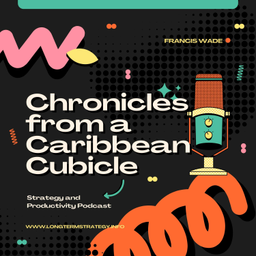
About Chronicles from a Caribbean Cubicle Podcast
There are significant challenges facing Caribbean companies. In the areas of strategic planning and productivity improvements, unique thinking is needed to break out of historical norms. But such thinking isn’t easy to find. Join me, Francis Wade, for some provocative insights into the way I see these problems. These are mostly audio editions of past Gleanr articles. longtermstrategy.substack.com (https://longtermstrategy.substack.com/s/chronicles-from-a-caribbean-cubicle?utm_medium=podcast)
- Publisher
- Francis Wade
- Category
- business · business
- Language
- en
- Explicit
- No
- First episode
- 9 Mar 2021
- Latest episode
- 5 Aug 2026
Latest episodes
142 episodes in the feed.
5 Aug 2026
The One Diagnostic Step Every Failed AI Rollout Skipped
There are two ways a board loses confidence in a CEO’s AI strategy. One is watching a rushed rollout blow up in public. The other is watching nothing happen, quarter after quarter, while rivals pull ahead. Leaders treat these as opposite sins — one of recklessness, one of paralysis. They are the same sin wearing two costumes. Consider a government vehicle-inspection office. For years, getting a car certified meant a wasted morning: unexplained queues, arbitrary waits, a process nobody could explain and everybody dreaded. The clerks weren’t the problem. They were as trapped in the system as the drivers standing in line. When the office was finally redesigned, the fix didn’t come from the counter staff working harder. It came from above — from leadership finally treating the process itself as something to be mapped, tested, and rebuilt. Decades of avoidable frustration turned out to be a leadership failure wearing a service-counter disguise. That’s the pattern behind almost every stalled or embarrassing AI rollout today: cause and effect get separated. The department that visibly breaks is rarely the one that made the mistake. The quarter where the failure shows up is rarely the quarter where it was made. That lag is exactly why the rushed CEO and the frozen CEO can’t see they share a cause. Skip the diagnosis, and the bill arrives later — as a scrapped pilot, a quiet rollback, or a board that’s run out of patience. Each time, it looks like an isolated, unrelated event. It isn’t. The Proof Is Piling Up This isn’t a resource problem, and it isn’t confined to one company, sector, or country. Starbucks spent nine months running an AI tool meant to automate beverage-inventory counts across its North American stores, before quietly retiring it after the system kept miscounting and mislabeling items, such as confusing similar milk types. Ford has been rehiring and promoting more than 350 experienced engineers after automated quality-control systems failed to capture the expertise of veteran employees. Commonwealth Bank of Australia replaced dozens of customer-service staff with an AI voice bot, then had to reverse the job cuts when the system couldn’t keep up and call volumes climbed. IBM automated large parts of its HR function, discovered the tool could resolve routine requests but stumbled on anything requiring judgment, and announced plans to triple its U.S. entry-level hiring soon after. A widely cited MIT study found that 95% of enterprise generative AI pilots fail to deliver measurable returns. None of these were companies short on capital, talent, or enthusiasm. Every one of them had the AI capability. What none of them had was a diagnosis of the underlying process before the tool was chosen. What Got Lost That’s understandable, in a way. Most companies today are wide open to AI because their own stakeholders are demanding they keep up. A new tool appears, it gets deployed, and results get measured afterward. That works fine when the change is as simple as installing a new printer. It fails the moment the process underneath is genuinely complex — which is most of the time. What’s missing is the step where the existing process gets mapped, stress-tested for bottlenecks, and redesigned before automation is even on the table. Both the rushed CEO and the frozen CEO would benefit from the identical corrective move — not “go faster,” not “go slower,” but insert the diagnostic step neither is in the habit of taking. If that sounds obvious, it’s worth asking why so many organizations quietly abandoned it. Process management — mapping, testing, and redesigning core operations — was standard executive discipline in the 1990s, built on Total Quality Management, Lean, and the Theory of Constraints. Somewhere along the way, leadership teams let it lapse. The lesson hasn’t gone anywhere; it’s just been sitting unused. Years before generative AI, executives attempting Robotic Process Automation without first doing this work were warned by experts that skipping it was a recipe for failure. The warning was accurate then. It’s still accurate now, just louder. There’s a second reason the step feels skippable: nearly every executive has personally felt AI work well. Ask ChatGPT or Claude a question on your phone, and an articulate, confident answer arrives in seconds. That experience quietly convinces leaders that AI should transform every part of the business with the same ease. But personal productivity gains and enterprise-wide transformation are not the same category of problem. Real organizational change requires the unglamorous work of scoping, staffing, and sequencing multi-year projects. There is no shortcut from a good chatbot answer to a redesigned supply chain. One Reveal Worth Adding In other podcast I have drawn a sharp line between planning and strategy: planning extrapolates from what you’re already doing, while strategy forces a real choice that involves tradeoffs. Most AI “strategies” are actually AI plans — lists of tools to deploy, extrapolated from what competitors are doing, with no binding constraint identified and no real choice made. A genuine AI strategy starts by asking which single process constraint, if resolved, would unlock the most value — and works backward from there. Everything else is activity dressed up as strategy. The Actual Fix The CEOs who rush and the CEOs who freeze are both missing the same discipline — not courage, not caution, but the willingness to slow down at the exact moment everyone else is speeding up. The rushed CEO skips the diagnosis to look decisive. The frozen CEO avoids it to look careful. Neither has done the work. The fix isn’t a faster rollout or a longer pause. It’s a process that’s been mapped and stress-tested before a single tool gets chosen. Boards don’t ultimately reward the leader who moved first or the one who moved last. They reward the one who knew where to look before moving at all. PS: 5 Prompts to Use With Your Favorite LLM Copy these into Claude, ChatGPT, or your assistant of choice to apply the article to your own organization. * Find your lag. “Walk me through a recent failure or slowdown in my organization. Help me trace it backward — what department, decision, or process choice from 12–24 months ago might actually be the root cause, even if it doesn’t look connected on the surface?” * Spot your substitute behavior. “I’m about to approve/reject an AI tool for [describe the process]. Before I decide, ask me questions that test whether I’ve actually mapped this process and identified its bottleneck — or whether I’m just reacting to pressure to ‘do something.’” * Run a mini process diagnosis. “Here’s how [a specific process] works today, step by step: [describe it]. Identify the most likely bottleneck, and tell me what would need to be true for automating this process to actually help rather than just move the bottleneck somewhere else.” * Test for real strategy vs. planning. “Here’s my current AI roadmap: [paste it]. Using Roger Martin’s distinction between planning and strategy, tell me honestly whether this is a strategy — with a real choice and a clear binding constraint — or a plan that’s just a list of tools.” * Pressure-test your own excuse. “I’m the CEO/leader in this situation: [describe whether you’re moving fast or holding back on AI]. Play devil’s advocate and challenge me on whether my current pace is actually a disguised way of avoiding a proper process diagnosis.” This is a public episode. If you'd like to discuss this with other subscribers or get access to bonus episodes, visit longtermstrategy.substack.com/subscribe (https://longtermstrategy.substack.com/subscribe?utm_medium=podcast&utm_campaign=CTA_2)
16 Jul 2026
The Missing Rung: Why Your Innovation Efforts Remain Uninspiring and Empty
The Missing Rung: Why Your Innovation Efforts Remain Uninspiring and Empty As the person responsible for driving innovation in your organisation, you have probably sat through a version of this conversation more than once. The leadership team agrees that a new category is needed. Everyone nods. A workshop is scheduled. Consultants are hired, sticky notes are deployed, and three months later the team resurfaces with a list of incremental improvements dressed up in the language of transformation. Nothing changes. The cycle repeats. This is not a talent problem. It is not a budget problem. It is not even a creativity problem — though it will feel like one. It is a navigation problem. And the reason it keeps recurring is that most organisations begin every innovation effort from the same invisible assumption: that they already know what kind of thing they are trying to become. They don’t. And without that clarity, no workshop, no consultant, and no off-site retreat will produce a genuinely new category. You will keep generating better versions of what you already are. There is a framework that changes this calculus entirely. It arrived quietly, in a new book by Joe Pine — the same strategist who gave executives The Experience Economy twenty-five years ago and reshaped the way the world thought about what companies actually sell. What a Category Actually Is Before you can design a new category, you need a precise definition of what a category is. In business, a category is not a filing label or a market segment. It is a space in people’s minds — the mental frame that allows a customer to understand what a product is, where it belongs in their life, and why it matters. “Smartphone,” “microwave oven,” and “streaming service” are all categories that someone invented. Each one began as an answer to a need that customers had not yet been able to name. Category design — the deliberate act of creating a new mental frame rather than competing inside an existing one — is widely discussed and rarely achieved. Most executives who attempt it eventually conclude that it requires a creative leap they cannot engineer. That conclusion, it turns out, is wrong. What it actually requires is a ladder. The Ladder Most Executives Have Only Seen Half Of Pine’s original insight, from The Experience Economy, was that organisations don’t just sell things — they offer value at different levels, and those levels form a hierarchy. At the bottom are commodities: undifferentiated raw inputs where price is everything. Above that are products: manufactured goods with consistent specifications. Above that are services: activities performed on behalf of the customer. And above that are experiences: carefully staged events that engage customers emotionally and memorably. Every hotel in the world, for example, offers a blend of products and services — a room, a meal, a concierge. A smaller number have moved up to experiences: the Marriott’s flagship properties with their signature design and curated atmosphere. Sandals, in the Caribbean, built an entire brand around the all-inclusive experience category. Each of these companies moved up Pine’s ladder deliberately, and each time they did, they left their competitors arguing about price on the rung below. Here is what Pine’s original framework did not include — and what his new book, Transformation Economy, now adds. There is a fifth rung. Above experience sits transformation: an offering that does not merely engage or delight the customer, but permanently changes them. Not their situation. Not their environment. Them — their skills, their identity, their capabilities, their trajectory. This rung exists in every industry. In most, it is unnamed, unclaimed, and therefore available. It is the most defensible category a company can occupy, and the hardest to copy, because transformation is not a feature. It is a relationship with a long-term outcome. Rung Invisibility: The Hidden Reason Innovation Stalls Most companies have never asked which rung they currently occupy. They operate without a precise definition of their own offering type, which means that when they sit down to innovate, they have no fixed starting point. Call it rung invisibility: you cannot climb toward a destination you cannot see. This is the innovator’s dilemma in its most structural form. It is not that successful companies refuse to innovate — it is that they keep innovating on the wrong rung. They add features to products, extend services, improve experiences, and call it transformation. The ladder makes the distinction visible. Once you can see the rungs, you can locate yourself accurately, name the next rung, and build toward it with precision. Waiting With a Destination in View In 2007, Andrew Ng began uploading his Stanford computer science lectures to the internet. The vision was clear: university-quality education, accessible to anyone, anywhere, free. What was not yet ready was the road. Broadband penetration was uneven. Streaming infrastructure was immature. Mobile adoption had not reached the scale required. The concept of learning via video had not yet been normalised for a mass audience. Ng spent five years building precursors, testing formats, and watching the infrastructure mature. When Coursera launched in 2012, it was not because the idea had finally arrived — it was because the enabling conditions had. MasterClass followed a similar logic: the transformation offering was clear (learn directly from the world’s best practitioners, not just their subject matter), but the model required cinematic production quality and broadband capable of delivering it at scale. Both companies launched not when they were ready, but when the world was. This is a categorically different posture from running innovation workshops. It is not luck. It is not serendipity. It is the discipline of naming a destination — a specific rung, a specific transformation offering — and then building the long-term strategy around the conditions that will make the climb viable. Pine himself waited over twenty-five years to write Transformation Economy. As he has said, the world simply wasn’t ready before now. Corporate Inspiration at Its Finest As a leader, you have probably tried to inspire your organisation through personal energy — motivating speeches, bold vision statements, off-site retreats designed to generate momentum. When the results are mixed, the temptation is to conclude that you need more charisma, a better facilitator, or a more compelling narrative. You don’t. What you need is a structure that does the inspiring for you. This is what Pine’s ladder offers when it is embedded in a corporate strategy: inspiration that lives in the architecture of the plan itself. Aspirational but credible. Fact-based. Free of hyperbole. Specific enough to span a decade without losing its force. When employees understand not just what the company does today but which rung it is climbing toward — and what conditions the organisation is watching for — they engage differently. The destination gives their work a direction that no workshop can manufacture. Steve Jobs was explicit, in at least one public interview, that Apple’s strategy was to wait — to define the destination clearly and hold it until the technology matured enough to make the climb possible. Inside Apple, the roadmap to the iPhone and iCloud gave those who knew it something to work toward that transcended any individual product cycle. That kind of inspiration is structural, not charismatic. It is replicable. And it begins with locating yourself honestly on the ladder. What to Do Next Every organisation, without exception, can do this. The transformation rung exists in your industry. It is almost certainly unnamed. The fact that it is unclaimed is not a warning — it is an invitation. The work begins with three questions. What rung does your organisation currently occupy — precisely, not aspirationally? What would a transformation offering look like in your sector: what would it permanently change about your customer? And what enabling conditions — technological, cultural, regulatory, infrastructural — are not yet mature, but are on their way? The EndPoint Method offers one systematic approach to answering these questions within a long-term strategy process. But the starting point is available to any leadership team willing to look at the ladder honestly and ask where they are. Innovation is not a creativity problem. It is a navigation problem. Pine’s ladder is the instrument. The fifth rung is waiting. PS — Five Prompts to Take This Further Use these with any AI assistant (Claude, ChatGPT, or similar). Replace the bracketed text with your own details. Prompt 1 — Locate your rung “I work in [industry]. Our core offering is [brief description]. Using Joe Pine’s five-rung ladder — commodities, products, services, experiences, transformations — help me identify which rung we currently occupy and what evidence supports that assessment. Be precise, not flattering.” Prompt 2 — Define the transformation offering “In the [industry] sector, what would a genuine transformation offering look like? Define it using Pine’s standard: an offering that permanently changes the customer themselves, not merely their situation or experience. Give me three specific examples of what this could mean for a company like [company type].” Prompt 3 — Map the enabling conditions “The transformation offering I want to build is [brief description]. What external conditions — technological, cultural, regulatory, or infrastructural — are not yet mature enough to support this at scale? Which of these are likely to mature in the next five to fifteen years, and what signals should I be watching for?” Prompt 4 — Diagnose your innovation process “My organisation runs [describe your current innovation process — workshops, sprints, planning cycles]. Using the concept of rung invisibility — the idea that companies cannot innovate toward a destination they cannot see — identify the specific points in our process where the absence of a named transformation rung is likely to be causing us to recycle existing assumptions.” Prompt 5 — Draft the strategic narrative “Help me write a one-page internal strategic narrative for my leadership team that: names our current rung on Pine’s ladder, defines the transformation offering we are building toward, identifies the two or three enabling conditions we are watching, and explains why this is a navigation strategy rather than a creativity exercise. Tone: direct, credible, free of consultant language.” P.S. The LTSP26 Conference is open for registration on the conference website (https://strategyconf.fwconsulting.com) and on on Linkedin. https://www.linkedin.com/events/7475287796359028737 (https://www.linkedin.com/events/7475287796359028737). Part of the lineup will feature Category Cathy, an interactive AI persona with unique knowledge of work by experts like Joe Pine (https://www.linkedin.com/article/edit/7481117076045148160/?author=urn%3Ali%3Afsd_company%3A1171057#), author of Transformation Economy. This is a public episode. If you'd like to discuss this with other subscribers or get access to bonus episodes, visit longtermstrategy.substack.com/subscribe (https://longtermstrategy.substack.com/subscribe?utm_medium=podcast&utm_campaign=CTA_2)
10 Jul 2026
The CEO Who Solved Everything - But Inspired No-one
Transcript The CEO Who Solved Everything — and Inspired No One You are putting in serious effort to motivate your team — and it still isn’t working. The hours are long, the intent is genuine, and the results are stubbornly flat. Before you blame your communication strategy, your budget, or your personality, consider a different diagnosis entirely. Two fictional CEOs illustrate the problem. Marcus is a decisive firefighter. He earned his position by tackling the problems nobody else would touch, and he has been doing the same thing ever since. Elena takes a more consultative path. She commissions engagement surveys, listens carefully to what staff say, and builds action plans from the results. Yet both are looking at the same uncomfortable numbers: absenteeism climbing, burnout reports rising, and employees quietly asking each other, “Where exactly are we headed?” Both assume the problem is in the delivery — the messaging, the resources, the rollout. They are looking in the wrong place. The actual diagnosis is a pattern called “Follower-Friendly Failure.” The Same Mistake in Different Clothes Follower-Friendly Failure is the attempt to build organisational momentum by removing friction. Fix the complaints. Address the survey results. Solve the urgent problems. The instinct is generous — leaders genuinely want to make things better for their people — but the strategy is structurally flawed. Marcus and Elena look like opposites: urgent problem-solver versus consensus-builder. But they are making the same error in different packaging. Their failure is not in how they lead. It is in what they are leading toward — or rather, the absence of any clear answer to that question. Elena’s approach is particularly instructive. Aggregating staff concerns produces a politically safe wish list, not a strategy. It assumes that resolving individual frustrations will compound into collective motivation. It won’t. Addressing one round of complaints simply surfaces the next round. The circle is vicious, and staff eventually exhaust themselves chasing problems that regenerate faster than they are solved. The missing ingredient is not smarter problem-solving. It is a destination. In this context, a destination is not a goal, a value, or a problem to be solved. It is a specific, vivid picture of where the organisation will stand at a defined point in the future — real enough that an ordinary person can orient themselves toward it. What Political Science Reveals About Leadership Research on voter behaviour offers an unexpected window into how destination-clarity functions as a loyalty mechanism. Studies of Donald Trump’s coalition have consistently found that roughly 25–35% of his supporters privately dislike specific policies, find aspects of his persona difficult, and disagree with particular decisions. They back him anyway. The reason is not charisma, party loyalty, or agreement with the plan. It is agreement with the destination. These voters know where he says the country is going, and that clarity holds them even when the specific steps, or personal foibles do not. The organisational parallel is direct. Every leadership group contains a subset of destination-first followers — people who will tolerate management friction, imperfect policies, and even a leader they find personally disagreeable, provided they can see clearly where the organisation is headed. Marcus and Elena have no mechanism for reaching this group because neither has named a destination unambiguous enough to reach them. This is what Dr. Riel Miller, a UNESCO senior adviser, calls Futures Literacy: the capacity to use the future as a resource for acting in the present. It requires holding the future genuinely open — treating several possible destinations as real — until a single, unambiguous endpoint is chosen. Once that commitment is made, something shifts. Inspiration and discretionary effort are not manufactured through communication techniques. They are released. This distinction matters more than most leadership development programmes acknowledge. Charisma, communication skill, and policy competence are all useful. But none of them substitute for a destination that employees can inhabit in their imagination before they inhabit it in reality The Leading Indicator No Dashboard Captures Executives searching for evidence that a strategy is working typically reach for lagging indicators: engagement scores, C-suite alignment, project milestones, revenue shifts. These confirm what has already happened. They do not tell you whether the organisation is actually moving. There is a better signal, and it costs nothing to detect. Consider an employee — call her Jody — who works in a mid-level, non-senior role. Her department has been identified as high-leverage: it sits in the 20% of organisational effort that drives 80% of strategic results, directly connected to a 15-year destination the company has committed to. Without a clear destination, that leverage is invisible to Jody. She spends Monday doing what she did the Monday before. This is not apathy. It is a rational response to ambiguity. When no clear endpoint exists, the safest professional behaviour is to replicate what worked yesterday. Jody is not the problem. The missing destination is. With one — a specific, unambiguous endpoint she can picture and act toward — something different happens. On Monday morning, unprompted by her manager, she spends three hours doing something she has never done before: taking deliberate actions aligned with where the organisation says it is going. Not because she was told to. Because she can see the destination and has decided to move toward it. Notice what did not cause this shift: not a town hall, not a revised KPI framework, not a team-building exercise. The destination did the work. Her manager’s job, once the destination is clear, is largely to stay out of the way. That behaviour — one ordinary person in a non-senior role doing something genuinely novel in alignment with the stated direction — is the leading indicator that a strategy is alive. Engagement surveys can score well while this signal is completely absent. The signal’s presence means the destination has landed. Its absence means it has not, regardless of what the dashboard reads. When enough Jodys emerge across an organisation, the needle moves. Not because leadership pushed harder, communicated more cleverly, or solved one more urgent problem. But because ordinary people with real jobs decided, on their own initiative, that the destination was worth moving toward. The practical implication is uncomfortable for leaders trained in comprehensive planning: resist the pressure to make the destination inclusive. A destination designed not to alienate anyone ends up directing no one. Choose one. Make it unambiguous. Then watch what Jody does on Monday morning. Five Prompts for Deeper Reflection Use these with any AI assistant (or as journaling prompts) to apply the ideas in this article to your own leadership context. Prompt 1 — Diagnose your own Follower-Friendly Failure “Here is how I currently try to motivate my team: [describe your approach]. Based on the distinction between problem-fixing and destination-setting, identify where my current approach might be producing Follower-Friendly Failure. What am I likely missing, and what would a clearer destination look like in my specific context?” Prompt 2 — Test your destination for ambiguity “Here is our current strategic vision or mission statement: [paste it]. Assess whether this constitutes a genuine, unambiguous destination that an ordinary employee could act toward on Monday morning — or whether it is a wish list, a values statement, or a problem-solving agenda in disguise. Then suggest what a sharper destination might say instead.” Prompt 3 — Find your Jody “Our organisation has articulated the following strategic direction: [describe it]. Help me identify what a ‘Jody Bloggs’ signal would look like in our context — that is, what specific, observable, novel behaviour by a non-senior employee would indicate that our destination has genuinely landed, rather than merely been communicated.” Prompt 4 — Identify your destination-first followers “The article describes a subset of followers who are loyal to a destination rather than to a leader’s personality or specific policies. Thinking about my own team or organisation, help me profile what this group might look like: how would I identify them, what do they need from a destination to engage, and how might I be inadvertently failing to reach them with my current communication?” Prompt 5 — Rewrite your strategy communication through a Futures Literacy lens “Here is how I typically communicate our strategy to staff: [paste an example — a town hall script, an all-staff email, a strategic summary]. Rewrite this using Futures Literacy principles: remove problem-solving language, eliminate wishlist elements, and replace them with a single unambiguous destination that an ordinary employee could picture and act toward. Show me the before and after side by side.” This is a public episode. If you'd like to discuss this with other subscribers or get access to bonus episodes, visit longtermstrategy.substack.com/subscribe (https://longtermstrategy.substack.com/subscribe?utm_medium=podcast&utm_campaign=CTA_2)
Podcast Authority Score: 37 / 100
A composite of feed quality, social presence, YouTube performance and engagement. Read the methodology.
- Quality
- 74
- Social presence
- 0
- YouTube
- 0
- Engagement
- 0
Host of Chronicles from a Caribbean Cubicle Podcast?
Claim your podcast to manage its listing and keep your show details accurate.
Pod Engine is an independent podcast discovery and analytics service and is not affiliated with or endorsed by this podcast. Artwork and show content belong to their owners. Full legal notice.
Explore this show
Podcast research with Pod Engine