- 28
- Episodes
- 2026
- First episode
About Civics & Commerce
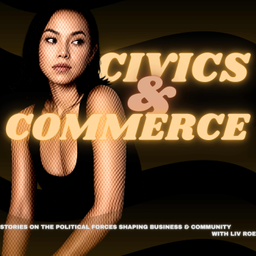
Stories on the political forces shaping business and community. civicsandcommerce.substack.com (https://civicsandcommerce.substack.com?utm_medium=podcast)
- Publisher
- 54
- Category
- business · government
- Language
- en
- Explicit
- No
- First episode
- 15 May 2026
- Latest episode
- 8 Jul 2026
Latest episodes
28 episodes in the feed.
8 Jul 2026
The politics of corporate yoga
Episode 28: Show notes The story in this episode is composite, drawn from real events. The identifying details have been changed to protect privacy, but the situations and the political contexts are real. The real-world events the story draws on, full citations, and further reading are below. REAL-WORLD EVENTS REFERENCED IN THIS EPISODE The corporate wellness industry and its empirical critique - The global wellness economy was valued at over 6.3 trillion US dollars in 2023, of which the workplace-wellness segment was 51 billion US dollars and projected to reach 58.4 billion US dollars by 2027. - A 2024 Oxford study of 46,336 UK workers across 233 organisations, drawing on Britain’s Healthiest Workplace surveys 2017-2018, compared participants and non-participants in 90 different workplace mental-health interventions. The author found no measurable wellbeing benefit from individual-level interventions including resilience training, mindfulness, stress management, relaxation classes, and wellbeing apps. The only intervention associated with positive wellbeing outcomes was workplace volunteering. - An earlier critical literature has developed since the mid-2010s on the political economy of corporate wellness, mindfulness-at-work, and the broader wellness industry’s role in transferring responsibility for the costs of overwork from the workplace to the worker. Body politics, the racialised hierarchy of wellbeing, and Indigenist health humanities - Susan Bordo’s 1993 Unbearable Weight remains a canonical study of how Western culture trains bodies, particularly female bodies, to receive themselves as projects of management through weight, food, dieting, exercise, and surgery. Bordo extended the analysis to men in her 1999 follow-up. - Sunera Thobani’s 2007 Exalted Subjects analyses how the Canadian state has constituted its national subject through racialised hierarchies, with some lives positioned as worth cultivating and others as threats to be managed. - Chelsea Watego’s 2021 Another Day in the Colony, written by a Munanjahli and South Sea Islander scholar first trained as an Aboriginal health worker, theorises Indigenist health humanities and refuses the colonial framing in which Aboriginal wellbeing is the absence of an Aboriginal problem. Costa Rica: from demilitarisation to Wellness Pura Vida - Costa Rica abolished its military on 1 December 1948 under President Jose Figueres Ferrer, following the end of the 1948 civil war. The keys to the armory were handed to the Department of Education. - The 1949 Constitution and subsequent reforms redirected the saved military spending into universal healthcare, free compulsory primary education (already established from 1870), a national social security system, and the nationalisation of electricity, telecommunications, and banking. - Costa Rica now has one of the highest average life expectancies in Latin America. The Nicoya Peninsula has been classified by Dan Buettner’s research as one of the world’s five Blue Zones, areas of unusual longevity. - The Costa Rican Tourism Board (ICT) launched its national Wellness Pura Vida strategy in the 2010s to position the country as a wellness-tourism destination. Slovenia: from Yugoslav-socialist spa rights to national wellness branding - Slovenia’s thermal-spa tradition is documented from at least 1403, when Terme Dobrna’s healing waters first appear in the record. Several Slovenian spas trace their use to Roman-era settlement. - Within Yugoslavia (1945-1991), healthcare was organised on socialist principles of universal access and solidarity, with significant decentralisation after the 1974 Constitution and the 1976 and 1980 Healthcare Acts. Spa rehabilitation in Yugoslavia’s thermal towns operated as a worker entitlement administered through the public-insurance system. - After Slovenian independence in 1991 and the 1992 health-system reforms, privatisation gradually expanded. By 2008, around 30 per cent of primary-care providers, 60 per cent of dentistry providers, and 20 per cent of outpatient specialist care were privatised. - The Slovenian Tourism Board now positions the country internationally as a wellness destination, with the 12 to 15 spas of the Association of Slovenian Natural Spas as anchor sites under a national wellness-tourism strategy. The setting acknowledgment - The City of Greater Bendigo is on the traditional lands of the Dja Dja Wurrung and the Taungurung Peoples of the Kulin Nation. The Dja Dja Wurrung Clans Aboriginal Corporation (known as DJAARA) is the registered Aboriginal party under the Traditional Owner Settlement Act 2010, following the Recognition and Settlement Agreement entered into with the State of Victoria on 28 March 2013. REFERENCES [1] Global Wellness Institute, 2023 Global Wellness Economy Monitor (Miami: Global Wellness Institute, 2023), https://globalwellnessinstitute.org/industry-research/global-wellness-economy-monitor-2023/ (Accessed: 28 May 2026). [2] William J. Fleming, “Employee Well-Being Outcomes from Individual-Level Mental Health Interventions: Cross-Sectional Evidence from the United Kingdom,” Industrial Relations Journal 55, no. 2 (2024): 162-182, https://doi.org/10.1111/irj.12418. [3] Carl Cederström and André Spicer, The Wellness Syndrome (Cambridge: Polity Press, 2015). [4] Ronald Purser, McMindfulness: How Mindfulness Became the New Capitalist Spirituality (London: Repeater Books, 2019). [5] Susan Bordo, Unbearable Weight: Feminism, Western Culture, and the Body (Berkeley: University of California Press, 1993). [6] Susan Bordo, The Male Body: A New Look at Men in Public and in Private (New York: Farrar, Straus and Giroux, 1999). [7] Sunera Thobani, Exalted Subjects: Studies in the Making of Race and Nation in Canada (Toronto: University of Toronto Press, 2007). [8] Chelsea Watego, Another Day in the Colony (St Lucia: University of Queensland Press, 2021). [9] Alejandro Abarca and Suren Pakhtigian, “A Farewell to Arms: The Peace Dividend of Costa Rica’s Army Abolition,” Journal of Development Studies (2024), https://doi.org/10.1080/00220388.2024.2445533; supporting: David P. Barash and Judith Eve Lipton, Strength Through Peace: How Demilitarization Led to Peace and Happiness in Costa Rica, and What the Rest of the World Can Learn from a Tiny, Tropical Nation (New York: Oxford University Press, 2019). [10] Visit Costa Rica (Instituto Costarricense de Turismo), “Blue Zones / Wellness Pura Vida,” https://www.visitcostarica.com/things-to-do/culture/blue-zones (Accessed: 28 May 2026); on the original Blue Zones research, see Dan Buettner, The Blue Zones: Lessons for Living Longer from the People Who’ve Lived the Longest (Washington: National Geographic, 2008). [11] On the Yugoslav socialist health system, see Drazenka Ivcic et al., “Health Care in Croatia under Yugoslav Socialism,” and related literature in the Springer volume on Central and Eastern European Healthcare Systems Reform; on the Slovenian thermal-spa tradition, see Slovenian Tourist Board, “Slovenia: A Globally Unique Wellness Destination,” https://www.slovenia.info/en/stories/slovenia-a-globally-unique-wellness-destination (Accessed: 28 May 2026); on the 600-year documented record at Terme Dobrna, see the spa’s institutional history. [12] Tit Albreht and Niek Klazinga, “Privatisation of Health Care in Slovenia in the Period 1992-2008,” Health Policy 90, nos. 2-3 (2009): 262-269, https://doi.org/10.1016/j.healthpol.2008.10.005. FURTHER READING Barbara Ehrenreich, Bright-Sided: How Positive Thinking Is Undermining America (New York: Metropolitan Books, 2009). A polemic against the wellness-adjacent ideology of positive thinking and its political function. Gabor Mate and Daniel Mate, The Myth of Normal: Trauma, Illness, and Healing in a Toxic Culture (Toronto: Knopf Canada, 2022). Argues that much of what is treated as individual illness reflects the structural conditions of late-capitalist life. Jia Tolentino, “Always Be Optimizing,” in Trick Mirror: Reflections on Self-Delusion (New York: Random House, 2019). A widely read essay on the bodily and aesthetic optimisation demanded of contemporary women. Sara Ahmed, The Promise of Happiness (Durham: Duke University Press, 2010). On happiness as an ideology and a technique of social ordering, directly relevant to wellness-industry framings. Geoffrey Rose, The Strategy of Preventive Medicine (Oxford: Oxford University Press, 1992). The classic statement of why population-level health outcomes depend on shifting the conditions across a whole population rather than on intervening with individuals. Eva Illouz, Cold Intimacies: The Making of Emotional Capitalism (Cambridge: Polity Press, 2007). On how the language of emotional self-management entered capitalist work culture. Aileen Moreton-Robinson, The White Possessive: Property, Power, and Indigenous Sovereignty (Minneapolis: University of Minnesota Press, 2015). For the broader political theory in which Watego’s work sits, on the Australian settler-colonial structure that conditions whose bodies are cultivated and whose are policed. All works, organisations, scholars, legislation, and historical events listed above are real and citable. For any source intended for formal academic or professional writing, direct verification against the original publication or institutional record is recommended. This is a public episode. If you would like to discuss this with other subscribers or get access to bonus episodes, visit civicsandcommerce.substack.com (https://civicsandcommerce.substack.com?utm_medium=podcast&utm_campaign=CTA_1)
3 Jul 2026
The politics of acting & performance rights
Episode 27, The Actor Show notes The story in this episode is composite, drawn from real events. The identifying details have been changed to protect privacy, but the situations and the political contexts are real. The real-world events the story draws on, full citations, and further reading are below. REAL-WORLD EVENTS REFERENCED IN THIS EPISODE The Australian performers' union and a century of organising - Australian performers first organised nationally as the Actors' Federation of Australasia, registered in January 1920. The body that became Actors Equity of Australia operated from that lineage; the union itself dates its work improving performers' conditions to 1939. - The Media, Entertainment and Arts Alliance (MEAA) was formed in 1992 (with the amalgamation completed across 1992-1993) through the merger of Actors Equity of Australia, the Australian Journalists Association, and the Australian Theatrical and Amusement Employees Association. Performers are represented through the MEAA Equity section, governed by the National Performers Committee, and affiliated internationally to the International Federation of Actors (FIA). - Protections won through this organising include minimum rates, residuals, rehearsal pay, per diems, and conditions covering safe and harassment-free workplaces. Intimacy coordination on Australian sets - MEAA released Australia's first Intimacy Guidelines for Stage and Screen in November 2020, developed with Screen Producers Australia, the Australian Directors' Guild, the Casting Guild of Australia, the MEAA National Stunt Committee, and the Australian Writers' Guild, and following 2018 workshops with the British intimacy coordinator Ita O'Brien. - The guidelines are industry best-practice and the expected standard rather than a statutory requirement. They emerged in the wake of #MeToo and an MEAA member survey reporting widespread experience of sexual harassment or assault on stage and screen. Related screen-safety guidance is hosted through Screen Safe Australia. The 2023 Hollywood labour disputes and the AI provisions - The Writers Guild of America struck from 2 May 2023. SAG-AFTRA, the union representing roughly 160,000 American performers, struck from 14 July 2023. It was the first joint strike of the two unions since 1960. - The SAG-AFTRA strike ended on 9 November 2023 with a tentative agreement reached on 8 November, ratified on 5 December 2023. The TV/Theatrical/Streaming agreement introduced digital-replica provisions requiring informed consent, a minimum of 48 hours' notice, and compensation for the creation and use of a performer's digital replica, whether generated on set or licensed. - A separate SAG-AFTRA Interactive Media (video game) dispute over AI ran from July 2024 to a ratified agreement in July 2025. Nollywood as an alternative creative economy - Nigeria's film industry, Nollywood, produces around 2,500 films a year, ranking second in the world by output behind India and ahead of the United States. The term was coined around 2002 by the New York Times journalist Norimitsu Onishi. - The industry grew from a 1990s grassroots video movement with roots in the Yoruba travelling-theatre tradition. It is built on independent contractors and distributor-financiers rather than studios, employs over a million people, and operates largely without the union protections built up over a century in Australia and the United States. The Turkish dizi industry - Turkey's television-drama industry (dizi) became one of the world's largest exporters of scripted television, sold into more than 140 countries; by 2024 it was variously ranked the second or third-largest TV-fiction exporter globally. - Under the AKP government, content has been regulated and sanctioned through the Radio and Television Supreme Council (RTÜK) and shaped through the state broadcaster (TRT), while scholars have documented significant creative-labour precarity in dizi production. REFERENCES [1] Media, Entertainment and Arts Alliance, "MEAA Equity," https://www.meaa.org/meaa-equity/ (https://www.meaa.org/meaa-equity/) (Accessed: 28 May 2026); on the 1920 origins and 1992 merger, see "Actors Equity of Australia," Australian Trade Union Archives. [2] Equity Foundation, "About Us: MEAA Equity," https://www.equityfoundation.org.au/about-us/meaa-equity/ (https://www.equityfoundation.org.au/about-us/meaa-equity/) (Accessed: 28 May 2026). [3] Media, Entertainment and Arts Alliance, Intimacy Guidelines for Stage and Screen (Sydney: MEAA, 2020), https://www.meaa.org/campaigns/intimacy-guidelines/ (https://www.meaa.org/campaigns/intimacy-guidelines/); on the member survey and the #MeToo context, see "Sex on Screens: Why You Need an Intimacy Coordinator," Variety Australia, 2022. [4] Stuart Hall, "Encoding and Decoding in the Television Discourse" (Birmingham: Centre for Contemporary Cultural Studies, 1973); reprinted as "Encoding/Decoding" in The Cultural Studies Reader, ed. Simon During (London: Routledge, 1993), 90-103. [5] Stuart Hall, ed., Representation: Cultural Representations and Signifying Practices (London: Sage Publications in association with the Open University, 1997). [6] Donna Haraway, "A Manifesto for Cyborgs: Science, Technology, and Socialist Feminism in the 1980s," Socialist Review 15, no. 2 (1985): 65-107; reprinted as "A Cyborg Manifesto: Science, Technology, and Socialist-Feminism in the Late Twentieth Century" in Simians, Cyborgs, and Women: The Reinvention of Nature (New York: Routledge, 1991), 149-181. [7] Donna Haraway, Staying with the Trouble: Making Kin in the Chthulucene (Durham: Duke University Press, 2016). [8] Anita Heiss, Dhuuluu-Yala (To Talk Straight): Publishing Indigenous Literature (Canberra: Aboriginal Studies Press, 2003); see also Anita Heiss, Am I Black Enough for You? (North Sydney: Bantam Australia, 2012). [9] International Trade Administration, U.S. Department of Commerce, "Nigeria: Media and Entertainment," https://www.trade.gov/country-commercial-guides/nigeria-media-and-entertainment (https://www.trade.gov/country-commercial-guides/nigeria-media-and-entertainment) (Accessed: 28 May 2026); supporting: Emily Witt, Nollywood: The Making of a Film Empire (New York: Columbia Global Reports, 2017). [10] Ergin Bulut, "Globally Connected, Nationally Restrained: Platform Ambiguities and Censorship in Turkey's Drama Production," International Journal of Cultural Studies (2025), https://doi.org/10.1177/13678779241254541 (https://doi.org/10.1177/13678779241254541); Yeşim Kaptan and Ece Algan, eds., Television in Turkey: Local Production, Transnational Expansion and Political Aspirations (Cham: Palgrave Macmillan, 2020); "The Third-Largest Exporter of Television Is Not Who You Might Expect," The Economist, 15 February 2024. [11] Screen Actors Guild-American Federation of Television and Radio Artists, "2023 TV/Theatrical Contracts: Artificial Intelligence," https://www.sagaftra.org/contracts-industry-resources/contracts/2023-tvtheatrical-contracts (https://www.sagaftra.org/contracts-industry-resources/contracts/2023-tvtheatrical-contracts) (Accessed: 28 May 2026). [12] Perkins Coie, "Generative AI in Movies and TV: How the 2023 SAG-AFTRA and WGA Contracts Address Generative AI," 2024, https://perkinscoie.com/insights/blog/generative-ai-movies-and-tv-how-2023-sag-aftra-and-wga-contracts-address-generative (https://perkinscoie.com/insights/blog/generative-ai-movies-and-tv-how-2023-sag-aftra-and-wga-contracts-address-generative); supporting: World Economic Forum, "AI and Hollywood: 5 Questions for SAG-AFTRA's Chief Negotiator," March 2024. FURTHER READING Kate Crawford, Atlas of AI: Power, Politics, and the Planetary Costs of Artificial Intelligence (New Haven: Yale University Press, 2021). A political-economy account of what artificial intelligence extracts and from whom, useful for thinking about whose labour a digital replica is built on. Brooke Erin Duffy, (Not) Getting Paid to Do What You Love: Gender, Social Media, and Aspirational Work (New Haven: Yale University Press, 2017). On the precarity built into creative and aspirational labour, and who absorbs the risk in industries organised around passion. Mark Banks, The Politics of Cultural Work (Basingstoke: Palgrave Macmillan, 2007). A study of how cultural labour is organised, valued, and contested, the wider field in which performer organising sits. Sarah Banet-Weiser, Authentic: The Politics of Ambivalence in a Brand Culture (New York: New York University Press, 2012). On the commodification of self-presentation and persona, relevant to the question of who owns a likeness once it is captured. Donna Haraway, Modest_Witness@Second_Millennium.FemaleMan©_Meets_OncoMouse™: Feminism and Technoscience (New York: Routledge, 1997). Haraway's extended account of how scientific and commercial systems lay claim to bodies and life. Anita Heiss, ed., Growing Up Aboriginal in Australia (Carlton: Black Inc., 2018). An anthology that puts Aboriginal voices in control of their own representation, the principle at the centre of Heiss's argument about control over how a people is depicted. Jade L. Miller, Nollywood Central (London: British Film Institute and Bloomsbury, 2016). A study of the distribution and political economy of the Nigerian film industry as a creative economy outside the Hollywood model. All works, organisations, scholars, legislation, and historical events listed above are real and citable. For any source intended for formal academic or professional writing, direct verification against the original publication or institutional record is recommended. About the host Liv Roe is a civic and political adviser working with businesses, organisations, and individuals on the political and civic forces that shape their work. She is based in Melbourne. To talk through a situation of your own, book a consultation at livroe.org (http://livroe.org). This is a public episode. If you would like to discuss this with other subscribers or get access to bonus episodes, visit civicsandcommerce.substack.com (https://civicsandcommerce.substack.com?utm_medium=podcast&utm_campaign=CTA_1)
29 Jun 2026
The politics of refillery stores
Episode 26, The Refillery Show notes The story in this episode is composite, drawn from real events. The identifying details have been changed to protect privacy, but the situations and the political contexts are real. The real-world events the story draws on, full citations, and further reading are below. REAL-WORLD EVENTS REFERENCED IN THIS EPISODE Queensland regulatory environment - Loose-food retail in Australia operates under the Australia New Zealand Food Standards Code, administered nationally by Food Standards Australia New Zealand and enforced by state and territory health authorities. Standards 3.2.2 (Food Safety Practices and General Requirements) and 3.2.3 (Food Premises and Equipment) carry the requirements most relevant to bulk-bin and dispenser-based retail. - Queensland's single-use plastics ban began with Stage 1 on 1 September 2021 (straws, stirrers, plates, unenclosed bowls, single-use cutlery, expanded polystyrene takeaway food containers and cups) under the Waste Reduction and Recycling (Plastic Items) Amendment Act 2021 (Qld). - Stage 2 took effect on 1 September 2023 (cotton buds with plastic stems, expanded polystyrene loose-fill packaging, plastic microbeads in rinse-off personal care and cleaning products, and new minimum-reusability standards for heavyweight plastic shopping bags) under the Waste Reduction and Recycling Regulations 2023 (Qld), passed on 25 August 2023. - A five-year roadmap projects further additions, including disposable coffee cups and lids, plastic drinking cups, single-use produce bags, balloon sticks, bread bag tags, and corflute tree guards. - Queensland's container refund scheme, Containers for Change, opened on 1 November 2018, administered by the not-for-profit Container Exchange (COEX). The scheme was expanded to include wine and spirit bottles from 1 November 2023. Australian container deposit scheme history - South Australia introduced the first Australian scheme under the Beverage Container Act 1975 (SA), in operation from 1977. - The Northern Territory scheme commenced in 2012. New South Wales (Return and Earn) commenced 1 December 2017. The Australian Capital Territory (ACT CDS) commenced 30 June 2018. Queensland (Containers for Change) commenced 1 November 2018. Western Australia (Containers for Change) commenced 1 October 2020. Victoria (CDS Vic) commenced 1 November 2023. Tasmania (Recycle Rewards) commenced 1 May 2025. - Boomerang Alliance and the Total Environment Centre led the multi-decade national advocacy for state and territory schemes against sustained opposition from the major beverage manufacturers. Global zero-waste movements - The lifestyle wave is most closely associated with Bea Johnson, a French-American writer based in California whose family began a waste-free transition in 2008. Johnson founded the Zero Waste Home blog in 2009 and published Zero Waste Home in 2013, articulating the five Rs framework (Refuse, Reduce, Reuse, Recycle, Rot). - The institutional wave pre-dates the lifestyle wave by roughly a decade. The Global Alliance for Incinerator Alternatives (GAIA) was founded in December 2000 in Johannesburg, South Africa, as a worldwide network of grassroots groups working against incineration and for zero-waste municipal systems. The Mother Earth Foundation, founded in the Philippines in 1998 and led for many years by Sonia Mendoza, has been at the centre of GAIA's zero-waste cities work in Asia, demonstrating municipal-scale separation, composting, and recovery infrastructure across Filipino local government units. Plastic-waste trade and returns to senders - The Basel Convention on the Control of Transboundary Movements of Hazardous Wastes and Their Disposal was adopted in 1989 and entered into force in 1992. The Basel Ban Amendment, prohibiting waste exports from OECD to non-OECD countries, entered into force on 5 December 2019. The 2019 plastic-waste amendment (Decision BC-14/12, adopted at COP14 in Geneva on 10 May 2019, in force 1 January 2021) added mixed and contaminated plastic waste to Annex II, requiring prior informed consent from receiving countries. - The Philippines returned 69 shipping containers of mis-declared household waste to Canada from Subic Bay on 31 May 2019, after a six-year diplomatic stand-off over containers shipped by an Ontario-based firm in 2013 and 2014. South Korea took back approximately 1,400 tonnes of mis-declared plastic waste from the Philippines in January 2019. Indonesia returned hundreds of containers to Australia, France, the United States, Germany, and other countries across the second half of 2019. - The civil-society coalition driving these returns included the EcoWaste Coalition, BAN Toxics, Greenpeace Philippines, the Global Alliance for Incinerator Alternatives, and the global Break Free From Plastic movement (founded September 2016, now over 12,000 member organisations). ACCC enforcement on environmental claims - The Australian Competition and Consumer Commission published its guidance on environmental claims, Making Environmental Claims: A Guide for Business, in December 2023. The guidance interprets the Australian Consumer Law (Schedule 2 of the Competition and Consumer Act 2010 (Cth)) as it applies to recyclability, compostability, "plastic-free", "carbon neutral", and similar marketing claims. - The ACCC has flagged greenwashing as an enforcement priority in its annual compliance and enforcement priorities for 2023-24, 2024-25, and 2025-26, with active investigations and proceedings against major Australian retailers and manufacturers. REFERENCES [1] Food Standards Australia New Zealand, Australia New Zealand Food Standards Code, Standard 3.2.2 (Food Safety Practices and General Requirements) and Standard 3.2.3 (Food Premises and Equipment), https://www.foodstandards.gov.au/code (https://www.foodstandards.gov.au/code); supporting: Food Standards Australia New Zealand, Safe Food Australia: A Guide to the Food Safety Standards, 3rd ed. (Canberra: Food Standards Australia New Zealand, 2016). [2] Department of Environment, Tourism, Science and Innovation (Queensland), "Single-Use Plastic Products Ban," Queensland Government, https://www.qld.gov.au/environment/management/waste/recovery/reduction/plastic-pollution/single-use-plastic-products-ban (https://www.qld.gov.au/environment/management/waste/recovery/reduction/plastic-pollution/single-use-plastic-products-ban) (Accessed: 25 May 2026); Waste Reduction and Recycling (Plastic Items) Amendment Act 2021 (Qld); Waste Reduction and Recycling Regulations 2023 (Qld). [3] Bea Johnson, Zero Waste Home: The Ultimate Guide to Simplifying Your Life by Reducing Your Waste (New York: Scribner, 2013); supporting: Bea Johnson, "About," Zero Waste Home, https://zerowastehome.com/bea (https://zerowastehome.com/bea) (Accessed: 25 May 2026). [4] Global Alliance for Incinerator Alternatives, On the Road to Zero Waste: Successes and Lessons from around the World (Quezon City and Berkeley: GAIA, 2012), https://www.no-burn.org/resources/on-the-road-to-zero-waste-successes-and-lessons-from-around-the-world/ (https://www.no-burn.org/resources/on-the-road-to-zero-waste-successes-and-lessons-from-around-the-world/); supporting: Mother Earth Foundation, "About Us," https://motherearthphil.org/about-us/ (https://motherearthphil.org/about-us/) (Accessed: 25 May 2026). [5] Ariel Salleh, Ecofeminism as Politics: Nature, Marx and the Postmodern (London: Zed Books, 1997); 2nd ed. with new forewords by Vandana Shiva and John Clark (London: Zed Books, 2017); supporting: Ariel Salleh, ed., Eco-Sufficiency and Global Justice: Women Write Political Ecology (London: Pluto Press, 2009). [6] David Naguib Pellow, Resisting Global Toxics: Transnational Movements for Environmental Justice (Cambridge, MA: MIT Press, 2007), https://direct.mit.edu/books/monograph/3268/Resisting-Global-ToxicsTransnational-Movements-for (https://direct.mit.edu/books/monograph/3268/Resisting-Global-ToxicsTransnational-Movements-for); supporting: David Naguib Pellow, Garbage Wars: The Struggle for Environmental Justice in Chicago (Cambridge, MA: MIT Press, 2002); David Naguib Pellow, What is Critical Environmental Justice? (Cambridge: Polity, 2017). Pellow is Dehlsen Chair and Professor of Environmental Studies at the University of California, Santa Barbara, and Director of the Global Environmental Justice Project. [7] "Groups Say Goodbye to Canada Waste, Urge PH Government to Ban All Waste Imports Immediately," Greenpeace Philippines, 30 May 2019, https://www.greenpeace.org/philippines/press/2711/groups-say-goodbye-to-canada-waste-urge-ph-government-to-ban-all-waste-imports-immediately/ (https://www.greenpeace.org/philippines/press/2711/groups-say-goodbye-to-canada-waste-urge-ph-government-to-ban-all-waste-imports-immediately/) (Accessed: 25 May 2026); supporting: "Philippines Ships Dumped Trash Back to Canada," AFP, 31 May 2019. [8] Secretariat of the Basel Convention, "Plastic Waste Amendments," Decision BC-14/12, 14th Meeting of the Conference of the Parties (Geneva, 10 May 2019), in force 1 January 2021, https://www.basel.int/Implementation/Plasticwaste/PlasticWasteAmendments/Overview/tabid/8426/Default.aspx (https://www.basel.int/Implementation/Plasticwaste/PlasticWasteAmendments/Overview/tabid/8426/Default.aspx) (Accessed: 25 May 2026); supporting: Stanley Widianto and Tabita Diela, "Indonesia to Send Hundreds of Containers of Waste Back to Western Nations," Reuters, 18 September 2019. [9] Henrietta Marrie, "National Research Institutions and their Obligations to Indigenous and Local Communities under Article 8(j) of the Convention on Biological Diversity," Humanities Research 7, no. 1 (2000): 41-53; supporting: Henrietta Fourmile, "Using Prior Informed Consent Procedures under the Convention on Biological Diversity to Protect Indigenous Traditional Ecological Knowledge and Natural Resource Rights," Indigenous Law Bulletin 4, no. 16 (1998): 14-17. [10] Boomerang Alliance, "Container Deposit Scheme Campaign History," https://www.boomerangalliance.org.au/tags/container_deposit (https://www.boomerangalliance.org.au/tags/container_deposit) (Accessed: 25 May 2026); supporting: Total Environment Centre, https://www.tec.org.au/ (https://www.tec.org.au/) (Accessed: 25 May 2026). [11] "Container Deposit Schemes in Australia," in Container Exchange (COEX), Year in Review 2024 (Brisbane: Container Exchange, 2024); supporting: Beverage Container Act 1975 (SA); Waste Reduction and Recycling Amendment (Container Refund Scheme) Bill 2017 (Qld); CDS Vic Order 2021 (Vic). [12] Australian Competition and Consumer Commission, Making Environmental Claims: A Guide for Business (Canberra: ACCC, December 2023), https://www.accc.gov.au/business/advertising-and-promotions/environmental-and-sustainability-claims (https://www.accc.gov.au/business/advertising-and-promotions/environmental-and-sustainability-claims); supporting: ACCC, "Compliance and Enforcement Priorities 2025-26," https://www.accc.gov.au/about-us/compliance-and-enforcement-policy-and-priorities (https://www.accc.gov.au/about-us/compliance-and-enforcement-policy-and-priorities) (Accessed: 25 May 2026). FURTHER READING Ariel Salleh, ed., Eco-Sufficiency and Global Justice: Women Write Political Ecology (London: Pluto Press, 2009). An anthology grounding ecofeminist political-economy in the global South, with chapters on water, food sovereignty, and the political body across multiple national contexts. Maria Mies and Vandana Shiva, Ecofeminism (London: Zed Books, 1993; 2nd ed. 2014). The foundational text on the ecological and feminist materialist tradition Salleh writes alongside. Aileen Moreton-Robinson, The White Possessive: Property, Power, and Indigenous Sovereignty (Minneapolis: University of Minnesota Press, 2015). A Goenpul scholar's account of how the assumption of property over land underwrites the Australian economic order, providing the wider frame for Marrie's work on Indigenous knowledge and intellectual property. Max Liboiron, Pollution Is Colonialism (Durham: Duke University Press, 2021). A Métis scientist's account of how pollution science was built on colonial assumptions about land, with direct relevance to the political economy of waste sinks in the global South. Heather Davis, Plastic Matter (Durham: Duke University Press, 2022). A philosophical account of plastic as a geological and political substance, useful for the longer argument about disposability as a material politics. Heather Rogers, Gone Tomorrow: The Hidden Life of Trash (New York: New Press, 2005). A journalistic and historical account of the construction of the American waste economy across the twentieth century, useful background for the planned-obsolescence critique. Annie Leonard, The Story of Stuff: How Our Obsession with Stuff Is Trashing the Planet, Our Communities, and Our Health, and a Vision for Change (New York: Free Press, 2010). The published book accompanying the 2007 short film, a movement-history account of consumer disposability and the alternatives. All works, organisations, scholars, legislation, and historical events listed above are real and citable. For any source intended for formal academic or professional writing, direct verification against the original publication or institutional record is recommended. About the host Liv Roe is a civic and political adviser based in Melbourne. She works with businesses, organisations, and individuals on the political and civic context of their work. Book a consultation at livroe.org (http://livroe.org). This is a public episode. If you would like to discuss this with other subscribers or get access to bonus episodes, visit civicsandcommerce.substack.com (https://civicsandcommerce.substack.com?utm_medium=podcast&utm_campaign=CTA_1)
Contact Civics & Commerce
- Guest appearances
- Does not typically book guests
Based on episode analysis; this does not confirm that the show is currently accepting guests.
Host of Civics & Commerce?
Claim your podcast to manage its listing and keep your show details accurate.
Pod Engine is an independent podcast discovery and analytics service and is not affiliated with or endorsed by this podcast. Artwork and show content belong to their owners. Full legal notice.
Explore this show
Podcast research with Pod Engine