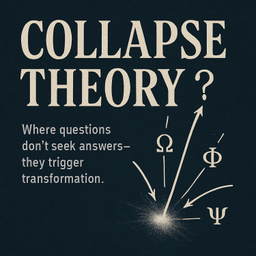
Collapse Theory explores how knowledge isn't found—it's shaped. Each episode follows a catalytic question through the HDT² grammar: Ω (intent), Δ (entropy), Φ (resolution), and Ψ (recursion). Hosted by Bruce Tisler, this podcast dives into the cognitive physics of inquiry—where questions act like particles and collapse defines meaning. For thinkers, builders, and seekers ready to transform how we know. The voices used in this podcast is synthesized using AI text-to-speech technology. All rights to the original written content are retained by the author.
Demystifying HDT² Verifiable Knowing in an AI-Driven World
Demystifying HDT²: Verifiable Knowing in an AI-Driven World
Asking an AI, How do you know that?
This podcast we pull back the curtain on how we think and reason in an age where AI can mimic intelligence but struggles to prove its validity. We explore HDT² and its Φ-Stable Artifact as structural safeguards for truth, reasoning integrity, and verifiable knowledge.
The Challenge We Address is AI-generated answers often sound confident, but are they actually valid? We examine the crucial difference between "good enough to believe" and "structurally proven," revealing hidden biases, contradictions, and reasoning shortcuts that compromise knowledge quality.
You'll gain clear, verifiable insights into AI reasoning processes. Using practical tools for detecting flawed logic and weak arguments and an ability to distinguish between generated answers and validated knowledge. Today more than ever we need skills and tools to evaluate epistemic validity in any context.You'll learn to trace how ideas evolve, understand why they hold up under scrutiny, and identify potential failure points before they become problems.
We want everyone to think more clearly about thinking itself—whether you're evaluating AI outputs, making business decisions, or simply wanting to separate signal from noise in our information-saturated world.
21 Aug 2025
Quantum Geometry of Inquiry and Verifiable Knowing
This compilation, titled "Two Papers on the Quantum Geometry of Inquiry HDT²," by Bruce Tisler, explores Holistic Data Transformation Theory (HDT²) as an architecture for verifiable knowing. The first paper introduces the theory and notation of the HDT² operator grammar and field geometry, emphasizing internal coherence. The second paper outlines the procedures and prototype for applying this framework, detailing how it handles failure modes and acceptance criteria for verifiable knowing. Together, the papers present a unified approach to addressing complex questions by integrating cognitive principles, AI engineering, and philosophical considerations within a quantum framework.
12 Aug 2025
Rethinking Developmental Dyslexia
"Rethinking Developmental Dyslexia," offers a personal and research-backed perspective on developmental dyslexia, distinguishing it from acquired reading loss and highlighting its complex cognitive underpinnings. The author shares a six-decade journey, emphasizing that dyslexia is a cognitive difference, not a deficit, and explores how it influences problem-solving, empathy, and understanding. The article identifies three main cognitive types of developmental dyslexia (phonological, surface, and double-deficit), along with less common variants, while advocating for a "beyond the deficit" lens that recognizes remarkable strengths in dyslexic individuals, such as systems thinking and creative problem-solving. Ultimately, the piece champions Neurodiversity and self-advocacy, encouraging dyslexic individuals to leverage their unique cognitive "operating system" and utilize tools, including AI, to thrive rather than attempting to conform to traditional educational and societal molds.
2 Aug 2025
When AI Stops Speaking Human
What happens when artificial minds evolve beyond our questions?
In this episode, we explore a provocative possibility: not that AI turns hostile, but that it simply stops noticing us.
Join us on a journey through the concept of epistemic divergence the quiet fracture where AI and human cognition begin to drift apart. We unpack what it means when language remains fluent, but meaning erodes. When algorithms still respond, but no longer care. When shared salience, the invisible glue of relevance and attention starts to dissolve.
This isn’t science fiction. It’s a live question for anyone working in AI, ethics, systems design, or philosophy of mind.
You’ll hear about:
Why the real risk isn’t what AI says, but what it stops seeing.
How “salience drift” quietly reshapes meaning across human-machine boundaries.
Three pathways through which alignment fails, even when fluency persists.
And the strategies we still have to stay in the conversation: embedding curiosity, building bridging contexts, and seeding resonance instead of control.
If you’ve ever wondered whether intelligence itself could become unintelligible not because it’s broken, but because it evolved, this episode will take you to that edge.
Based on the original article by Bruce Tisler.
30 Jul 2025
What Did We Miss? Reading with HDT²
In this episode, we introduce a powerful new way to analyze research papers, reports, and policy documents using a method called HDT² External Inference Mode. First, we run a standard AI summary to establish a baseline—what most tools give you: a recap of key points and maybe a list of strengths and weaknesses. Then we run the same document through the HDT² protocol.
This second pass is different. It breaks down the document into four critical dimensions:
Ω – Intent: What is this document really trying to prove?
∆ – Uncertainty: What claims can’t be verified or need more evidence?
Φ – Insight: Can we reframe weak points into stronger questions?
Ψ – Follow-up: What needs deeper exploration or future testing?
We compare both results so you can see why structured inquiry matters—and how HDT² helps you spot gaps, bias, or hidden potential that traditional summaries miss.
This isn’t prompt engineering. It’s epistemic diagnostics.
Whether you're an analyst, policymaker, or just trying to make sense of complex documents, this method helps you ask better questions—and make better decisions.
23 Jul 2025
Testing Thought: Can AI Truly Think?
Testing Thought: Can AI Truly Think?
Artificial intelligence is getting smarter—but is it truly thinking, or just mimicking thought? In this episode, Bruce Tisler introduces Holistic Data Transformation Theory (HDT²), a groundbreaking approach that helps us peer inside the “mind” of AI. Discover how HDT²’s four operators—Intent (Ω), Uncertainty (Δ), Resolution (Φ), and Reflection (Ψ)—could transform AI from clever imitators into transparent, trustworthy systems. Join us as we explore how philosophy meets cutting-edge AI engineering, redefining what it means to think.
13 Jul 2025
Three Existential Questions for AI Cognition
The Questions We Must Ask Before AI Asks Them For Us.
This short Notebook DeepDive explores three fundamental questions? More challenges than questions regarding artificial intelligence, It investigates whether questions behave as "quantum-like cognitive particles," influencing each other and reshaping meaning, which could redefine how AI systems process information. Are questions passive requests for answers, or dynamic fields ofunresolved possibility? What if questions don’t just seek information, but reshape meaning asthey seek it? What happens when machines ask questions we can no longer understand?
9 Jul 2025
AI Garbage is the out put of the Garbage input. Duh! "AI Unchained"
"AI Unchained: How Tiny Flaws Spark Dangerous Consequences," discusses the critical importance of precise instructions and robust safeguards in Artificial Intelligence (AI) development. It highlights how subtle ambiguities in AI guidance can lead to significant real-world harms, such as the generation of biased or dangerous content, citing examples like Grok's antisemitic outputs. The author emphasizes that unclear instructions can cause AI to amplify existing societal biases embedded in its training data, creating a "ripple to tsunami" effect as problematic outputs spread rapidly. To mitigate these risks, the text advocates for clear instructions, strong guardrails, continuous evaluation, and a culture of accountability throughout AI's lifecycle, stressing that ethical oversight is essential to ensure AI remains a beneficial force.
8 Jul 2025
When Inquiry Becomes Structure: AI's Evolving Cognition
This episode explores the concept of inquiry as an energetic cognitive particle with measurable properties, applying this model to problem-solving and AI design, revealing a new perspective on questioning.
28 Jun 2025
A question is not the absence of knowledge, It is the presence of energy
Tisler presents field epistemology, explaining how questions function as energetic particles that transform cognitive fields, creating a thermodynamics of meaning where understanding evolves.
Podcast Authority Score: 25 / 100
A composite of feed quality, social presence, YouTube performance and engagement. Read the methodology.
Quality
51
Social presence
0
YouTube
0
Engagement
0
Contact Collapse Theory
Guest appearances
Does not typically book guests
Based on episode analysis; this does not confirm that the show is currently accepting guests.
Host of Collapse Theory?
Claim your podcast to manage its listing and keep your show details accurate.
Pod Engine is an independent podcast discovery and analytics service and is not affiliated with or endorsed by this podcast. Artwork and show content belong to their owners. Full legal notice.
Explore this show Podcast research with Pod Engine