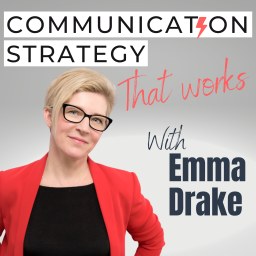
Welcome to the Communication Strategy That Works podcast. I'm Emma, your host, and I am making it my mission to help you get the 'comms stuff' right, spend your money more wisely, and have much more impact.
I'm an in-house expert turned external advisor, and I help you if you're a 'comms' and PR leader or manager understand how to find essential customers, engage them in products and services, stand out from the competition, and protect your brand reputation. I cover a wide range of topics through solo shows and 'deep dive' guest episodes.
I share three episodes a month with you that include insights from 20 years of experience working with, and in, fast-paced, growing, and established B2B businesses and initiatives.
I've been there and got the badge, so I am distilling this knowledge into easy peasy pointers to help you grow your business and brand profile with the right communication strategy 'That Works'.
I bust the myths (and I've pretty much heard all of them) break through the jargon, and give you practical, essential and useful advice and tips that you can use. I will save you time, money and energy whether you are listening regularly when at work or on the move, or bingeing at the weekend Netflix box-set style.
Ep 179. Banking on It: What Starling taught me about communicating innovation
As part of a mini series, I am looking at communicating complex topics, and I am starting with a book I read recently on holiday, recommneded by my 80 year old dad who provided IT systems for banks for many, many years. I've been reading Banking on It by Anne Boden, the founder of Starling Bank.
It's the story of building a completely new bank from scratch – taking on an established industry, raising the money, securing a banking licence, building the technology and, ultimately, persuading people to trust a bank they'd never heard of with their money. Oh, and she's also a women in finance.
But I found myself reading it less as a book about banking and female founders, and more as a book about innovation, customer behaviour and communications.
Because a lot of the challenges Boden describes are familiar to anyone trying to introduce something genuinely new.
You can believe passionately in the idea. You can have significant investment behind it. You can have brilliant technical people and a product you genuinely think is better.
But ultimately, you still have to persuade somebody to do something differently.
And that brought me back to something I've been talking about recently: when you're communicating innovation, there's a journey from awareness, to understanding, to confidence, and finally to action.
So rather than review the book chapter by chapter, there are three questions it left me thinking about.
So, let's dive in!
24 Jun 2026
Ep 178. Why Long-Form Content Wins in an Age of Short Attention Spans
𝐴𝑡𝑡𝑒𝑛𝑡𝑖𝑜𝑛, 𝐴𝑙𝑔𝑜𝑟𝑖𝑡ℎ𝑚𝑠 & 𝐹𝑜𝑟𝑚𝑎𝑡𝑠 𝑆𝑒𝑟𝑖𝑒𝑠 - 𝐸𝑝𝑖𝑠𝑜𝑑𝑒 3
Welcome to the final part in the series.
Why are newsletters growing? Why are podcasts continuing to thrive? Why are people spending 20 minutes reading a LinkedIn article or listening to an hour-long conversation when we're constantly told that attention is disappearing?
The answer reveals something important about communication in 2026. Because while attention may be fragmented, our appetite for depth hasn't disappeared. In fact, I would argue that it's becoming more valuable than ever.
One of the things I've been thinking about a lot lately is the contradiction at the heart of communication today. People scroll faster than ever. Content is shorter. Videos need to hook us in the first few seconds. Every platform seems to reward speed, immediacy, and constant novelty.
Yet, at the same time, some of the most successful content right now is long-form. Podcasts are thriving. Newsletters are growing. Thoughtful LinkedIn articles are being shared. People are still reading books. They're still listening to hour-long conversations. They're still investing time in ideas that matter.
So what's going on?
Let's dive in!
13 Mar 2026
Ep 177. The New Attention Economy: How 2026 Algorithms Decide What Gets Seen
𝑨𝒕𝒕𝒆𝒏𝒕𝒊𝒐𝒏, 𝑨𝒍𝒈𝒐𝒓𝒊𝒕𝒉𝒎𝒔 & 𝑭𝒐𝒓𝒎𝒂𝒕𝒔 - Episode 2
In the last episode, I looked at why some ideas stick by reviewing 𝑀𝑎𝑑𝑒 𝑡𝑜 𝑆𝑡𝑖𝑐𝑘. It gave us a powerful reminder: clear, emotionally resonant messages survive. But in 2026, there's another layer to the story, one that didn't exist when that book was written.
Today, attention itself is mediated by algorithms.
Before a human ever sees your digital message, an invisible system has already made a decision about it. Algorithms rank, filter, interpret, and prioritise digital content based on thousands of signals. In many cases, they determine whether your message is amplified, quietly buried, or never shown at all.
So if we want to communicate effectively digitally today, we need to understand not just how people think, but how platforms decide what people see.
So, let's dive in.
Reach and audience
Public platform figures. Ratings count people who left a rating, not total listeners.
Apple Podcasts (US)
4.7 / 5
3 ratings
Podcast Authority Score: 58 / 100
A composite of feed quality, social presence, YouTube performance and engagement. Read the methodology.
Quality
84
Social presence
0
YouTube
0
Engagement
81
Host of Communication Strategy That Works podcast?
Claim your podcast to manage its listing and keep your show details accurate.
Pod Engine is an independent podcast discovery and analytics service and is not affiliated with or endorsed by this podcast. Artwork and show content belong to their owners. Full legal notice.
Explore this show Podcast research with Pod Engine