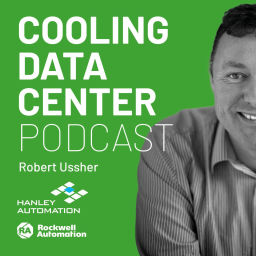
Explore the dynamic world of AI and cooling systems with host Robert Ussher from Hanley Automation. Whether you're a tech enthusiast, policymaker, or simply curious, this podcast is your gateway to understanding the pivotal role of cooling technologies in the AI revolution. Join us for insightful interviews, cutting-edge discussions, and actionable strategies that shed light on the future of AI in DC and beyond. From industry experts to innovative solutions, each episode delivers valuable insights to keep you informed and inspired. Subscribe now to stay ahead of the curve and be part of the conversation shaping the future of AI and cooling in DC.
Demetrio Velasco, Liquidpulse: Two Megawatt Load Banks, Clean Fluids & Why You Can't Skip Integrated Testing
What if the only way to know your liquid cooling infrastructure will hold up is to make it fail on purpose, before a single rack goes into the white space?
In this episode, Demetrio Velasco of Liquidpulse joins Robert to talk about something the industry has needed for a while: a two-megawatt liquid cooled load simulator capable of stress testing critical cooling infrastructure in a live data centre under real test conditions.
From starting out as a controls engineer building pump and hydronics systems, to launching Liquidpulse out of Dallas and putting liquid cooled load banks into the market at scale, Demetrio brings a manufacturer's view to a commissioning problem that keeps getting bigger.
Together, they explore:
· Why the jump from a 500kW machine to a two megawatt prototype happened faster than anyone planned
· How modular, networkable units let teams run tests at 28 megawatts of simultaneous load
· The origin story: a client with an urgent need, a friend's phone call, and a full witness test where the scope changed at the last minute
· Why load bank cleanliness matters, and the standard Liquidpulse is pushing at OCP to protect flushed technical cooling systems
· The air separation problem nobody predicted, and the auto air vent fix that became a second generation feature
· What integrated testing really proves: the cooling, the medium voltage generation, the power failure recovery modes, and the people commissioning it all
· The Texas site that skipped integrated commissioning and spent a year working through double digit outages
· Why a hybrid unit generating 165kW liquid load and 60kW air load exists alongside the 500kW machines
If you have ever wondered how anyone signs off on infrastructure built for loads that do not exist yet, Demetrio explains the engineering and the commercial reality behind it.
His take? "It's either you live test or you load test." There is no third option.
8 Jul 2026
Clifford Federspiel, Vigilent: Self-Driving Cooling, Predictive Control & Why Fixed Set Points Are Costing You More Than You Think
What if the biggest barrier to maximizing cooling capacity and efficiency isn't the hardware in your data hall, but the static set points and manual control strategies you've been running since day one?
In this episode, Clifford Federspiel, founder of Vigilent and former Johnson Controls and UC Berkeley engineer, joins Robert for a wide-ranging conversation about what happens when you hand cooling control to a machine learning system that can predict what's coming next, and why the data centre industry's dependence on fixed, conservative control is leaving real savings untouched.
From building sensor-driven efficiency solutions for "lost and forgotten" buildings in 2004, to deploying predictive cooling optimisation across over a thousand sites worldwide, Cliff brings two decades of practical AI and controls experience to an industry still debating whether to trust automation.
Together, they explore:
Why Vigilent's system can learn a facility's cooling dynamics in as little as a few hours
How predictive "look ahead" control differs from the basic PID and fuzzy logic embedded in most OEM equipment
The self-driving car analogy: why operators can always take control back, and why they rarely need to
How saving cooling power in AI data centres directly translates to more compute capacity and revenue
Why the common practice of "even wear" on equipment actually maximises the risk of simultaneous failure
The growing complexity of dual cooling plants as liquid and air systems coexist at the rack
Why fixed set points become exponentially more expensive as rack densities climb from 10kW to 100kW+
How Vigilent's operational data helps teams make informed decisions about when hardware investment is truly needed
If you've ever wondered whether your cooling plant could be doing more with what it already has, or wanted someone to explain AI-driven optimisation without the hype, Cliff delivers straight talk backed by over a thousand deployments. His take? The industry is driven by fear, but the proof is already there, and a system watching every minute and adjusting dynamically will always outperform static setpoints and manual controls.
21 May 2026
Bill Kosik, HED & The Green Grid: Inflexion Points, Common Sense & Why We've Been Here Before
What if the biggest barrier to scaling liquid cooling isn't the engineering, but an industry-wide habit of keeping things secret that don't need to be kept secret?
In this episode, Bill Kosik of HED and chair of The Green Grid's AI Impacts working group joins Robert for a genuinely insightful conversation about the long view of data centre design, and why the lessons from IBM's water-cooled mainframes still apply to today's 300kW racks.
From his time at Hewlett Packard's facilities design group working on liquid-cooled supercomputing, to leading mission critical projects at HED today, Bill brings three decades of pragmatism to an industry that often confuses novelty with progress.
Together, they explore:
Why liquid cooling isn't new technology and what the 1980s mainframe era can still teach us
How the manufacturers stepping up with full liquid-cooled product suites unlocked the current scale
The inflexion points reshaping cooling design, from 5kW cabinets a decade ago to 300kW racks today
Why the industry's culture of secrecy is fuelling public misunderstanding around water use, noise and vibration
How global end users, not just regulators, are driving sustainability standards in the United States
The retrofit opportunity hiding in Tier IV enterprise data centres being repurposed for small-scale AI
Why ASHRAE 90.4 becoming part of energy code means you can't design around it anymore
The case for designing data centres that don't look like distribution warehouses
If you've ever wondered whether 300kW racks will one day feel as routine as 30kW racks do now, or wanted someone to put today's AI build-out in proper historical context, Bill delivers the kind of measured engineering wisdom that's increasingly rare in a hype-driven market.
His take? In five years we'll be sitting around laughing at how we didn't know how to cool a 300kW rack. The history of this industry is one of inflexion points, and the people who recognise them early are the ones who shape what comes next.
Reach and audience
Public platform figures. Ratings count people who left a rating, not total listeners.
Apple Podcasts (US)
5.0 / 5
2 ratings
Spotify
5.0 / 5
8 ratings
Podcast Authority Score: 31 / 100
A composite of feed quality, social presence, YouTube performance and engagement. Read the methodology.
Quality
50
Social presence
0
YouTube
0
Engagement
32
Host of Cooling Data Center Podcast?
Claim your podcast to manage its listing and keep your show details accurate.
Pod Engine is an independent podcast discovery and analytics service and is not affiliated with or endorsed by this podcast. Artwork and show content belong to their owners. Full legal notice.
Explore this show Podcast research with Pod Engine